Rain Days at Manilla: I.

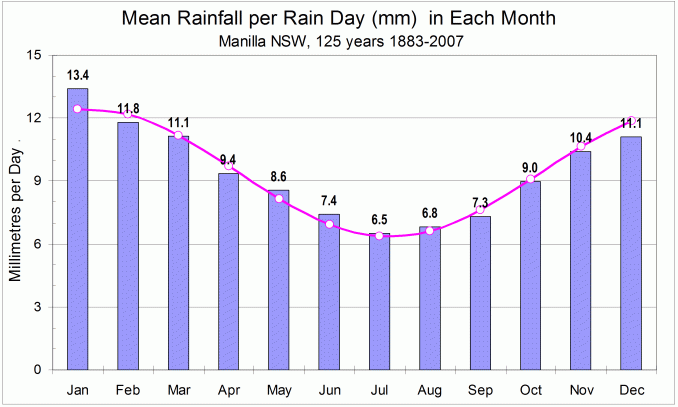
Rain per rain day graph

The annual pattern of rain day rainfall

In Manilla, the mean pattern of rainfall on rain days through the months of the year is simple and regular. This pattern can be worked out from the 125-year rainfall record of Manilla Post Office, Station 055031, beginning in 1883.
The graph above shows that, on the average, on a day when rain falls in January, the total in the day is about thirteen millimetres. When rain falls in July, the total in a day is about half of that: that is, six and a half millimetres. The pattern through the year is close to a perfect harmonic cycle, with a maximum in the third week of January, (four weeks after the longest day) and a minimum exactly six months later, in the third week of July. Only two of the monthly readings do not match the pattern well: January has about one millimetre more than would fit the curve, and December about half a millimetre less.
Of course, most people in the district realise that heavier rain falls in summer, but few would know any details. I do not think that the Bureau of Meteorology has ever worked through these figures. [See note below about the use of “rain days” in the Bureau.]
This very simple pattern of mean rainfall per rain day is the more remarkable because it comes from two other patterns that are not so simple.
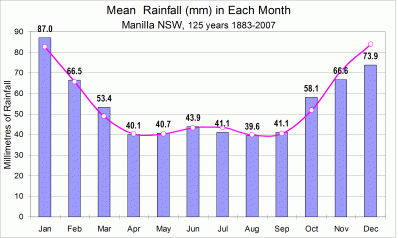
MeanRainEachMonthThe second graph is the pattern of monthly rainfall totals through the year. Manilla has two peaks of rainfall volume in the year. The major peak comes in the last days of December, a few days after the longest day, and a minor peak just six months later, at the end of June. Winter is marked, not by a minimum of rainfall, but by a secondary maximum. Much more detail is given in the post “A seasonal rainfall model for Manilla”
and in the post “Manilla 30-year Monthly Rainfall Anomalies”.

The final graph shows simply how many days of rain there are in each calendar month, on the average. This pattern is quite strange. Most months of the year have about six rain days. April has fewer: Continue reading
No rain, and no rain gauge

A very long spell with no rain

My town, Manilla NSW, may be having one of the longest periods without rain in 133 years. We will never know.

The records of the Manilla Post Office rain gauge, No. 055031, show that the longest periods without rain were as follows:
1. August 1946: 62 days;
2. April 1912: 55 days;
3. Apr-May 2002: 47 days;
4. August 1914: 46 days;
5. May 1927: 45 days;
6. Mar-Apr 1980: 44 days;
7. April 1925: 43 days;
8. August 1982: 42 days;
9=. March 1896: 41 days;
9=. August 1995: 41 days;
To judge by my rain gauge, we have had a rainless period that is already equal seventh longest since 1883. Today, rain bands are passing through, but perhaps no rain will fall in my gauge. There may be several rainless days yet.

My gauge not valid for Manilla

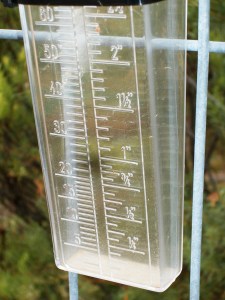
Photo of dry wedge-type rain gauge

My rain gauge

The photo shows my personal rain gauge. It is dusty because it has been dry for the last 43 days.
Whether it rains in my gauge today or not, my reading cannot count in the record for the town of Manilla. It is as if it is this dry spell is not happening.
My gauge is very simple and not precise. It is hard to read to parts of a millimetre. I bought a cheap one, because there is no point in having a precise rain gauge in my yard. The yard is too sheltered to meet the Bureau of Meteorology standard. My house is also a kilometre away from the Post Office.

Manilla’s failed rainfall record

Rainfall was first recorded at the Manilla Post Office in March 1883. The record of readings was essentially unbroken through 132 years until the 26th of March 2015. There are towns with longer rainfall records, but not very many.
Continue reading

The 2002 rainfall shortages at Manilla

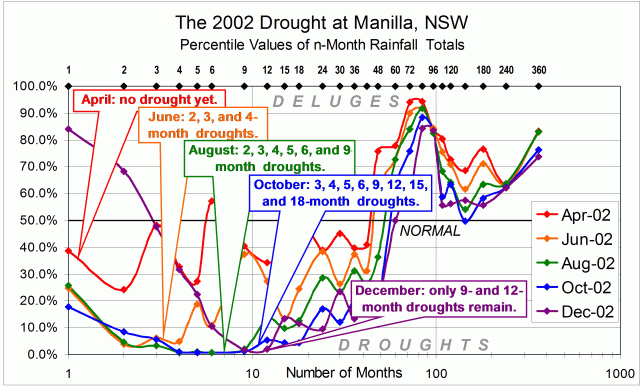
Graph of monthly percentile rainfall in a drought

In 2002, Manilla had a 6-month drought with one of the most extreme rainfall shortages on record. In nearly fifty years since 1966 there have been no other shortages like it.

I have discussed this drought in two posts: “Profile of an Extreme Drought”, and 3-year trends to August 2004 (An extreme 1-year drought).

[For an update on the longer and more extreme drought of 2018-19, see the note below.]

This post is about the rainfall record only. It compares the percentile values of rainfall totals for groups of months: one month, two months, and so on. The graph shows how the drought began, developed and faded. Other droughts may go through similar stages. I have plotted the pattern of rainfall shortages month by month, showing only even-numbered months. I have plotted them in different colours, with matching “Call-out” labels.

April 2002 (Red): no drought yet.
In April, the monthly rainfall was slightly below average: in the 40th percentile. In this month, nearly all rainfall totals up to the 42-month total were also below average. Only the 6-month total was above average. This set up the conditions for a drought. Notice that rainfall totals for periods longer than 42 months were all well above average. This hardly changed at all in this year. There had been a lot of rain in previous decades.

June 2002 (Orange): 2, 3, and 4-month droughts.
When May rainfall was in the 1st percentile and June rainfall in the 25th percentile, the June 2, 3, and 4-month totals became serious or severe shortages (below the 10th percentile).

August 2002 (Green): 2, 3, 4, 5, 6, and 9-month droughts.
With July rainfall again in the 1st percentile, and August rainfall in the 26th, the drought became extreme. The 4, 5, and 6-month totals were in the 1st percentile: few months had ever had such low figures.

October 2002 (Blue): 3, 4, 5, 6, 9, 12, 15, and 18-month droughts.
September and October both had rainfall in the 18th percentile. That relieved the short-term shortages somewhat, but not those in the medium term. Shortages in the 4, 5, and 9-month totals were in the 1st percentile, but the 6-month total was very much worse. At 76 mm, this 6-month total was the third driest on record, beaten only by August 1888 (43 mm) and September 1888 (69 mm).

December 2002 (Purple): only 9- and 12-month droughts remain.
November rainfall that was near average (40th percentile) and high December rainfall (84th percentile) broke the drought. Only some longer-term effects persisted as severe rainfall shortages in 9- and 12-month totals.

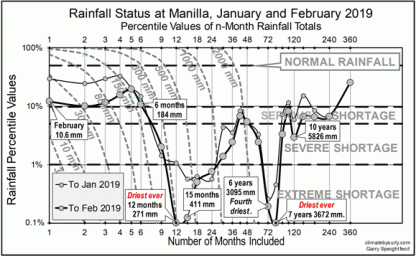
Rainfall status Jan-Feb 2019


Note added 2019.
Later such graphs in this blog have a logarithmic scale to distinguish the extreme rainfall shortages. Here is the one for the even more extreme drought of February 2019.

El Niño and My Climate

ENSO and Manilla NSW temperature anomalies over sixteen years

Temperature

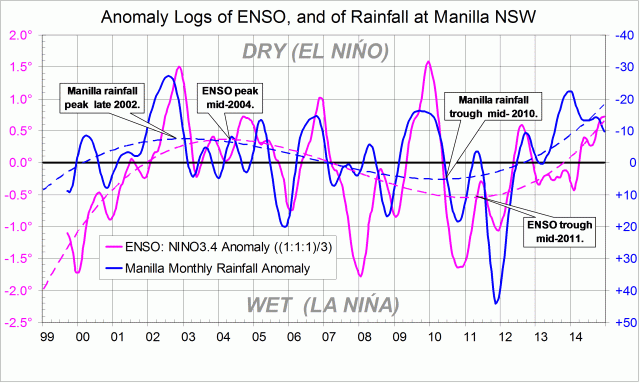
The first graph shows that the temperature at Manilla NSW agreed very closely with El Niño and La Niña temperatures for a good part of the last sixteen years.
The El Nino – Southern Oscillation (ENSO) is shown by NINO3.4 monthly anomaly values, and temperature at Manilla, NSW is smoothed monthly mean daily maximum temperature anomalies. (See the Note below.)
Values of Manilla temperatures agree with those of ENSO through the major temperature peaks and troughs in the spring seasons of 2002, 2006, 2007, 2009, and 2010. In the two highest peaks of 2002 and 2009 and the deep trough of 2010, Manilla temperature extremes were more than a month ahead of ENSO temperature extremes.
Since mid-2011, the two curves do not agree well:
* A La Nina in summer 2011-12 that was very weak produced the deepest of all troughs in Manilla temperature.
* An El Nino in winter 2012 resulted in heat at Manilla, but not until four months later.
* In spring 2013, when there was no El Nino at all, Manilla had a heat wave just like those with the El Nino’s of 2002 and 2009, .
The record for ENSO since January 2013 is unlike that earlier this century: it flutters rather than cycles.
To show slower changes, I have drawn cubic trend lines for both of the variables. These also agree closely, with ENSO going from a maximum (2004) to a minimum (2011) seven years later. Manilla temperature trends remained ahead of ENSO temperature trends by one or two years.

Rainfall

ENSO and Manilla NSW rainfall anomalies over sixteen years.

Continue reading

February Climate Anomalies Log

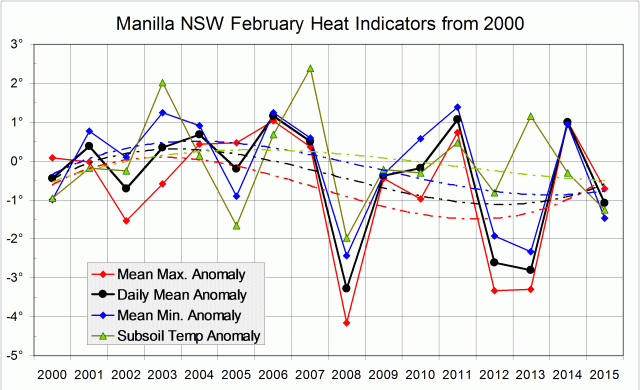
Heat indicators log for February

This post is the twelfth in a set for the 12 calendar months that began with March. Graphs are sixteen-year logs of the monthly mean anomaly values of nine climate variables for Manilla, NSW, with fitted trend lines. I have explained the method in notes at the foot of the page.

Raw anomaly values for February

Extreme values of February anomalies were as follows:

Daily Maximum Temperature Anomalies (3) -4.2 deg: February 2008; -3.3 deg: February 2012; -3.3 deg: February 2013;
Daily Mean Temperature Anomalies (1) -3.3 deg: February 2008;
Rainfall Anomalies (1) +120 mm: February 2012;
Dew Point Anomalies (2) -4.6 deg: February 2014; -4.6 deg: February 2015.

Trend lines for February

Heat Indicators

All heat indicator quartic trends began slightly low and ended slightly low. They had a low peak about 2004, and a trough later. The trough was deepest and earliest for daily maximum temperature (2011), followed by daily mean temperature in 2012, daily minimum temperature in 2014, and subsoil temperature in 2015 or later.

Moisture indicators log for February

Continue reading