3-year trends to August 2016

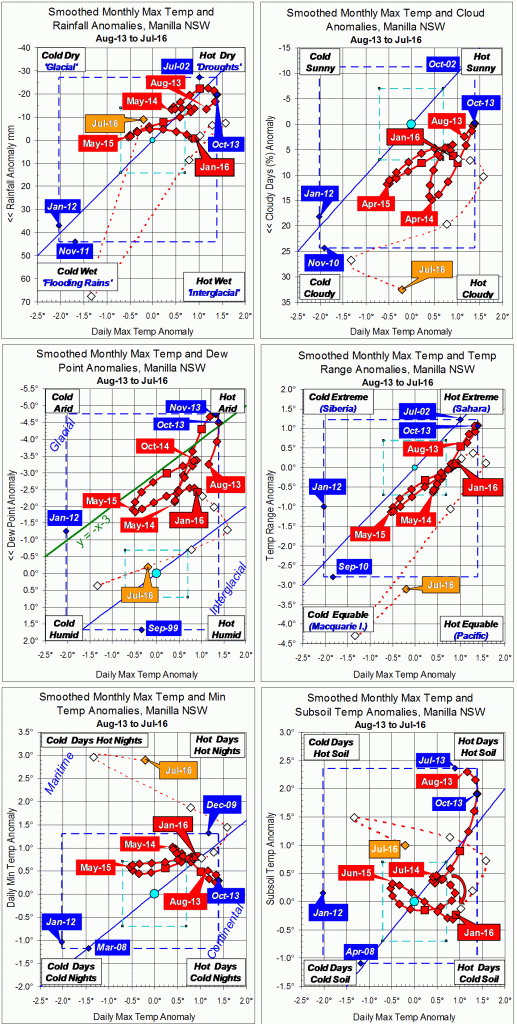
Parametric plots of smoothed climate variables at Manilla
“August 2016 cool and wet”

Trends to August 2016

August raw anomaly data (orange)

August 2016 was marked by low mean daily maximum temperature and high total rainfall. On the first graph the data point is in the cold wet “flooding rains” corner. However, the other five variables are close to normal.

 Fully smoothed data (red)

Fully-smoothed data is now available for the summer of 2015-16. Most variables became static in that season, but cloudiness increased, dew point fell, and subsoil temperature rose.
Most variables were close to normal: rainfall, cloudiness, daily temperature range and subsoil temperature. Daily maximum and minimum temperatures were rather high, while dew point was low. [Low dew point anomalies near the line (y = -x – 3) rather than (y = -x) may be due to an instrument error, since corrected.]


Note:

Fully smoothed data – Gaussian smoothing with half-width 6 months – are plotted in red, partly smoothed data uncoloured, and raw data for the last data point in orange. January data points are marked by squares.
Blue diamonds and the dashed blue rectangle show the extreme values in the fully smoothed data record since September 1999.

Normal values are based on averages for the decade from March 1999.* They appear on these graphs as a turquoise (turquoise) circle at the origin (0,0). A range of anomalies called “normal” is shown by a dashed rectangle in aqua (aqua). For values in degrees, the assigned normal range is +/-0.7°; for cloudiness, +/-7%; for monthly rainfall, +/-14 mm.

 * Normal values for rainfall are based on averages for the 125 years beginning 1883.
Rain Days at Manilla: I.

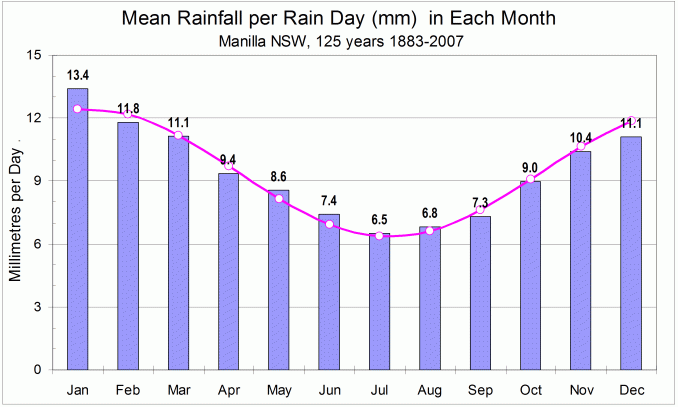
Rain per rain day graph

The annual pattern of rain day rainfall

In Manilla, the mean pattern of rainfall on rain days through the months of the year is simple and regular. This pattern can be worked out from the 125-year rainfall record of Manilla Post Office, Station 055031, beginning in 1883.
The graph above shows that, on the average, on a day when rain falls in January, the total in the day is about thirteen millimetres. When rain falls in July, the total in a day is about half of that: that is, six and a half millimetres. The pattern through the year is close to a perfect harmonic cycle, with a maximum in the third week of January, (four weeks after the longest day) and a minimum exactly six months later, in the third week of July. Only two of the monthly readings do not match the pattern well: January has about one millimetre more than would fit the curve, and December about half a millimetre less.
Of course, most people in the district realise that heavier rain falls in summer, but few would know any details. I do not think that the Bureau of Meteorology has ever worked through these figures. [See note below about the use of “rain days” in the Bureau.]
This very simple pattern of mean rainfall per rain day is the more remarkable because it comes from two other patterns that are not so simple.

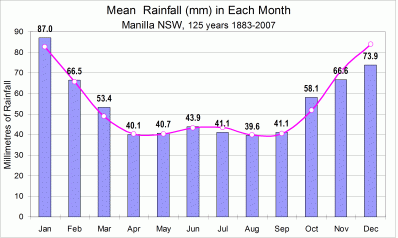
MeanRainEachMonthThe second graph is the pattern of monthly rainfall totals through the year. Manilla has two peaks of rainfall volume in the year. The major peak comes in the last days of December, a few days after the longest day, and a minor peak just six months later, at the end of June. Winter is marked, not by a minimum of rainfall, but by a secondary maximum. Much more detail is given in the post “A seasonal rainfall model for Manilla”
and in the post “Manilla 30-year Monthly Rainfall Anomalies”.

The final graph shows simply how many days of rain there are in each calendar month, on the average. This pattern is quite strange. Most months of the year have about six rain days. April has fewer: Continue reading

Porch is a Breezeway or a Sun-trap

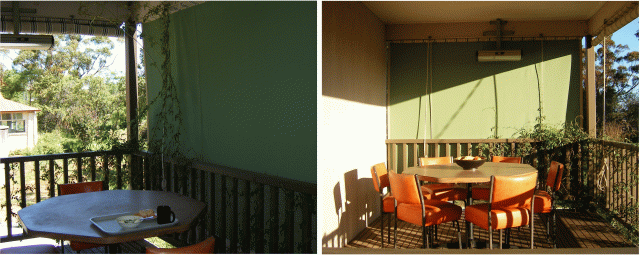
Photos show awnings arraged for summer and for winter

Porch Awnings in Summer and Winter

This porch, which is a sun-trap in winter, is converted simply to a shaded breezeway for summer.
The porch is an upstairs outdoor room, open on three sides, at the west end of my house. With a Tallowwood deck and steel balustrade, it could be called a verandah or a balcony. I like to call it a talar, although it is not as grand as the talar of the Ali Qapu Palace, Isfahan.
For the colder part of the year, from March to October, the talar awnings are arranged as in the right photo. I fasten down the canvas awning on the south side to stop drafts, and I roll up the awning on the west side so I can enjoy the views. On sunny winter afternoons it is pleasant to have a late lunch there, with temperatures in the high twenties, several degrees warmer than the maximum in the thermometer screen.
For the warmer part of the year, from November to February, the awnings are arranged as in the left photo. The awning on the west side is fastened down against the intolerable heat of the afternoon sun. That also keeps the heat off the west wall of the house. The south awning is raised, to allow air to flow through, from south to north. When there is a breeze, it can be comfortable to sit on this porch even on very hot days.
By the use of cheap canvas awnings, this porch can make outdoor living pleasant in months when the climate here is too cold or too hot for it.

July 2016 had a record warm night

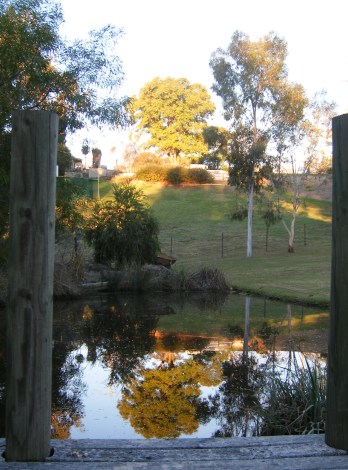
Photo of a pond at sunset

A neighbour’s dam

The second cloudiest month of this century brought the warmest July night.
There were two very warm spells in the trace of weekly average temperature. Both were due mainly to warm nights. The second spell, coming in the third week, reached nearly six degrees above normal. On the morning of Saturday the 23rd, the minimum reading on the screen thermometer, 14.4°, was the highest July minimum in the record from 1999.
Up to the 25th, the weather was changeable, with some days overcast and rainy, and others fine and sunny. A very warm sunny day on the 17th, following a frost, had the unusually wide daily temperature range of 21.9°. From the 25th, the weather settled to what is normal for July. In the whole month, there were sixteen frosts, which is normal.
The highest rainfall reading was only 11.4 mm. Ten days had rainfall recorded, but three of these had 0.2 mm, on days when rain was not seen.

Weather log for July 2016

Comparing July months

The mean daily maximum temperature (16.9°) was normal. The mean daily minimum temperature (4.0°) was two degrees above normal, making the average temperature (10.5°) one degree above normal. Similarly, the subsoil temperature (14.7°) was one degree above normal.
The daily temperature range, normally 15.0°, was 12.9°, not quite as narrow as in 2010 (12.3°). The early morning dew point was normal. At 2.2°, it was so close the the daily minimum temperature (4.0°) that fogs were to be expected.
The month was extraordinarily cloudy. Cloud cover is assessed by the number of octas (eighths) of the sky seen to be covered by cloud at 9 am. I compare cloudiness of months by the percentage of “cloudy mornings”: those when I see more than four octas of cloud. This month, with 21 cloudy mornings, had 68%. July normally has only 35%. The only month in this century with a higher value was June 2013, with 73%.
The monthly rainfall total of 32.4 mm is below the average (41 mm), in the 47th percentile. The greatest rainfall “shortage” is now in the 48-month total (2221 mm) which is in the 14th percentile. Both Greenhatch Creek and Rushes Creek are just flowing.

Climate for July 2016.


Data. Rainfall figures for this month are from the automatic rain gauge at Manilla, published on the internet by the Bureau of Meteorology as Station 55031. All other data, including subsoil at 750 mm, are from 3 Monash Street, Manilla.

3-year trends to July 2016

Parametric plots of smoothed climate variables at Manilla
“July 2016 extreme cloudiness”

Trends to July 2016.

July raw anomaly data (orange)

In July 2016, raw anomalies for most variables returned towards normal from extreme values in June. Some now fell within the normal range: daily maximum temperature, rainfall, and dew point. Subsoil temperature remained high. Daily temperature range was still very low and daily minimum temperature very high. The variable that became even more extreme in this month was cloudiness.

 Fully smoothed data (red)

Fully-smoothed data can now be calculated up to January 2016. By that month the climate, as smoothed, was slightly warmer than in my 1999 to 2009 reference decade.


Note:

Fully smoothed data – Gaussian smoothing with half-width 6 months – are plotted in red, partly smoothed data uncoloured, and raw data for the last data point in orange. January data points are marked by squares.
Blue diamonds and the dashed blue rectangle show the extreme values in the fully smoothed data record since September 1999.

Normal values are based on averages for the decade from March 1999.* They appear on these graphs as a turquoise (turquoise) circle at the origin (0,0). A range of anomalies called “normal” is shown by a dashed rectangle in aqua (aqua). For values in degrees, the assigned normal range is +/-0.7°; for cloudiness, +/-7%; for monthly rainfall, +/-14 mm.

 * Normal values for rainfall are based on averages for the 125 years beginning 1883.