Is There Any Drought Now?

No. In Manilla just now, there is no drought of any kind: not a short drought, a medium-length drought, or a long drought; not an extreme drought, a severe drought, or even just a serious drought.
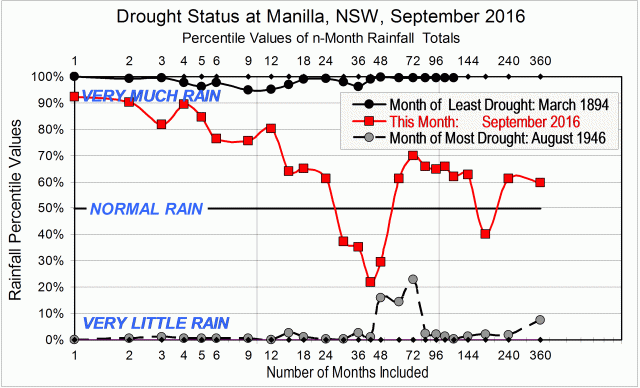
A new comprehensive graph of the severity of drought at one site.

In this graph, each line of data points is for one particular month. The middle line, joining the red squares, shows the whole rainfall drought situation for last month: September 2016.
This is a new kind of graph. (See Note 1 below.) It can show how severe a drought is, not only during the last month or two, but during the last year, and during the last many years. That is a lot of information.

How to read the graph

A month of extreme drought would have data points very low down on the graph. The scale on the left side is amount of rainfall. It must be a “percentile” value. For example: if the amount of rain that fell is just more than has been seen in the driest 5% of all months, it has a value in the 5th percentile. (See Note 2 below.)

Along the top and bottom of the graph I have plotted a number of months.
The number does not show time passing. It shows the number of months I included in a calculation. For each month on record I did many calculations. I added up the total rainfall for:
* the month itself;
* two months including the previous month;
* three months including the month before that;
* … and so on.
I found the totals for larger groups of months extending back as far as 360 months (30 years).
Using all these rainfall totals, I calculated percentile values to plot on the graph. For example, for groups of 12 months, all groups of 12 consecutive months are compared with each other, to find the percentile value of the 12-month period ending in a given month. (See Note 3 below.)

Which months had the most drought and least drought?

The worst drought there could ever have been would be one with data points along the bottom line of the graph. In such a disastrous month, all the rainfall totals would be the lowest on record, not just the one-month total, but also the two-month total and so on up to the 360-month total. Every one of them would be the lowest total on record. It has never been as bad as that.
The “best” time, in terms of being free of drought, would be a month with all its data points along the top edge of the graph. For that month, every rainfall total, for a short period or a long period, would be the wettest on record.
From the Manilla rainfall record, I have chosen to display the most drought and the least drought that actually occurred.

The most drought: August 1946

The month of August 1946 had no rain. Of course, that was the lowest rainfall for any August month (One among 13 months on record that had no rain.). As a result, the percentile rank for that month’s rainfall is zero. Most totals for groups of any number of months ending in August 1946 are also on the “zero-th” percentile, that is, the lowest on record. Thus, it was an extreme drought in the short term, medium term and long term.
For this month, percentile values that are above the third percentile occur in the totals for 48, 60, and 72 months, as shown. These figures, while not extremely low, were still well below normal (Normal is the 50th percentile.). They occur because these totals include some wet months in 1940, 1941, and 1942.

The least drought: March 1894

March 1894, with 295 mm of rain, was one of the the wettest months ever, ensuring a 100th percentile value. The rainfall totals for groups of months ending in that month included six other “wettest ever” values, and all other groups of months were also very wet. No group of months was below the 95th percentile. (See Note 4 below.)

Current drought situation (September 2016)

This month’s rainfall total of 122.4 mm puts it in the 92nd percentile of all monthly rainfall values, far above the median value marked as “normal” on the graph. The 2-month rainfall total (203 mm), and the 4-month rainfall total (350 mm) are almost as high, each in the 90th percentile.
Continue reading
Rain Days at Manilla: I.

Rain per rain day graph

The annual pattern of rain day rainfall

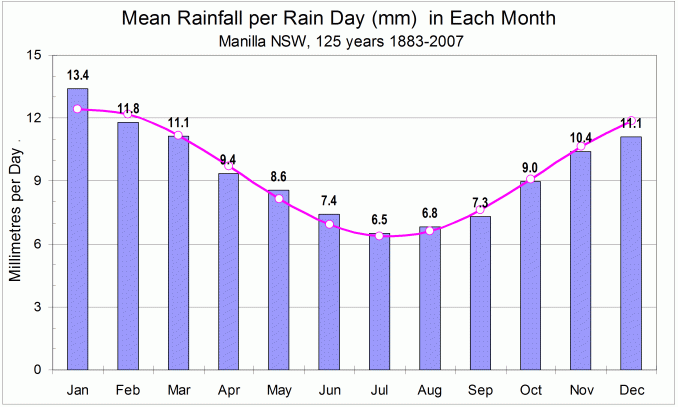
In Manilla, the mean pattern of rainfall on rain days through the months of the year is simple and regular. This pattern can be worked out from the 125-year rainfall record of Manilla Post Office, Station 055031, beginning in 1883.
The graph above shows that, on the average, on a day when rain falls in January, the total in the day is about thirteen millimetres. When rain falls in July, the total in a day is about half of that: that is, six and a half millimetres. The pattern through the year is close to a perfect harmonic cycle, with a maximum in the third week of January, (four weeks after the longest day) and a minimum exactly six months later, in the third week of July. Only two of the monthly readings do not match the pattern well: January has about one millimetre more than would fit the curve, and December about half a millimetre less.
Of course, most people in the district realise that heavier rain falls in summer, but few would know any details. I do not think that the Bureau of Meteorology has ever worked through these figures. [See note below about the use of “rain days” in the Bureau.]
This very simple pattern of mean rainfall per rain day is the more remarkable because it comes from two other patterns that are not so simple.

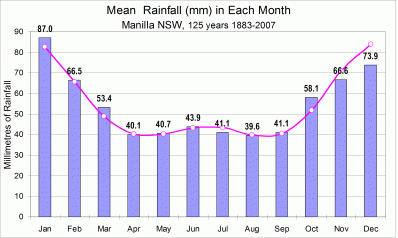
MeanRainEachMonthThe second graph is the pattern of monthly rainfall totals through the year. Manilla has two peaks of rainfall volume in the year. The major peak comes in the last days of December, a few days after the longest day, and a minor peak just six months later, at the end of June. Winter is marked, not by a minimum of rainfall, but by a secondary maximum. Much more detail is given in the post “A seasonal rainfall model for Manilla”
and in the post “Manilla 30-year Monthly Rainfall Anomalies”.

The final graph shows simply how many days of rain there are in each calendar month, on the average. This pattern is quite strange. Most months of the year have about six rain days. April has fewer: Continue reading

Manilla’s Droughts, 1884 to 1916

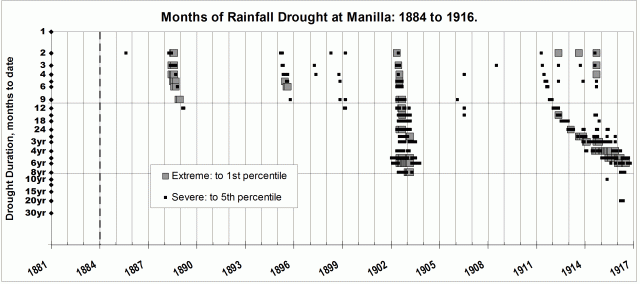
Graphical log of droughts, 1884 to 1916

The catastrophic droughts in 1902 and 1912-16 were quite different.

In the years before 1917 shown here, Manilla had several times of extreme drought. They came in 1888, 1895, 1902, and in a cluster that began in 1912.
(1.) The 1888 extreme droughts were of 2-, 3-, 4-, 5-, 6- and 9-month duration. The 2-month event was in August, and other events came later as they became longer, until the 9-month event came in December (having begun in April).
(2.) In 1895, drought was extreme only for durations of 5-months (June) and 6-months (July and August). Although droughts of 2-, 3-, 4-, and 9-month duration also occurred, they were not extreme, but merely “severe”.
(3.) Manilla’s 1902 (“Federation”) drought was phenomenal. Extreme droughts of nearly all durations from 2 months through to 96 months occurred (and ended) at practically the same time. The 2-month event plots at May 1902. The 96-month extreme drought plots at February-March 1903. None of the drought events around 1902 extended far into 1903; all ceased abruptly. The rainfall shortages began earlier according to a simple pattern; the longer the duration of the extreme event, the earlier it began. The 1902 extreme 1-year drought began in September 1901, and the extreme 8-year drought began in 1895.
(4.) The cluster of drought events extending through 1912 and 1916 was as bad as the events of 1902, but quite different. Merely “severe” short-duration events began in April 1911. Events of increasing duration came at later dates, forming a smooth curve on the graph. Beyond 12-month duration, and up to 72-month duration, there were extreme events at nearly all classes of duration. By the 72-month duration, the date of plotting had drifted forward in time to January-July 1916. The beginning of these 72-month events would have been during Continue reading

No rain, and no rain gauge

A very long spell with no rain

My town, Manilla NSW, may be having one of the longest periods without rain in 133 years. We will never know.

The records of the Manilla Post Office rain gauge, No. 055031, show that the longest periods without rain were as follows:
1. August 1946: 62 days;
2. April 1912: 55 days;
3. Apr-May 2002: 47 days;
4. August 1914: 46 days;
5. May 1927: 45 days;
6. Mar-Apr 1980: 44 days;
7. April 1925: 43 days;
8. August 1982: 42 days;
9=. March 1896: 41 days;
9=. August 1995: 41 days;
To judge by my rain gauge, we have had a rainless period that is already equal seventh longest since 1883. Today, rain bands are passing through, but perhaps no rain will fall in my gauge. There may be several rainless days yet.

My gauge not valid for Manilla

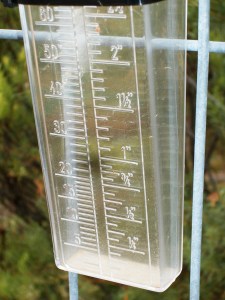
Photo of dry wedge-type rain gauge

My rain gauge

The photo shows my personal rain gauge. It is dusty because it has been dry for the last 43 days.
Whether it rains in my gauge today or not, my reading cannot count in the record for the town of Manilla. It is as if it is this dry spell is not happening.
My gauge is very simple and not precise. It is hard to read to parts of a millimetre. I bought a cheap one, because there is no point in having a precise rain gauge in my yard. The yard is too sheltered to meet the Bureau of Meteorology standard. My house is also a kilometre away from the Post Office.

Manilla’s failed rainfall record

Rainfall was first recorded at the Manilla Post Office in March 1883. The record of readings was essentially unbroken through 132 years until the 26th of March 2015. There are towns with longer rainfall records, but not very many.
Continue reading

More Droughts After Heavier Rains III.

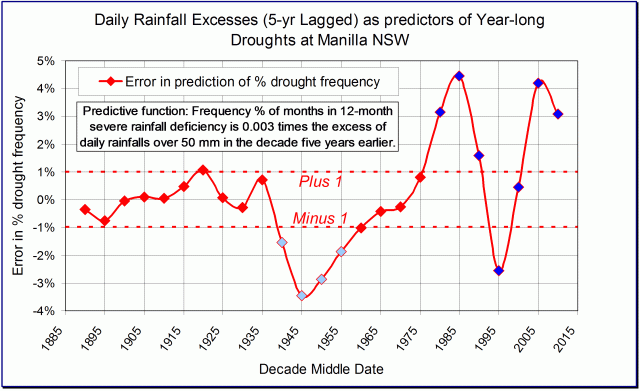
Graphical log of errors when droughts are predicted from rains

Droughts and flooding rains at Manilla NSW were related in a way that is remarkable and unexpected.

Part III. Predicting drought from heavy rain

[Back to Part II: Scatter-plots]

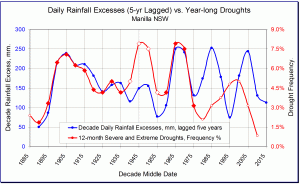
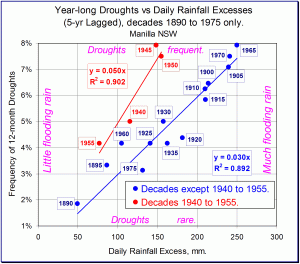
The graph above is derived from the first graph in this series (copied here) by using the blue regression trend-line from the scatter plot of selected data (also copied here). (For data details, sLog of 1-year droughts and 5-year lagged heavy rainfallsee Note 1, below.)

The equation of the trend line, y = 0.030x is used AS IF to use the daily rainfall excesses to predict the drought frequency five years later. The graph shows the “error” of this “prediction”. (In Note 2, below, I concede that this data set could not support such prediction.)
As expected from the previous graphs, the “prediction” is accurate at most data points to 1975. It is correct to the nearest percentage whole number at nine of the eighteen points. From 1940 to 1955, droughts are uniformly more frequent than predicted. After 1975, the error curve swings wildly up and down.

Could droughts have been predicted from heavy rainfalls?

Scatter-plot 1890 to 1975

By about 1915, it is conceivable that this relationship could have been discovered, either by analysis of such data, or by modelling of the climate system. Then, the data for the next 20 years, up to 1935, would seem to confirm it. Data from 1940 to 1955 would cause doubts, but data from 1960 to 1975 would restore confidence. Then the utter failure of the model in the following four decades would have led to its abandonment, at least for the time being.

Climate shifts of 1975

Continue reading