3-year trends to April 2015

Parametric plots of smoothed climate variables at Manilla
“April 2015: equable”
Trends to April 2015

  April raw anomaly data (orange)

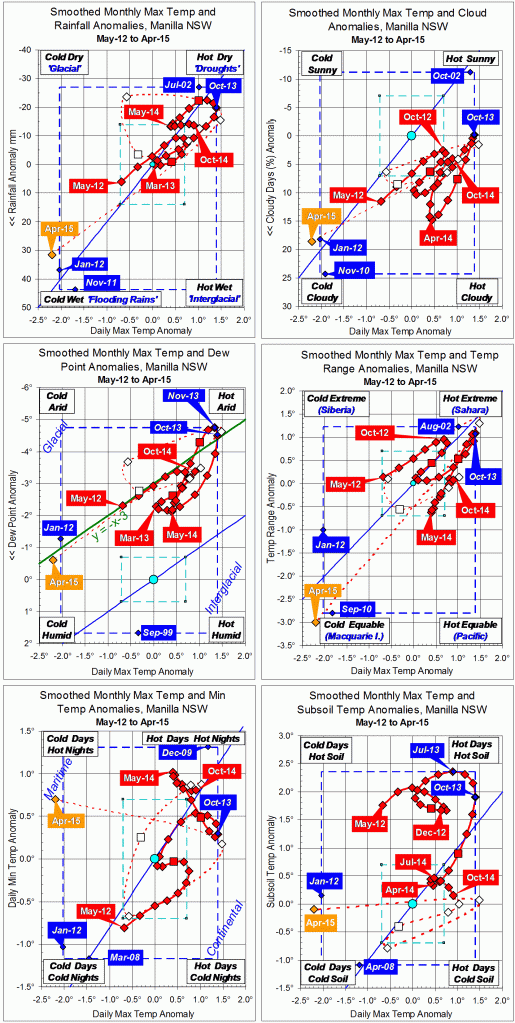
In April, daily maximum temperature anomaly became very low (-2.1°) while daily minimum temperature anomaly remained high (+0.7°). Other anomalies, except subsoil temperature, moved down the graphs, showing moist conditions. The extremely low temperature range anomaly (-3.0°) shows that the climate was equable, as it had been in the spring of 2010 (a smoothed record value).

Fully smoothed data (red)

The latest fully-smoothed data anomalies (October 2014) moved little, being warm and slightly dry.

Loops in the subsoil anomaly graph

The parametric plot of subsoil temperature anomaly against that of daily maximum temperature (bottom right) shows several clockwise loops. That is, peaks or troughs of subsoil temperature precede those of daily maximum (air) temperature by a month or more. This is not what one would expect. Indeed, where graphs of these variables earlier in this sixteen-year record show such loops, they are always anti-clockwise. Subsoil temperature anmalies lag those of daily maximum air temperature. See the graphs for August 2002, August 2004, August 2006, August 2008, May 2010, and April 2012.

In the last mentioned graph, the three extreme points included show no lag between the two variables. That period, from early 2009 to late 2011 marks the transition from a stable regime of subsoil temperature lagging daily maximum air temperature to the current regime of subsoil temperature leading daily maximum air temperature.


Note:

Fully smoothed data – Gaussian smoothing with half-width 6 months – are plotted in red, partly smoothed data uncoloured, and raw data for the last data point in orange. January data points are marked by squares.
Blue diamonds and the dashed blue rectangle show the extreme values in the fully smoothed data record since September 1999.

Normal values are based on averages for the decade from March 1999.* They appear on these graphs as a turquoise (turquoise) circle at the origin (0,0). A range of anomalies called “normal” is shown by a dashed rectangle in aqua (aqua). For values in degrees, the assigned normal range is +/-0.7°; for cloudiness, +/-7%; for monthly rainfall, +/-14 mm.

 * Normal values for rainfall are based on averages for the 125 years beginning 1883.

March 2015 was hot

Photo of bird in a gum tree

Blue-faced honeyeater in a White Box tree

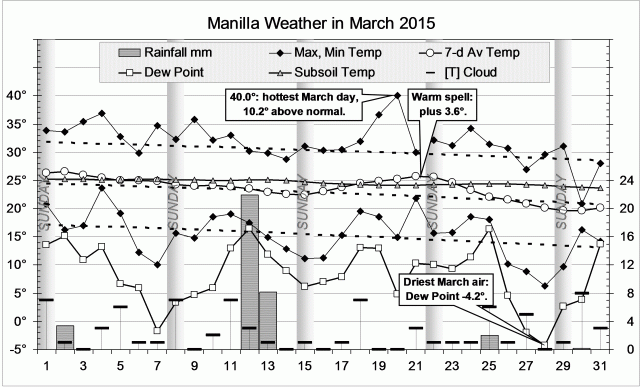
March had 5 hot days over 35°: more than January (2) or February (3), but less than December (7) or November (10!). On the 20th the temperature reached 40.0°, making it the hottest March day of the century, 10.2° above normal. It came in a warm spell, with a weekly mean temperature 3.6° above normal. Some days had extremely low humidity, with afternoon values below 10%. The morning dew point on the 28th, minus 4.2°, was the lowest March value.
There were five rain days, with the highest reading 22.0 mm on the 12th.

Weather log for March 2015

Comparing March months

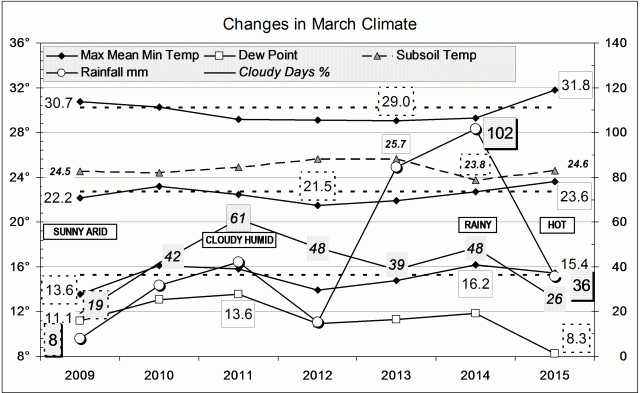
The average daily maximum temperature, at 31.8°, was the hottest of any March in this short record. It was almost the same as in each of the months of this summer, but not as high as that of last November (33.9°). The daily mean temperature (23.6°) was also the highest for March, just beating the 23.4° of March 2000. Night temperatures were normal, making the daily temperature range wider than normal. The mean early morning dew point of 8.3° was a record low value.
The total rainfall of 35.8 mm, while well below the average of 53 mm, is quite normal. It is in the 46th percentile: nearly half of all March totals were lower. Among rainfall totals for more than one month, there is little change. Again, the only serious shortage is in the 24-month total, which is now in the 5th percentile.

Climate for March 2015


Data. Rainfall data up to 26/3/15 is from Manilla Post Office, courtesy of Phil Pinch. Temperatures, including subsoil at 750 mm, and other data are from 3 Monash  Street, Manilla.

3-year trends to March 2015

Parametric plots of smoothed climate variables at Manilla
“March 2015: hot”

Trends to March 2015

 March raw anomaly data (orange)

In March, the daily maximum temperature anomaly became very high (+1.6 degrees), but not nearly as high as the raw value had been in November (+5.1 degrees). Most other anomalies moved up the graphs towards “droughts” but not beyond normal values. Dew point remained as low as in February, and rainfall returned from very low to normal.

Fully smoothed data (red)

The latest fully-smoothed data anomalies (September 2014) moved a little towards “droughts” from the near-normal values of the winter.


Note:

Fully smoothed data – Gaussian smoothing with half-width 6 months – are plotted in red, partly smoothed data uncoloured, and raw data for the last data point in orange. January data points are marked by squares.
Blue diamonds and the dashed blue rectangle show the extreme values in the fully smoothed data record since September 1999.

Normal values are based on averages for the decade from March 1999.* They appear on these graphs as a turquoise (turquoise) circle at the origin (0,0). A range of anomalies called “normal” is shown by a dashed rectangle in aqua (aqua). For values in degrees, the assigned normal range is +/-0.7°; for cloudiness, +/-7%; for monthly rainfall, +/-14 mm.

 * Normal values for rainfall are based on averages for the 125 years beginning 1883.
Very Wet Days at Manilla: Decade Excesses

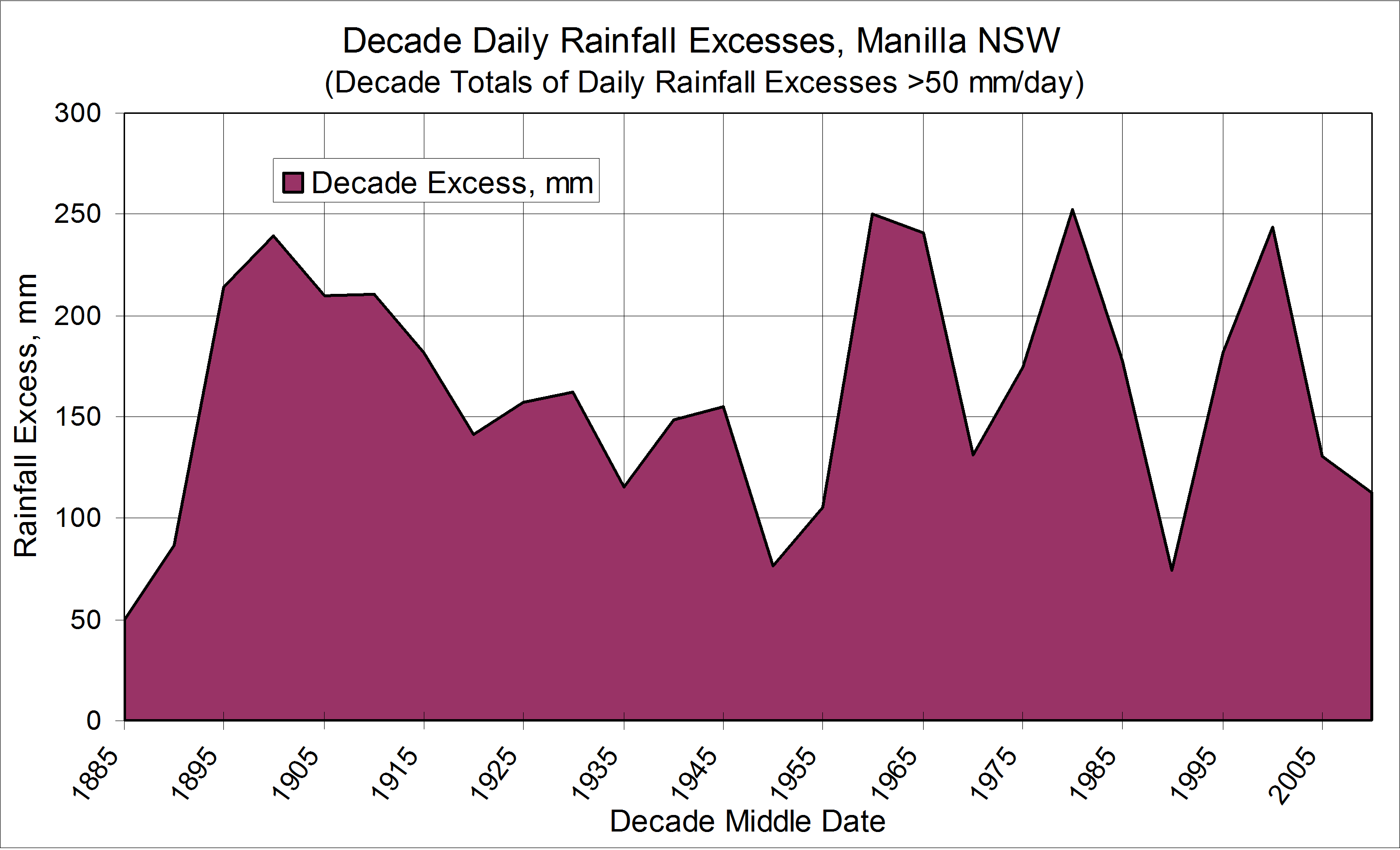
Log of decade totals of rainfall excess, Manilla, NSW Last month I posted a complete log of days at Manilla that had more than 50 mm of rainfall.
I call days that have more than 50 mm of rainfall “very wet days”. At Manilla, on the average, these have come only once per year. Days with more than 50 mm of rainfall have no special meaning, but they can be taken as a rough indication that local flooding, or even general flooding, is likely: the “Flooding Rains” of Dorothea Mackellar.*
The graph I posted did not show whether these very wet days, likely to cause floods, had a bigger effect at some times than at others. This graph shows that.

Since it is only the excess rainfall that runs off, leading to flooding, I have subtracted 50 mm from each “very wet day” rainfall amount. Then I have summed all such excesses for each half-decade. I summed the half-decades in pairs to give a decade sum (in mm) centered on the years 1885, 1890, 1895, etc. For example, the decade centered on 1925 had a total of daily rainfall excesses of 157 mm. (Values for 1880-84 were estimated from those for 1883 and 1884.)
Some decades had very high values of excess rainfall: there was about 250 mm in the decades centered on 1900, 1960, 1965, 1980, and 2000. There were very low values, below 100 mm, in the decades centered on 1885, 1890, 1950, and 1990. There appears to be no trend.

Note added June 2015.

The close similarity of two graphs, the one of heavy rainfalls in this post, and the one of year-long droughts in an earlier post led me to write a further series of three posts:
More droughts After Heavier Rains I.
More droughts After Heavier Rains II.
More droughts After Heavier Rains III.

* By arrangement with the Licensor, The Dorothea Mackellar Estate, c/- Curtis Brown (Aust) Pty Ltd.

Managing my low-energy house: II. Features needing attention

Photo of clear-story area with winter sun and a fan

Clear-story fan set for winter

This post, and the companion post I. Features needing no attention were posted originally to a forum of the Alternative Technology Association (See Note below.)

My low-energy house at Manilla, NSW, maintains year-round comfort in a climate of daily and seasonal extremes. In the climate classification of the Building Code of Australia, it is in Zone 4: “Hot dry summer, cool winter”, along with Tamworth, Mildura and Kalgoorlie.
This house differs from most houses in relying on the design of the house to achieve comfort, with hardly any energy needed for heaters or coolers.
There is little artificial control: the “home automation system” consists only of timers set twice a year. Some of the comfort features call for daily action in certain seasons. However, these simple daily chores could have been avoided by small changes in the design. [But see “Note added 2016.”]

The success of the house in maintaining comfort in all seasons is shown by scatter-plots of daily indoor and outdoor maximum and minimum temperatures over a period of three years.

Features re-set twice a year

Dates for re-sets

For part of each year, the Manilla climate is too hot for comfort, and for the rest it is too cold. Some house features are re-set twice a year, making a “winter regimen” and a “summer regimen”. At first, I set the change-over dates near the equinoxes, 20th March and 22nd September. For simplicity I changed on 1st April and on 1st October. Later, I found it better to change on 1st March and 1st November, because the time when the climate is too hot is shorter than the time when it is too cold.

Motorized curtains

Curtains fitted to five north-facing windows, and a shutter fitted to a sun-porch window, should be opened to admit winter sun and closed at night to trap the heat. In summer they should be closed by day to keep out radiant heat and opened at night to allow heat to radiate out. The curtains and the shutter have motors controlled by a programmable timer (at lower right in the photo). In autumn (1st March), the timer is set to open at 07:40 and close at 17:20 daily. In spring (1st November) the timer is set to open at 18:00 and close at 06:00 (Standard Time).

Clear-story windows and fans

Continue reading