March Climate Anomalies Log

Heat Indicators log for March months

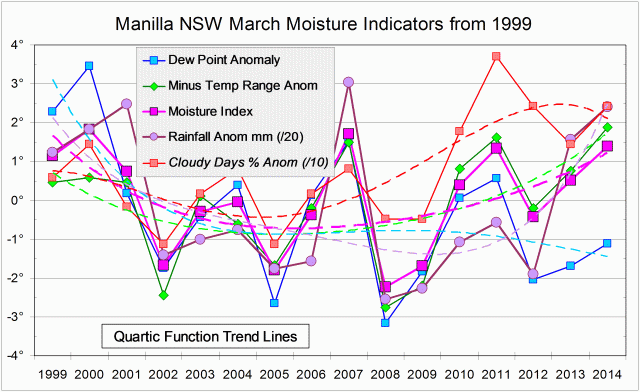
This post is the first in a set for the 12 calendar months. Graphs are sixteen-year logs of the monthly mean anomaly values of nine climate variables for Manilla, NSW, with fitted trend lines. I have explained the method in notes at the foot of the page.

Raw anomaly values for March

Extreme values for March anomalies in this period were:
Daily Minimum Temperature anomaly -2.9°: March 2008;
Morning Dew Point Anomaly +3.5°: March 2000;
Morning Dew Point Anomaly -3.2°: March 2008;
Rainfall anomaly +61 mm: March 2007;
Percent cloudy mornings anomaly +37%: March 2011.

Trend lines for March

Heat Indicators

Daily maximum temperature showed minima about -1 deg in 2001 and 2014, and a maximum about zero in 2007.
Daily minimum showed a minimum two years later, about 2003, then rose in parallel with daily maximum, but ended very high.
Subsoil temperature did not agree, and varied less. It had maxima in 2002 and 2012. It may show a lag of five years behind daily maximum.

Moisture Indicators log for March months

Continue reading

Manilla NSW in Global Warming Context

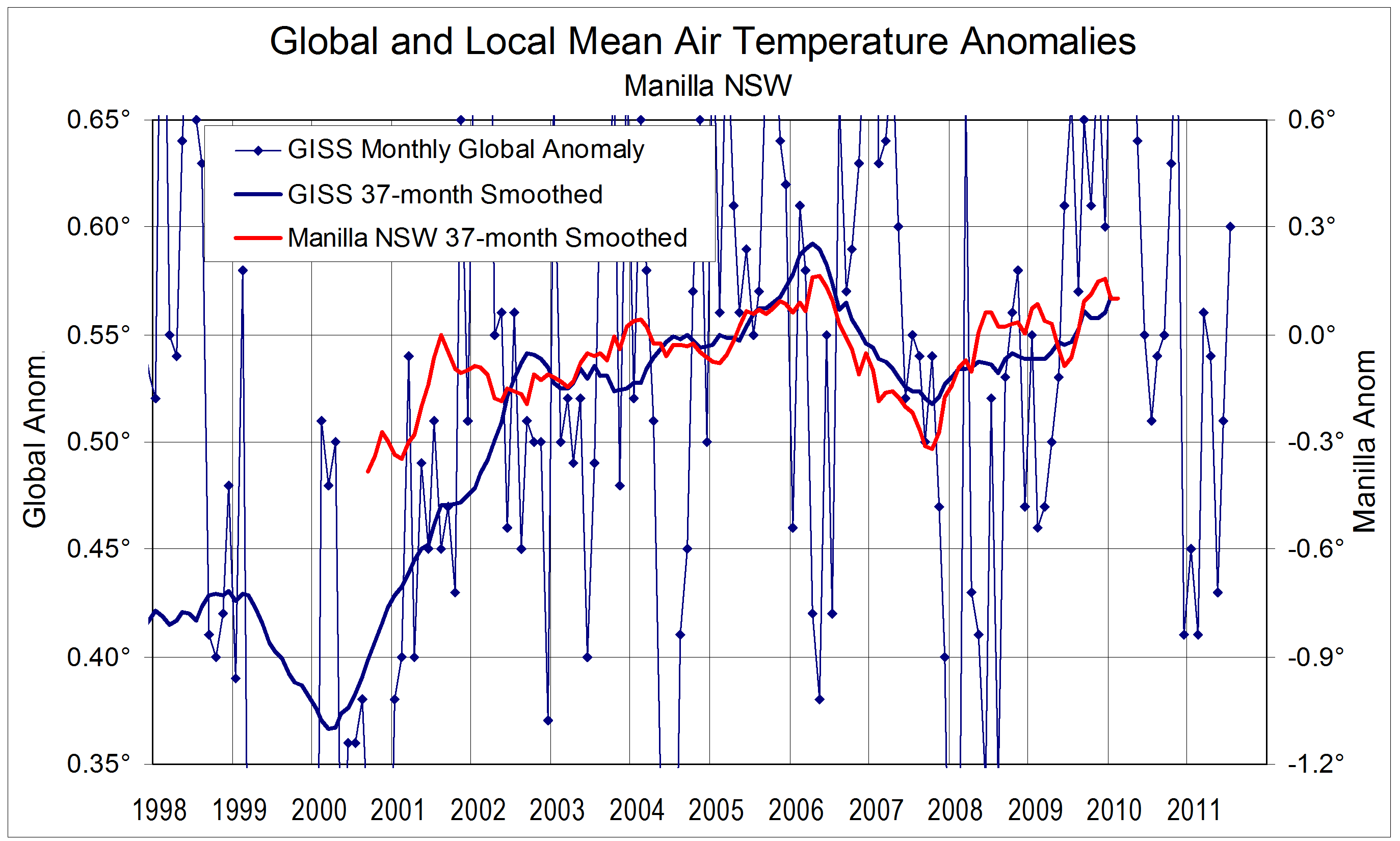
Logs of smoothed world and local temperatures.

[I posted an Up-dated version of this graph in July 2014]

Up-to -date data on global temperature change can easily be down-loaded from Ole Humlum’s website “climate4you“.
Humlum favours sampling windows 37 months wide. For my own data at Manilla, NSW, I have always used windows about six months wide, which show up Australia’s vigorous Quasi-biennial oscillations of climate. I tried Humlum’s 37-month window on my data, with quite startling results, as shown in the graph above.

Humlum re-presents three records since 1979 of global monthly air surface temperature anomalies:
* HadCRUT3: by the (UK Met Office) Hadley Centre for Climate Prediction and Research, and the University of East Anglia’s Climatic Research Unit (CRU), UK.
* NCDC: National Climatic Data Centre, NOAA, USA.
* GISS: Goddard Institute for Space Studies, Columbia University, New York, NASA, USA.
When smoothed by a 37-month running average, these data sets give very similar results. I use the GISS data because it matches my data best.

The match is very good, particularly in the sharp fall from the maximum in April 2006 to the minimum in September 2007. Where my data begins in September 2000, both curves rise steeply from low values, but mine peaks in August 2001, more than a year before a corresponding peak in global temperature (September 2002). After that, there is a plateau, where the graphs rise together to the highest peak (April 2006).
The other global data sets, HadCRUT and NCDC, have temperature falling or steady along the 2002-2006 plateau.
There are two reasons for plotting my data on a separate axis (on the right). First, the reference periods are different: GISS uses 1951-1980, while I use the decade from April 1999. Second, temperature varies much more at a single station than in the average of many stations around the world. I use a scale six times larger.

It turns out that the cold time in Manilla in late 2007, which I had mentioned in several contexts, was a cold time world-wide.

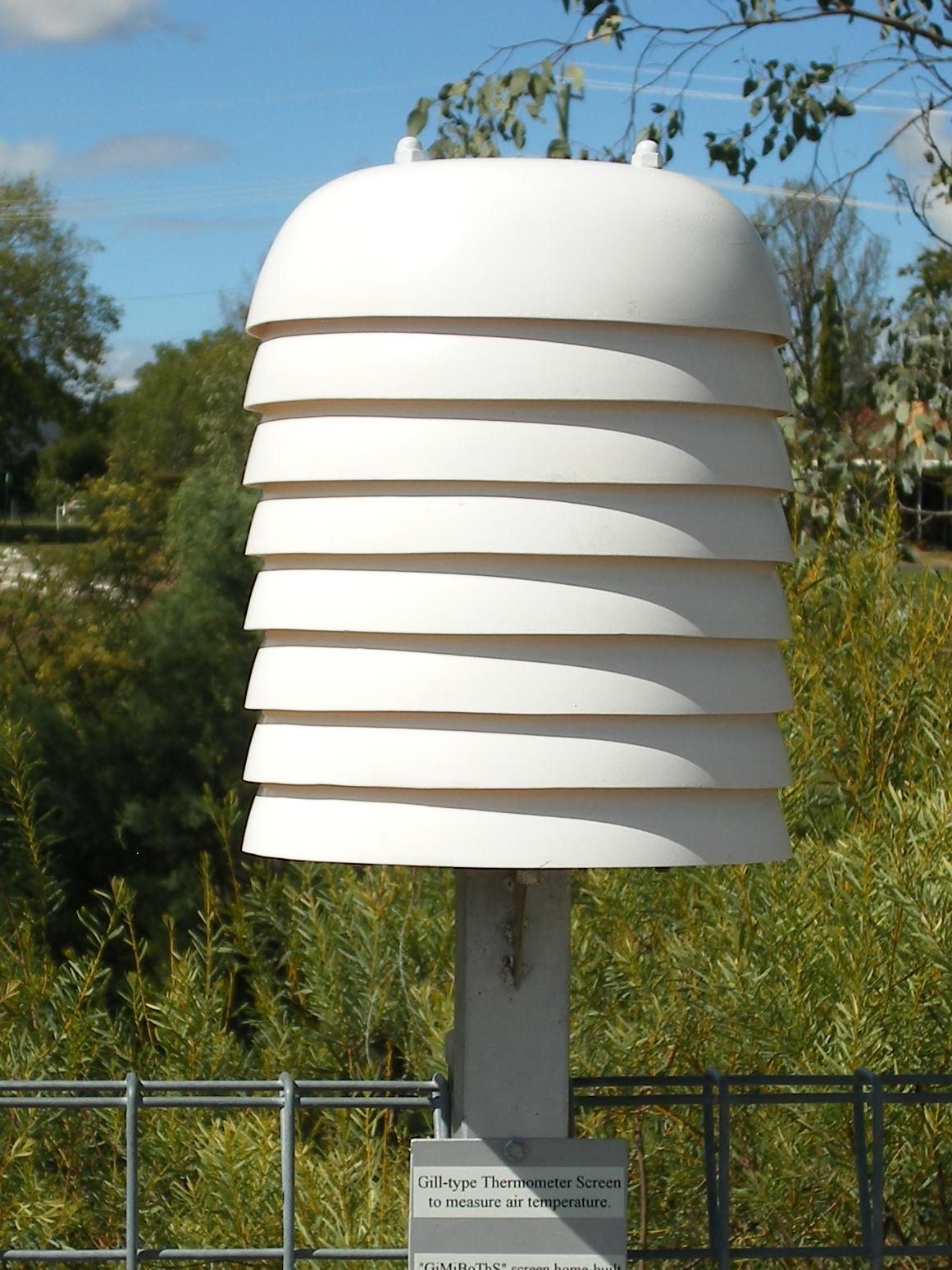
Home-made thermometer screen

Giant Mixing Bowl Thermometer Screen

I am over the moon at getting agreement between data from my home-made thermometer screen and the best that world climatologists can do. It makes me inclined to believe some of the things they say.


This article and graph were posted on 18th August 2011 in a weatherzone forum: General Weather/ Observations of Climate Variation.


Predict weather from ENSO?

(Someone asked me to set down my thoughts about this.)

“Droughts and flooding rains” *

The climates of places in Australia cycle from hot, arid and dry, to cold, humid and wet every couple of years. (Dorothea Mackellar said she loved a sunburnt country “of droughts and flooding rains”*) This is a kind of quasi-biennial oscillation (QBO).  For more about the QBO, see this post, and the links in it. The cycles get weaker and stronger, more droughty or more rainy, and sometimes take about one year, sometimes three or more.

The climate of the Pacific Ocean has similar cycles, called the Southern Oscillation, discovered by Gilbert Walker a century ago. The pressure difference between Darwin and Tahiti oscillates in a way that reflects other widespread changes in climate. This is now called the El Niño – Southern Oscillation (ENSO) and it is monitored by sea-surface temperature east of Nauru in the Pacific Ocean, called NINO3.4. Now that we have up-to-date data on NINO3.4, the public has been led to believe that the data can be used to forecast Australian weather. It really can’t.

Problem No.1: Weather varies from place to place.

Every district in Australia has different weather, so one size does not fit all. Wasyl Drosdowsky made a map defining the regions that have consistent relationships to ENSO and other indices, but nobody has taken up the idea. (I would if I was boss of the Bureau of Meteorology!) Drosdowsky’s regions are rather similar to the States, but Victoria and the southern half of South Australia form a single region.

Problem No.2: Forecast is too late.

The ENSO cycle does not predict a cycle in any part of Australia because it happens at about the same time, and it takes a month or more to collate the data. Weather prediction from ENSO is always late. Consequently, there is a business to predict ENSO some months ahead. These predictions are very unreliable. Then the predictions of ENSO values are used to predict Australian weather, with vague statements of which regions will be affected.

To make matters worse, my Manilla data from 1999 shows that my weather happens in advance of the ENSO changes. I compared the ENSO log from 1999 to 2011 with smoothed daily maximum temperature anomaly, (1 month ahead)  smoothed monthly rainfall anomaly, (2 months ahead) and smoothed early morning dew point anomaly(3 months ahead). If droughts and deluges happen before peaks and troughs of ENSO at other places in Australia, this makes prediction from ENSO even less likely to work.

[Note added 14/07/2015. Updated graphs comparing the ENSO log from 1999 to 2014 with smoothed daily maximum temperature anomaly and smoothed monthly rainfall anomaly at Manilla are in this post. Manilla’s climate has not related very well to ENSO since mid-2011.]

[Note added 10/10/2019. Updated data confirm that ENSO lagged Manilla rainfall by 2 months from 1999 to August 2011, then failed to relate to Manilla rainfall after September 2011.
See: “21-C Rain-ENSO-IPO: Line graphs” and “21-C Rain ENSO IPO: Scatterplot”.
According to Power et al.(1999)Australian rainfall usually fails to relate to ENSO when the IPO goes positive, as it did from 2014 to 2017 (and 2018?).]


* By arrangement with the Licensor, The Dorothea Mackellar Estate, c/- Curtis Brown (Aust) Pty Ltd.


Data are cheap; information is expensive!


Originally posted on 12/5/2013 to a thread “ENSO Discussion 2013” on a “weatherzone forum.

Manilla 30-year Monthly Rainfall Anomalies

Manilla 30-year Monthly Rainfall Anomalies

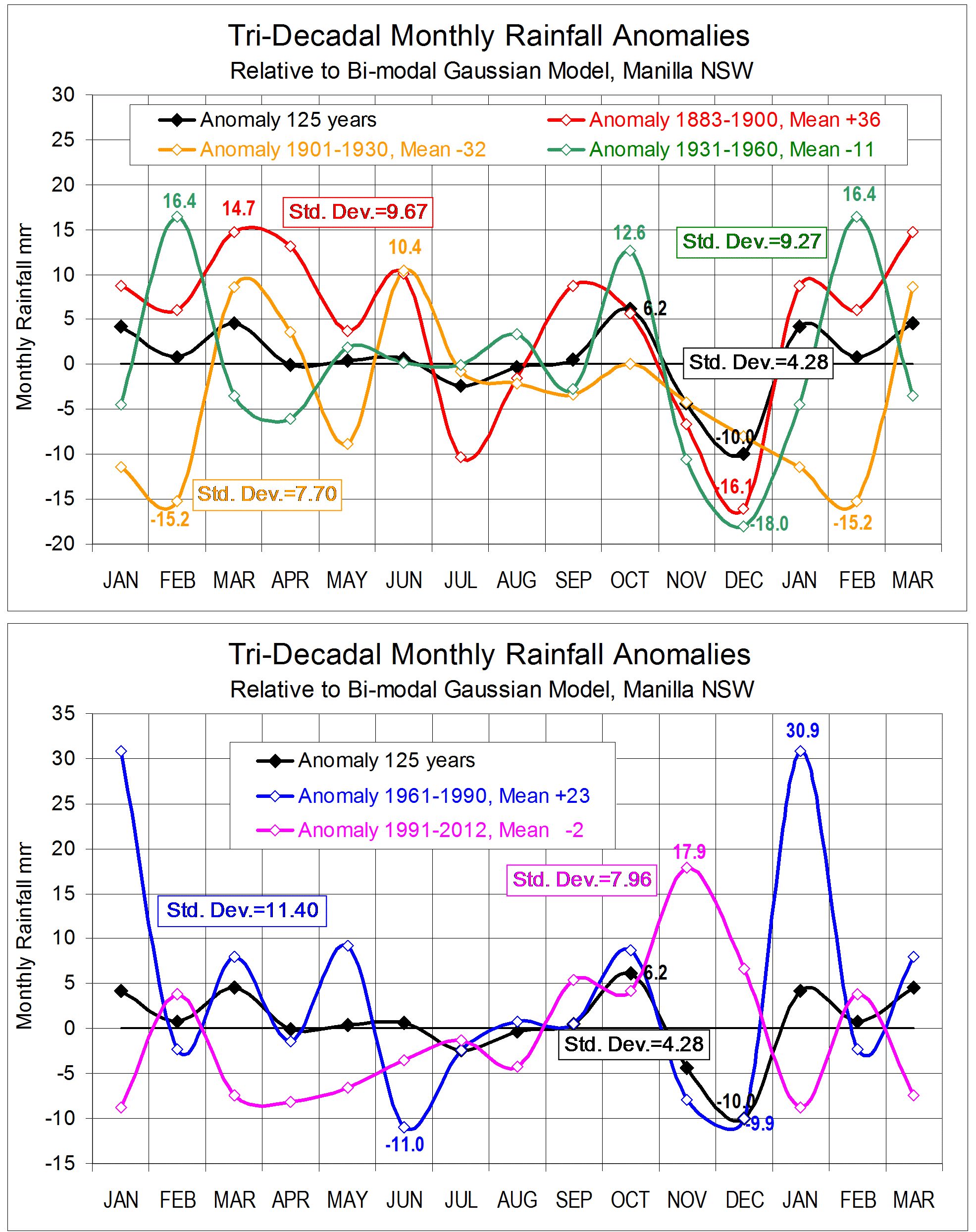
In an earlier post I modelled the seasonal distribution of rainfall at Manilla, NSW, as a bi-modal Gaussian distribution with a higher Gaussian peak very close to the summer solstice and a lower one very close to the winter solstice.
Monthly discrepancies of the 125-year average from the model are small. They are plotted in black on each of the two graphs here. Only two months could not be made to fit the model well: October has 6.2 mm more rain than expected, and December has 10.0 mm less.
The graphs show anomalies from the model for each of five “epochs” of three decades (or less). They are:
1883 to 1900 – “19th Century” (19thC)
1901 to 1930 – “World War I” (WW I)
1931 to 1960 – “World War II” (WW II)
1961 to 1990 – “BoM Normal Period” (BoM)
1991 to 2012 – “21st Century” (21stC)
Continue reading

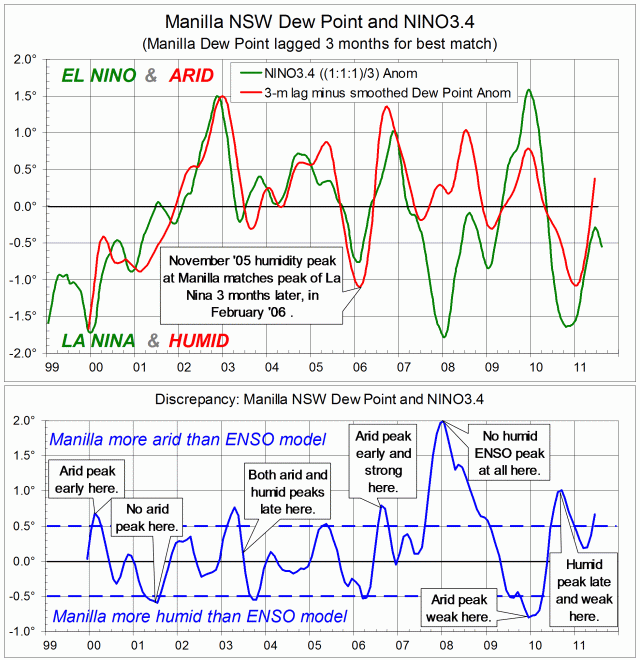
Manilla Dew Point leads ENSO by three months

Manilla dew point lags NINO3.4 sea surface temperature by 3 months.

(This material justifies a statement in the post “Predict weather from ENSO?”)

The graphs above are like those in two previous posts, but show how Manilla smoothed monthly dew point anomalies, like temperature anomalies and rainfall anomalies, relate to the El Niño-Southern Oscillation (ENSO).

High (El Niño) values of Sea Surface Temperature (NINO3.4) are shown here to relate to low humidity at Manilla, NSW. As humidity data, I estimate dew points daily at sunrise. Dew points, like Sea Surface Temperatures, are expressed in degrees celsius, but corresponding anomalies take the opposite sense. The first graph plots the Manilla dew point anomaly, given a  negative sign, and the NINO3.4 anomaly. To improve the match, I have lagged the Manilla dew points by three months. As an example, I have noted on the graph the match of Manilla’s November 2005 humidity peak with the La Nina ENSO peak of February 2006.

To the eye, the over-all match is better than in either the rainfall or the maximum temperature plots of earlier posts. The two curves here match very well from 2000 to 2007.

The second graph shows the discrepancy between the two curves. Dashed lines show limits of a good match at +/-0.5 degrees. The nature of each larger discrepancy is noted. (“Here” in text boxes means “at Manilla”.)
After 2007 there are large mis-matches between Manilla dew point and ENSO. Dew point fluctuations suddenly become less than might be expected from NINO3.4 values. It may be relevant that, as I posted elsewhere  in July 2010, skies suddenly became very much cloudier at Manilla after August 2007.

I have also tried plotting the following variables against NINO3.4:

Daily minimum temperature;
Daily temperature range;
Percent cloudy mornings;
Subsoil temperature.

None of them matches NINO3.4 well enough to display.

The three sets of graphs show “teleconnections” between Sea Surface Temperatures in the equatorial Pacific and climate variables at Manilla in inland NSW, Australia. Climatic peaks come earlier at Manilla than in the Pacific:

Peaks of daily maximum temperature come one month earlier;
peaks of rainfall come two months earlier;
peaks of Dew Point come three months earlier.

In a simple-minded way, it seems to me more likely that Australia’s climate drives the Southern Oscillation than the other way around. I know that this is speculation. (Sort of like Abraham Ortellius suggesting in 1587 that Africa and South America might have drifted apart.)

Notes
1. High frequency noise is reduced in the case of the Manilla monthly data by a Gaussian smoothing function of half-width six months.
2. On advice, I represent the El Nino – Southern Oscillation phenomenon (ENSO) by the NINO3.4 area anomalies from the OISSTv2 data set.
My enquiries about the best data to use are in this “weatherzone”  thread.
The ensemble of sea surface temperatures does not have much high-frequency noise. There is some, however, and I have used the same smoothing as used in the (formerly authoritative) Oceanic Nino Index (ONI), that is, a running mean of each three monthly values.


This was posted originally in a “weatherzone” forum, with the date 12 November 2011. It is posted here with the nominal date 29 November 2011.