When is the First Frost?

This year (2017) the first frost at Manilla came on the 11th of May, close to the middle date for it: the 13th of May. In just half of the years, the first frost comes between ANZAC Day (the 25th of April) and the 19th of May.
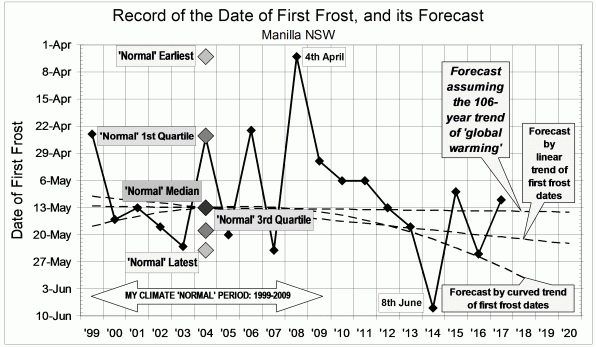
Graphical record of first frost dates
(See the notes below: “Observing Frosts in Manilla.”)

The date of first frost from year to year

The graph shows the dates of first frosts in the last nineteen years. One feature stands out: from a very early date of the 4th of April in 2008, the dates got later each year to a very late date of the 8th of June in 2014. Otherwise, the dates simply jumped around.
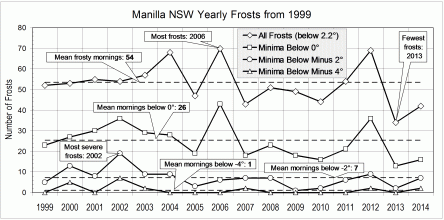
Graphical log of frostsThe date of first frost hardly relates at all to the number of frosts in a season. This graph, copied from an earlier post, shows how poorly they match. The earliest first frost, in 2008, was in a year with a normal number of frosts. In the least frosty year, 2013, the first frost did not come late.

The central date and the spread

To find the central value and the spread of a climate item like this calls for readings for a number of years called a “Normal Period”. (See note below on Climate Normals.) I chose the first eleven years of my readings (1999 to 2009) as my Normal Period. For this period I found these five order statistics:

Lowest (earliest) value: 4th April;
First Quartile value: 25th April (ANZAC Day);
Median (middle) value: 13th May;
Third Quartile value: 19th May;
Highest (latest) value: 24th May.

These five values divide the dates of first frost into four equal groups. For example, the first frost comes before ANZAC Day in one year out of four. This could confirm what Manilla gardeners know already!

Is the first frost getting later?

Talk of global warming leads us to expect the date of first frost to get later. By how much?
Dates on the graph after 2009 seem to be later in the season than during the Normal Period. As shown, a linear trend line fitted to the data points slopes steeply down towards later dates in later years. A curved trend line (a parabola) slopes down even more steeply. However, with so few data points, these trend lines are wild guesses, not to be relied on for forecasting future frosts.
Australian Bureau of Meteorology data for NSW from 1910 shows that daily minimum temperatures have been rising at 0.11° per decade.  (That is much faster than the rate for daily maximum temperatures, which is 0.07° per decade.) To work out how this might affect the date of first frost in Manilla, one needs to know that the daily minimum temperature in this season gets lower each day by 0.15°. One day of seasonal cooling will more than cover a decade of climate warming. The effect of global warming is to make the date of first frost only one day later in fourteen years. If the middle date of first frost was the 13th of May in the Normal Period, centred on 2004, the forecast middle date of first frost next year (2018) would be the 14th of May. This is shown by the flattest of the three trend lines on the graph.

Looking ahead, it seems unlikely that the date of first frost will get later by as much as a week within a lifetime.

[Update 12 August 2019:
This estimate of the median date of first frost, 13 May, is not changed by first frosts observed on 15 May 2018 and 12 May 2019.]


Notes

1. Observing Frost in Manilla

Continue reading

Global Warming Bent-Line Regression

HadCRUT global near-surface temperatures

HadCRUtemp2lineThis graph, posted with permission, shows a bent line fitted to the HadCRUT annual data series for global near-surface temperature. Professor Thayer Watkins of San Jose State University Department of Economics posted it on his blog about 2009.

HadCRUTsmoothWithout knowing of this work, I constructed the second graph. I used data from the same HadCRUT source, but a data set smoothed by the authors.

In April 2013 I posted it to a forum thread in”weatherzone”.

Next, I added to that graph a logarithmic plot of global carbon emissions, similarly fitted with a series of straight trend lines.

Log from 1850 of world surface air temperature and carbon emissionsThis I included in posts to several forums: in a post to “weatherzone”, in a post to the Alternative Technology Association forum, and finally in a post to this blog.

Both Professor Watkins and I have fitted bent lines to the data. I fitted the lines by eye (for which I was accused of “cherry-picking”). Professor Watkins used an explicit process of Bent-Line Regression, minimising the deviations by the method of least-squares. Like me, he initially chose by eye the dates of the change points where the straight lines meet. But he then adjusted them so as to minimise the least squares deviations.
[See notes below on the method of Bent-Line Regression.]

The trend lines and change points are practically the same in the Thayer Watkins and the “Surly Bond” graphs:
1. (Up to Down) TW: 1881; SB: 1879.
2. (Down to Up) TW: 1911; SB: 1909.
3. (Up to Down) TW: 1940; SB: 1943.
4. (Down to Up) TW: 1970; SB: 1975.
As I said at the time, once straight trend lines are chosen, the dates of change points to fit this data series closely do not allow of much variation.

Relation to the IPO (or PDO) of the Pacific

Not by coincidence, Watkins and I both went on to relate the multi-decadal oscillations of Pacific Ocean temperatures to the global near-surface average temperatures.

My approach

I merely plotted my chosen global temperature change points on to the Pacific graphs (I chose to cite the IPO (Inter-decadal Pacific Oscillation)). In two posts I noted (i) the way the change points in the HadCRUT global temperature series were close to those in the IPO, and (ii) the way the IPO seemed able to explain why the trend in global warming was “bent” in 1943 and 1975 but, in that case, could only sharpen the bends of 1910 and 1880.

Professor Watkins’ approach

AGT_PDO7Professor Watkins did a separate Bent Line Regression Analysis on the Pacific graphs (He chose to cite the earlier-developed PDO (Pacific inter-Decadal Oscillation)). His analysis “A Major Source of the Near-Sixty Year Cycle in Average Global Temperatures is the Pacific (Multi)Decadal Oscillation” is here.

He admits the match is poor, with various lags and a different period. He concludes:
“Thus while the Pacific (Multi)Decadal Oscillation appears to be involved in the cycles of the average global temperature there have to be other factors also involved.”

The significance of the IPO

Continue reading

Cool Dry April 2017

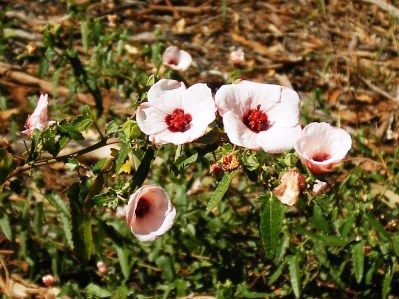
Pavonia blooms on a roadside

Roadside Pavonia

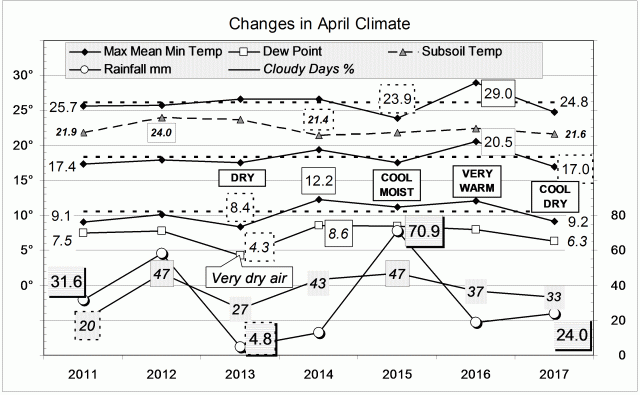
April began with cool days and nights, about three degrees below normal. However, the weather did not get any cooler until the last few days. In particular, ANZAC Day, at 27.4°, was the warmest day of the month – but that was more than a degree cooler than ANZAC Day 2002. (The average daily maximum temperature for ANZAC Day (from 2000) is 24.3°. The hottest was 28.7° (2002) and the coldest 16.8° (2012).)

Soaking rain of 10.6 mm, registered on the 26th, came with a remarkably warm night of 16.6°. Coming so late in autumn, this was 7.9° above normal, breaking the record of 7.1° above normal for an April night (20/04/06).
Further rain on the 27th (11.2 mm) fell as showers on a very cold day of 14.3°, that was 9.8° below normal. The final three nights were cold. The 30th, at 4.3°, was the coldest night of the month, but it was far from frosty.

Weather log for April 2017

Comparing April months

This month was cool, with a mean temperature of 17.0°, but not nearly as cool as April in 2008 (15.8°), 2006 (16.6°), or 1999 (15.6°). It was also rather low in moisture, with only 24 mm of rain, only 33% cloudy mornings, a daily temperature range as wide as 15.6°, and an early morning dew point of only 6.3°. What is unusual is the combination of low temperature values and low moisture values. Manilla’s climate generally swings between high temperature with low moisture (“droughts”) and low temperature with high moisture (“flooding rains”), as the poet said. (See these graphs.)
The total rainfall of 24.0 mm was at the 40th percentile, below the April average of 40 mm. There are no serious shortages of rainfall for groups of months to this date.

Climate for April 2017.


Data. A Bureau of Meteorology automatic rain gauge operates in the museum yard. From 17 March 2017, 9 am daily readings are published as Manilla Museum, Station 55312.  These reports use that rainfall data when it is available. All other data, including subsoil at 750 mm, are from 3 Monash Street, Manilla.