Manilla 30-year Monthly Rainfall Anomalies

Manilla 30-year Monthly Rainfall Anomalies

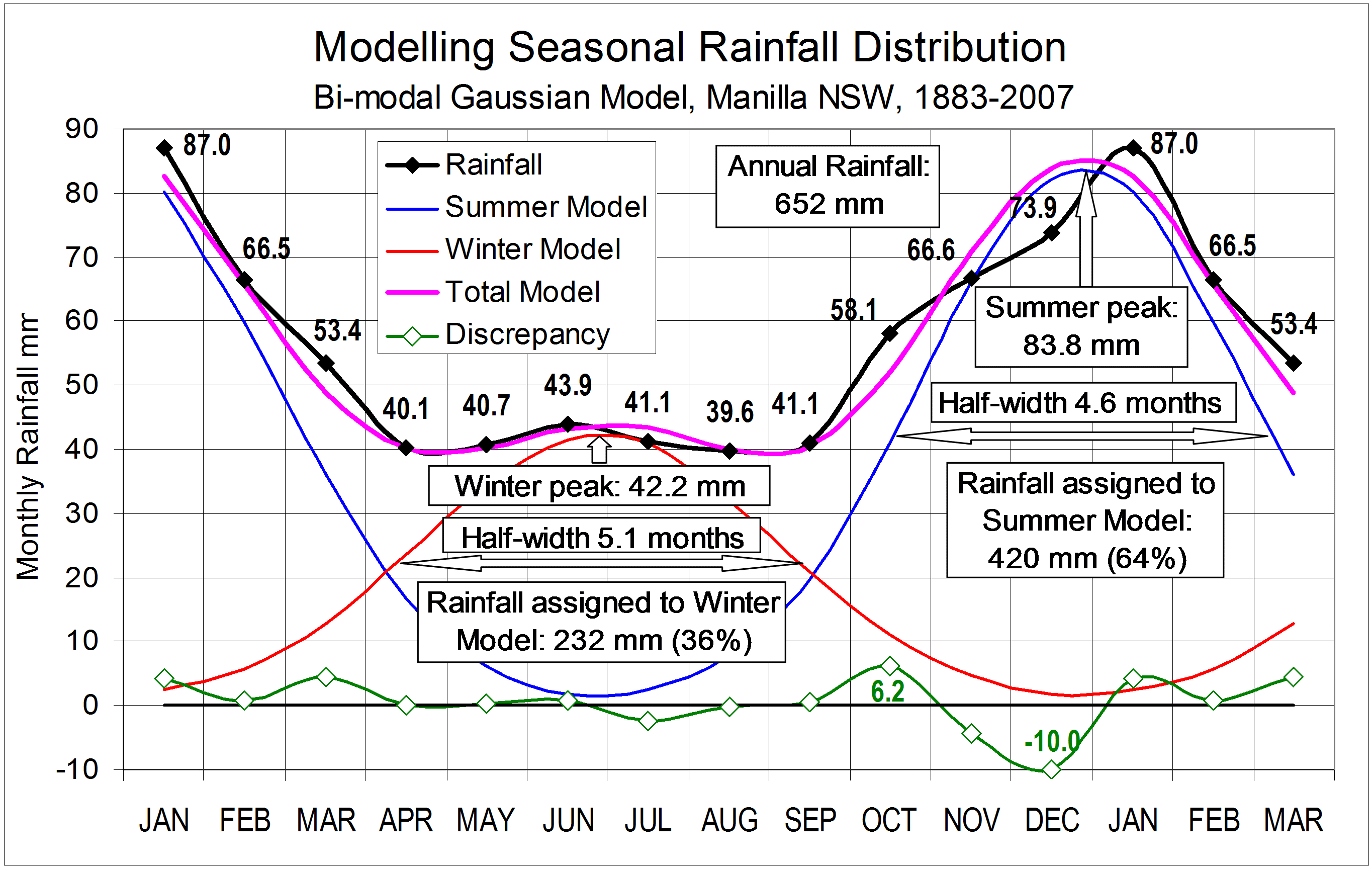
In an earlier post I modelled the seasonal distribution of rainfall at Manilla, NSW, as a bi-modal Gaussian distribution with a higher Gaussian peak very close to the summer solstice and a lower one very close to the winter solstice.
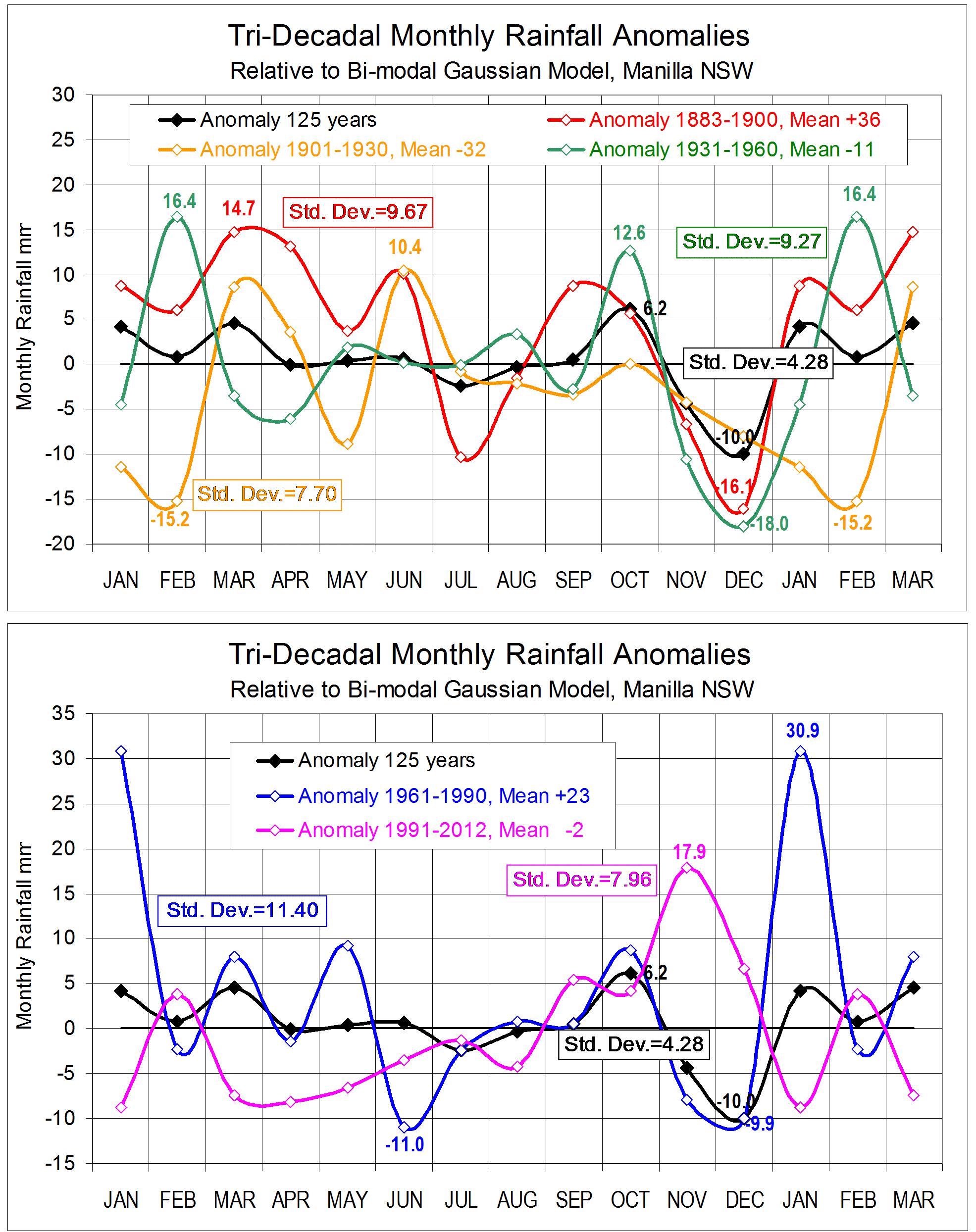
Monthly discrepancies of the 125-year average from the model are small. They are plotted in black on each of the two graphs here. Only two months could not be made to fit the model well: October has 6.2 mm more rain than expected, and December has 10.0 mm less.
The graphs show anomalies from the model for each of five “epochs” of three decades (or less). They are:
1883 to 1900 – “19th Century” (19thC)
1901 to 1930 – “World War I” (WW I)
1931 to 1960 – “World War II” (WW II)
1961 to 1990 – “BoM Normal Period” (BoM)
1991 to 2012 – “21st Century” (21stC)
Continue reading

A Seasonal Rainfall Model for Manilla, NSW

Model of seasonal rainfall, Manilla

At 31 degrees south latitude, Manilla, in eastern Australia, lies between the winter rainfall regime of the westerly belt and the summer regime of the monsoon. Much more rain falls at Manilla in summer than in winter.
On this graph, the rainfall distribution by calendar months is shown by the black line and numbers (mm) . This is the average curve for the 125-year period from the first observations in 1883 up to 2007. For any shorter period the curve is not smooth. This record is scarcely long enough to yield a stable estimate of the seasonal pattern. Continue reading

Manilla rainfall extremes reflect NINO3.4 temperature

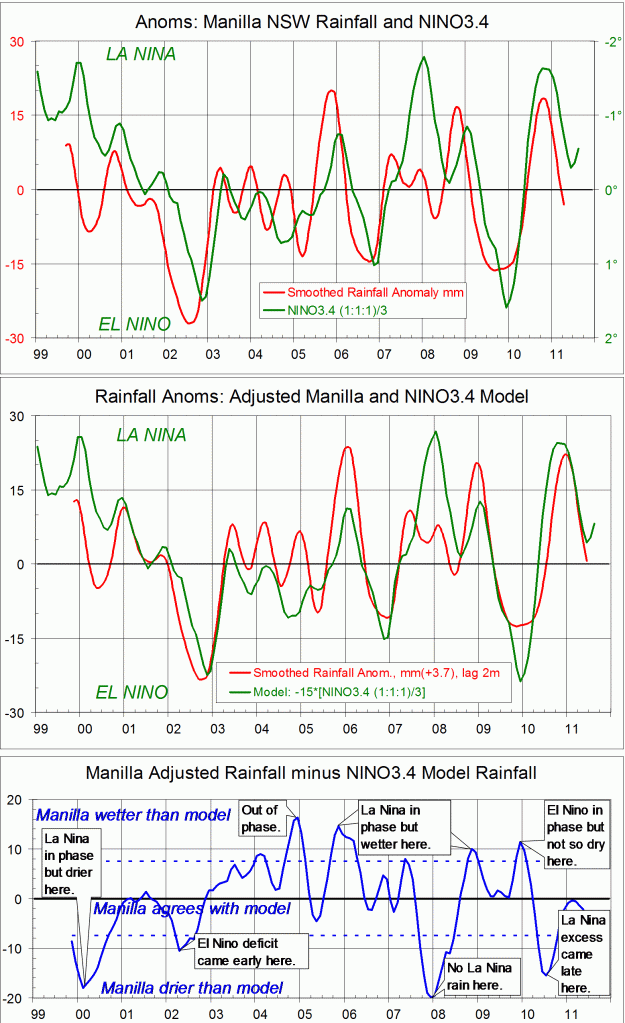
Manilla rainfall matches NINO3.4 sea surface temperature.

(This material justifies a statement in the post “Predict weather from ENSO?”)

The graphs above are like those in an earlier post, but show how Manilla monthly rainfall anomalies, rather than maximum temperature anomalies relate to the El Nino-Southern Oscillation (ENSO). Most people using ENSO  want to predict Australian regional rainfall.

In the second graph I have improved the match at peaks and troughs of smoothed Manilla monthly rainfall anomalies and NINO3.4 sea surface temperature anomaly data in two ways.
1. I converted the sea surface temperature anomaly (degrees C) into a model of resultant rainfall anomaly (mm) by multiplying by minus fifteen.
2. I added 3.7 mm of rainfall to the Manilla figures, and I lagged the data by two months.

To the eye, the over-all correspondence between actual and modelled rainfall is good, but not quite as good as in the temperature graphs. One form of mis-match is that two of the greatest rainfall deficits (“El Nino” Nov-06, Dec-09) are broader and shallower than in the model. (Perhaps an arithmetic measure of rainfall anomaly is not the best.)

The third graph shows how much Manilla rainfall, as adjusted, differs from the rainfall “predicted” by the NINO3.4 model. Dashed lines show limits of a good match at +/- 7.5 mm (corresponding to +/-0.5 degrees). The nature of each larger discrepancy is noted.

A good match demands lagging actual rainfall at Manilla by two months. That implies that peaks and troughs in Manilla rainfall anomalies happen two months before the matching anomalies of NINO3.4. I wonder if prediction is even practical if that is the case in other parts of Australia.

Notes
1. High frequency noise is reduced in the case of the Manilla monthly data by a Gaussian smoothing function of half-width six months.
2. On advice, I represent the El Nino – Southern Oscillation phenomenon (ENSO) by the NINO3.4 area anomalies from the OISSTv2 data set.
My enquiries about the best data to use are in this “weatherzone”  thread.
The ensemble of sea surface temperatures does not have much high-frequency noise. There is some, however, and I have used the same smoothing as used in the (formerly authoritative) Oceanic Nino Index (ONI), that is, a running mean of each three monthly values.


This was posted originally in a “weatherzone” forum, with the date 28 October 2011. It is posted here with the nominal date 16 November 2011.

(Note added: Updated to include 2013 here.)


Spring 2008 was the seventh wettest

Weather log spring 2008

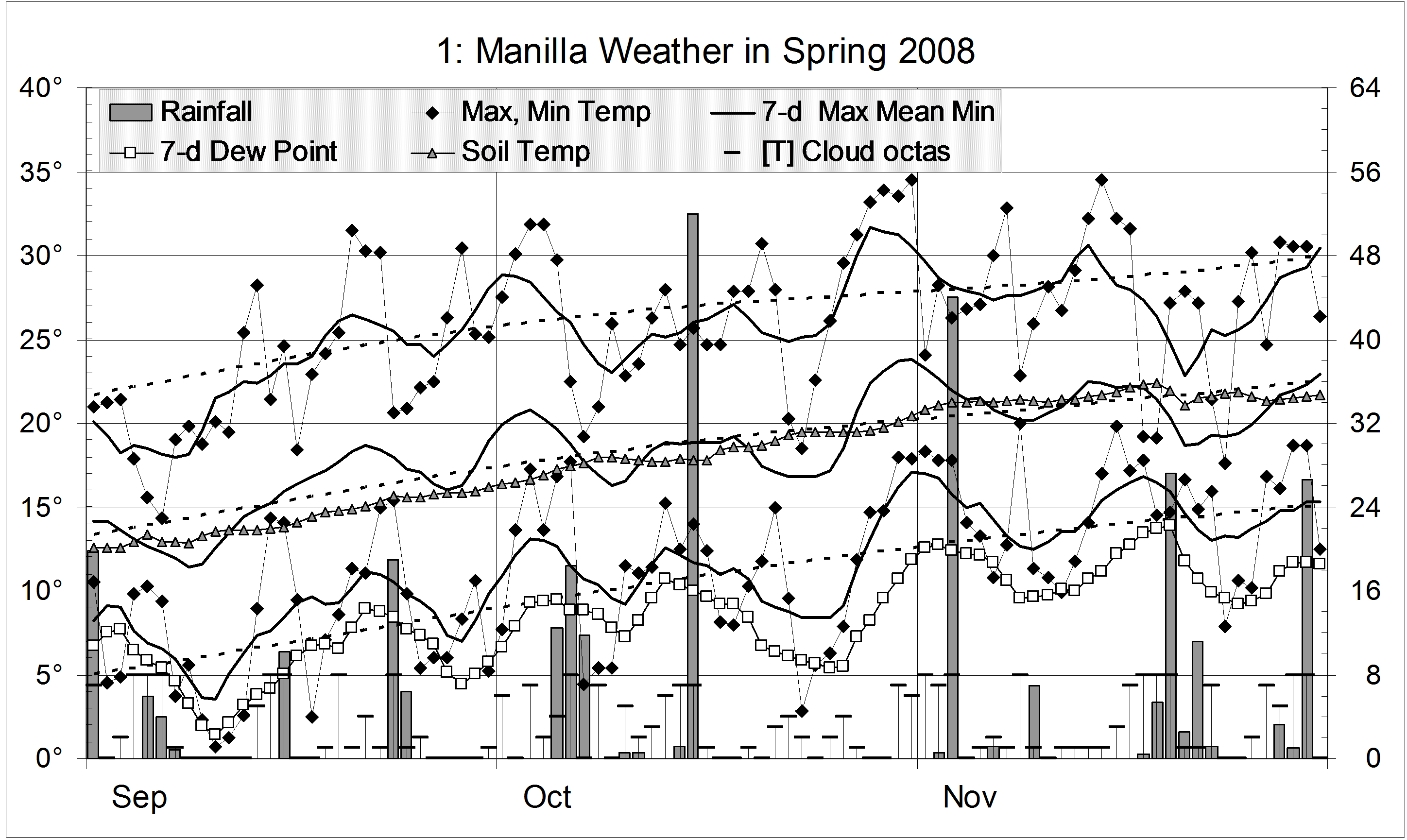
There were about six cycles of low and high temperature during spring. The third week of October was particularly cool, with dry air. By contrast, days and nights were more than seven degrees warmer by the end of the month.
There were 27 rain days, eight more than usual. Although the total rainfall (295 mm) was extremely high, the highest daily fall was only 52 mm. There were only two mild frosts early in the season.


The mean temperature was normal for spring. Rather cool days and rather warm nights combined to make the daily temperature range (14.4°) the narrowest for the decade, well below the average of 15.9°.(Note added. The mean daily temperature range for spring 2010 was far narrower: 12.9°.)
This spring was rather more humid, and had rather more cloud than usual.
This was the seventh wettest spring in the 126-year record, equal with 1973. Wetter springs occurred only in two clusters. The first cluster was 1916 (326 mm) and 1917 (327 mm); the second was 1949 (330 mm), 1950 (379 mm), 1954 (319 mm) and 1955 (321 mm). (Note added. Spring 2011 was very much wetter, with a record spring rainfall of 431.7 mm.)

Climate spring 2008

Data. Rainfall data is from Manilla Post Office, courtesy of Phil Pinch. Dew Point values before August 2005 are from Tamworth Airport 6 am data supplied by the Bureau of Meteorology. Temperatures, including subsoil at 750 mm, and other data are from 3 Monash Street, Manilla.