June 2015 rather wet

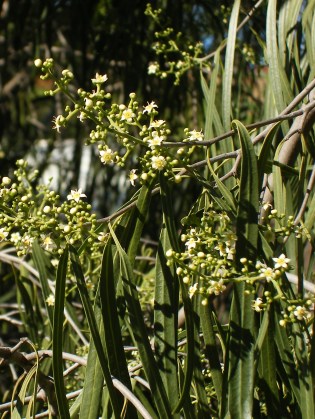
Photo of the tiny blossoms of the Wilga, an Australian shrub

Wilga blossoms in June

The first week of June was cold but sunny, the second warm, and the rest not quite so warm. Rain registered (unofficially) on the 17th was 54.5 mm. That was close to the record June day of rainfall at Manilla Post Office: 55.1 mm on 18/6/1930.
The early morning minimum of the 17th was extremely warm, at 12.8°: the fifth warmest for June. There were 12 frosts (as usual) but none was severe. On two mornings, fog persisted past nine o-clock.
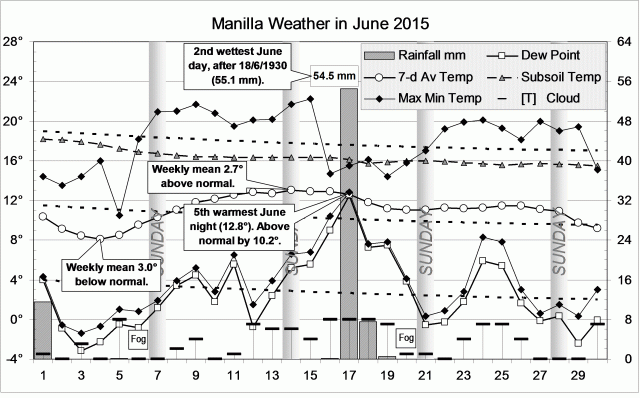
Weather log for June 2015

 Comparing June months

Most monthly averages were near normal. Daily minima were up one degree, and morning dew points down one degree.
While lower than in June 2013, the total rainfall of 74.4 mm is high: in the 82nd percentile. Among rainfall totals for more than one month, there are no serious shortages. The lowest percentile value (11th) is for the 24-month total of 996 mm.

Climate for June 2015


Data. All data, including subsoil at 750 mm, are from 3 Monash Street, Manilla. Rainfall data up to 26/3/15 is from Manilla Post Office, Station 055031.
Constructing My Solar-passive House

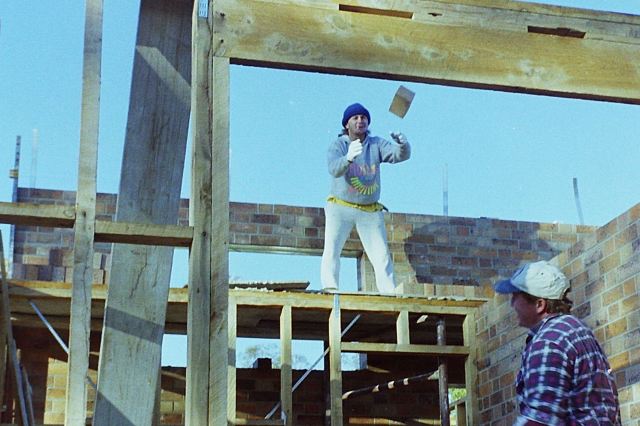
Photo of tossing a brick

One Brick Thermal Mass

The “Indoor climate” posts on this blog relate to the particular house that I live in. Mainly by luck, it has proved to need very little energy indeed to remain comfortable in all seasons.
Recently, I have collected and arranged photos of the house so that people can see what kind of a house it is.
These photos are accessed by way of “My House Page”.

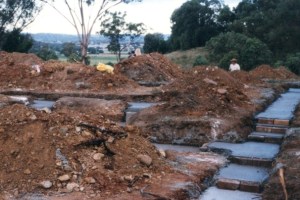
House footings on a rise

Footings View East

In the last few days I have uploaded photos of the stages in the building of the house. They are in two galleries. The first, “Building Photos: Start” covers from preparation for building up to the erection of timber frames. The photo on the left, showing some of the footings, is an example.

The second new gallery, “Building Photos: Finishing” covers from laying bricks for thermal mass walls (as in the photo at the top) to the completion of an acrylic textured coating on the walls.

Photos of the completed house, inside and out, had been posted already, in “Award photos 1999”.

Once an “Indoor Climate” post or page has been accessed on this web-site, links to all others appear. A post such as this one, when accessed through “Home” will not link to the others until it is selected positively by clicking its title line.

Very cloudy days in May 2015

Photo of a case moth

A case moth

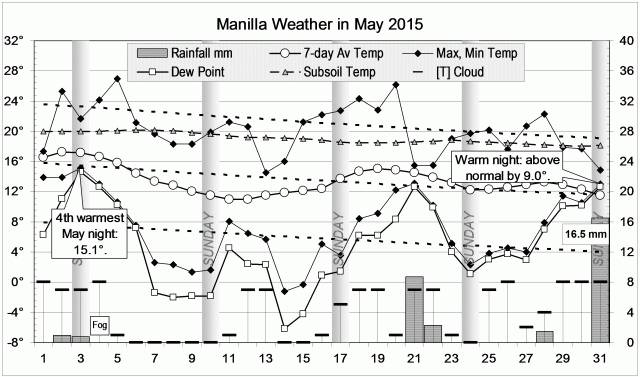
While there were four frosts (usually 6) that came early in the month, a record number of eleven nights were warmer than 10°. Some were very warm. At 15.1°, the night of the 3rd was the 4th warmest May night. Although the night of the 31st was only 13.0°, since it came so late, that was 9.0° above normal for that date. By contrast, most days were cooler than normal.
The frostier times were sunny, but skies later became cloudy. Finally, days were chilly and overcast. Cloud blanketed the hills, but steady rain (16.5 mm) held off until the very end.

Weather log for May 2015

 Comparing May months

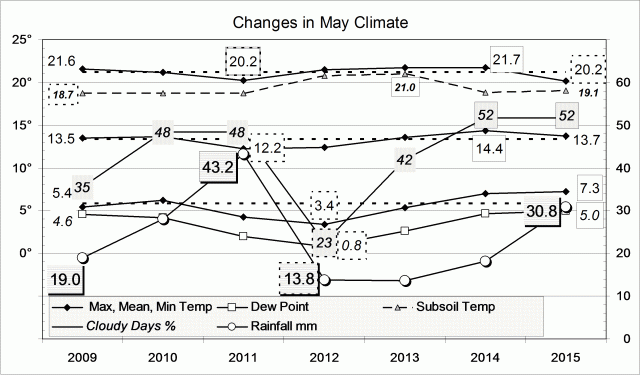
The most remarkable mean value for the month is the daily temperature range: at 12.9°, it is 2.4° below normal. The May months with the narrowest ranges to date, in 2001 and 2014, had ranges of 14.7°, only 0.6° below normal. The narrow temperature range is due to cloudy skies which, at 52%, equal the record for May.
Linked with these figures are a very cool mean daily maximum temperature of 20.2°, and a very warm mean daily minimum temperature of 7.3°. The mean early morning dew point (5.0°) is not high, but higher than in any May month since 2007.
The total rainfall of 30.8 mm is in the 51st percentile. (While the long-term May average is 40 mm, May rainfall in the 21st century has averaged only 21 mm.) Among rainfall totals for more than one month, there are no serious shortages. The lowest percentile value (14th) is for the 24-month total of 1019 mm.

Climate for May 2015


Data. All data, including subsoil at 750 mm, are from 3 Monash Street, Manilla.

More Droughts After Heavier Rains III.

Graphical log of errors when droughts are predicted from rains

Droughts and flooding rains at Manilla NSW were related in a way that is remarkable and unexpected.

Part III. Predicting drought from heavy rain

[Back to Part II: Scatter-plots]

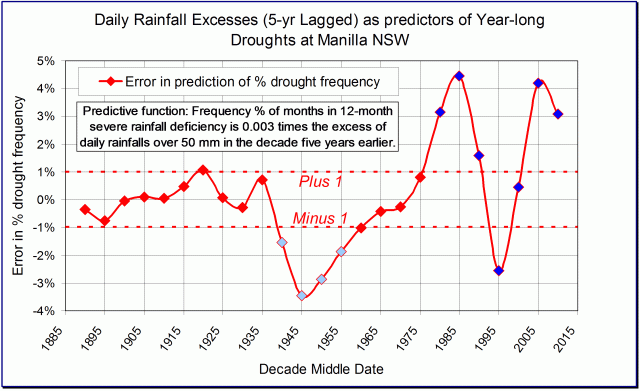
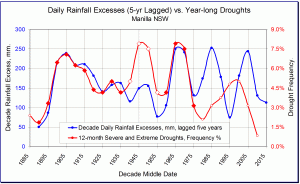
The graph above is derived from the first graph in this series (copied here) by using the blue regression trend-line from the scatter plot of selected data (also copied here). (For data details, sLog of 1-year droughts and 5-year lagged heavy rainfallsee Note 1, below.)

The equation of the trend line, y = 0.030x is used AS IF to use the daily rainfall excesses to predict the drought frequency five years later. The graph shows the “error” of this “prediction”. (In Note 2, below, I concede that this data set could not support such prediction.)
As expected from the previous graphs, the “prediction” is accurate at most data points to 1975. It is correct to the nearest percentage whole number at nine of the eighteen points. From 1940 to 1955, droughts are uniformly more frequent than predicted. After 1975, the error curve swings wildly up and down.

Could droughts have been predicted from heavy rainfalls?

Scatter-plot 1890 to 1975

By about 1915, it is conceivable that this relationship could have been discovered, either by analysis of such data, or by modelling of the climate system. Then, the data for the next 20 years, up to 1935, would seem to confirm it. Data from 1940 to 1955 would cause doubts, but data from 1960 to 1975 would restore confidence. Then the utter failure of the model in the following four decades would have led to its abandonment, at least for the time being.

Climate shifts of 1975

Continue reading

More Droughts After Heavier Rains II.

Scatter-plot 1890 to 1975

Droughts and flooding rains at Manilla NSW were related in a way that is remarkable and unexpected.

Part II. Scatter-plots

[Back to Part I: Graphical logs]

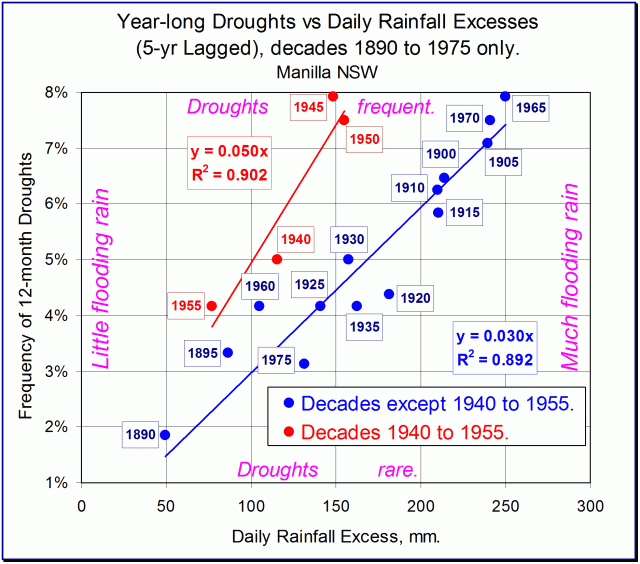
I have made scatter plots to see how much correlation there is between the two data sets: the frequency % of severe 12-month drought and the total decadal daily rainfall excesses over 50 mm, when lagged five years. (For data details, see Note 1, below.)

A. The first 70% of the data

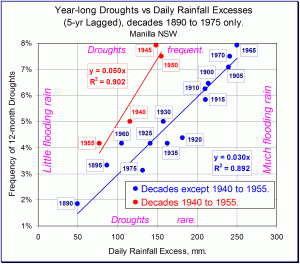
The first scatter-plot includes only the first 70% of the data, from 1890 to 1975, which showed matching patterns on the graphical log copied below. I have broken the data points into two groups: the aberrant group 1940 to 1955 (red) and the fourteen best-matched points (blue). The trend line that best fits those fourteen points is y = 0.028x + 0.407, with R-squared = 0.898. However, I have been able to fit the trend line y = 0.030x, that shows y proportional to x, without making R-squared worse than 0.892.
Similarly, the four decades centred on 1940, 1945, 1950 and 1955, had y = 0.050x, with R-squared equal to 0.902.

Expressed in words: for fourteen of the first eighteen data points, the frequency % of severe 12-month droughts remained close to 0.03 times the decade total of daily rainfall (>50 mm/day) measured five years earlier. For the other group of four adjacent points, the number was not 0.03, but 0.05.

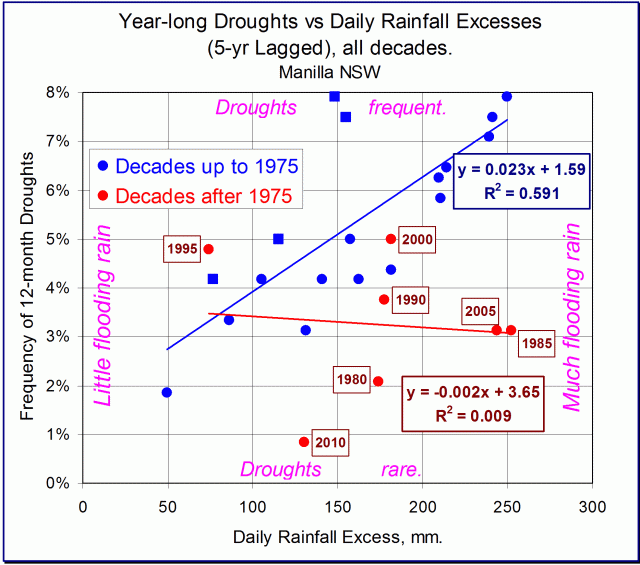
B. All the data

Scatter-plot 1890 to 2010

The second scatter plot shows data for all 25 (five-year overlapped) decades. There is a “shot-gun” pattern, as expected. Continue reading