3-year trends to February 2015

Parametric plots of smoothed climate variables at Manilla
“February 2015: very dry”
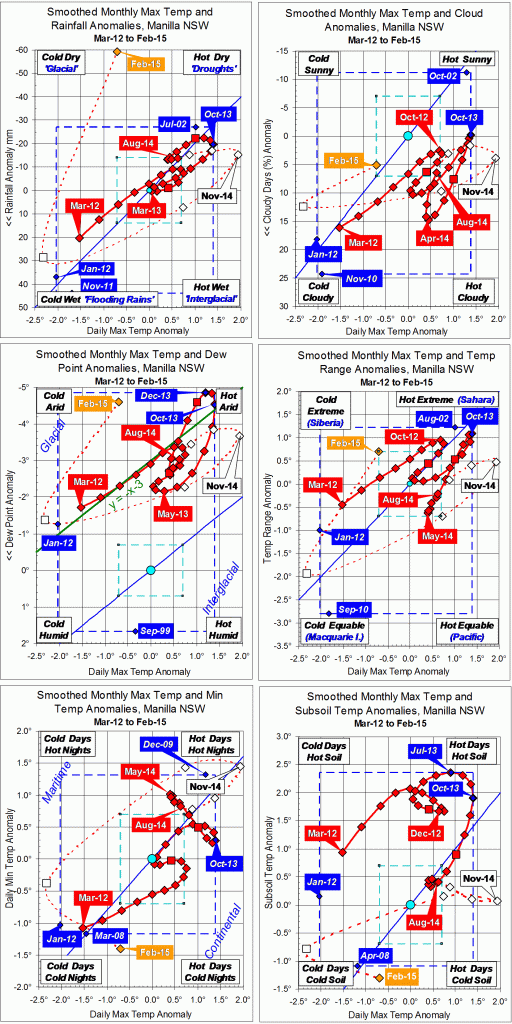
Trends toFebruary 2015

  February raw anomaly data (orange)

In February, most anomalies moved back towards “droughts” from the “flooding rains” values of January. Rainfall became extremely low, but daily maximum temperature did not rise as far as “normal”.
Exceptionally, February daily minimum temperature and subsoil temperature became very low.

Fully smoothed data (red)

The latest fully-smoothed data anomalies (August 2014) complete the winter of 2014. Through the winter season, most values were static and near normal. (Dew point, like most recent values of that variable, was 3 degrees lower than normal.)


Note:

Fully smoothed data – Gaussian smoothing with half-width 6 months – are plotted in red, partly smoothed data uncoloured, and raw data for the last data point in orange. January data points are marked by squares.
Blue diamonds and the dashed blue rectangle show the extreme values in the fully smoothed data record since September 1999.

Normal values are based on averages for the decade from March 1999.* They appear on these graphs as a turquoise (turquoise) circle at the origin (0,0). A range of anomalies called “normal” is shown by a dashed rectangle in aqua (aqua). For values in degrees, the assigned normal range is +/-0.7°; for cloudiness, +/-7%; for monthly rainfall, +/-14 mm.

 * Normal values for rainfall are based on averages for the 125 years beginning 1883.

February 2015 a very dry month

Photo of a baby Kookaburra

Baby Laughing Kookaburra

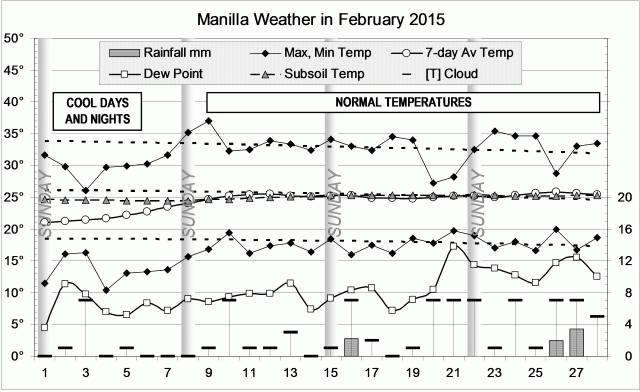
After a very cool first week, normal temperatures returned, both by day (33°) and by night (18°) . Early on, most mornings were sunny. Later, many were almost overcast, but only three days had light rain, with a maximum of 3.4 mm.

Weather log  February 2015

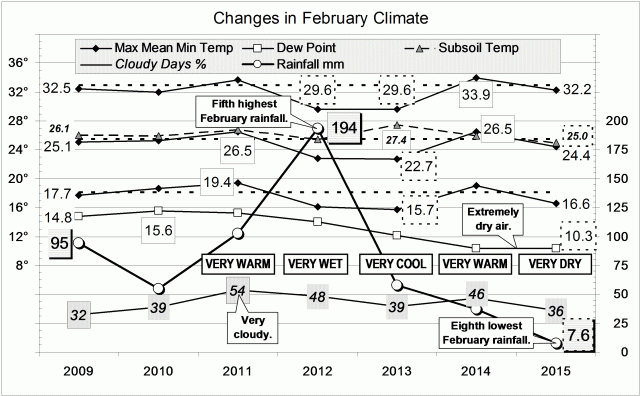
Comparing February months

Most of the last seven February months have been unusual in some way. This month was very dry, with near-record low rainfall and very low humidity. By contrast, February 2012 was very wet, as well as very cool. Both 2011 and 2014 were very warm, but 2011 was also very cloudy and humid. February 2013 was the coolest, without being wet like 2012.
The total rainfall of 7.6 mm this month was very low (6th percentile): this was the 8th driest February, and the driest since 1989, which (like 1974) had 7.0 mm. Still, taking rainfall totals for groups of months, only the 24-month total (985 mm) is a serious shortage, in the 9th percentile.

Climate forFebruary 2015


Data. Rainfall data is from Manilla Post Office, courtesy of Phil Pinch. Temperatures, including subsoil at 750 mm, and other data are from 3 Monash  Street, Manilla.

With the retirement of the Post-master, Phil Pinch, the future of rainfall observations at Manilla Post Office (055031), kept for 132 years since March 1883, is uncertain.

February Climate Anomalies Log

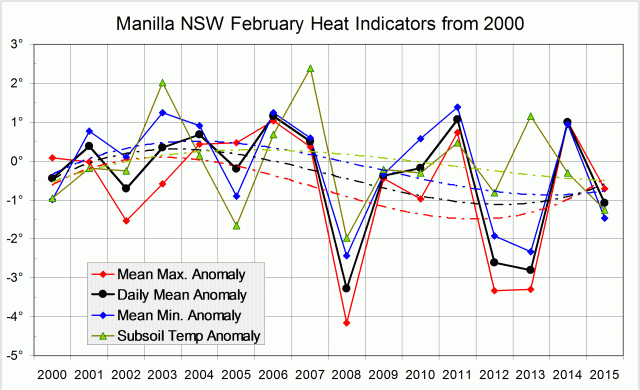
Heat indicators log for February

This post is the twelfth in a set for the 12 calendar months that began with March. Graphs are sixteen-year logs of the monthly mean anomaly values of nine climate variables for Manilla, NSW, with fitted trend lines. I have explained the method in notes at the foot of the page.

Raw anomaly values for February

Extreme values of February anomalies were as follows:

Daily Maximum Temperature Anomalies (3) -4.2 deg: February 2008; -3.3 deg: February 2012; -3.3 deg: February 2013;
Daily Mean Temperature Anomalies (1) -3.3 deg: February 2008;
Rainfall Anomalies (1) +120 mm: February 2012;
Dew Point Anomalies (2) -4.6 deg: February 2014; -4.6 deg: February 2015.

Trend lines for February

Heat Indicators

All heat indicator quartic trends began slightly low and ended slightly low. They had a low peak about 2004, and a trough later. The trough was deepest and earliest for daily maximum temperature (2011), followed by daily mean temperature in 2012, daily minimum temperature in 2014, and subsoil temperature in 2015 or later.

Moisture indicators log for February

Continue reading

Log of Very Wet Days at Manilla.

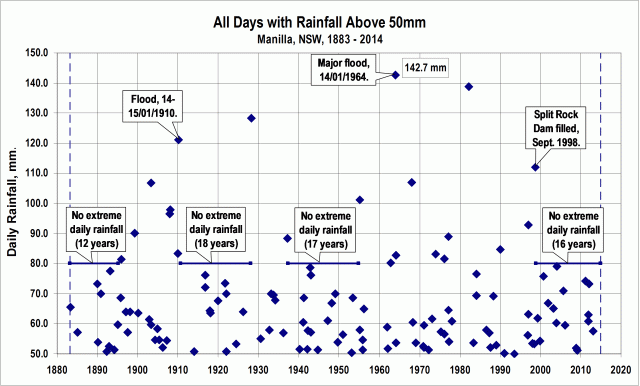
Graphical log of days with over 50mm rain

In the 130-year record of very wet days at Manilla, NSW, extreme rainfalls have not become more common recently.

Data

I arranged all daily rainfall readings for Manilla, NSW, from March 1883 to December 2014 in order of rainfall amount, and selected only the 125 readings greater than 50 mm. I plotted the values against the date, expressed in years, to two decimal places. (See Note below.)

Result

The five highest readings

The five highest readings, greater than 110 mm per day, include events that gave rise to two floods and the filling of a reservoir newly-built to store water for irrigation. The highest daily reading, 142.7 mm, came with the highest flood known at Manilla, in 14/01/1964. Thus, the highest flood matches the highest daily rainfall. That is because nearly all the flood-water came down the Manilla River, which flows in a semi-circle, with none of the catchment area far away from the rain-gauge.
These five highest readings seem to fly in an arc above the rest, with a peak near the middle of the graph. The rise and fall of this arc may have no meaning, for there are very long gaps between the events. All the same, it is a fact that there were no readings above 110 mm per day in the decades before 1910 or after 1998.

Periods with no daily readings over 80 mm

Continue reading

Geoff’s solar-passive house at Manilla

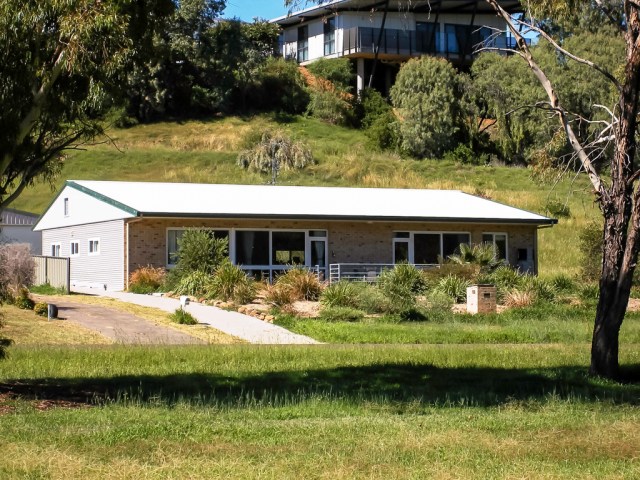
View of solar-passive house

Geoff’s solar-passive house

A second high-mass solar-passive house was built in 2009 in Strafford Street Manilla, within 300 metres of my house in Monash Street.
My friend Geoff designed his house and used the same builder that I did. Sadly, after five comfortable years in his house, Geoff has passed away. Thanks to his daughter, I can show you the features of the house.
Thermometers, and power bills show that its performance is similar to mine. That is to say, it is very successful!

In Manilla’s climate of daily and seasonal temperature extremes, Geoff rarely needed to use his low-powered reverse-cycle air conditioner.

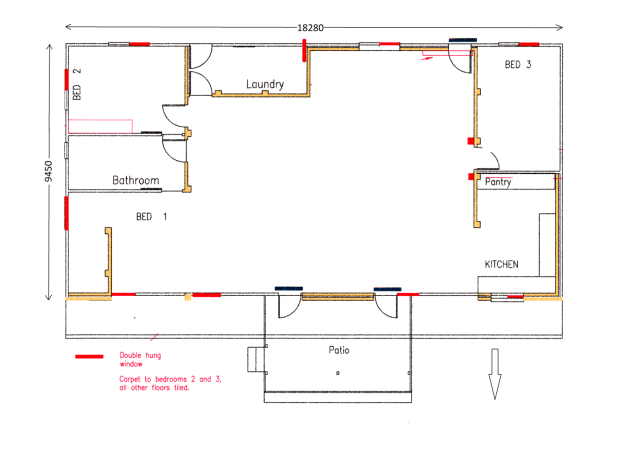
Plan of solar-passive house

Strafford Street solar-passive house: plan

Specifications

Dimensions

Length, East-West:     18.28 m
Width, North-South:    9.45 m
Ceiling height:               2.70 m

Area

Room area, Living/Kit/Bed 1/Study:      115.9 m^2
Room area, Bed 2:                                    13.8 m^2
Room area, Bed 3:                                    14.1 m^2
Room area, Bathroom:                              8.6 m^2
Room area, Laundry/Darkroom:               7.7 m^2
Area of walls:                                             12.7 m^2
Total House Area (without patio):       172.8 m^2

Exterior walls

North wall: double brick
East, west, and south walls: 90 mm stud, including 9.61 m reverse brick veneer
Cladding of stud walls: custom orb (horizontal)
Cladding of gable ends: plain roofing panels with 50 mm foam

Interior walls

Single brick:    17.16 m
Stud wall:        11.66 m

Windows (and two glass doors)

All double-glazed 3/6/3 in uPVC frames
(North-facing window area is 16% of the floor area of the house.)
North-facing:           27.00 m^2 (76%)
East-facing:               3.84 m^2 (11%)
South-facing:            4.50 m^2 (13%)
West-facing:             0.00 m^2 (0%)
Total:                      35.34 m^2 (100%) Continue reading