3-year trends to October 2015

Parametric plots of smoothed climate variables at Manilla
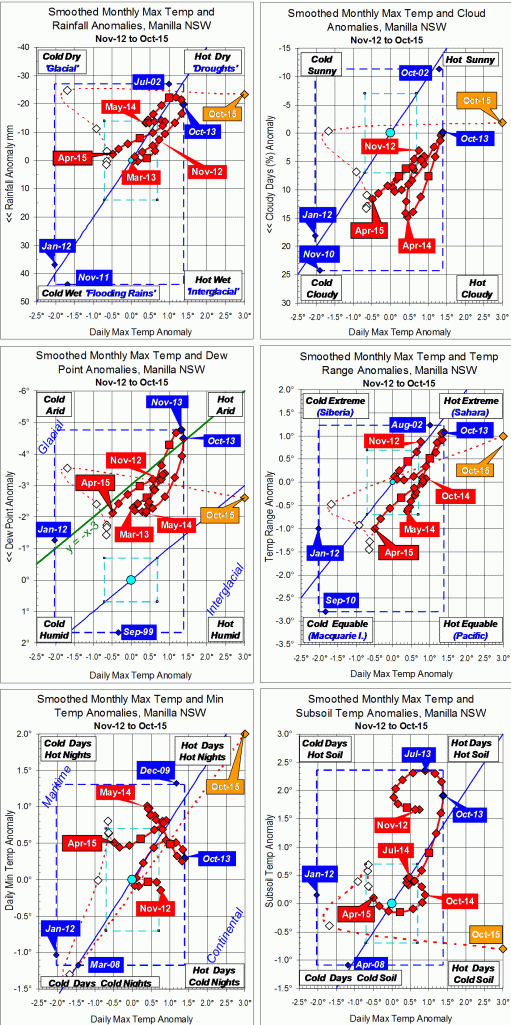
“October 2015: very warm”
Trends to October 2015

October raw anomaly data (orange)

After a cool September, October was very warm: the warmest of the new century in both daily maximum and daily minimum. The daily temperature range was also high, but the soil temperature was not. Rainfall remained rather low, while cloudiness and dew point were near normal.
[The recorded anomaly values for daily maximum and for daily minimum were +3.2° and +2.2° respectively. For convenience, I have plotted them 0.2° lower.]

 Fully smoothed data (red)

In the latest fully smoothed data (April 2015) all trends on the first four graphs continued to move steadily away from drought. The daily minimum temperature anomaly began to rise, and subsoil temperature rose faster.


Note:

Fully smoothed data – Gaussian smoothing with half-width 6 months – are plotted in red, partly smoothed data uncoloured, and raw data for the last data point in orange. January data points are marked by squares.
Blue diamonds and the dashed blue rectangle show the extreme values in the fully smoothed data record since September 1999.

Normal values are based on averages for the decade from March 1999.* They appear on these graphs as a turquoise (turquoise) circle at the origin (0,0). A range of anomalies called “normal” is shown by a dashed rectangle in aqua (aqua). For values in degrees, the assigned normal range is +/-0.7°; for cloudiness, +/-7%; for monthly rainfall, +/-14 mm.

 * Normal values for rainfall are based on averages for the 125 years beginning 1883.

3-year trends to September 2015

Parametric plots of smoothed climate variables at Manilla
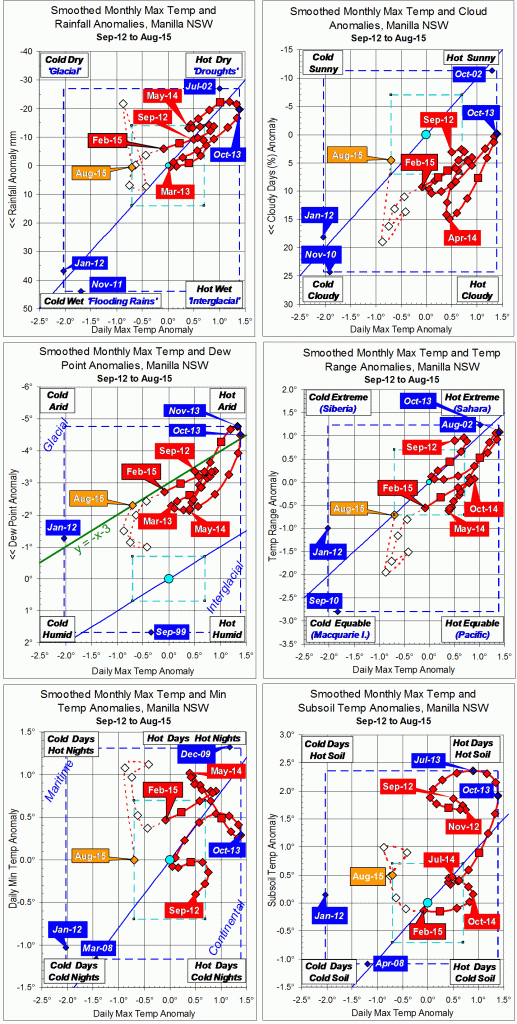
“September 2015: cold and dry”

Trends to September 2015


September raw anomaly data (orange)

September brought big changes in all raw values of climate anomalies, except for daily temperature range, which stayed rather low.
There was a sharp drop in temperatures: maximum, minimum and subsoil.
Moisture measures – rainfall, cloud and dew point – all fell.

These transitory values are unlike either the hot arid values of El Niño conditions in eastern Australia or the cold moist La Niña conditions. They are like a mild form of the cold arid conditions that are thought to have occurred in glacial periods.

 Fully smoothed data (red)

Fully-smoothed anomaly values for March 2015 continued the trends of late summer. Most moved further away from drought. Daily minimum temperature became static, and subsoil temperature began to rise.


Note:

Fully smoothed data – Gaussian smoothing with half-width 6 months – are plotted in red, partly smoothed data uncoloured, and raw data for the last data point in orange. January data points are marked by squares.
Blue diamonds and the dashed blue rectangle show the extreme values in the fully smoothed data record since September 1999.

Normal values are based on averages for the decade from March 1999.* They appear on these graphs as a turquoise (turquoise) circle at the origin (0,0). A range of anomalies called “normal” is shown by a dashed rectangle in aqua (aqua). For values in degrees, the assigned normal range is +/-0.7°; for cloudiness, +/-7%; for monthly rainfall, +/-14 mm.

 * Normal values for rainfall are based on averages for the 125 years beginning 1883.
3-year trends to August 2015

Parametric plots of smoothed climate variables at Manilla
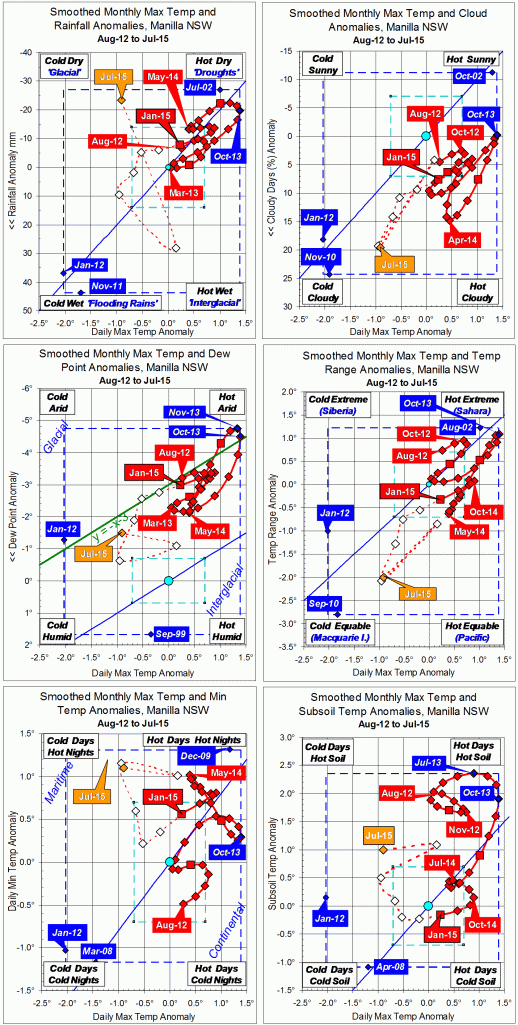
“August 2015: cooler, moister trend persists”

Trends to August 2015

Fully smoothed data (red)

The last fully-smoothed data point (February 2015) completes the summer of 2014-15. This summer had a steady cooling and moistening trend for all variables except subsoil temperature, which passed through a minimum. Three of these seven variables were very close to normal: daily maximum temperature, rainfall, and subsoil temperature. Skies were rather cloudy, dew point was three degrees low (as is now usual), daily temperature range was half a degree low, and daily minimum temperature was half a degree high. These four variables all relate to moisture. Only the dew point shows low moisture: the others show high moisture, while the rainfall was normal.

August raw anomaly data (orange)

The partially-smoothed data points from March to July (uncoloured) show excursions, but the unsmoothed data point for August (orange) is close to the trend established in the summer. That is, cooler and moister. However, no variables had values far from normal.


Note:

Fully smoothed data – Gaussian smoothing with half-width 6 months – are plotted in red, partly smoothed data uncoloured, and raw data for the last data point in orange. January data points are marked by squares.
Blue diamonds and the dashed blue rectangle show the extreme values in the fully smoothed data record since September 1999.

Normal values are based on averages for the decade from March 1999.* They appear on these graphs as a turquoise (turquoise) circle at the origin (0,0). A range of anomalies called “normal” is shown by a dashed rectangle in aqua (aqua). For values in degrees, the assigned normal range is +/-0.7°; for cloudiness, +/-7%; for monthly rainfall, +/-14 mm.

 * Normal values for rainfall are based on averages for the 125 years beginning 1883.
3-year trends to July 2015

Parametric plots of smoothed climate variables at Manilla
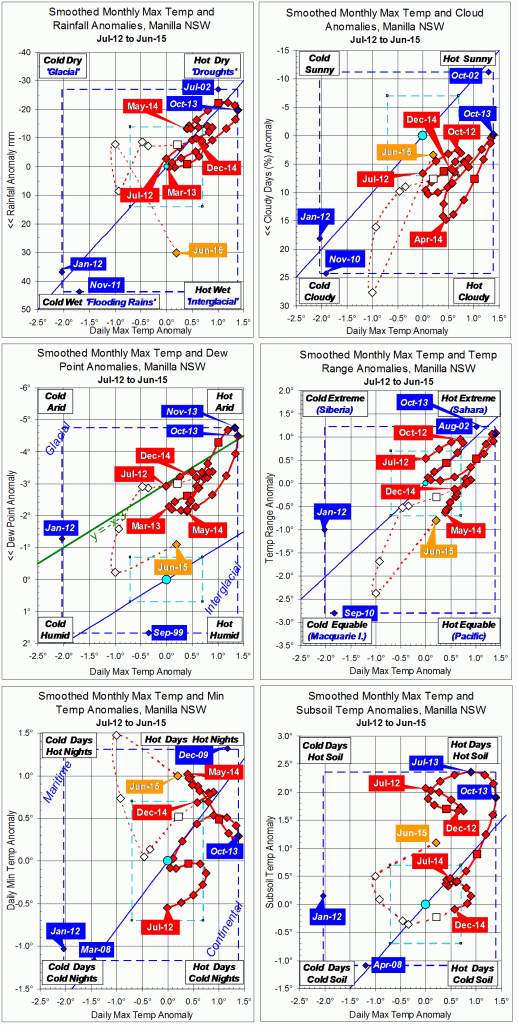
“July 2015: cooler, moister trend”

Trends to July 2015

July raw anomaly data (orange)

The near-normal values of June are now seen as merely interrupting a trend to cooler, moister climate. July had very low day temperature, very high cloudiness, and very low daily temperature range, but dew point was not extreme. Discordantly, rainfall, which had been very high in June, became very low in July.
Night-time and subsoil temperatures continued their trends towards higher values. (Relatively warm nights have now persisted for 17 months.)

Fully smoothed data (red)

January 2015 was relatively cooler by day than the previous month, but each of the other variables moved only slightly down the graphs.

El Niño

In this record, the last hot dry climate phase that matched an El Niño was in November-December 2009. At that time, the daily maximum temperature anomaly was very high, the rainfall anomaly was low, and the daily minimum temperature anomaly (lower left graph) was a record high.
Later, in November-December 2013, without an El Niño, Manilla had a more extreme hot dry climate phase. As seen on these graphs (marked in blue), 21st century records were set then for anomalies of high daily maximum temperature, high subsoil temperature, and low dew point.
Now, in July 2015, an El Niño is forecast, but these Manilla graphs show no movement as yet away from cool moist climate.


Note:

Fully smoothed data – Gaussian smoothing with half-width 6 months – are plotted in red, partly smoothed data uncoloured, and raw data for the last data point in orange. January data points are marked by squares.
Blue diamonds and the dashed blue rectangle show the extreme values in the fully smoothed data record since September 1999.

Normal values are based on averages for the decade from March 1999.* They appear on these graphs as a turquoise (turquoise) circle at the origin (0,0). A range of anomalies called “normal” is shown by a dashed rectangle in aqua (aqua). For values in degrees, the assigned normal range is +/-0.7°; for cloudiness, +/-7%; for monthly rainfall, +/-14 mm.

 * Normal values for rainfall are based on averages for the 125 years beginning 1883.
3-year trends to June 2015

Parametric plots of smoothed climate variables at Manilla
“June 2015: back to normal”

15JunParam

June raw anomaly data (orange)

Nearly all raw anomalies for the latest month are nearer to normal than the partially-smoothed anomalies of the autumn months. They are also quite close to the smoothed values of a year ago. Rainfall stands alone as a high value.

Fully smoothed data (red)

In December 2014, most anomalies were normal, or near normal, and changing only slowly.


Note:

Fully smoothed data – Gaussian smoothing with half-width 6 months – are plotted in red, partly smoothed data uncoloured, and raw data for the last data point in orange. January data points are marked by squares.
Blue diamonds and the dashed blue rectangle show the extreme values in the fully smoothed data record since September 1999.

Normal values are based on averages for the decade from March 1999.* They appear on these graphs as a turquoise (turquoise) circle at the origin (0,0). A range of anomalies called “normal” is shown by a dashed rectangle in aqua (aqua). For values in degrees, the assigned normal range is +/-0.7°; for cloudiness, +/-7%; for monthly rainfall, +/-14 mm.

 * Normal values for rainfall are based on averages for the 125 years beginning 1883.