Decadal and Inter-decadal changes in rainfall: II.

Log of smoothed summer and winter rainfall anomalies.

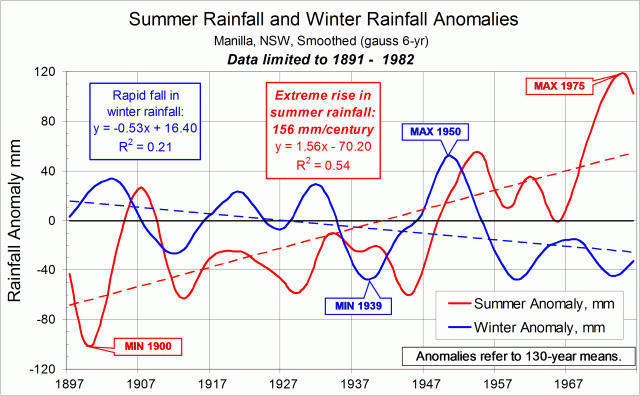
Part 2 of 3: The record restricted to 1891-1982 (92 years)

(See Notes below for data and plotting details.)

No climatic record is ever long enough to demonstrate apparent cycles, trends or extremes beyond doubt. In Part 1, a linear trend of summer rainfall rising at 24.7 mm per century was fitted to the whole 130-year record. Although this is a very high (perhaps unsustainable) rate of increase, the trend line explains hardly any of the variation. The R-squared value is 0.03! However, there does seem to be a steeper quasi-linear trend prevailing for most of the period of record. The graphs I have posted here show a restricted record beginning in 1891 and ending in 1982. This simulates an analysis done in 1983 (which could not have used more recent data) and supposes that records earlier than 1891 were unavailable for some reason.

I have chosen these dates so that
(i) the near-record smoothed summer rainfall maximum of 1891 is excluded but the record smoothed summer rainfall minimum of 1900 is included;
(ii) the record smoothed summer rainfall maximum of 1975 is included but the very low smoothed summer rainfall minimum of 1987 is excluded.
(Due to the smoothing window extending six years before and after a specified date, smoothed rainfall values can be calculated only from 1897 to 1976.)

Log of smoothed sum and difference of summer and winter rainfall anomalies.

Linear trends

For this restricted data set of 92 years, all four linear trends are very much steeper than for the whole 130-year record. The R-squared values are also much higher, indicating that the Continue reading
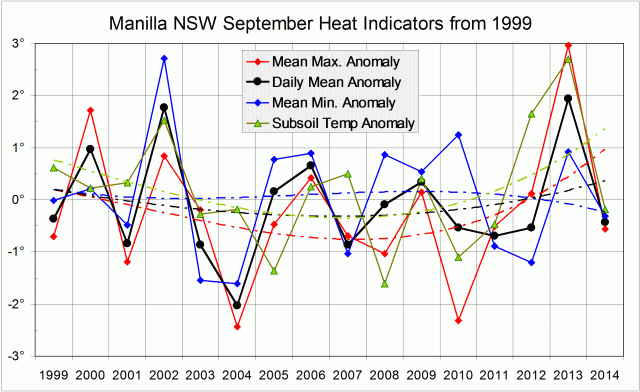
September Climate Anomalies Log

Heat Indicators log for September months

This post is the seventh in a set for the 12 calendar months that began with March. Graphs are sixteen-year logs of the monthly mean anomaly values of nine climate variables for Manilla, NSW, with fitted trend lines. I have explained the method in notes at the foot of the page.

Raw anomaly values for September

Extreme values of September anomalies in this period were all in the “Moisture Indicators” group:

Temperature range anomaly (minus) +3.6 deg: September 2010;
Cloudy days % anomaly +33%: September 2010;
Dew Point Anomalies (4) -3.8 deg: September 2011, -4.7 deg: September 2012, -4.9 deg: September 2013, -4.1 deg: September 2014.

Trend lines for September

Heat Indicators

The trend of daily maximum temperature anomalies was concave, with a minimum at 2007. The trend of mean temperature anomalies was similar, but less concave. The trend of minimum temperature anomaly was almost straight, but had a weak maximum in 2008 and ended low. The subsoil temperature anomaly trend was parallel to that of the daily maximum, but higher.

Moisture Indicators log for September months

Continue reading

Decadal and Inter-decadal changes in rainfall: I.

Log of smoothed summer and winter rainfall anomalies.

Part 1 of 3: The whole 130-year record

(See Notes below for data and plotting details.)

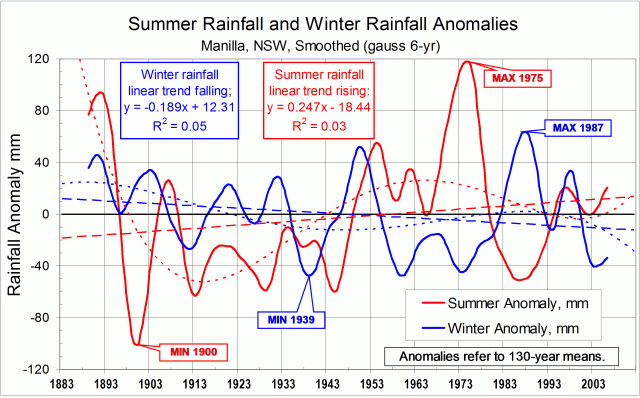
Anomalies of smoothed summer and winter rainfall

Episodes of high or low summer rainfall do not coincide with those of winter rainfall (except in 1891). Nor do they consistently oppose each other, although this is common. The summer rainfall anomaly (red) was extremely low (-101 mm) about 1900, and extremely high (+119 mm) about 1975. The winter rainfall anomaly (blue) had lower extreme values: 1939 (-48 mm) was the lowest of several low values, and 1987 (+63 mm) the highest of several high ones.

Seasonal sums and differences

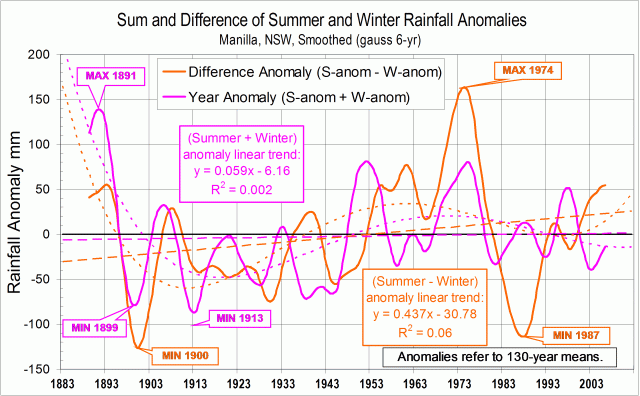
I plotted the smoothed yearly value of rainfall anomaly as the sum (purple) of a winter anomaly value and that of the following summer. There was an extreme maximum in 1891 (+139 mm!), and minimal values in 1899 (-79 mm) and 1913 (-87 mm), among others.
The difference between summer and winter seasonal anomalies (orange) shows as an extreme summer excess in 1974 (+163 mm), and extreme winter excesses in 1900 (-126 mm) and 1987 (-114 mm).

Log of smoothed sum and difference of summer and winter rainfall anomalies.

“Dreadful Thirst”

Banjo Paterson’s comic verse “City of Dreadful Thirst” refers to the town of Narromine, 300 kilometres west of Manilla.
Continue reading

Hammering Global Warming Into Line

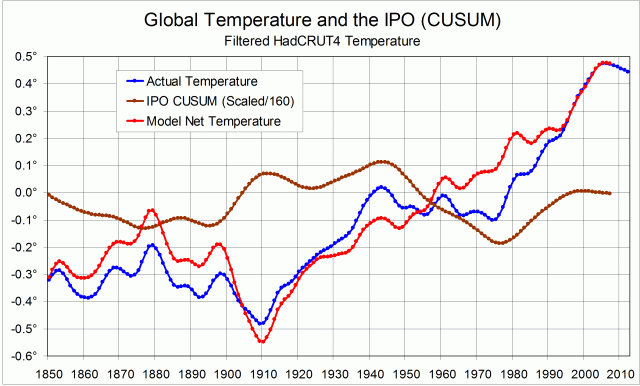
Global temp and IPO graph

In my post of 18 Sep 2014 “The record of the IPO”, I showed a graph of the Inter-decadal Pacific Oscillation,plotted as a cumulative sum of anomalies (CUSUM).

Log from 1850 of world surface air temperature and carbon emissionsThis CUSUM plot has a shape that makes it seem that it could be used to straighten the dog-leg (zig-zag) trace of global temperature that we see. A straighter trace of global warming would support the claim that a log-linear growth in carbon dioxide emissions is the main cause of the warming.

My attempt to straighten the trace depends on the surmise (or conjecture) that the angles in the global temperature record are caused by the angles in the IPO CUSUM record. That is, the climatic shifts that appear in the two records are the same shifts.
I have adopted an extremely simple model to link the records:
1. Any global temperature changes due to the Inter-decadal Pacific Oscillation are directly proportional to the anomaly. (See Note 1.);
2. Temperature changes driven by the IPO are cumulative in this time-frame.

To convert IPO CUSUM values to temperature anomalies in degrees, they must be re-scaled. By trial and error, I found that dividing the values by 160 would straighten most of the trace – the part from 1909 to 2008. (See Note 2.) The first graph shows (i) the actual HadCRUT4 smoothed global temperature trace, (ii) the re-scaled IPO CUSUM trace, and (iii) a model global temperature trace with the supposed cumulative effect of the IPO subtracted.


The second graph compares the actual and model temperature traces. I note, in a text-box, that the cooling trend of the actual trace from 1943 to 1975 has been eliminated by the use of the model.
The graph includes a linear trend fitted to the model trace for the century 1909 to 2008, with its equation: y = 0.0088x – 0.9714 and R² = 0.9715.

Continue reading

The record of the IPO

Graphical record of the IPO, plus CUSUM plot and climate shift dates

My post showing shifting trends in world surface temperature and in carbon emissions brought a suggestion from Marvin Shafer that allowing for the PDO could straighten the trend. I think that perhaps it could, but I have tried the IPO (Inter-decadal Pacific Oscillation) rather than the PDO (Pacific inter-Decadal Oscillation). (See below.)

Along the top of the graph I have marked in the climate shifts that prevent the trace of world temperature from being anything like a straight line. The blue line is the IPO, as updated to 2008.
The IPO is positive in the space between the last two climate shifts, negative in the next earlier space, and positive in part of the space before that. By plotting the CUSUM values of the IPO (red), it is clear that the pattern of the IPO relates very closely to the climate shift dates. Four of the seven extreme points of the IPO CUSUM trace match climate shifts. In addition, since 1925, the CUSUM trace between the sharply-defined extreme points has been a series of nearly straight lines. These represent near-constant values of the IPO, a rising line representing a positive IPO and a falling line a negative one.

As shown by the map in the Figure copied below, a positive extreme of the IPO has higher than normal sea surface temperatures in the equatorial parts of the Pacific. Could the transfer of heat from the ocean to the atmosphere be enhanced at such times?

This conjecture is developed in the post “Hammering Global Warming Into Line”.

[Note added August 2019.
The IPO was negative from 1999 to 2014, then became postive again.
The paper by Power et al.(1999) linked below showed that Australian rainfall and its prediction was more closely related to the El Nino-Southern Oscillation (ENSO) when the IPO was negative. Data for Manilla NSW confirms that. See “21-C Rain-ENSO-IPO: Line graphs” and “21-C Rain ENSO IPO: Scatterplot”.]


The PDO and the IPO

The PDO is the Pacific Decadal Oscillation (or Pacific inter-Decadal Oscillation). It is one of a number of climate indicators that rise and fall over periods of a decade or more. These indicators have been introduced by different research groups at different times.
A current list of such indicators is in the contribution of Working Group I to the Fifth Assessment Report (5AR) of the Intergovernmental Panel on Climate Change (IPCC). The list is in Chapter 2 (38MB). It is at the end, in a special section: “Box 2.5: Patterns and Indices of Climate Variability”. Continue reading