
This graph is a log of cumulative values of the monthly Southern Oscillation Index for the last 139 years. (See Note added 25th August 2014 below.)
(See also Note Added 19 December 2015 regarding the mis-match between this SOI record and the climate record at Manilla.)
(See Note added 27/3/2016 below, for a prior construction of this graph.)
High values of the SOI (contrary to NINO3.4 values for the ENSO index) relate to deluges in Australia and low values relate to droughts.
This is the CUSUM technique, invented in 1954 by E.S.Page. Pay attention to the slopes on the graph.
I have identified major El Niño and La Niña events on the graph. La Niñas have extreme upward slopes and El Niños exteme downward slopes.
The main feature of the graph, which is obscure in graphs that do not use CUSUM, is that La Niñas dominated the 60-year period from 1917 to 1976, and El Niños dominated the 25-year period from 1976 to 2000. I have drawn linear trend lines to make this clear. The first trend line (La Niña dominant) begins at an SOI CUSUM value of -30 in May 1917 and ends at a value of +960 in February 1976, yielding a slope of +1.4 SOI units per month. The second trend line (El Niño dominant) ends at a value of -40 in December 1999, yielding a slope of -3.5 SOI units per month.
The tendency to El Niños in the second period was greater than the tendency to La Niñas in the first period by a factor of more than two.
Although the period since 2000 is very short, the trend seems to slope upward at about +1.0 SOI units per month.
These decadal changes in the short-term mean value of the SOI are graphed in a later post. That graph does not use the CUSUM concept, and the changes in the mean value are overwhelmed by month-to-month variation.
I posted discussion of an earlier version of this graph in “Weatherzone” Forums >> Weather >> Climate and Climate Change >> ENSO Discussion 2012 Post #1103736
Note added 25th August 2014
Another CUSUM SOI graph
By searching the net for “cusum soi” I find that a plot of the cumulative sum of values of the Southern Oscillation Index was published by Cordery and Yao in 1993: “Non stationarity of phenomena related to drought”.
Neither the data nor the approach of Cordery and Yao are the same as mine.
Data
Cordery and Yao used monthly normalised SOI anomaly data supplied by the Bureau of Meteorology, as I did. They mention that “Prior to 1933 there are 7 gaps in the SOI sequence resulting from a total of 102 months of data missing from the Papeete pressure record.” I have not found any note of this with the Bureau’s current data table.
Apart from an (unexplained) reduction in the scale of CUSUM values by a factor of 500, there are important differences in detail. During the time of La Niña dominance, I find that the major CUSUM peaks (La Niña turning to El Niño) in 1918, 1939, and 1976 lie almost in one line. Cordery and Yao’s plot has the 1939 peak relatively much higher: the second highest on the record after the 1976 peak, and almost as high.
Approach
Cordery and Yao used CUSUM to show that the SOI series was not stationary for a part of the time. I used it to identify persistent shifts in the SOI mean value.
Note added 19 December 2015
The influence of the Southern Oscillation index on the climate of Manilla, NSW is cryptic at best.
In particular, the inter-decadal changes shown on this graph are not expressed at all in the episodes of drought at this station. Extreme droughts were concentrated in the period from 1900 to 1950 as shown here.
I have discussed the mis-match with the SOI in another post.
In that post, I also pointed out:
“The record for this site provides no support for any relation at all between global temperature and drought.”
Note added 22 March 2018, amended 21 May 2018.
I have since found a relation of that kind, described in the post “Rainfall kurtosis vs. HadCRUT4, revised”.
 Leptokurtosis of Manilla 12-monthly rainfall totals, which indicates extremes of rainfall – both positive and negative – has a pattern that matches that of global temperature anomalies when detrended.
Note added 27 March 2016
Prior construction of this graph.
I constructed this CUSUM SOI graph in 2012 on my own initiative, without knowledge of a prior construction by David Archibald in 2010. His graph (yellow background colour) appears to have an identical trace. Without adding linear trend lines, Archibald identifies the same end points of the long period of La Nina dominance followed in 1976 by a period of El Nino dominance.
Archibald published his graph in a guest post in “Watt’s Up With That”:
My graph and Archibald’s can both by found in a search of images for “southern oscillation index”.

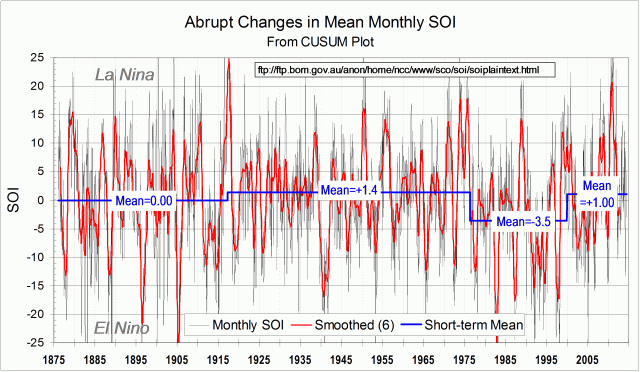
 The graph above is in a more familiar form . It may help to explain what the earlier graph means. That is, that the SOI was dominated by positive values (towards La Niña) for about fifty-nine years before 1976, and was dominated by negative values (towards El Niño) for twenty-four years after that date. From 2000 the trend seems to be upward, showing La Niña dominance again. Broadly, these were straight-line CUSUM relationships throughout each of the periods, as shown by the coloured trend lines. Slopes on a CUSUM plot represent offsets of the mean monthly value: the mean SOI in the earlier period was +1.4 units, and that in the second period was -3.5 units. Since 2000, the mean monthly value is around +1.0 units. Continue reading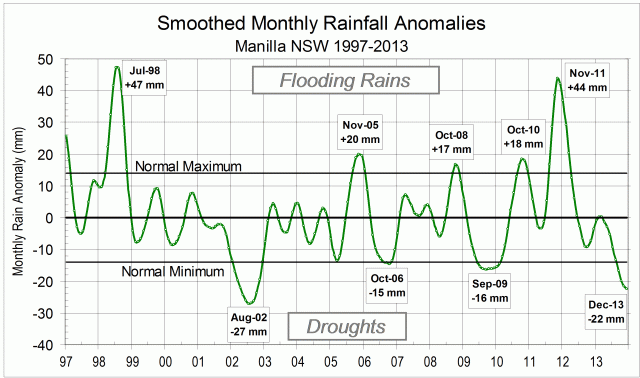
 climate by surly