Warm Wet May 2017

Photo of blossoms on a gum tree

Mugga Ironbark Blossoms

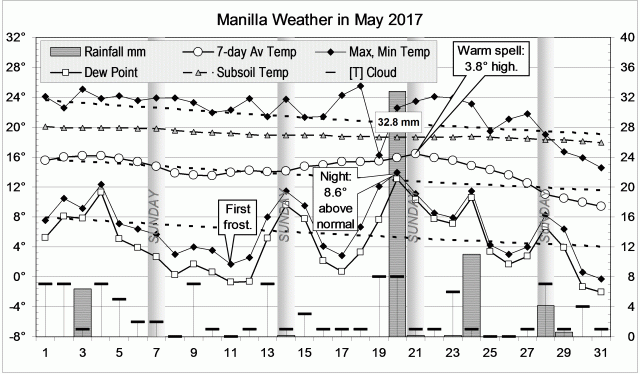
The weather was normal for the first half of the month, bringing a mild first frost on the 11th, close to the normal date for it. Then the weather became warmer and wetter. Rain totalling 32.8 mm was recorded on the 20th, while the minimum temperature of 14.0° that morning was 8.6° above normal. The weekly average temperature rose to 3.8° above normal, before falling below normal as the rain eased towards the end of the month. The last two mornings were frosty.
In all, there were five rain days (over 0.2 mm) when there are usually three.

Weather log for May 2017

Comparing May months

Like May last year, this month was about one degree warmer than normal, unlike May of 2007, which was half a degree warmer again. The dew point (4.7°) was a little low, the daily temperature range (15.3°) normal, the cloudiness (32%) and the rainfall rather high.
The total rainfall of 55.6 mm was at the 70th percentile, well above the May average of 41 mm. There are no shortages of rainfall for groups of months to this date.

Climate for May 2017


Data. A Bureau of Meteorology automatic rain gauge operates in the museum yard. From 17 March 2017, 9 am daily readings are published as Manilla Museum, Station 55312.  These reports use that rainfall data when it is available. All other data, including subsoil at 750 mm, are from 3 Monash Street, Manilla.

Cool Dry April 2017

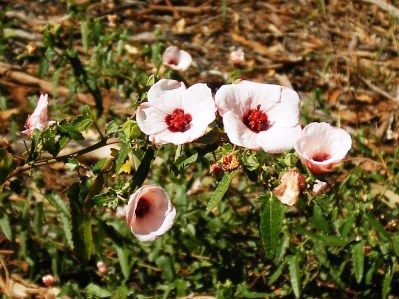
Pavonia blooms on a roadside

Roadside Pavonia

April began with cool days and nights, about three degrees below normal. However, the weather did not get any cooler until the last few days. In particular, ANZAC Day, at 27.4°, was the warmest day of the month – but that was more than a degree cooler than ANZAC Day 2002. (The average daily maximum temperature for ANZAC Day (from 2000) is 24.3°. The hottest was 28.7° (2002) and the coldest 16.8° (2012).)

Soaking rain of 10.6 mm, registered on the 26th, came with a remarkably warm night of 16.6°. Coming so late in autumn, this was 7.9° above normal, breaking the record of 7.1° above normal for an April night (20/04/06).
Further rain on the 27th (11.2 mm) fell as showers on a very cold day of 14.3°, that was 9.8° below normal. The final three nights were cold. The 30th, at 4.3°, was the coldest night of the month, but it was far from frosty.

Weather log for April 2017

Comparing April months

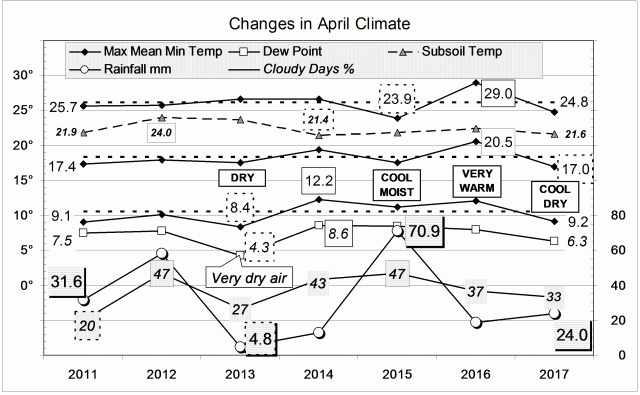
This month was cool, with a mean temperature of 17.0°, but not nearly as cool as April in 2008 (15.8°), 2006 (16.6°), or 1999 (15.6°). It was also rather low in moisture, with only 24 mm of rain, only 33% cloudy mornings, a daily temperature range as wide as 15.6°, and an early morning dew point of only 6.3°. What is unusual is the combination of low temperature values and low moisture values. Manilla’s climate generally swings between high temperature with low moisture (“droughts”) and low temperature with high moisture (“flooding rains”), as the poet said. (See these graphs.)
The total rainfall of 24.0 mm was at the 40th percentile, below the April average of 40 mm. There are no serious shortages of rainfall for groups of months to this date.

Climate for April 2017.


Data. A Bureau of Meteorology automatic rain gauge operates in the museum yard. From 17 March 2017, 9 am daily readings are published as Manilla Museum, Station 55312.  These reports use that rainfall data when it is available. All other data, including subsoil at 750 mm, are from 3 Monash Street, Manilla.

Rainy days in March 2017

March 2017 had 17 rain days. In 134 years, this was beaten only by June 1950, which had 18. [See Note below: “Manilla rain day statistics”]
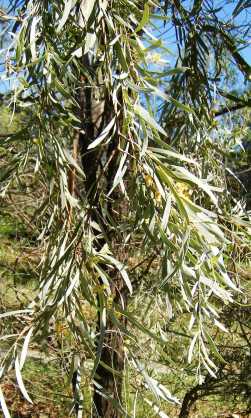
Fronds of Acacia pendula

Weeping Myall

[Three years later, this post still gets hits. Perhaps people are sucked in by the title. I have added information and links, in case they really are interested in the topic.]

After the record high temperatures of February, day and night temperatures in March were normal, without extremes. On a weekly basis, the first half of the month was cooler than the second half. The subsoil temperature followed the weekly air temperature down, to be a degree below normal by the 20th.
The second week had mainly clear skies and low dew points, Then the skies became persistently cloudy and dew points were high. A number of afternoons had oppressive humidity, with minimum values over 70%.
Of the 17 rain days, only three were early in the month, and they had little rain. The highest daily reading of 15.0 mm came on the 22nd.
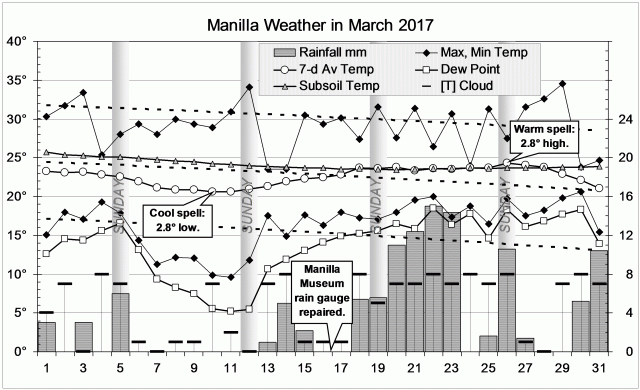
Weather log for March 2017

Comparing March months

March had been sunny and very warm in both 2016 and 2015. This March was like that of 2014 and 2013, but with even more moisture. The mean average temperature was normal but, due to the cloudiness (58% cloudy mornings), the mean daily maximum, 29.1° was low and the mean daily minimum, 16.4°, was high, yielding the record narrow daily temperature range for March of 12.7°. The mean early morning dew point, 13.7°, was the highest March value in a decade, and the mean afternoon humidity minimum, at 53%, was far above the usual value of 30%.
The total rainfall of 113.2 mm was at the 90th percentile, far above the March average of 54 mm. The previous month, February, had only 4.1 mm, at the 4th percentile for that month. Taken together the two-month total of 117.3 mm was well above normal, at the 63rd percentile.
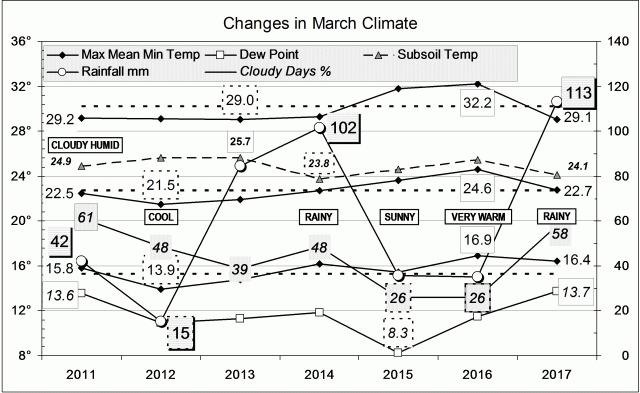
Climate for March 2017

[Note: Manilla rain day statistics

The number of rain days in a month at Manilla reached 18 only once, in June 1950. Both June 2016 and this month, March 2017, had 17 rain days. This month’s high number is more remarkable, as March has only 4.8 rain days on average. Most months of the year have about six rain days on average, but the autumn months of March, April, and May have an average of 4.6 rain days per month. The averages are posted here.]


Data. In 2016, a Bureau of Meteorology automatic rain gauge (formerly used for flood prediction) was set up in the museum yard as the official Manilla rain gauge. From 23 May 2016, its daily readings were published as if from Manilla Post Office, Station 55031. The gauge ceased transmitting five months later, on 7 October 2016. This month, after repair, it came into operation again. From 17 March 2017, daily readings are now published as Manilla Museum, Station 55312.

In these reports,the rainfall data is from Station 55031 or Station 55312 when available. Otherwise, rainfall data is from 3 Monash Street, Manilla.  All other data, including subsoil at 750 mm, are also from there. 

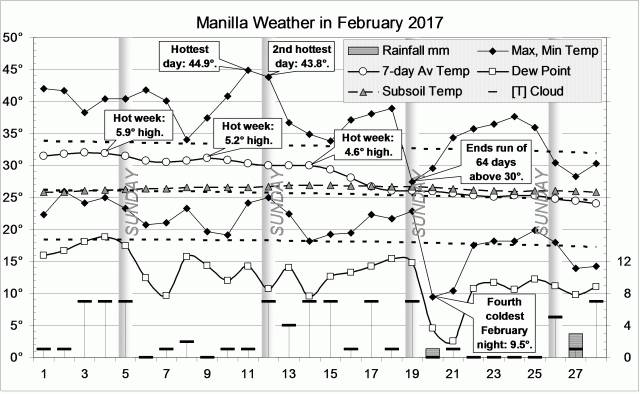
February 2017 had the hottest day

February 2017 was a month of extreme heat and hardly any rain.

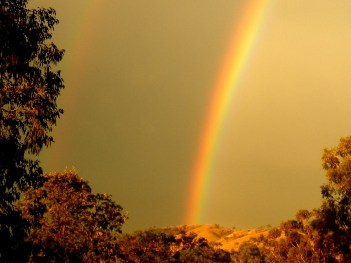
Rainbow

No-rain Rainbow

The temperature rose to 44.9° on the 11th, the highest reading in this record from 1999. The next day, at 43.8°, was the next highest, beating readings of 43.7° on 3/01/2014 and 43.2° on 12/01/2013. These extremely hot days were part of a long heat-wave. Every day reached above 30° for 64 days up to the 19th, and the average weekly temperature was above 30° (4° above normal) from the 1st to the 15th.
Nights also remained warmer than normal until, abruptly, the temperature fell to 9.5° on the 20th: the 4th coldest February night! After that, day and night temperatures were normal.
Rain showers were seen frequently, but the only daily readings (unofficial) were 1.1 mm on the 20th and 3.0 mm on the 27th.

Weather log February 2017

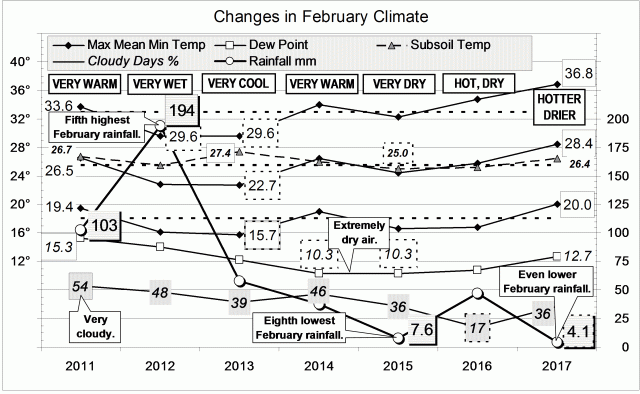
Comparing February months

This was by far the hottest February of the new century, with highest values of all three temperatures: mean maximum temperature (36.8°), mean average temperature (28.4°) and mean minimum temperature (20.0°). Subsoil temperature was normal.
While cloudiness was normal, a rather low dew point and rather wide daily temperature range reflect low moisture, while the rainfall was very low indeed.
The estimated monthly rainfall total of 4.1 mm exceeds that of just a very few February months: 1901 (2 mm), 1932 (3 mm), and perhaps 1923 and 1938 (both 4 mm), but no others. However, this extremely low rainfall for the month has not brought any serious rainfall shortages for totals of more than one month. The four-month total of 123 mm is at the 17th percentile, which is not even as bad as the five-year total (2844 mm) which is at the 14th percentile.

Climate for February 2017.


Data. Rainfall figures are usually from the automatic rain gauge at Manilla, published on the internet by the Bureau of Meteorology as Station 55031. However, the gauge ceased recording four months ago (8/10/16), and this month’s readings are from my non-standard gauge. All data, including subsoil at 750 mm, are from 3 Monash Street, Manilla.

Manilla’s Yearly Rainfall History

Lately, Manilla’s rainfall is normal, and more reliable
than it ever was.

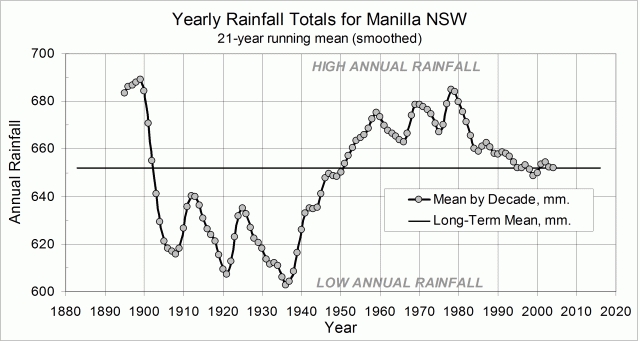
Manilla yearly rainfall record, 21-yr smoothed

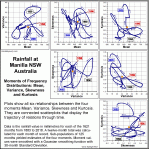
Six graphs of rainfall moment relations


[Note added April 2019.
I have taken this topic very much further in posts such as “Relations Among Rainfall Moments” 29 May 2018.]

Yearly rainfall totals

The first graph helps to make sense of the history of Manilla’s rainfall, using the totals for each year. The actual figures make little sense, jumping up or down from one year to the next. The figures here have been calmed down. First, I replaced each yearly figure by an average of twenty-one years, ten years before and ten years after the date. Then I smoothed that figure some more.
The pattern is plain. There were periods in the past when there was much more or less rain than usual.
In four decades the rainfall was some 30 mm higher than normal: the 1890’s, 1950’s, 1960’s and 1970’s. In four other decades, the rainfall was some 30 mm lower than normal: the 1900’s, 1910’s, 1920’s and 1930’s.
Rainfall here collapsed about 1900. The collapse was was widespread, as was recognised half a century ago.

Using the average line drawn across the graph (at 652 mm), you can see that rainfall was below average from 1902 to 1951: almost exactly the first half of the twentieth century. After 1951, rainfall was above average for the 44 years to 1995. Since then, the annual rainfall (as plotted) has been remarkably close to the 132-year average.
Present rainfall will seem low to those who remember the 1970’s, but the 1970’s were wet times and now is normal. Few alive now will remember that Manilla’s rainfall really was much lower in the 1930’s.

[The pattern in Manilla’s history of annual rainfalls is better shown in a graph in a later post. The new graph, using 21-year median values, has a clear pattern of collapse, growth and collapse.]

Manilla yearly rainfall scatters.

Yearly rainfall scatter

The second graph also groups the data twenty-one years at a time. It shows the scatter of yearly rainfalls in each group. More scatter or spread means the rainfall was less reliable. Comparing the graphs, times of high scatter (very unreliable rainfall) were not times of low rainfall, as one might think. Annual rainfall scatter and rainfall amount were not related.
Times of very unreliable rainfall came in 1919 (dry), 1949 (normal) and 1958 (wet). Times of reliable rainfall came in 1908 and 1936 (both dry). However, by far the most reliable rainfall came since 1992, extending to 2004 and likely up to this year.

Global warming

It has been argued that human-induced climate change will cause climatic extremes to happen more often in future. Already, when any extreme climate event is reported, someone will say that climate change has caused it.

The present steady rise in global temperature began about 1975. Does this Manilla rainfall record show more extreme events since that date? Definitely not! Quite the contrary. Continue reading