3-year trends to April 2020

April, like March, continued cool
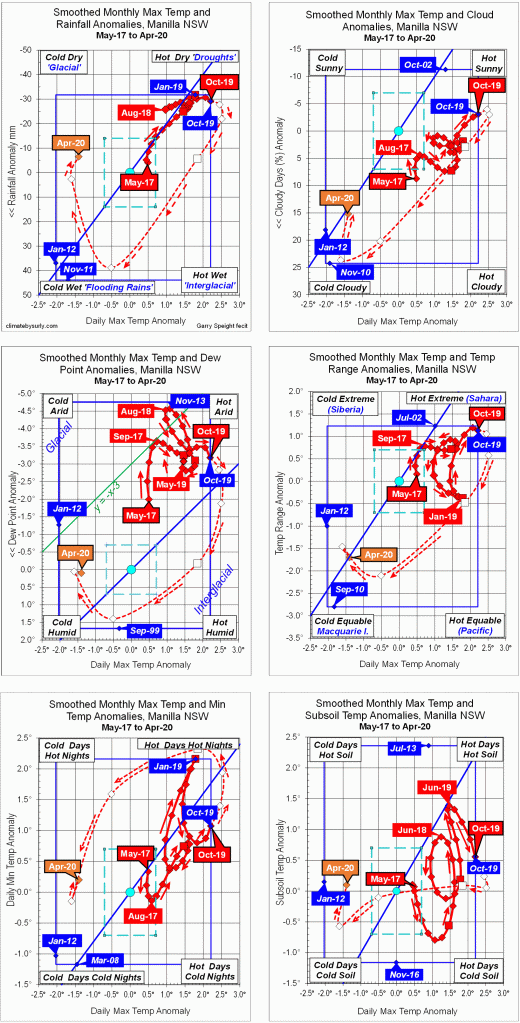
April raw anomaly data (orange)

Current raw anomaly values for April appeared very little changed from those of March. However, as noted below, many values are estimates only.

Temperatures

Daily maximum temperature anomaly (all x-axes), which had been very high until January, remained near -1.5°.
Daily minimum temperature anomaly (lower left): stayed just below normal.
Subsoil temperature anomaly (lower right): stayed near normal.

Moistures (moist is at the bottom)

Rainfall anomaly (upper left) stayed near normal.
Cloudiness anomaly (upper right): fell from very high to high.
Dew point anomaly (middle left): remained normal.
Daily temperature range anomaly (middle right) stayed near -1.5°.

 Fully smoothed data values (red) 

The fully-smoothed daily maximum temperature anomaly for October 2019 again broke the 21st century record, reaching a value of 2.21° above normal. The daily minimum anomaly also rose, but the subsoil anomaly fell. Despite the high and increasing air temperatures, smoothed moisture anomalies for October 2019 did not move further towards drought.

[Note.
Due to illness, 45 days were missed for some Manilla values for the whole of April 2020. No values were noted for cloud or soil temperature; daily maximum and minimum air temperatures were estimated by regression on values from Tamworth Airport Automatic Weather Service.]


Notes:

January data points are marked by squares.

Smoothing Continue reading
March 2020: cool, moist

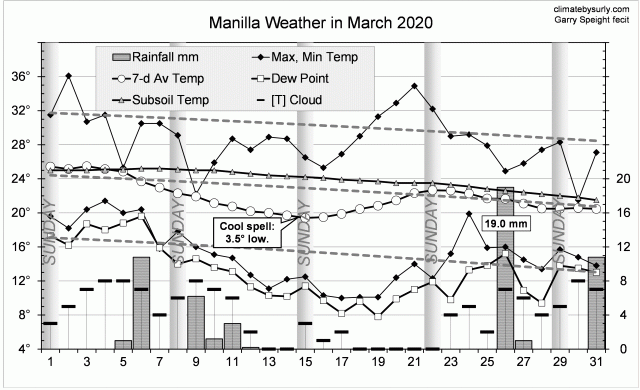
Weather log for March 2020

[Note.
Due to illness, 45 days were missed for some Manilla values, beginning in March (23/3/20). No values were noted for cloud or soil temperature; daily maximum and minimum air temperatures were estimated by regression on values from Tamworth Airport Automatic Weather Service.]

March weekly mean temperatures were near normal, but cooler in the second week.
Cloudy skies, with high dew points and rain came early and late in the month. There were nine rain days, with the highest reading of 19.0 mm on the 26th.

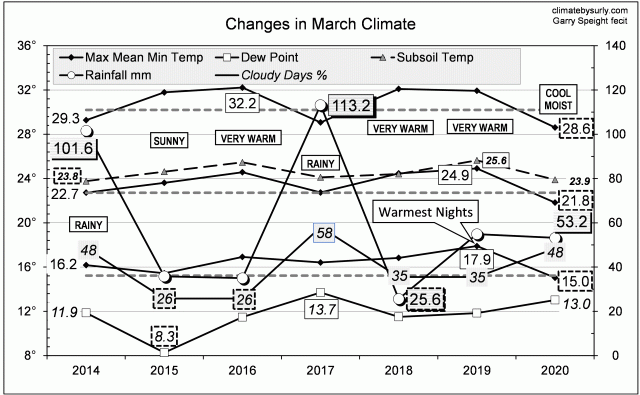
Comparing March months

The mean monthly temperature, at 21.8°, was rather low: cooler than in the last six March months. Days, at 28.6°, were third coolest for March in the new century, only March of 2001 and 2003 having cooler days.
Most moisture values were rather higher than in March of 2018 or 2019. The rainfall total of 53.2 mm was at the 60th percentile for March (and near the average (53 mm)).

Drought

I will report separately on the on-going drought.


Data. A Bureau of Meteorology automatic rain gauge operates in the museum yard. From 17 March 2017, 9 am daily readings are published as Manilla Museum, Station 55312.  These reports use that rainfall data when it is available. Recording resumed on 20 July 2019. Unfortunately, the gauge failed during February (25/02/2020 ). Until its repair on 11/3/20, I used my own gauge.
My estimates of early morning dew point have drifted anomalously low. From August 2019, I use data from the Tamworth Airport published graphs.
All other data, including subsoil at 750 mm, are from 3 Monash Street, Manilla.

October 2017: no drought

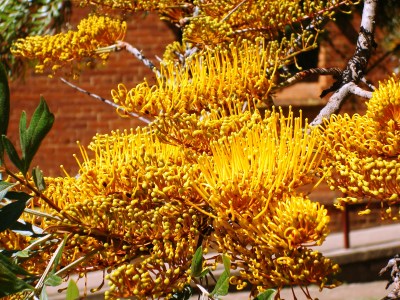
Grevillea robusta flowers

Flowers of Silky Oak

No temperatures were extreme in this month. In the second week, the mean weekly temperature was four degrees above normal, rather like the last week of September.
Dry air on the 6th and on the 31st made the dew point eight degrees low, but humid air on the 11th made it seven degrees high.
My rain gauge registered six rain days, with high readings of 38.5 mm on the 9th, 22.0 mm on the 12th, and 16.8 mm on the 21st. (The automatic gauge at the Museum remained down.)

Weather log for October 2017

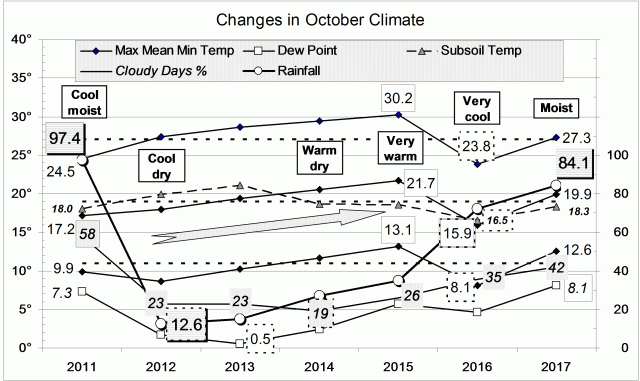
Comparing October months

As shown by the arrow on the second graph, October months became warmer and more moist with each year from 2012 to 2015. October 2016 was very cool, then this month was again warm. The trend to more moisture continued through all six October months from 2012 to 2017. It was shown not only by rainfall, but also by cloudiness, dew point, and narrowing daily temperature range. No other calendar months had this trend.
The high total rainfall of 84.1 mm (80th percentile) wiped out the serious and severe rainfall shortages seen in September. Now, the lowest percentile value is that for the 4-month total (117 mm). Being at the 15th percentile, it does not rate as serious.

Note added December 2019.
Data in this post for October 2017 and the preceding October months seem to give no warning of the approach of the drought of 2018-19 – the worst drought in the history of Manilla.

Climate for October


Data. A Bureau of Meteorology automatic rain gauge operates in the museum yard. From 17 March 2017, 9 am daily readings are published as Manilla Museum, Station 55312.  These reports use that rainfall data when it is available.  The gauge last reported on 24 September 2017.

All other data, including subsoil at 750 mm, are from 3 Monash Street, Manilla.

3-year trends to October 2017

Avoiding drought

3-year trends to October 2017

October raw anomaly data (orange)

October 2017 was moist: all moisture indicators had dropped sharply down the graphs, retreating from the aridity of August and September. Daily maximum temperature anomaly (x-axis in all graphs) fell towards normal, while that of the subsoil (lower right graph) remained low. Daily minimum temperature anomaly (lower left graph) jumped from extremely low to extremely high.

 Fully smoothed data (red)

The latest fully-smoothed data point is that for April 2017.
At that time, the climate was warm and almost static. There was a pause in a drift towards aridity.


Note:

Fully smoothed data – Gaussian smoothing with half-width 6 months – are plotted in red, partly smoothed data uncoloured, and raw data for the last data point in orange. January data points are marked by squares.
Blue diamonds and the dashed blue rectangle show the extreme values in the fully smoothed data record since September 1999.

Normal values are based on averages for the decade from March 1999.* They appear on these graphs as a turquoise (turquoise) circle at the origin (0,0). A range of anomalies called “normal” is shown by a dashed rectangle in aqua (aqua). For values in degrees, the assigned normal range is +/-0.7°; for cloudiness, +/-7%; for monthly rainfall, +/-14 mm.

 * Normal values for rainfall are based on averages for the 125 years beginning 1883.

June 2017 not as wet as in 2016

Close-up Australian magpie

Thieving Magpie

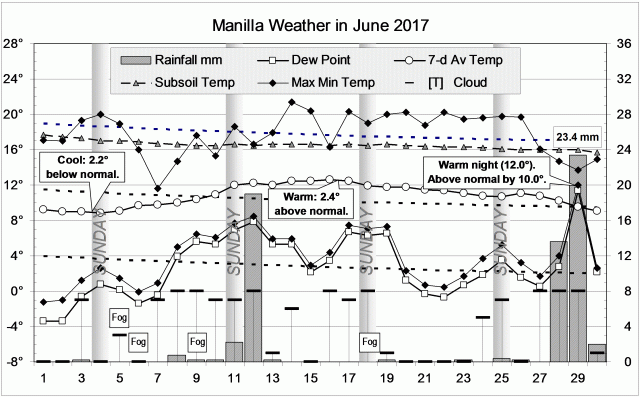
The month began cool, but became warm in the second half. The only unusual daily temperature was the early morning reading of 12.0° on the 29th, 10.0° above normal. There were ten frosts, when there are normally thirteen. On several mornings there was fog in the valley.
Seven days (normally six) registered rain over 0.2 mm. Significant falls came around the 12th and the 29th. On the 29th, the reading was 23.4 mm, but the rain extended over more than one day, totalling 39 mm. It was neither steady nor heavy, but unusually persistent. At Tamworth, rain fell in 27 hours out of 30.

Weather log for June 2017

Comparing June months

June of 2016 had been the wettest and most cloudy of the new century, with warm nights and cold days to match. This June, while moist, was close to normal. It was very like June 2015 and June 2014.
The month’s total rainfall of 62.8 mm was at the 75th percentile, well above the June average of 44 mm. There are no shortages of rainfall for groups of months to this date.

Climate for June months


Data. A Bureau of Meteorology automatic rain gauge operates in the museum yard. From 17 March 2017, 9 am daily readings are published as Manilla Museum, Station 55312.  These reports use that rainfall data when it is available. Since that gauge records “0.2 mm” on many rainless days, I cannot call those days rain days if the monthly count of rain days is not to show a sudden jump to record-breaking numbers.

All other data, including subsoil at 750 mm, are from 3 Monash Street, Manilla.