3-year trends to July 2017

Fine with a wide daily temperature range

3-year climate trends to July 2017

July raw anomaly data (orange)

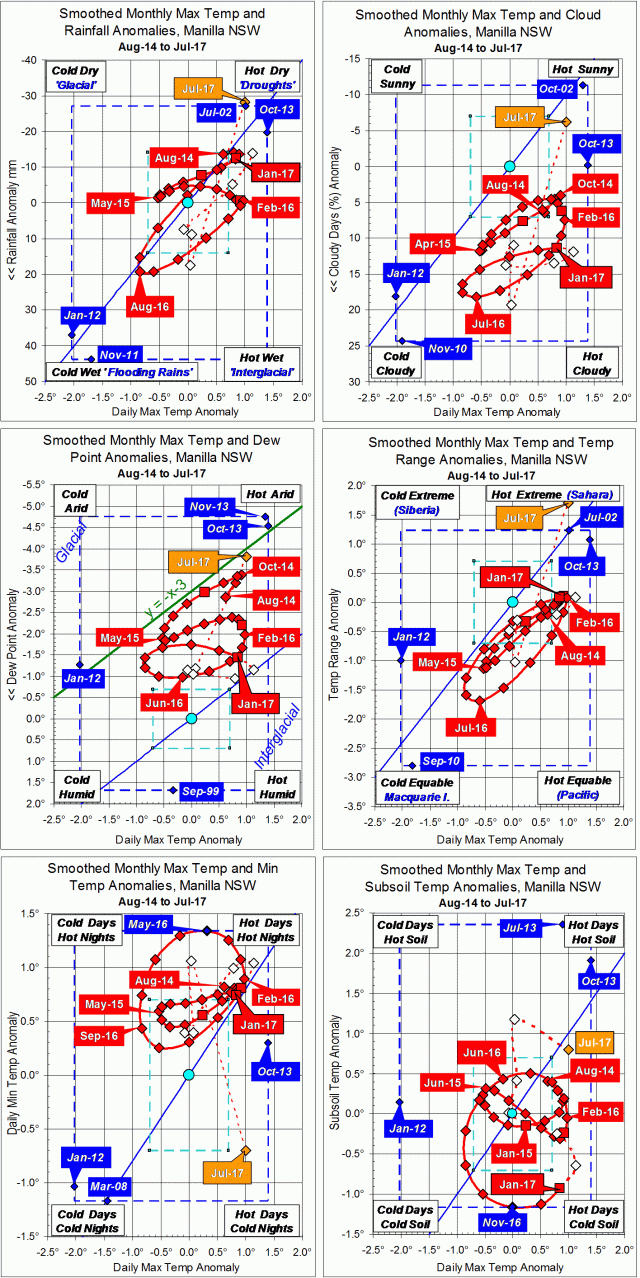
In July 2017 the largest anomaly was the very wide daily temperature range (middle right graph). This was linked to the daily minimum temperature anomaly (lower left graph) falling suddenly very low.
All moisture indicators pointed to aridity (upwards), and the anomalies of both daily maximum temperature and subsoil temperature were high.

 Fully smoothed data (red)

The latest available fully-smoothed data point, January 2017, showed continued warming in the anomalies of maximum, minimum and subsoil temperatures. These were coming to a peak: the maximum and minimum perhaps in February, but subsoil not for several months.
Moisture anomaly variables were near a peak of aridity. Dew point had peaked (low) in November, cloudiness (low) and daily temperature range (high) in January, with rainfall (low) likely in February.


Note:

Fully smoothed data – Gaussian smoothing with half-width 6 months – are plotted in red, partly smoothed data uncoloured, and raw data for the last data point in orange. January data points are marked by squares.
Blue diamonds and the dashed blue rectangle show the extreme values in the fully smoothed data record since September 1999.

Normal values are based on averages for the decade from March 1999.* They appear on these graphs as a turquoise (turquoise) circle at the origin (0,0). A range of anomalies called “normal” is shown by a dashed rectangle in aqua (aqua). For values in degrees, the assigned normal range is +/-0.7°; for cloudiness, +/-7%; for monthly rainfall, +/-14 mm.

 * Normal values for rainfall are based on averages for the 125 years beginning 1883.

June 2017 not as wet as in 2016

Close-up Australian magpie

Thieving Magpie

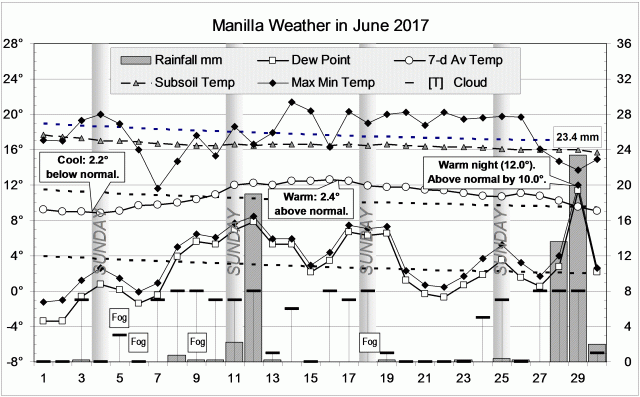
The month began cool, but became warm in the second half. The only unusual daily temperature was the early morning reading of 12.0° on the 29th, 10.0° above normal. There were ten frosts, when there are normally thirteen. On several mornings there was fog in the valley.
Seven days (normally six) registered rain over 0.2 mm. Significant falls came around the 12th and the 29th. On the 29th, the reading was 23.4 mm, but the rain extended over more than one day, totalling 39 mm. It was neither steady nor heavy, but unusually persistent. At Tamworth, rain fell in 27 hours out of 30.

Weather log for June 2017

Comparing June months

June of 2016 had been the wettest and most cloudy of the new century, with warm nights and cold days to match. This June, while moist, was close to normal. It was very like June 2015 and June 2014.
The month’s total rainfall of 62.8 mm was at the 75th percentile, well above the June average of 44 mm. There are no shortages of rainfall for groups of months to this date.

Climate for June months


Data. A Bureau of Meteorology automatic rain gauge operates in the museum yard. From 17 March 2017, 9 am daily readings are published as Manilla Museum, Station 55312.  These reports use that rainfall data when it is available. Since that gauge records “0.2 mm” on many rainless days, I cannot call those days rain days if the monthly count of rain days is not to show a sudden jump to record-breaking numbers.

All other data, including subsoil at 750 mm, are from 3 Monash Street, Manilla.

3-year trends to June 2017

Parametric plots of smoothed climate variables at Manilla
A 13-month “Mackellar cycle”

3-year climate trends to June 2017

June raw anomaly data (orange)

In June 2017 the daily maximum temperature was normal. Moisture variables were low on the graphs, showing rather high moisture. Both daily minimum temperature and subsoil temperature were high. For each variable, the raw value was close to the smoothed value of June 2016, just twelve months earlier.

 Fully smoothed data (red)

The latest available fully-smoothed data point, December 2016, showed warming and drying. Only the dew point anomaly had just passed a “dry” peak. Smoothed subsoil temperature anomaly, which had reached a record low value in November, began to rise, like both of the air temperature anomalies.

The Mackellar cycle

Manilla’s climate variables often move in the cycle of “droughts and flooding rains” from Dorothea Mackellar’s poem “My Country”.*

In that cycle, temperature and moisture move together: hot with dry, cold with wet. On my graphs, hot is to the right. The top four graphs have dry at the top. (I count daily temperature range anomaly as a moisture indicator: high values show dryness.)

The “Mackellar cycle” drives the anomaly values up and down the blue trend lines that skew from cold-and-wet at the lower left to hot-and-dry at the upper right. The path is seldom straight, as any lead or lag of moisture will curve it into an ellipse.

Ellipses on the graphs show the cycle has been strong for two years since the winter of 2015. Its period has been very short: only twelve or thirteen months. Daily maximum air temperature anomaly reached a peak in February of both 2016 and 2017 (hot in late summer-autumn), and reached a trough in August-September 2016 (cold in late winter-spring).

On the top four graphs the cycle advances around an ellipse clockwise. A peak of dryness (up) comes several months before the related peak of daily maximum temperature anomaly (right). Similarly, wetness (down) comes before low temperature (left). I have posted already about the way this cycle skewed the seasons in 2016.

The two graphs at the bottom contain only temperatures. Circles on those graphs show that both the daily minimum temperature anomaly and the subsoil temperature anomaly have been lagging the daily maximum temperature anomaly by several months during these last two years (and not before).


In a post to a “weatherzone” forum, I have annotated (in green) the graph for Dew Point Anomaly versus Daily Max Temp Anomaly. It is the one that shows most clearly the elliptical trace caused by the cycles. That forum thread: “Climate Driver Discussion 2017 (Enso, IOD, PDO, SAM etc.)” has almost no reports of climate cycles observed in Australia.


Note:

Fully smoothed data – Gaussian smoothing with half-width 6 months – are plotted in red, partly smoothed data uncoloured, and raw data for the last data point in orange. January data points are marked by squares.
Blue diamonds and the dashed blue rectangle show the extreme values in the fully smoothed data record since September 1999.

Normal values are based on averages for the decade from March 1999.* They appear on these graphs as a turquoise (turquoise) circle at the origin (0,0). A range of anomalies called “normal” is shown by a dashed rectangle in aqua (aqua). For values in degrees, the assigned normal range is +/-0.7°; for cloudiness, +/-7%; for monthly rainfall, +/-14 mm.

 * Normal values for rainfall are based on averages for the 125 years beginning 1883.


*By arrangement with the Licensor, The Dorothea Mackellar Estate, c/- Curtis Brown (Aust) Pty Ltd.

Wet Autumn 2017

Sunset photo.

Manilla Sunset

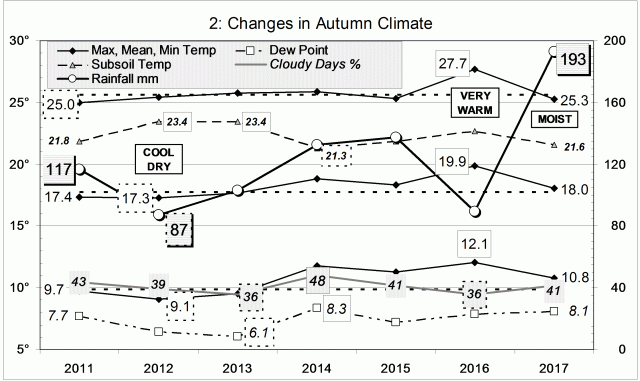
Autumn this year had normal temperatures, in stark contrast to very high temperatures both in the summer and in the autumn of last year. The decline to winter was not smooth, however, but went by steps. For three weeks in each month there was no cooling then, after some rain, there was a sudden cooling through three, four, or five degrees.
Rain fell frequently except for two gaps of a fortnight each, the first coming in mid-April. The second ended with 32.8 mm of rain registered on May the 20th. There were 26 rain days, which is twice usual number, and more than in any autumn in the new century.

Graphical log for autumn 2017

There was plenty of moisture. Only the early morning dew point (8.1°) was low, by half a degree. The daily temperature range was a narrow 14.5°, and the cloudiness a high 41%.
The total rainfall of 192.8 mm was at the 80th percentile, far above the autumn average of 134 mm. There has not been a wetter autumn since 1990 (203 mm). A little earlier there was a cluster of wetter autumns: 1977 (307 mm), 1979 (203 mm), 1982 (238 mm), 1983 (314 mm: 4th wettest), and 1988 (231 mm). Autumn 1894 was the very wettest, with 388 mm.

Climate for autumn 2017


Data. A Bureau of Meteorology automatic rain gauge operates in the museum yard. From 17 March 2017, 9 am daily readings are published as Manilla Museum, Station 55312.  These reports use that rainfall data when it is available. All other data, including subsoil at 750 mm, are from 3 Monash Street, Manilla.

Warm Wet May 2017

Photo of blossoms on a gum tree

Mugga Ironbark Blossoms

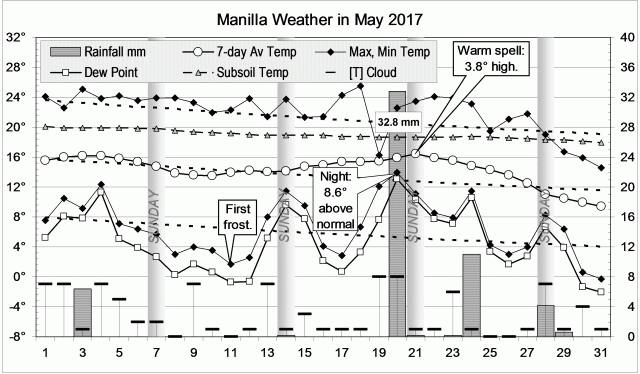
The weather was normal for the first half of the month, bringing a mild first frost on the 11th, close to the normal date for it. Then the weather became warmer and wetter. Rain totalling 32.8 mm was recorded on the 20th, while the minimum temperature of 14.0° that morning was 8.6° above normal. The weekly average temperature rose to 3.8° above normal, before falling below normal as the rain eased towards the end of the month. The last two mornings were frosty.
In all, there were five rain days (over 0.2 mm) when there are usually three.

Weather log for May 2017

Comparing May months

Like May last year, this month was about one degree warmer than normal, unlike May of 2007, which was half a degree warmer again. The dew point (4.7°) was a little low, the daily temperature range (15.3°) normal, the cloudiness (32%) and the rainfall rather high.
The total rainfall of 55.6 mm was at the 70th percentile, well above the May average of 41 mm. There are no shortages of rainfall for groups of months to this date.

Climate for May 2017


Data. A Bureau of Meteorology automatic rain gauge operates in the museum yard. From 17 March 2017, 9 am daily readings are published as Manilla Museum, Station 55312.  These reports use that rainfall data when it is available. All other data, including subsoil at 750 mm, are from 3 Monash Street, Manilla.