3-year trends to March 2015

Parametric plots of smoothed climate variables at Manilla
“March 2015: hot”

Trends to March 2015

 March raw anomaly data (orange)

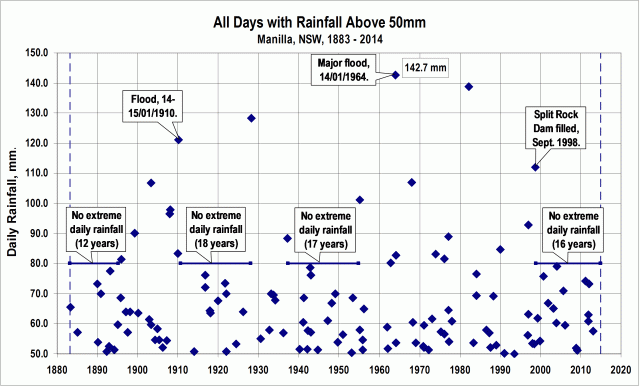
In March, the daily maximum temperature anomaly became very high (+1.6 degrees), but not nearly as high as the raw value had been in November (+5.1 degrees). Most other anomalies moved up the graphs towards “droughts” but not beyond normal values. Dew point remained as low as in February, and rainfall returned from very low to normal.

Fully smoothed data (red)

The latest fully-smoothed data anomalies (September 2014) moved a little towards “droughts” from the near-normal values of the winter.


Note:

Fully smoothed data – Gaussian smoothing with half-width 6 months – are plotted in red, partly smoothed data uncoloured, and raw data for the last data point in orange. January data points are marked by squares.
Blue diamonds and the dashed blue rectangle show the extreme values in the fully smoothed data record since September 1999.

Normal values are based on averages for the decade from March 1999.* They appear on these graphs as a turquoise (turquoise) circle at the origin (0,0). A range of anomalies called “normal” is shown by a dashed rectangle in aqua (aqua). For values in degrees, the assigned normal range is +/-0.7°; for cloudiness, +/-7%; for monthly rainfall, +/-14 mm.

 * Normal values for rainfall are based on averages for the 125 years beginning 1883.
Very Wet Days at Manilla: Decade Excesses

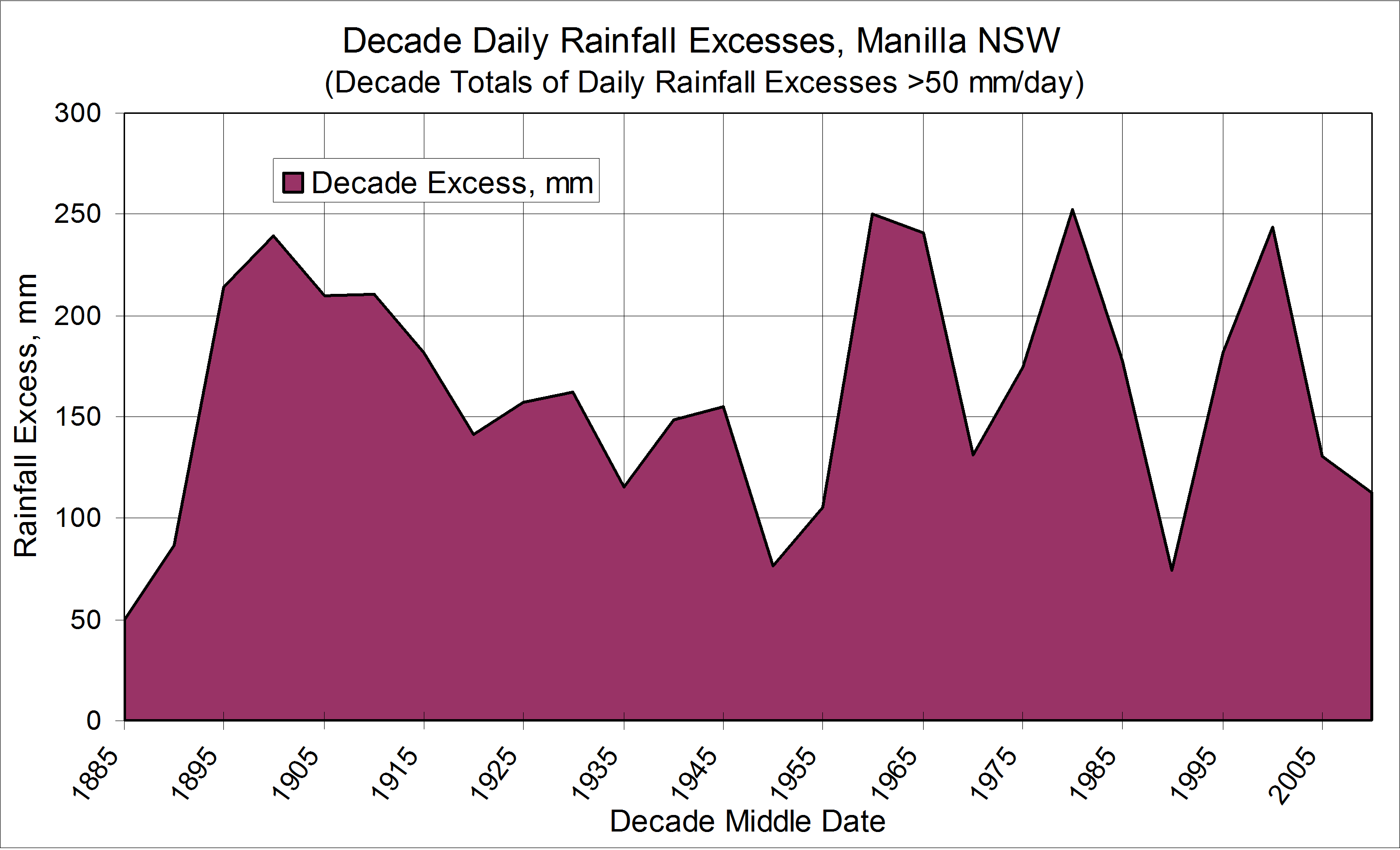
Log of decade totals of rainfall excess, Manilla, NSW Last month I posted a complete log of days at Manilla that had more than 50 mm of rainfall.
I call days that have more than 50 mm of rainfall “very wet days”. At Manilla, on the average, these have come only once per year. Days with more than 50 mm of rainfall have no special meaning, but they can be taken as a rough indication that local flooding, or even general flooding, is likely: the “Flooding Rains” of Dorothea Mackellar.*
The graph I posted did not show whether these very wet days, likely to cause floods, had a bigger effect at some times than at others. This graph shows that.

Since it is only the excess rainfall that runs off, leading to flooding, I have subtracted 50 mm from each “very wet day” rainfall amount. Then I have summed all such excesses for each half-decade. I summed the half-decades in pairs to give a decade sum (in mm) centered on the years 1885, 1890, 1895, etc. For example, the decade centered on 1925 had a total of daily rainfall excesses of 157 mm. (Values for 1880-84 were estimated from those for 1883 and 1884.)
Some decades had very high values of excess rainfall: there was about 250 mm in the decades centered on 1900, 1960, 1965, 1980, and 2000. There were very low values, below 100 mm, in the decades centered on 1885, 1890, 1950, and 1990. There appears to be no trend.

Note added June 2015.

The close similarity of two graphs, the one of heavy rainfalls in this post, and the one of year-long droughts in an earlier post led me to write a further series of three posts:
More droughts After Heavier Rains I.
More droughts After Heavier Rains II.
More droughts After Heavier Rains III.

* By arrangement with the Licensor, The Dorothea Mackellar Estate, c/- Curtis Brown (Aust) Pty Ltd.

3-year trends to February 2015

Parametric plots of smoothed climate variables at Manilla
“February 2015: very dry”

Trends toFebruary 2015

  February raw anomaly data (orange)

In February, most anomalies moved back towards “droughts” from the “flooding rains” values of January. Rainfall became extremely low, but daily maximum temperature did not rise as far as “normal”.
Exceptionally, February daily minimum temperature and subsoil temperature became very low.

Fully smoothed data (red)

The latest fully-smoothed data anomalies (August 2014) complete the winter of 2014. Through the winter season, most values were static and near normal. (Dew point, like most recent values of that variable, was 3 degrees lower than normal.)


Note:

Fully smoothed data – Gaussian smoothing with half-width 6 months – are plotted in red, partly smoothed data uncoloured, and raw data for the last data point in orange. January data points are marked by squares.
Blue diamonds and the dashed blue rectangle show the extreme values in the fully smoothed data record since September 1999.

Normal values are based on averages for the decade from March 1999.* They appear on these graphs as a turquoise (turquoise) circle at the origin (0,0). A range of anomalies called “normal” is shown by a dashed rectangle in aqua (aqua). For values in degrees, the assigned normal range is +/-0.7°; for cloudiness, +/-7%; for monthly rainfall, +/-14 mm.

 * Normal values for rainfall are based on averages for the 125 years beginning 1883.
Log of Very Wet Days at Manilla.

Graphical log of days with over 50mm rain

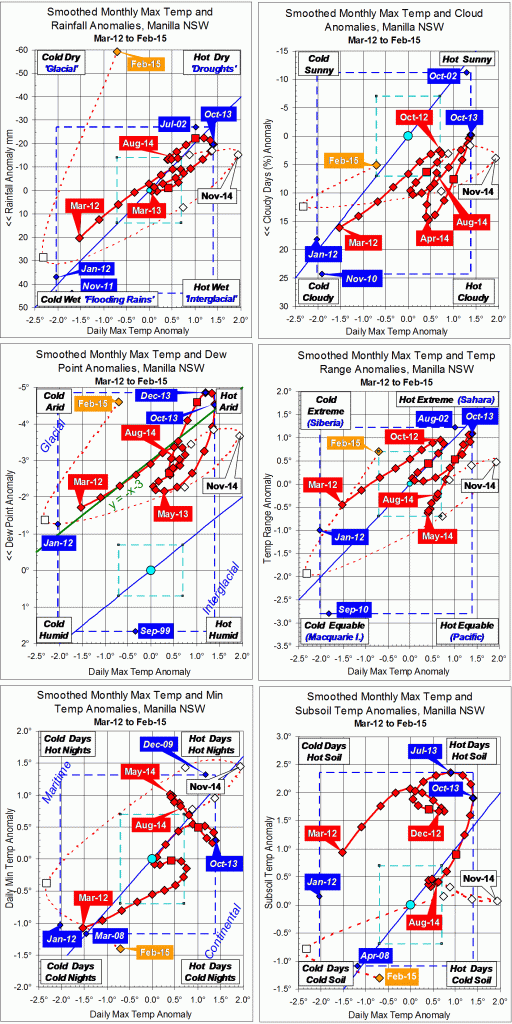
In the 130-year record of very wet days at Manilla, NSW, extreme rainfalls have not become more common recently.

Data

I arranged all daily rainfall readings for Manilla, NSW, from March 1883 to December 2014 in order of rainfall amount, and selected only the 125 readings greater than 50 mm. I plotted the values against the date, expressed in years, to two decimal places. (See Note below.)

Result

The five highest readings

The five highest readings, greater than 110 mm per day, include events that gave rise to two floods and the filling of a reservoir newly-built to store water for irrigation. The highest daily reading, 142.7 mm, came with the highest flood known at Manilla, in 14/01/1964. Thus, the highest flood matches the highest daily rainfall. That is because nearly all the flood-water came down the Manilla River, which flows in a semi-circle, with none of the catchment area far away from the rain-gauge.
These five highest readings seem to fly in an arc above the rest, with a peak near the middle of the graph. The rise and fall of this arc may have no meaning, for there are very long gaps between the events. All the same, it is a fact that there were no readings above 110 mm per day in the decades before 1910 or after 1998.

Periods with no daily readings over 80 mm

Continue reading

3-year trends to January 2015

Parametric plots of smoothed climate variables at Manilla
“January 2015: rainy cool days”

Trends to January 2015


January raw anomaly data (orange)

Anomalies for all variables except subsoil temperature moved across the graphs, from “droughts” in November to “flooding rains” in January. Subsoil temperature had been normal from February to December (11 months!), then became cooler than normal in January.
Most raw anomaly values for January were close to the fully-smoothed anomaly values of the La Niña-affected cool summer of 2012. This month’s daily temperature range was even narrower, and the subsoil temperature lower, but the daily minimum temperature was not so low.

Fully smoothed data (red)

The latest fully-smoothed data anomalies (July 2014) were near normal. (Dew point, like most recent values of that variable, was 3° lower than normal.)


Note:

Fully smoothed data – Gaussian smoothing with half-width 6 months – are plotted in red, partly smoothed data uncoloured, and raw data for the last data point in orange. January data points are marked by squares.
Blue diamonds and the dashed blue rectangle show the extreme values in the fully smoothed data record since September 1999.

Normal values are based on averages for the decade from March 1999.* They appear on these graphs as a turquoise (turquoise) circle at the origin (0,0). A range of anomalies called “normal” is shown by a dashed rectangle in aqua (aqua). For values in degrees, the assigned normal range is +/-0.7°; for cloudiness, +/-7%; for monthly rainfall, +/-14 mm.

 * Normal values for rainfall are based on averages for the 125 years beginning 1883.