No rain, and no rain gauge

A very long spell with no rain

My town, Manilla NSW, may be having one of the longest periods without rain in 133 years. We will never know.

The records of the Manilla Post Office rain gauge, No. 055031, show that the longest periods without rain were as follows:
1. August 1946: 62 days;
2. April 1912: 55 days;
3. Apr-May 2002: 47 days;
4. August 1914: 46 days;
5. May 1927: 45 days;
6. Mar-Apr 1980: 44 days;
7. April 1925: 43 days;
8. August 1982: 42 days;
9=. March 1896: 41 days;
9=. August 1995: 41 days;
To judge by my rain gauge, we have had a rainless period that is already equal seventh longest since 1883. Today, rain bands are passing through, but perhaps no rain will fall in my gauge. There may be several rainless days yet.

My gauge not valid for Manilla
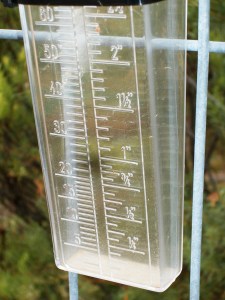
Photo of dry wedge-type rain gauge

My rain gauge

The photo shows my personal rain gauge. It is dusty because it has been dry for the last 43 days.
Whether it rains in my gauge today or not, my reading cannot count in the record for the town of Manilla. It is as if it is this dry spell is not happening.
My gauge is very simple and not precise. It is hard to read to parts of a millimetre. I bought a cheap one, because there is no point in having a precise rain gauge in my yard. The yard is too sheltered to meet the Bureau of Meteorology standard. My house is also a kilometre away from the Post Office.

Manilla’s failed rainfall record

Rainfall was first recorded at the Manilla Post Office in March 1883. The record of readings was essentially unbroken through 132 years until the 26th of March 2015. There are towns with longer rainfall records, but not very many.
Continue reading
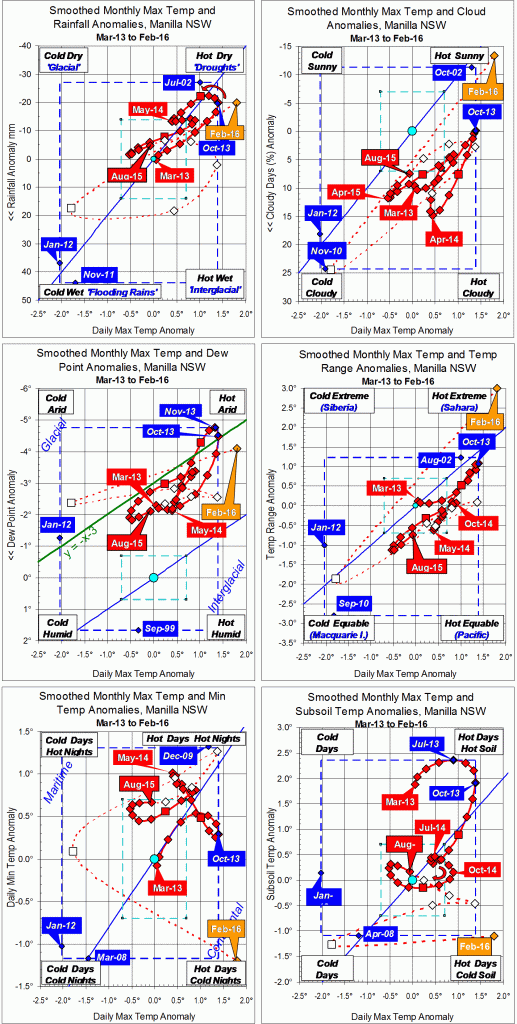
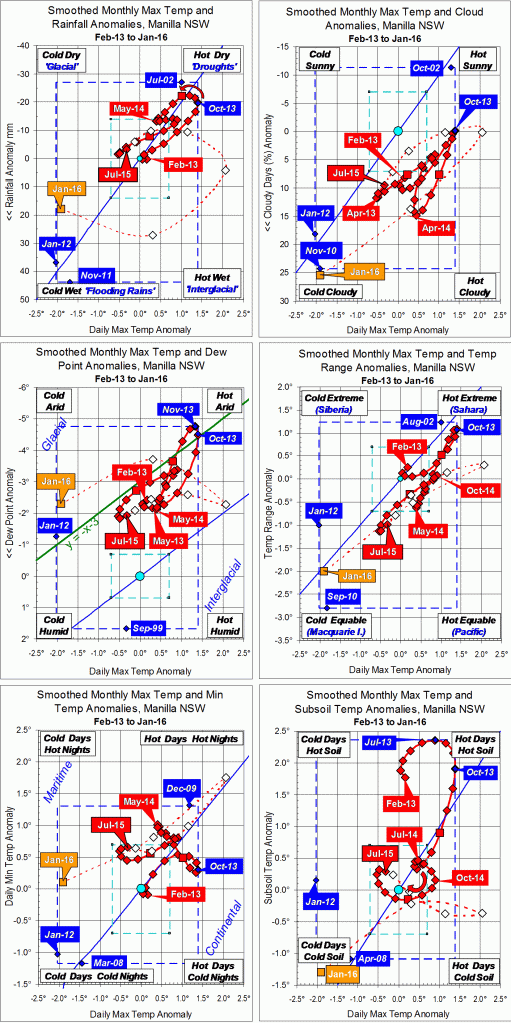
3-year trends to February 2016

Parametric plots of smoothed climate variables at Manilla
“February 2016: suddenly dry”

Trends to February 2016

February raw anomaly data (orange)

In February 2016, raw values for anomalies moved completely across the graphs, from cool and moist in January, generally to hot and dry in February. As in a desert, days became very hot, skies very sunny, and the daily temperature range extreme. Rainfall and dew point were only moderately low, while daily minimum temperature abruptly fell very low, and subsoil temperature remained very low.

 Fully smoothed data (red)

With data for August 2015, fully smoothed data is complete for winter 2015. Most anomalies for the season were quite small, but were moving away from cool and moist.

Trend lines on the graphs

Manilla’s climate often oscillates along the blue trend lines from bottom left (cool, moist) to top right (hot, dry) on the graphs. The climate can also vary along other axes.
In this time-frame the sub-soil temperature anomaly (bottom right graph) is leading the daily maximum temperature anomaly by several months. That produces a clockwise looping pattern. The daily minimum temperature anomaly (bottom left graph) sometimes moves with the daily maximum temperature anomaly, and sometimes moves against it. When against it, as from July 2013 to October 2014, the climate swings between Continental, with hot days and cool nights (as October 2013), and Maritime, with cool days and warm nights (as May 2014). Current raw data for January and February 2016 show a large swing from Maritime to Continental.


Note:

Fully smoothed data – Gaussian smoothing with half-width 6 months – are plotted in red, partly smoothed data uncoloured, and raw data for the last data point in orange. January data points are marked by squares.
Blue diamonds and the dashed blue rectangle show the extreme values in the fully smoothed data record since September 1999.

Normal values are based on averages for the decade from March 1999.* They appear on these graphs as a turquoise (turquoise) circle at the origin (0,0). A range of anomalies called “normal” is shown by a dashed rectangle in aqua (aqua). For values in degrees, the assigned normal range is +/-0.7°; for cloudiness, +/-7%; for monthly rainfall, +/-14 mm.

 * Normal values for rainfall are based on averages for the 125 years beginning 1883.

3-year trends to January 2016

Parametric plots of smoothed climate variables at Manilla
“January 2016: moist again”

Trends to January 2016

January raw anomaly data (orange)

In January 2016, raw values for nearly all anomalies moved well towards the cool and moist corner of the graphs.

 Fully smoothed data (red)

In the latest month with fully smoothed data (July 2015) anomalies were quite small, but were moving towards warm and dry. Partially smoothed data points for more recent months show that the warm and dry “El Nino” influence on values around October and November was smaller than it seemed at first. In particular, rainfall did not go below the “normal” range, but the anomaly of daily minimum temperature rose quite high.


Note:

Fully smoothed data – Gaussian smoothing with half-width 6 months – are plotted in red, partly smoothed data uncoloured, and raw data for the last data point in orange. January data points are marked by squares.
Blue diamonds and the dashed blue rectangle show the extreme values in the fully smoothed data record since September 1999.

Normal values are based on averages for the decade from March 1999.* They appear on these graphs as a turquoise (turquoise) circle at the origin (0,0). A range of anomalies called “normal” is shown by a dashed rectangle in aqua (aqua). For values in degrees, the assigned normal range is +/-0.7°; for cloudiness, +/-7%; for monthly rainfall, +/-14 mm.

 * Normal values for rainfall are based on averages for the 125 years beginning 1883.

3-year trends to December 2015

Parametric plots of smoothed climate variables at Manilla
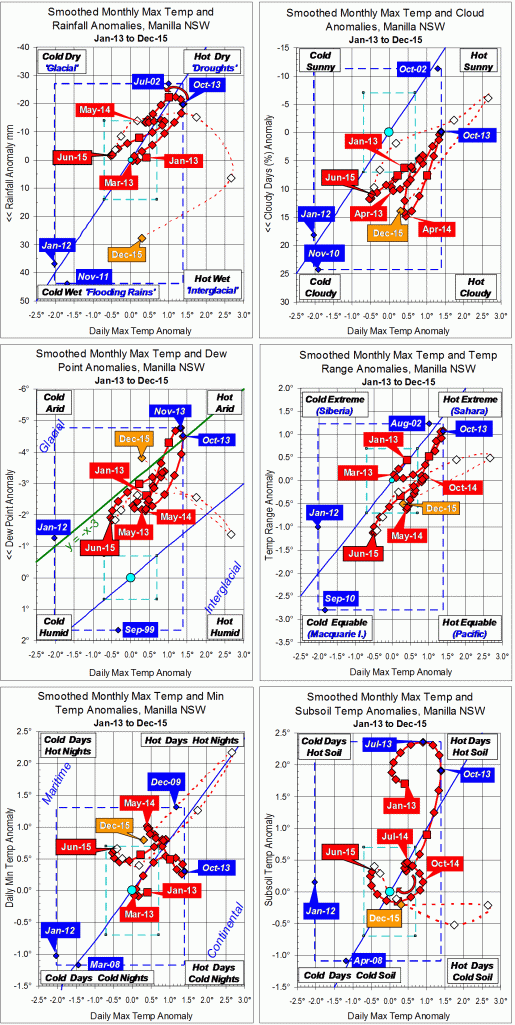
“December 2015: moist”

Trends to December 2015

December raw anomaly data (orange)

In December, raw values for daily maximum and daily minimum temperature anomaly, which had been very high in October and November, returned to normal. Rainfall and cloud became higher than normal.

 Fully smoothed data (red)

In the latest month with fully smoothed data (June 2015) no anomalies were changing much. Most were near cool/moist climate peaks (towards the lower left): only daily minimum temperature and subsoil temperature were near warm/dry peaks. None of these peaks had extreme values.


Note:

Fully smoothed data – Gaussian smoothing with half-width 6 months – are plotted in red, partly smoothed data uncoloured, and raw data for the last data point in orange. January data points are marked by squares.
Blue diamonds and the dashed blue rectangle show the extreme values in the fully smoothed data record since September 1999.

Normal values are based on averages for the decade from March 1999.* They appear on these graphs as a turquoise (turquoise) circle at the origin (0,0). A range of anomalies called “normal” is shown by a dashed rectangle in aqua (aqua). For values in degrees, the assigned normal range is +/-0.7°; for cloudiness, +/-7%; for monthly rainfall, +/-14 mm.

 * Normal values for rainfall are based on averages for the 125 years beginning 1883.

3-year trends to November 2015

Parametric plots of smoothed climate variables at Manilla
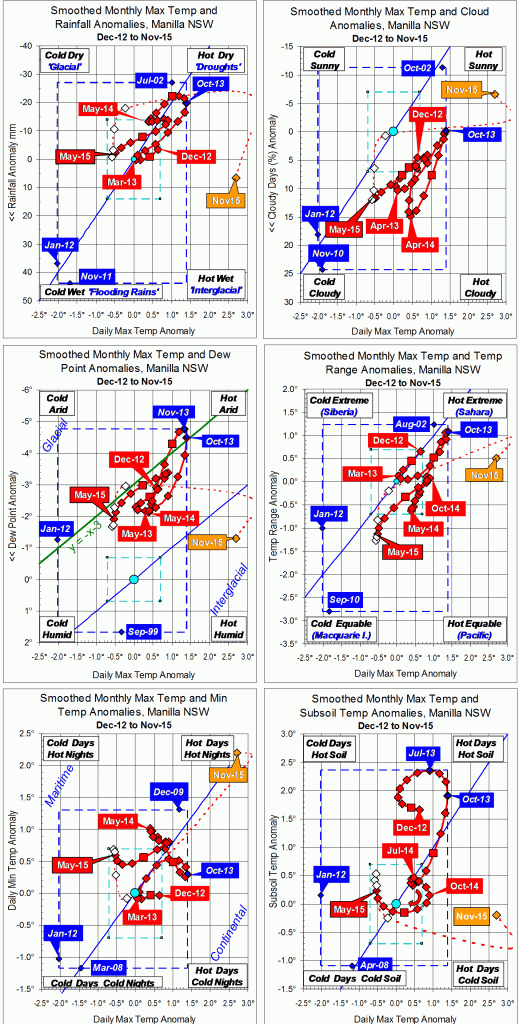
“November 2015: warm days and nights”

Trends to November 2015

November raw anomaly data (orange)

While November daily maximum anomalies were not as warm as in October, daily minimum anomalies were warmer (on the lower left graph). Apart from these, nearly all other climatic anomalies for November were near normal.

 Fully smoothed data (red)

The latest fully smoothed data (May 2015) completes the autumn months (MAM) of 2015. In that season, no variables were changing much. Daily maximum temperature, daily minimum temperature, subsoil temperature, and monthly rainfall were all near normal. Skies were rather cloudy, daily temperature range rather narrow and dew point (as is now usual) rather low. It seemed certain that the winter season would see a trend reversal: minimum values in the anomalies of daily maximum temperature and daily temperature range, and maximum values in the anomalies of daily minimum temperature, subsoil temperature, monthly rainfall, cloudiness, and dew point.

The three-year pattern

In these three years, a repeating annual cycle is best seen in the centre-right graph, which relates daily temperature range to daily maximum temperature. In May of each year the climate was relatively cool and equable (or maritime), while in October of each year it was relatively warm and extreme (or continental).


Note:

Fully smoothed data – Gaussian smoothing with half-width 6 months – are plotted in red, partly smoothed data uncoloured, and raw data for the last data point in orange. January data points are marked by squares.
Blue diamonds and the dashed blue rectangle show the extreme values in the fully smoothed data record since September 1999.

Normal values are based on averages for the decade from March 1999.* They appear on these graphs as a turquoise (turquoise) circle at the origin (0,0). A range of anomalies called “normal” is shown by a dashed rectangle in aqua (aqua). For values in degrees, the assigned normal range is +/-0.7°; for cloudiness, +/-7%; for monthly rainfall, +/-14 mm.

 * Normal values for rainfall are based on averages for the 125 years beginning 1883.