Rain storm in October 2008

The daily weather log

Weather log October 2008

October began fine and very warm, with 32° days and 17° nights. Wet days from the 4th to the 6th brought warm nights at first, followed by a very cold day (19.2°) and night (4.4°). From the 10th to the 21st normal temperatures prevailed. Then a strong southerly made days and nights 10° colder again. The night of the 23rd was 9.0° cooler than normal. The month was frost-free, however.
Calmer, sunny weather returned, with the last day the hottest, at 34.5°.
The seventh rain day of the month brought 52 mm. Rain drove in horizontally during a south-westerly gale after 5pm on Tuesday the fourteenth. This was reported, with a photo of broken trees, in the “Manilla Express” (21/10/08). The gale was a gustfront fanning out from the downburst of a thunderstorm. Storm gustfront gales in this area often blow from the south-west. Within minutes, cold air is dumped on the ground from a height of more than 5 kilometres. The downburst brings the strong south-west winds found there down to ground level.

 Comparing October months

Climate October 2008

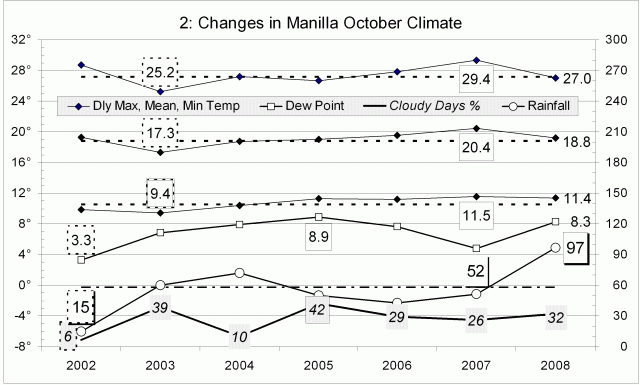
Unlike last October, which was remarkably warm and had a high daily temperature range, this October had temperatures near normal, with rather warm nights bringing a lower daily temperature range. Both humidity and cloudiness were slightly above normal.

Manilla has had a lot of rain.
The high rainfall total, 97 mm, is on the 83rd percentile for October. Only 21 recorded Octobers were wetter, including October 1999 (104mm) and 2000 (110 mm). Most rainfall totals for several months together are now above the median (the 50th percentile). The total for 2 months (September and October) is in the 82nd percentile, 3 months in the 71st, 4 months in the 60th, 5 months in the 63rd, and 6 months in the 50th percentile. Rainfall totals for longer periods, up to 60 months, are above the median with only two exceptions: the totals for 9 months (42nd percentile) and for 30 months (35th percentile).


Data. Rainfall data is from Manilla Post Office, courtesy of Phil Pinch. Dew point values before August 2005 are from Tamworth Airport 6 am data supplied by the Bureau of Meteorology. Temperature and other data are from 3 Monash Street, Manilla.


September 2008 had good rain

The daily weather log

Weather log September 2008

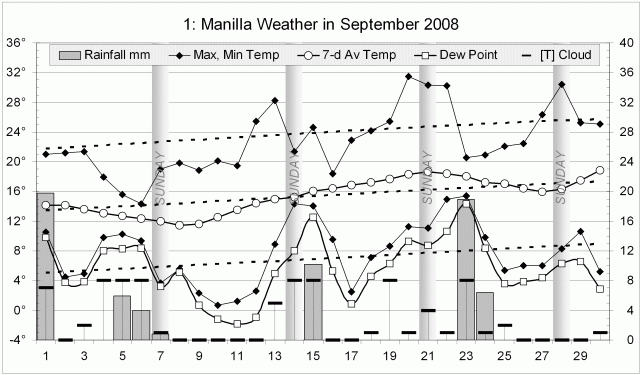
September was a month of changeable weather. It began with normal temperatures returning after a very cold August. Then there was a spell of fine cold weather, with the seven-day mean falling back to 12°, another much warmer fine spell at 18°, and a third at normal temperature (16°).
Between the fine spells there were seven rain days, including very good falls of 19.8 mm on the 1st and 19.0 mm on the 23rd. The total was 66.2 mm.
Despite all the changes, temperatures were not extreme. Only the wet, overcast day on the 6th, reaching 14.3°, was 8° below normal. The hottest day, the 20th, reached 31.5°. Mild frosts on the 10th and 11th did not fall below zero in the screen.
Having twelve mornings completely free of cloud is normal for September. (In 2003, the number was 23!) A milky haze persisted from the 16th to the 22nd, perhaps caused by cypress-pine pollen.

 Comparing September months

Climate September 2008


The mean of the daily mean temperatures was normal. The mean of the daily maxima was down, and that of the daily minima was up. This made the mean daily temperature range (15.0°) equal lowest September value of the decade, well below the average of 16.5°.
The humidity (early morning dew point: 5.6°) and percentage of cloudy mornings (30%) were a little higher than usual.
The rainfall total, 66 mm, is on the 82nd percentile for September. This is far above the average (41 mm), but less than the 100 mm of September 2005. Last September, by contrast, had only 2 mm: the third driest on record.
Totals for several months together now show no serious shortages. The total for 2 months (August and September) is in the 52nd percentile, 3 months in the 41st, 4 months in the 47th, 5 months in the 32nd, and 6 months in the 22nd percentile. Rainfall totals for longer periods are normal.


Data. Rainfall data is from Manilla Post Office, courtesy of Phil Pinch. Dew point values before August 2005 are from Tamworth Airport 6 am data supplied by the Bureau of Meteorology. Temperature and other data are from 3 Monash Street, Manilla.


Winter came very late in 2008*

Weather log winter 2008

The daily weather log

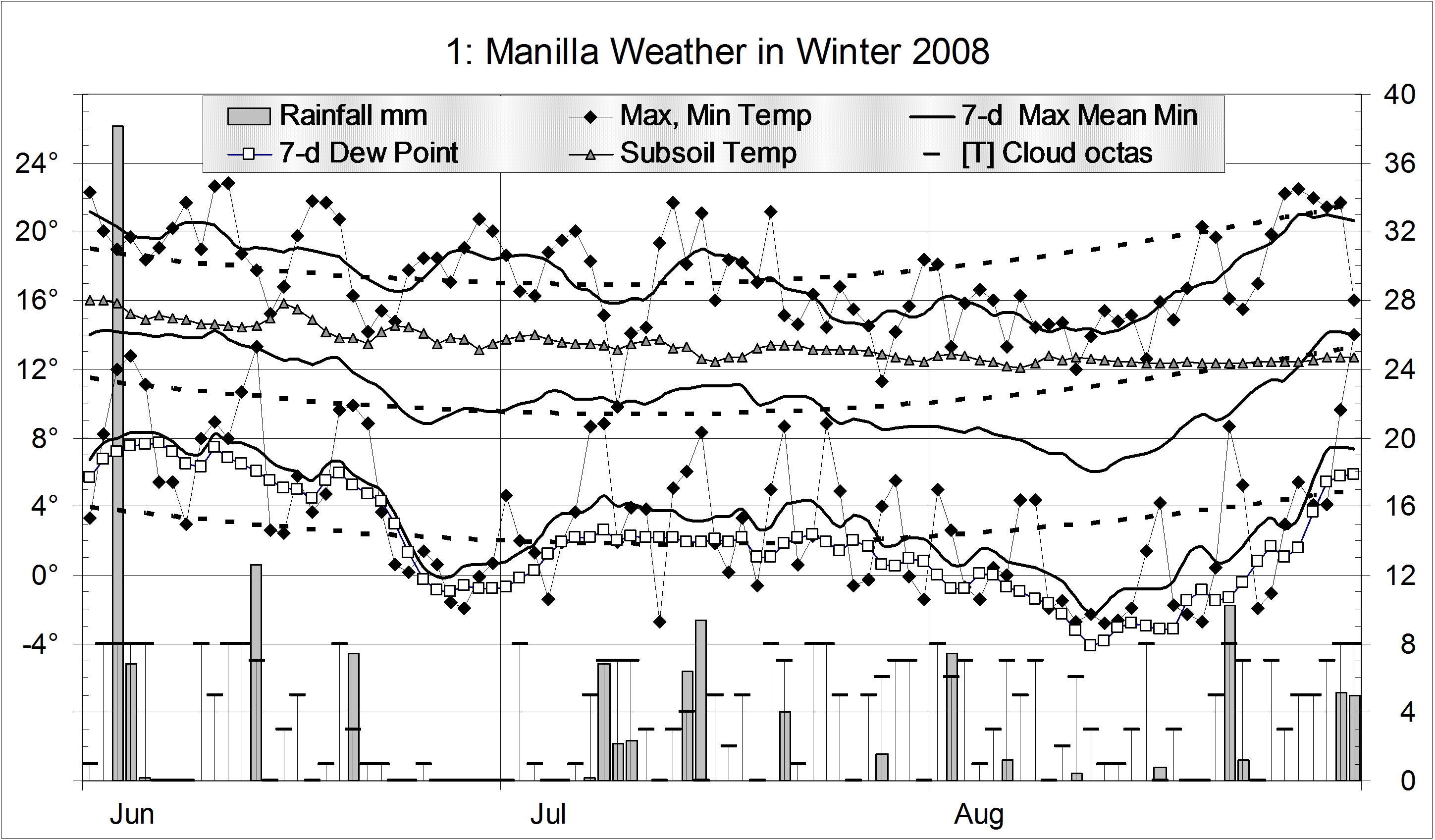
For most of June and July, temperatures were warmer than normal, especially at night. There were a couple of severe frosts in late June, and one in mid-July. The coldest part of winter, however, came extremely late. In the second week of August, both days and nights were six degrees colder than normal. There were more sub-zero nights in August than in June and July together.
Early morning dew points above 7° in early June showed high humidity. Later, dew points below zero showed the air was extremely dry in late June and almost all of August.
The winter was a little less frosty than usual, with 40 frosts rather than the usual 44. There were 24 readings below zero and 7 below minus two, but none below minus four.
There were 21 rain days, totaling 136 mm. Most rain came early in the season. The first rain day, with 38.2 mm, was the wettest winter day in ten years.
July and August were extremely cloudy months, with 52% and 55% cloudy mornings. June, at 37%, was also cloudy.

Comparing winter seasons

Mean daily temperatures (daily maximum, minimum, and mean) were close to normal this winter. Because the maximum was slightly down, and the minimum slightly up, the daily temperature range was reduced. At 14.1°, it was narrower than the normal 15.3° but not extreme like the 13.2° of last winter.
The mean dew point of 1.9° was normal for winter.
The rainfall total of 134 mm is above the long-term average for winter (125 mm). The graph includes the ninth driest winter, 2002. Just ten years ago, 304 mm of rain in the winter of 1998 made it the second wettest on record.
This was the cloudiest winter of the decade. Forty-eight percent of the mornings had more than 4/8 cloud. The winter average is thirty-one percent. The graph suggests a trend to more cloudy winters since 2002.

Climate winter 2008

Data. Rainfall data is from Manilla Post Office, courtesy of Phil Pinch. Dew Point values before August 2005 are from Tamworth Airport 6 am data supplied by the Bureau of Meteorology. Temperatures, including subsoil at 750 mm, and other data are from 3 Monash Street, Manilla.

* The title is a rhyming anapestic tetrameter. With the original “by”-line, it was a rhyming  anapestic hexameter. No-one noticed.

3-year trends to August 2008

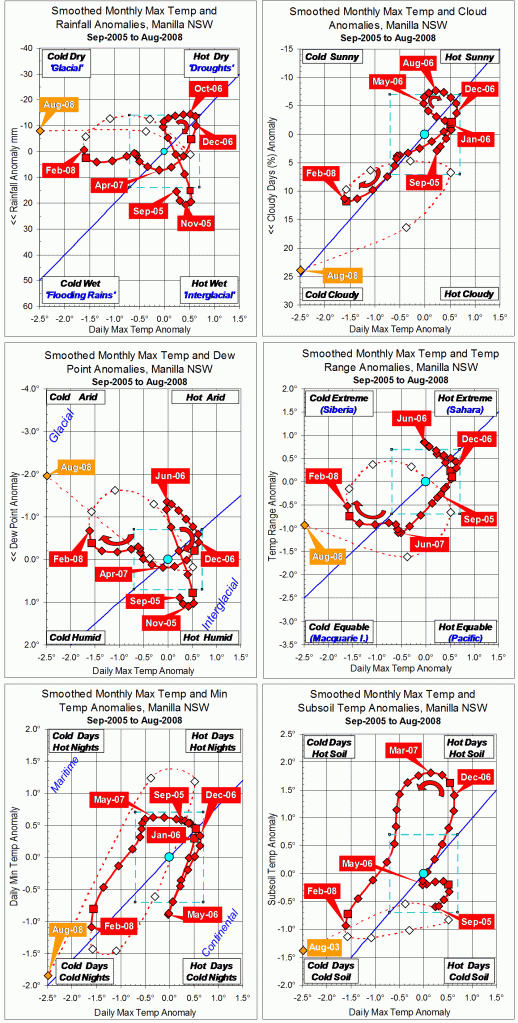
Parametric plots of smoothed climate variables at Manilla
“Years with unusual trends”
Trends to August 2008

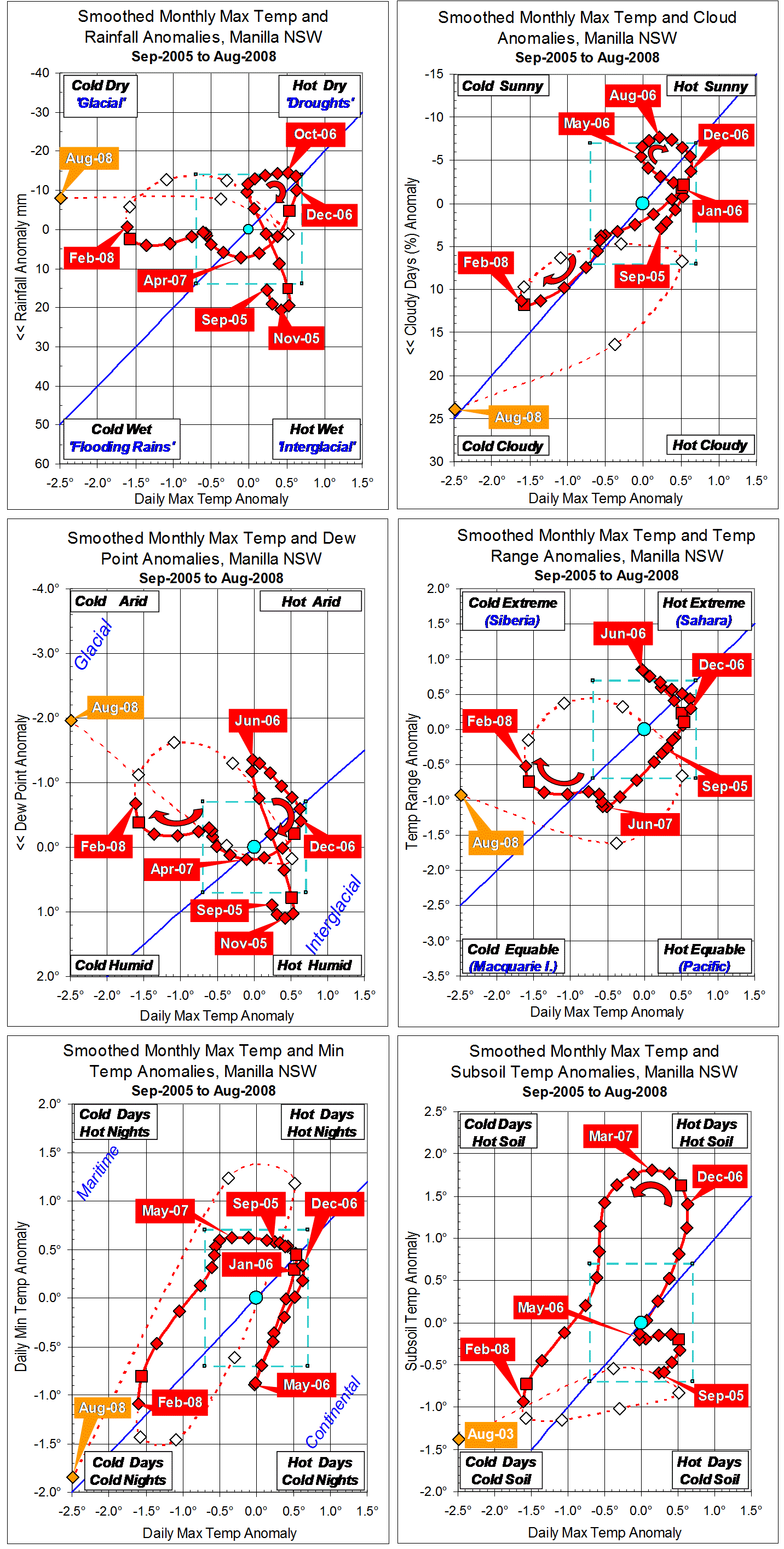
These graphs, ending with raw data for August 2008, show fully-smoothed data from September 2005 to February 2008. They include all months of the calendar years 2006 and 2007.
Smoothed daily maximum temperature anomaly (X-axis on all graphs) began 2006 high in the “normal” range, fell to normal by June, and rose again to +0.63°  in November and December. It then fell from high to very low through 2007, reaching the record low value of -1.61°  by February 2008. (Note added: This record low maximum temperature anomaly stood for only 19 months, until September 2010.)
Smoothed rainfall anomaly peaked at +20.6 mm in November 2005, fell rapidly to -11.7 mm in June 2006 and slowly to -14.6 mm in October 2006. It rose again to just above normal by February 2007, and changed little in the following year.
Smoothed percent cloudy mornings followed a similar course to that of rainfall but, as temperature fell through 2007, cloudiness (unlike rainfall) increased, as is normal,  along the blue trend-line.
(Note added in May 2014: Although the minimum value of the cloudiness anomaly in August 2006 (-7.7%) is less negative than the record minimum in August 2002 (-11.3%) (or even than the minimum in February 2005 (-9.1%)) it is more negative than any later value. No smoothed negative values at all were recorded in almost seven years between February 2007 and October 2013.)
Smoothed dew point anomaly also followed a similar course to that of rainfall but, unlike cloudiness, actually declined as temperature fell during 2007. Temperature range anomaly moved like dew point anomaly.
Daily minimum temperature mainly varied in the same sense as daily maximum temperature, but at a higher rate. As an exception, from January to June 2007, it rose slightly as maximum temperature fell. That moved the curve towards a more “maritime” climate for the rest of the time. Subsoil temperature anomaly moved in a similar pattern.

Unusual trends

Through the years 2006 and 2007 shown here, the climate moved as much along the axis from top left to bottom right, as along the usual axis from top right to bottom left. It departed from the typical Quasi-biennial oscillation of “droughts and flooding rains”*. (Note added: The extreme negative maximum temperature anomaly of February 2008 was the only one on this record that was not linked to an extreme positive rainfall anomaly.)
(Note added concerning global temperature: At this time there was a sudden major cooling in mean air temperature, both locally and globally. This linked post  shows that, when 37-month averages of global and local values are plotted, mean temperature fell from a peak in April or May 2006 to a trough in October 2007, breaking the global warming trend. The global (GISS) value fell by 0.074° (and the Manilla value by 0.48°). The connection is enigmatic. The unusual trends shown here do not match the dates of the cooling event, but come mainly before or after it.)

* By arrangement with the Licensor, The Dorothea Mackellar Estate, c/- Curtis Brown (Aust) Pty Ltd.

Note:
Fully smoothed data – Gaussian smoothing with half-width 6 months – are plotted in red, partly smoothed data uncoloured, and raw data for the last data point in orange. January data points are marked by squares.
Normal values are based on averages for the decade from March 1999. They appear on these graphs as a turquoise (turquoise) circle at the origin (0,0). A range of anomalies called “normal” is shown by a dashed rectangle in aqua (aqua). For values in degrees, the assigned normal range is +/-0.7°; for cloudiness, +/-7%; for monthly rainfall, +/-14 mm.

(Note added in May 2014: A much later post titled “3-year trends to May 2010” is the first of a consecutive series of parametric plots, updated monthly at the time of observation and originally posted elsewhere.
This earlier data was not edited in this form at the time.
To display all existing fully-smoothed data points at least once, I have prepared these back-dated posts in the same format for:
“3-year trends to August 2002” which includes smoothed data September 1999 to February 2002, covering the calendar years 2000 and 2001.
“3-year trends to August 2004” which includes smoothed data September 2001 to February 2004, covering the calendar years 2002 and 2003.
“3-year trends to August 2006” which includes smoothed data September 2003 to February 2006, covering the calendar years 2004 and 2005.
“3-year trends to August 2008” (this post) which includes smoothed data September 2005 to February 2008, covering the calendar years 2006 and 2007.
In these back-dated posts the anomaly values depend on climate normals that are based on the decade ending February 2009, and were thus not available until after that date. I have written the posts as if they were available at the time.
In places I have written some “Notes added in May 2014” (like this) commenting on how values observed at that time relate to more recent events.)


August 2008 very cold and cloudy

The daily weather log

Weather log August 2008

The second week of August was the coldest week of the year. Temperatures by day and night were six degrees below normal. In the whole month few temperatures were above normal. Only six days got above 20°, compared to the usual twelve. The very last night soared to nine degrees above normal.
However, no days or nights were particularly cold. Although the 13th was the coldest morning of the winter at -2.8°, it was only a little lower than -2.7° on the 11th and 20th (and also on the 12th of July).
Most days had very dry air, with morning dew points below zero. Despite that, there was a lot of cloud. The number of mornings free of cloud was only five, the fewest in ten Augusts.
There were nine rain days spaced through the month, totalling 31.6 mm.

 Comparing August months

Climate August 2008

All the mean temperatures (daily maximum, daily mean, and daily minimum) were the lowest for August in a decade. The mean was over two degrees below normal.

It was a frosty month. In ten Augusts, none had as many minima below -2° (6) or below zero (14) as this one, but August 2005 had more total frosts (21 versus 18) counting minima below +2.2° in the screen.
Mean humidity (morning dew point) was extremely low. At -0.4°, it was over two degrees below normal. In the decade, only July 2002 had drier air, with a mean morning dew point of -3.1°.
There were more cloudy mornings (55%) than in any August of the decade. Five of the seven cloudiest months of the decade have come within the last ten months: Nov ’07, Dec ’07, Feb ‘08, Jul ’08, and Aug ’08. All had 50% or more cloudy mornings, almost twice the decade median of 27%.
The rainfall total, 31.6 mm, is on the 46th percentile for August, and below the average (40 mm). Totals for several months together are much the same as a month ago, but the serious shortage has moved back to the six-month total. The total for 2 months (July and August) is in the 28th percentile, 3 months in the 41st, 4 months in the 25th, 5 months in the 17th, and 6 months in the 7th percentile . Rainfall totals for longer periods are normal.


Data. Rainfall data is from Manilla Post Office, courtesy of Phil Pinch. Dew point values before August 2005 are from Tamworth Airport 6 am data supplied by the Bureau of Meteorology. Temperature and other data are from 3 Monash Street, Manilla.