2018 the second driest year

The calendar year 2018 was the second driest in 136 years at Manilla NSW

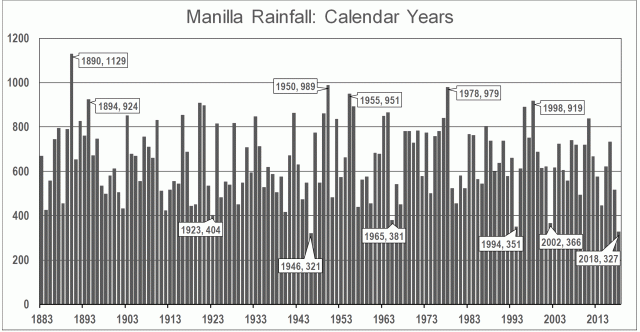
Log of Manilla annual rainfall

With a rainfall total of 327 mm (estimated), 2018 was the second driest calendar year in Manilla’s record from 1883. The driest was 1946, which had 321 mm. On the graph, the six driest years are marked, as well as the six wettest.
The official record of rainfall at Manilla Post Office, Station 55031, was continuous from March 1883 to 26 March 2015. It failed for lack of a volunteer observer. Since then the official record has been fragmentary. It relies on an automatic rain gauge, Manilla (Museum) Station 55312, which was faulty before it was re-sited, and has failed repeatedly since. Most of the rainfall readings used for this graph since March 2015 are from my non-standard rain-gauge on a non-standard site in Monash Street. They generally matched readings from the Manilla (Museum) automatic rain gauge when it was serviceable, but they have no official standing. A neighbour’s readings are similar but 10% higher. Those readings totalled 363.5 mm for the year 2018, which would make it not the second driest year, but the third driest year, after 1994 (351 mm).

2018 hottest and driest

In the nineteen years 2000 to 2018, this last year was the hottest and the driest.

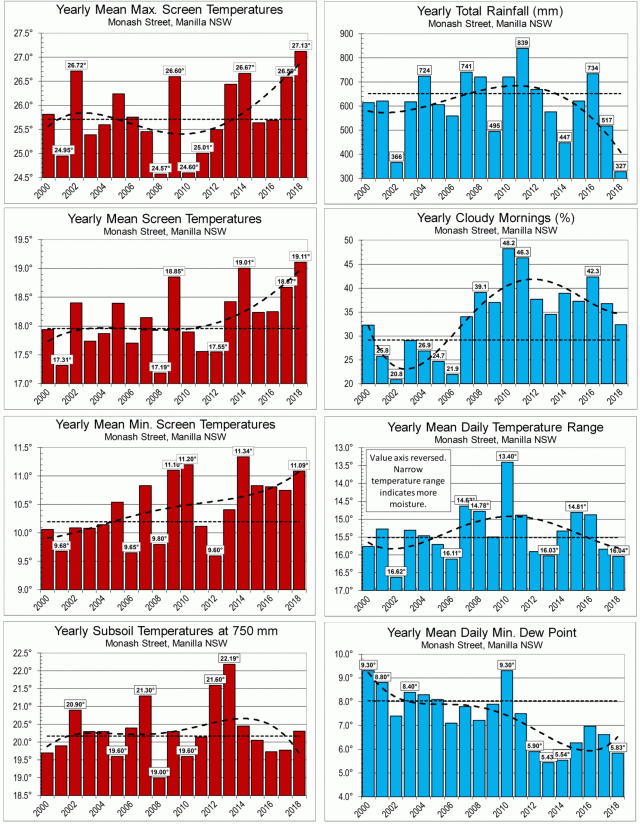
Climate logs 19 years

Climate records kept at 3 Monash Street, Manilla from April 1999 yield these eight graphs of climate variables. The graphs on the left (red) show heat and those on the right (blue) show moisture.
These graphs show the figures for calendar years. They do not show hot summers or cold winters. In particular, each summer spans two calendar years.
In general, the temperatures in this 19-year record rose, with a pause between 2004 and 2012. Moisture peaked about 2010.

Day Temperatures

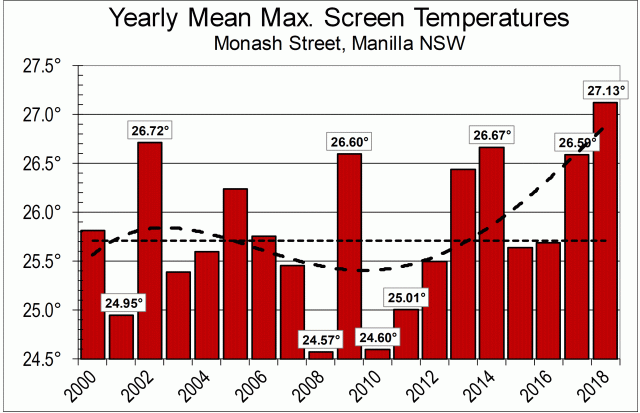
Daily max temp, 19 years

Day temperatures are shown by the mean maximum temperature in the thermometer screen. The year 2018, at 27.13°, had the hottest days by far. Four other years with hot days were widely spread: 2002, 2009, 2014, and 2017. The coldest days were in 2008 (24.57°) and 2010 (24.60°), followed by 2001 and 2011.

Average Temperatures

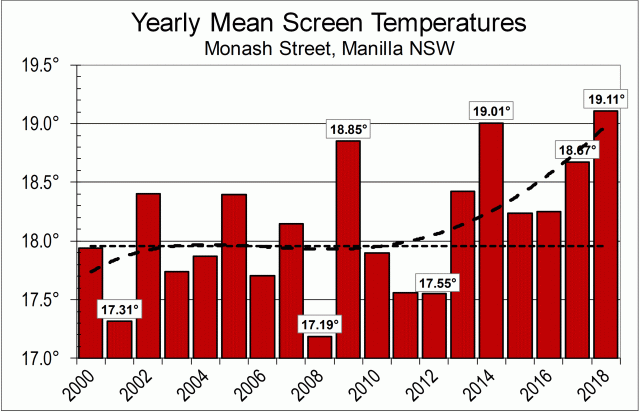
Daily Mean Temp, 19 years.

This graph shows warmth in general, as is done in the study of global warming. For each day, the daily maximum and daily minimum temperatures are averaged. Then these values are averaged for each year. The year 2018 was the warmest (19.11°), but 2017 was only fourth, beaten by 2014 and 2009. The coolest year in this century was 2008 (17.19°), followed by 2001, 2011, and 2012.

Night temperatures

Daily min temp, 19 years

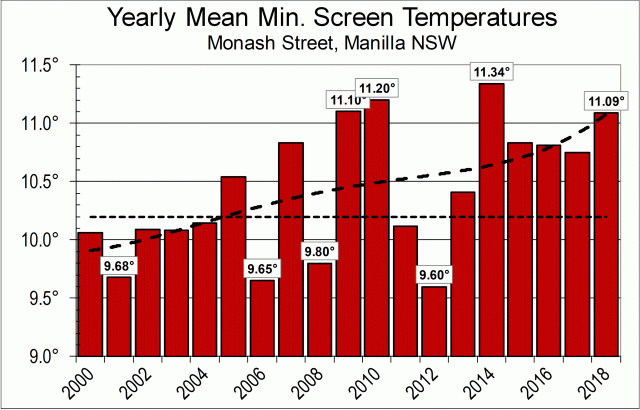
Night temperatures are shown by the mean minimum temperature in the thermometer screen. The year 2018 , at 11.09°, had only the fourth warmest nights. The warmest were in 2014, at 11.34°, followed by 2010 and 2009. Years with nights cooler than 10° on average were 2012, 2008, 2006 and 2001.

Subsoil temperatures

Continue reading

December 2018 dry and hot

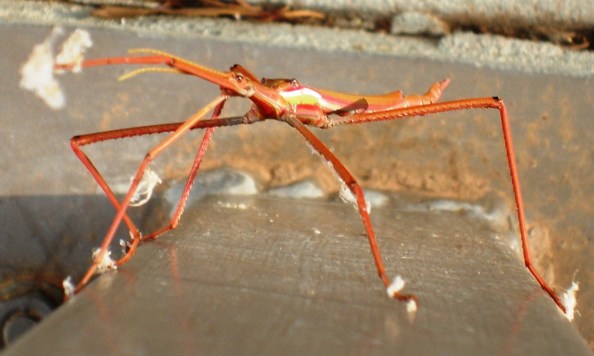
Tropidoderus stick insect

Stick Insect

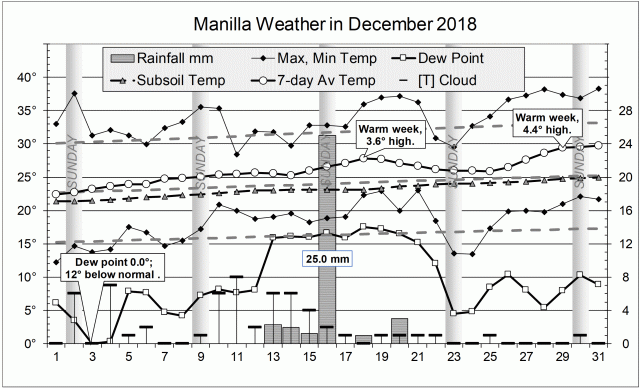
Weekly temperatures, which began normal, then remained high all month, peaking
around four degrees above normal on the 18th and again on the 29th. Only a few days or nights were cooler than normal.
There were six rain days, grouped around the 16th, which had 25 mm. Earlier and later times had sunny skies and low dew points.

Graphical log of weather December 2018

Comparing December months

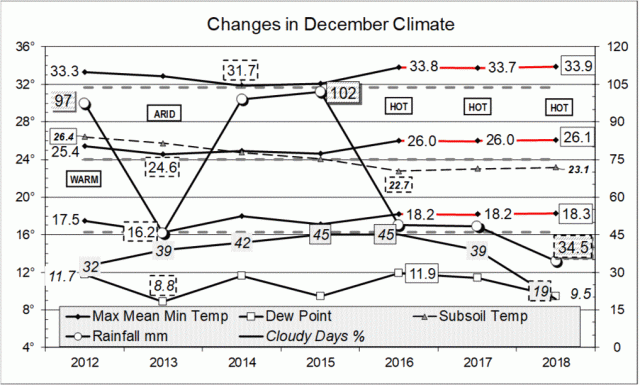
Remarkably, the three mean temperatures this month are practically the same as those of both December 2017 and December 2016. They are higher, but by no more than 0.2°, near the limit that can be read on my thermometers. The mean daily maximum of 33.9° and the mean daily mean of 26.1° are the hottest for December in this record from 1999. (The mean daily minimum of 18.3° was exceeded by 18.6° in December 2009.)
This was one of the most sunny December months. The percentage of cloudy mornings (19.4%) was the same as in December 2006, but higher than in 2002 or 2005 (both 16.1%).
The rainfall of 34.5 mm is at the 22nd percentile, far below the average (74 mm). Lower rainfall totals occurred in December of 2001 (34 mm) and 2006 (19 mm). I have reported the on-going drought in another post.

Climate in December months


Data. A Bureau of Meteorology automatic rain gauge operates in the museum yard. From 17 March 2017, 9 am daily readings are published as Manilla Museum, Station 55312.  These reports use that rainfall data when it is available.  Since no 9 am readings have been recorded since August, I have substituted my non-standard gauge readings for all days.
All other data, including subsoil at 750 mm, are from 3 Monash Street, Manilla.

3-year trends to December 2018

December hot and dry

3-year trends to December 2018

December raw anomaly data (orange)

In December 2018, the top two graphs show that rainfall was low and skies sunny.
The daily maximum temperature (x-axes, all graphs) and daily minimum temperature (lower left graph) were extremely high, but the subsoil was cool. Dew point and daily temperature range were near normal.

 Fully smoothed data (red)

Climate anomaly data when smoothed in this way do not show changes from month to month, but only those cycles that last for a year or more. The smoothed data identify the month when a peak occurs in a cycle .

By June 2018, the last date for which data can be fully smoothed (as described below), some variables had already peaked in their contribution to the current extreme drought.

The anomaly of daily maximum temperature (x-axis, all graphs) had peaked in March 2018. Two months later, in May 2018, the rainfall anomaly peaked (negative) to a 21st-century record low value of minus 28.3 mm. (In the 2002 drought daily maximum temperature had not peaked until after the peak of minimum rainfall.)
By June, cloudiness was decreasing towards a minimum (perhaps in August 2018) without becoming much less cloudy than normal. Dew point anomaly was still decreasing, and seemed likely to reach a record low value about August.
The anomaly of daily temperature range had been at a (high) level characteristic of drought since the previous winter (2017). It had changed little, and peaked in May 2018 without getting near the record high value of July 2002.
The anomaly of daily minimum temperature has a cryptic relation to drought. In this case, the value peaked sharply in February 2018 before falling rapidly. It may have reached a minimum about August 2018.
The anomaly of subsoil temperature was high in June 2018, and seemed likely to peak about July, lagging four months behind the daily maximum temperature anomaly.


Notes:

January data points are marked by squares.

Smoothing

Smoothing uses Gaussian functions.
For fully smoothed data the function has a Standard Deviation of 2.5 months, it spans 13 monthly data points, and has a half-width of 6 months, which suppresses cycles shorter than 12 months. For partly smoothed data, the span of the function is reduced to 11 months, 9 months and so on.

Fully smoothed data points are plotted in red, partly smoothed data uncoloured, and raw data for the last data point in orange.

Limiting values

Blue diamonds and the dashed blue rectangle show the extreme values in the fully smoothed data record since September 1999.

Normal values

Normal values are based on averages for the decade from March 1999.* They appear on these graphs as a turquoise (turquoise) circle at the origin (0,0). A range of anomalies called “normal” is shown by a dashed rectangle in aqua (aqua). For values in degrees, the assigned normal range is +/-0.7°; for cloudiness, +/-7%; for monthly rainfall, +/-14 mm.

 * Normal values for rainfall are based on averages for the 125 years beginning 1883.

Driest 18 months in 50 years

In December 2018, droughts of long duration got worse.

Rainfall shortage November-December 2018

Graph of Rainfall Shortages

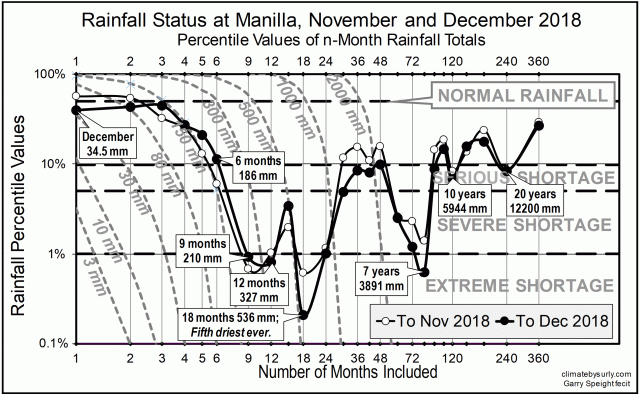
This graph shows all the present rainfall shortages at Manilla, short term and long term, as percentile values. The latest values, as at the end of December, are shown by a black line with black circles. Those from one month earlier, at the end of November, are shown by a thinner line with smaller white circles.

Changes this month

Short-term shortages

Although December rainfall (34.5 mm) was below normal, it was enough to keep the totals for 2, 3, 4, and 5 months above the level of “serious shortage”. Because the 6-month total rose to 186 mm, it too did not count as a serious shortage.

Extreme shortages

There were extreme shortages (1st percentile) at durations of 9 months (210 mm), 12 months (327 mm), 18 months (536 mm) and 7 years (3891 mm). The 18-month shortage was the most extreme, being the fifth lowest in history, after four lower values in 1966 (the lowest: 514 mm). The extreme 7-year shortage that has now appeared is lower than any since 1942.

Worsening long-term shortages

This drought brings worsening long-term rainfall shortages. Among the 14 selected durations longer than 2 years that are shown here, 10 of them are now serious shortages (10th percentile) or worse.
As well as the extreme 7-year shortage, two serious shortages that appeared in November are now worse: the 10 year total fell from 5964 mm to 5944 mm, and the 20-year total fell from 12209 mm to 12200 mm. The 10-year shortfall amounts to nearly one year of rain.
Such long-term rainfall shortages were common early in the 20th century. They have hardly occurred since the Keepit Dam was built in 1960.


Further Explanation

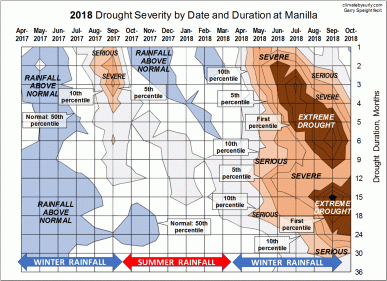
Drought 2018 contour chartMuch more detail was given in the post: “Contours of Manilla’s 2018 Drought” (with data up to October only). Notes include: “Long-term shortages”, “Classes of rainfall shortage”, and “Manilla rainfall records”.