Hot and dry records in January 2019

In January 2019, the smoothed anomaly value of monthly rainfall reached a record low (-31.8 mm/month), and that of monthly mean maximum temperature a record high (+1.79°).

Rainfall and temperature trajectory Sep2016 toFeb 2019

[This graph is extracted from a forthcoming post in the series “3-year trends…”. ]

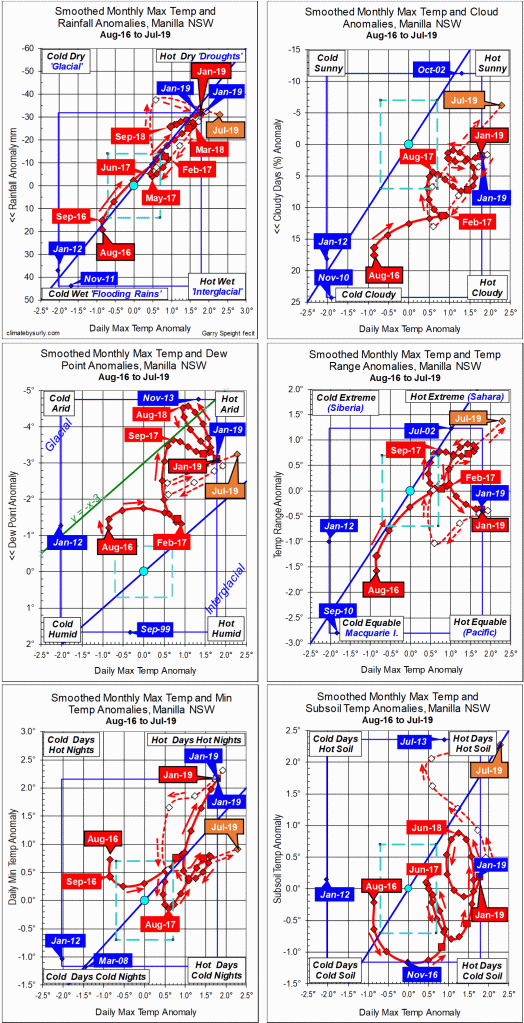
This graph shows temperature and rainfall anomalies, not raw data. It shows how far the actual values differ from normal. The 30 data points from September 2016 to February 2019 (coloured red) are smoothed to show only cycles longer than one year.

The earliest data point, September 2016, had temperature and rainfall just beyond the normal range on the cool and wet side (lower left). Since that date, all the smoothed data points have fallen close to the sloping Mackellar trend line (blue) from cool-wet to hot-dry. (See the note below: Mackellar trend line.)
In the 4 months up to January 2017, warming and drying was rapid, passing completely through the “normal” range. Next, some cooling and wetting occurred to May 2017, then warming and drying resumed to a full drought in March 2018. Through the year 2018, drought prevailed, with a rainfall anomaly always below -25 mm. The temperature anomaly fell to only +1 deg by August, but rose again while rainfall fell. Records for low rainfall and high temperature were broken repeatedly.
January 2019 had the lowest smoothed monthly rainfall anomaly of the 21st century (-31.8 mm/month), and the highest monthly mean maximum temperature (+1.79°).
The following month, February 2019, had a slightly decreased temperature anomaly, and an increased rainfall anomaly. Later data points with less smoothing applied suggest that the smoothed record values of January may stand for some time.


Note.

Mackellar trend line

The insight of Dorothea Mackellar that this is a land “of droughts and flooding rains” *
is expressed in these graphs by a blue trend line passing through the “Normal” point in the centre (aqua) and extending both to “Droughts” with high temperature and low rainfall at the top right and to “Flooding Rains” with low temperature and high rainfall at the bottom left. Smoothed data points for anomalies of mean monthly daily maximum temperature and monthly rainfall totals generally lie close to the sloping blue line in such graphs for all of the last 20 years. (Search “3-year climate trends”, this one, for example).

Notice that record high and low values of smoothed anomalies of rainfall and daily maximum temperature (dates marked in blue) lie close the this blue line, supporting the estimate.
Empirically, one degree of increase in temperature anomaly matches 20 mm of decrease in monthly rainfall anomaly: the Mackellar Constant for Manilla is -20mm/month/degree.

* By arrangement with the Licensor, The Dorothea Mackellar Estate, c/- Curtis Brown (Aust) Pty Ltd.
21-C Rain ENSO IPO: Scatterplot

The anomaly of monthly rainfall at Manilla, NSW varied with that of ENSO for only a part of the 21st century to date.

Scatterplot Rainfall vs ENSO

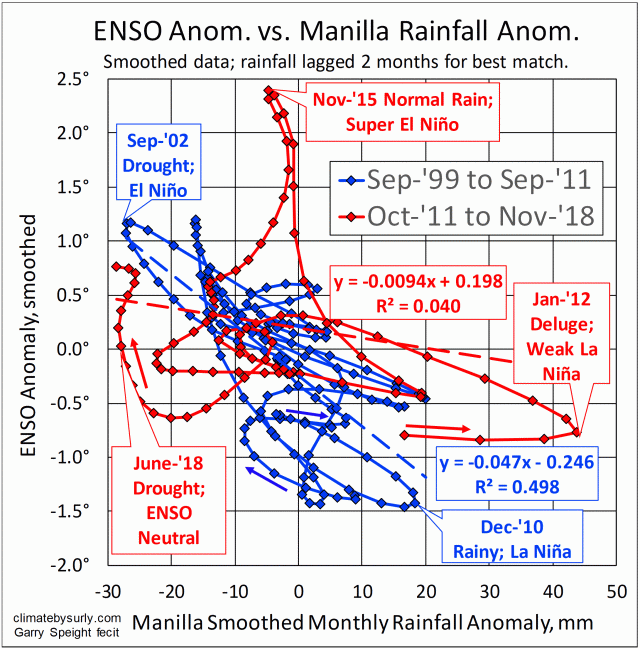
This connected scatterplot relates the smoothed anomaly of the El Niño-Southern Oscillation (ENSO) to the smoothed and 2-month-lagged anomaly of monthly rainfall at Manilla, NSW. The earlier data, from September 1999 to September 2011, is plotted in blue, and the later data, from October 2011 to November 2018, in red.

The same data was displayed as a dual-axis line plot in an earlier post titled “21-C Rain-ENSO-IPO: Line graphs”. Data sources are linked there.

The line plot revealed two things: the relationship changed from earlier to later times, and there was a better match when the rainfall data was lagged by two months. To clarify, I prepared various scatterplots with fitted regressions.

Raw data scatterplots

Scatterplots of the raw data values yielded regressions with very low values of the coefficient of determination (R-squared). For the whole population, R-squared was 0.028. I then checked the coefficient when I lagged the rainfall by 1-, 2-, or 3-months. A 1-month lag almost doubled the coefficient to 0.041; a 2-month lag gave 0.055, and a 3-month lag gave 0.041 again.
My observation that Manilla rainfall typically leads ENSO by 2 months is confirmed.

Connected scatterplots of smoothed and lagged data

The smoothing function used in the dual-axis line plot of the earlier post makes a good visual match. That suggests that local rainfall and ENSO are physically related at a periodicity no shorter than 12 months.
Using the smoothed and 2-month-lagged data, I have made the scatterplots shown in the graph above.
The better-matched data from September 1999 to September 2011 (blue) has a satisfactory R-squared of 0.498, nearly 20 times greater than that of the raw data. The very poorly-matched data from October 2011 to November 2018 (red) has an R-squared value of 0.040, no better than the raw data.

Patterns in the sequence of rainfall and ENSO values

In the above graph, I have joined the consecutive smoothed data points to make a connected scatterplot. Because little noise remains, clear patterns appear.

Matched rainfall and ENSO

The pattern up to September 2011 (blue) is mainly a series of ellipses, some clockwise and some anti-clockwise. They are almost parallel to the regression line:

y = -0.047x-0.246

The blue point furthest to the top left is that for September 2002, a time of extreme drought and El Niño.
The blue point furthest to the bottom right is that for December 2010, a time of very high rainfall and La Niña.

Discordant rainfall and ENSO

The pattern from October 2011 (red) swings about wildly and does not repeat. The regression (with a trivial coefficient of determination) is nearly horizontal. Near its ends are the extreme drought of June 2018 and the deluge of January 2012, both at times when ENSO was near neutral. At the top of the graph is the Super El Niño of November 2015, when Manilla rainfall was normal.

Conclusion

Scatterplots, connected scatterplots and regressions confirm that a strong relation between rainfall at Manilla and ENSO failed in 2011 as the IPO was rising from a negative toward a positive regimen.

21-C Rain-ENSO-IPO: Line graphs

From 1999, rainfall at Manilla NSW matched ENSO only up to 2011, before the IPO became positive.

Manilla rain, ENSO, IPO

This graphical log compares the rainfall at Manilla NSW with the El Niño-Southern Oscillation (ENSO) and the Inter-decadal Pacific Oscillation (IPO) through the 21st century to date. Values shown are anomalies, smoothed. (See Notes below on “Data”, “Smoothing”, and “Lagged Rainfall”.)

Rainfall (black) uses the left axis scale; the ENSO (magenta) and the IPO (green) use the inverted right axis scale.

[21st century temperature and rainfall at Manilla are compared as smoothed data in the post “21-C Climate: Mackellar cycles”.]

Matches between rainfall and ENSO

There is an excellent match between the rainfall and ENSO values in the left part of the graph.
I improved the visual match by various means:
1. The ENSO scale (magenta) is inverted, because positive values of the ENSO anomaly relate to negative values of rainfall anomaly here.
2. The scales are harmonised: the zero values are aligned, and 20 mm of monthly rainfall anomaly is scaled to (minus) one degree of ENSO anomaly.
3. Smoothing is applied to suppress cycles shorter than 12 months.
4. Rainfall anomaly values are lagged by two months. (See the Note below.)
As lagged, most peaks and troughs of rainfall coincide with troughs and peaks of ENSO, and their sizes (as scaled) are often similar.

Failure to match rainfall and ENSO

In the right part of the graph, the match between rainfall and ENSO fails. There are extreme mismatches: the Super-El Niño of 2014-16 had no effect on local rainfall, the rainfall deluge of 2011-12 came with a mild and declining La Niña, and the extreme drought of 2018 came while ENSO was neutral.
By visual inspection, I judge that a close relation of rainfall to ENSO, which had applied for the twelve years up to September 2011, then failed for the following seven years.

Influence of the IPO

The inter-decadal Pacific Oscillation (IPO) affects the relation between ENSO and Australian weather. (See note below “Effect of the IPO”.)

Power et al.(1999) show that Australian seasonal weather and its prediction align with ENSO only when the IPO is negative. It follows that a good match between ENSO and Manilla rainfall was expected while the IPO (green) was negative from 1999 to 2013, and was not expected from 2014 to 2017. The trend of the IPO through 2016-17 makes it likely that the IPO continued positive through 2018, as the mismatch between rainfall and ENSO persisted.
Power et al. note that the relation is not sensitive to the width of a neutral zone chosen to separate the positive and negative regimens of the IPO. In this particular case, the rainfall/ENSO match failed as the IPO rose through minus one degrees. However, the rainfall/ENSO match began in 1999, much earlier than the time when the IPO fell through minus one degrees.

Scatter plots

In a following post I show scatter plots and regressions for the periods of match and mismatch on this graphical log.


NOTES

Data

Rainfall

Continue reading

July 2019 had the warmest days

Ruby Saltbush Enchylaena tomentosa

Drought-proof Ruby Saltbush

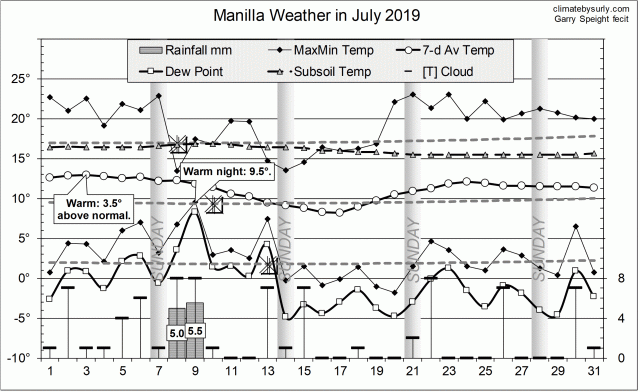
Only the middle week of July was not warmer than normal. Nearly all days and nights were above average for this coldest time of the year, but none was exceptional. No night minimum was as warm as ten degrees. There were 15 frosts (normally 17), but, as happened in July 2009 and 2010, there were no severe frosts reading below minus two degrees in the screen.
Rain was recorded on the 8th and 9th, estimated as 5.0 mm and 5.5 mm.

Weather log July 2019

Comparing July months

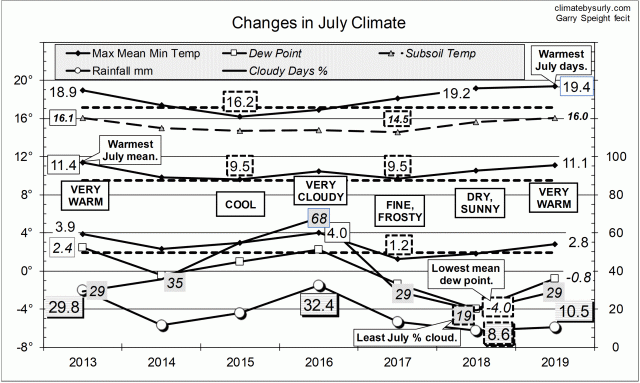
The last three July months saw maximum, mean, and minimum temperatures steadily rising, with the temperature range (17 deg) staying high. That was not true earlier in the decade: from 2008 to 2012 temperatures were steady and the daily temperature range (14 deg) was low, with cool days and warm nights. It was the case again in July 2015 and 2016, as shown here.
Indicators of moisture were again low, but not as low as in July 2018, with its record low dewpoint and cloudiness. The (estimated) rainfall total of 10.5 mm is at the 14th percentile for July.

Climate at July 2019

Drought

I have reported separately on the on-going drought that continues to break low-rainfall records at durations of 15-months and longer.


Data. A Bureau of Meteorology automatic rain gauge operates in the museum yard. From 17 March 2017, 9 am daily readings are published as Manilla Museum, Station 55312.  These reports use that rainfall data when it is available.  Since no 9 am readings have been recorded since August 2018, I have substituted my non-standard gauge readings for all days.
All other data, including subsoil at 750 mm, are from 3 Monash Street, Manilla.

3-year trends to July 2019

Record dry and warm (as smoothed)

3-year climate trends to July 2019

July raw anomaly data (orange)

Temperatures

Daily maximum temperature anomaly (all x-axes): above the maximum for smoothed values.
Daily minimum temperature anomaly (lower left): just above the upper limit of normal values.
Subsoil temperature anomaly (lower right): very high.

Moistures (moist is at the bottom)

Rainfall anomaly (upper left): very low.
Cloudiness anomaly (upper right): normal.
Dew point anomaly (middle left): low, like the other recent values.
Daily temperature range anomaly (middle right): very high.

 Latest fully smoothed data (red), January 2019

Temperatures

Daily maximum temperature was a new record positive value of +1.79 deg, beating +1.62 deg set in March and December 2018.
Daily minimum temperature set a new record of +2.18 deg, beating +1.98 deg set the previous month.
Subsoil was normal due to phase lag.

Moistures (moist is at the bottom)

Rainfall smoothed anomaly was a new 136-year record value of minus 31.75 mm per month, breaking the record of minus 30.8 mm set the previous month.
Cloudiness was normal.
Dew point was low.
Daily temperature range was normal.


Notes:

January data points are marked by squares.

Smoothing Continue reading