Dry September 2019

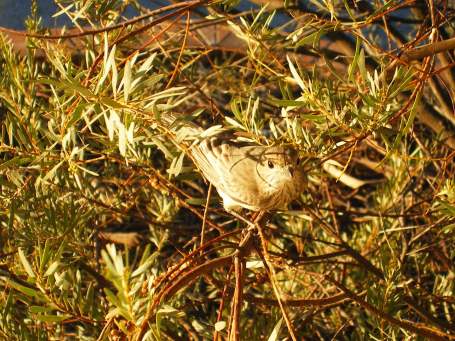
Striped Honeyeater at the Window

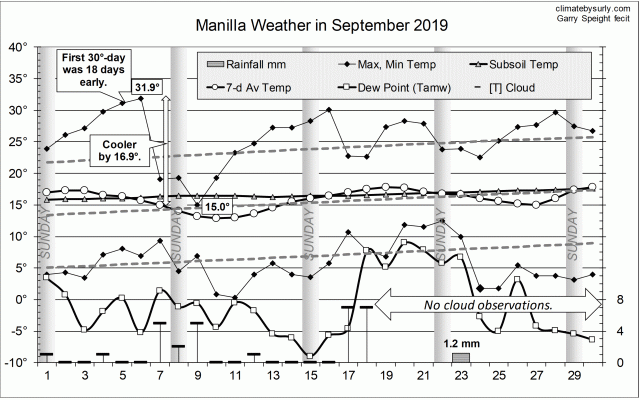
Weekly average temperatures increased slightly, as is usual in September. Unusual day temperatures came early in the month. The first 30-degree day was 18 days early, on the 5th. The next day was the hottest of the month, at 31.9°. During the next 3 days the daily maximum temperature fell by 16.9° to 15.0°, the coldest day of the month. Later, temperatures stayed closer to normal. There were 4 frosts, the usual number.
At the Manilla Museum, 1.2 mm of rain was recorded on the 23rd.
Comparing September months

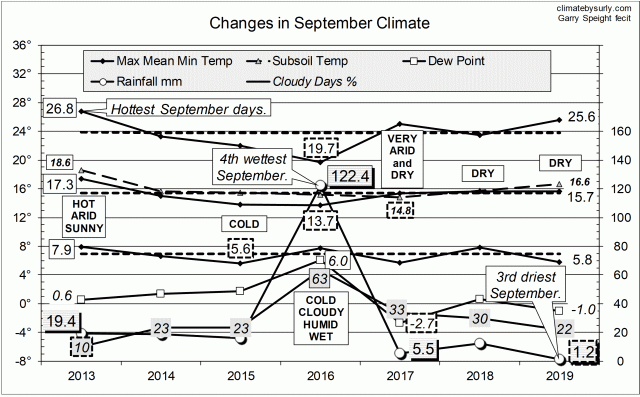
The last three September months have all been dry, with low dew points, wide daily temperature ranges and not much cloud. They have not been nearly as hot as September of 2013, however.
The rainfall total of 1.2 mm is the 3rd lowest September reading, after 0 mm in 1980 and 1 mm in 1925. By way of contrast, the second graph also includes the deluge of 122.4 mm in September 2016, the 4th wettest on record.
Drought

I will report separately on the on-going drought that continues to break low-rainfall records at durations of 15-months and longer.


Data. A Bureau of Meteorology automatic rain gauge operates in the museum yard. From 17 March 2017, 9 am daily readings are published as Manilla Museum, Station 55312.  These reports use that rainfall data when it is available. Recording resumed on 20 July 2019.
My estimates of early morning dew point have drifted anomalously low. From August 2019, I use data from the Tamworth Airport published graphs.
All other data, including subsoil at 750 mm, are from 3 Monash Street, Manilla.

3-year trends to August 2019

Summer record hot-dry (as smoothed)

3-year climate trends to August 2019

August raw anomaly data (orange)

Temperatures

Daily maximum temperature anomaly (all x-axes): near the maximum for smoothed values.
Daily minimum temperature anomaly (lower left): near normal.
Subsoil temperature anomaly (lower right): very high.

Moistures (moist is at the bottom)

Rainfall anomaly (upper left): very low.
Cloudiness anomaly (upper right): normal.
Dew point anomaly (middle left): low, like the other recent values.
Daily temperature range anomaly (middle right): very high.

 Latest fully smoothed data (red), summer 2018-19

Temperatures

Daily maximum temperature anomaly peaked at a record +1.79° in January.
Daily minimum temperature anomaly held the record vaue of +2.16° through January and February.
Subsoil rose rapidly from normal.

Moistures (moist is at the bottom)

Rainfall smoothed anomaly peaked negative in January at the record value of minus 31.75 mm per month.
Cloudiness was normal.
Dew point was low.
Daily temperature range was normal.


Notes:

January data points are marked by squares.

Smoothing Continue reading

Winter 2019 lowest rainfall?

White box eucalyptus tree

White Box Tree

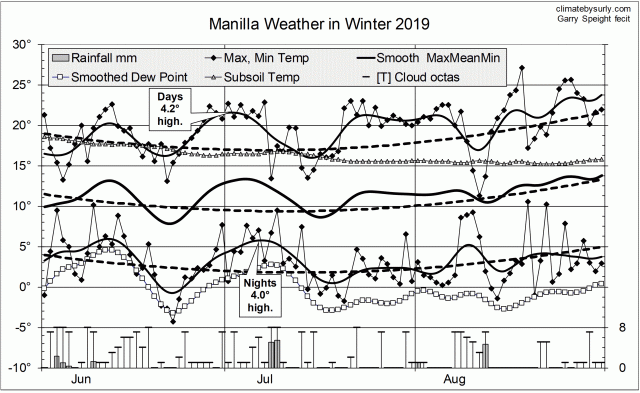
There were several warm spells, mainly as warm days. The warmest was in early July, when days were 4.2° high and nights 4.0°. The only unusual daily temperatures were one high maximum of 27.1° and one low maximum of 11.3° in July.

There were 41 frosts, normally 44.
As in the drought year of 2002, there were only 8 rain days. The highest reading (estimated) was only 5.5 mm on 9 July.

Weather log winter 2019

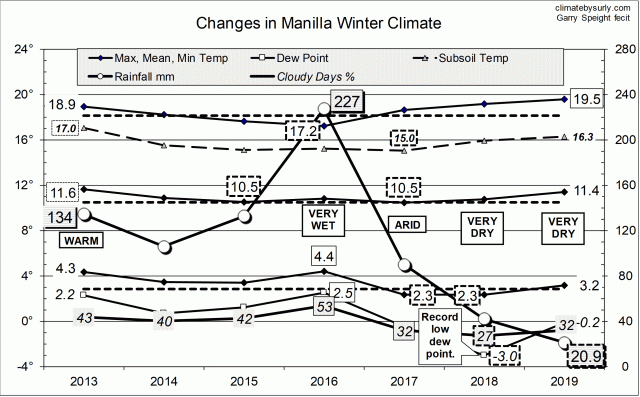
This winter had the warmest days of the new century (19.5°) but nights that were near normal (3.2°).
Apart from the extremely low rainfall, the other moisture indicators (little cloud, low dew point, wide daily temperature range) were not as severe as in winter 2018.
The total rainfall of 20.9 mm is the 2nd lowest on record for winter. However, it may actually be the lowest. Although the year 1888 had recorded winter rainfall of only 6 mm, there is doubt about that. Daily readings are missing for June and July. The next lowest was 1946, with 29 mm, then 1972 and 1982, both with 32 mm.

winter climate 2019


Data. A Bureau of Meteorology automatic rain gauge operates in the museum yard. From 17 March 2017, 9 am daily readings are published as Manilla Museum, Station 55312.  These reports use that rainfall data when it is available. In this season, I used my own readings until 20 July, when the Museum gauge began recording again. My estimates of early morning dew point have become anomalously low. From 1 August 2019, I use values taken from Tamworth Airport graphs at the time of minimum temperature.
All other data, including subsoil at 750 mm, are from 3 Monash Street, Manilla.
New drought records in August 2019

Rainfall status July-August 2019

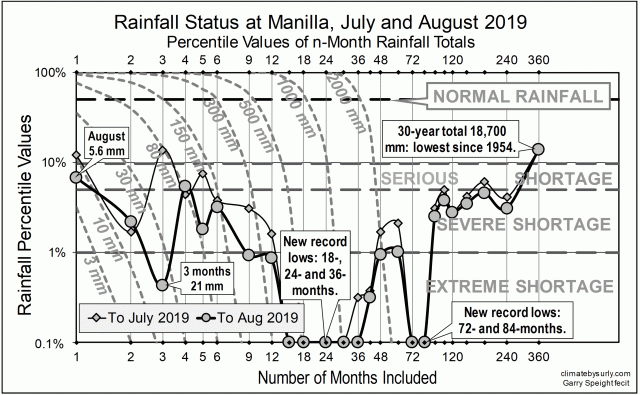
Graph of Rainfall Shortages

This graph shows all the present rainfall shortages at Manilla, short term and long term, as percentile values. The latest values, as at the end of August, are shown by a thick black line with large circles. Those from one month earlier are shown by a thinner line with small diamonds. [The method is described in “Further Explanation” below.]

Record low rainfall values

August rainfall of only 5.6 mm at Manilla has brought more drought records. The rainfall totals for 18-, 24-, 36-, 72-, and 84-months are new record lows.
The record-low 36-month total is remarkable. Only the great droughts of 1947, 1914, and 1967 had rainfall nearly so low for so long, but the current 36-month total (1283 mm) is more than 50 mm lower than in those great droughts. Given that Manilla’s mean  annual rainfall is 652 mm, 1283 mm represents less than two years of rainfall in three years.

Severe and extreme rainfall shortages

For plotted durations longer than four months, only the very longest (30 years) is not a severe or extreme rainfall shortage. For durations beyond 84 months (including 30 years) every total is lower than has been seen since 1954, 65 years ago.


Further Explanation

The following notes explain aspects of this work under these listed headings:

Data analysis

Cumulative rainfall totals
Percentile values
Severity of rainfall shortages

Limitations of this analysis

Monthly rainfalls form a single population
Observations are not retrospective
The rain gauge failed

Data analysis

Continue reading

Dry August 2019

Blossoms on a street tree

August Blossoms

Weekly average temperatures steadily increased as is usual in August. Day and night temperatures also were not far from normal. The warmest day reached 27.1° and the coldest night -1.4°. There were 15 frosts, the usual number.
Rain was recorded at the Manilla Museum on the 1st (1.0 mm) and the 12th (4.6 mm).

Weather log august 2019

Comparing August months

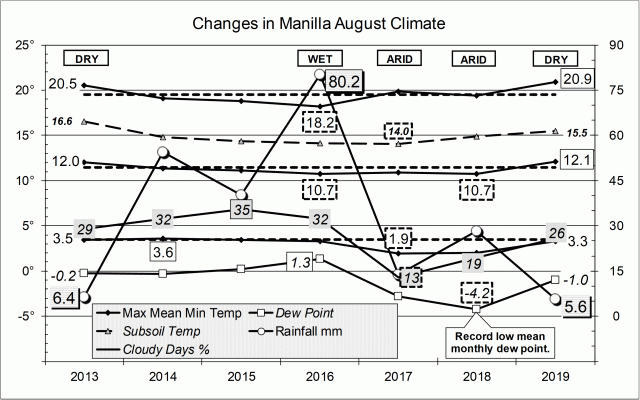
This dry month was very like August 2013, with the August months between being mainly rather cooler and wetter.
The mean maximum temperature (20.9°) was above normal by 1.4°, and the mean minimum temperature (3.3°) was near normal. The resulting temperature range (17.6°) was high, agreeing with the rather low cloudiness (26%) and dew point (-1.0°).
The rainfall total of 5.6 mm is at the 8th percentile for August.

Climate for August 2019

Drought

I have reported separately on the on-going drought that continues to break low-rainfall records at durations of 15-months and longer.


Data. A Bureau of Meteorology automatic rain gauge operates in the museum yard. From 17 March 2017, 9 am daily readings are published as Manilla Museum, Station 55312.  These reports use that rainfall data when it is available.  No 9 am readings were recorded from August 2018 to 19 July 2019. Recording resumed on 20 July 2019.
My estimates of early morning dew point have drifted anomalously low. From August 2019, I use data from the Tamworth Airport published graphs.
All other data, including subsoil at 750 mm, are from 3 Monash Street, Manilla.