One- and two-year droughts recur in January 2019

Drought contour plot to Jan 2019

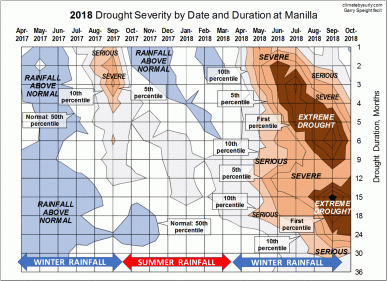
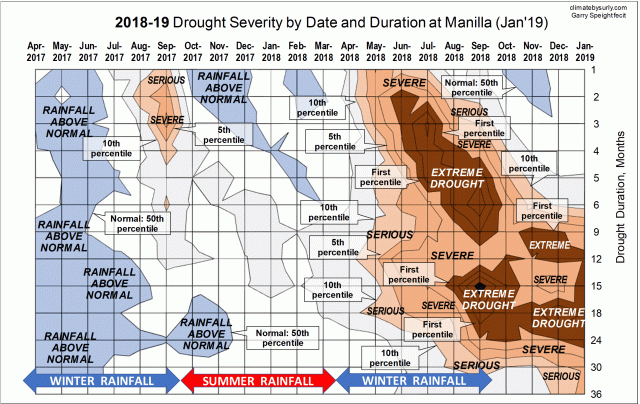
This contour plot shows the progress of the extreme drought at Manilla up to January 2019. Colours show rainfall shortages as percentiles. Dates plot along the top, and durations down the side.

One month rainfall totals (on the top row)

By January 2019, there had been six months without serious monthly rainfall shortages. The months of serious rainfall shortage (light brown) were earlier, in May, June and July 2018. The only other month with such low rainfall was September 2017.

Droughts lasting less than one year (rows 2, 3, 4, 5, 6, 9)

As the effects of low monthly rainfall added up, extreme droughts appeared (dark brown). That is, rainfall totals below the 1st percentile. (They are the lowest rainfall totals, that have occurred in less than 1% of the historical record.)
By June 2018, the 2-month and 3-month totals were already extreme shortages. Similarly, by July, the 3-month, 4-month, and 5-month totals were extreme shortages. By September 2018, extreme shortages extended as far as the 9-month total. That total, adding up the nine months from January to September 2018, included only one month (February) that had rainfall above normal.
In these durations of less than one year, extreme droughts were rare after September 2018. Because the last six months had no serious monthly shortages, the final month (January) includes no serious shortages for durations from 2 months up to 6 months.

Droughts of 1 year to 2 year duration (rows 12, 15, 18, 24)

By August 2018, an extreme 15-month drought appeared. That 15-month total then included not only the dry months of winter 2018, but also the dry month of September 2017. By September 2018, the 15-month total became the driest on record (400 mm). By October all four droughts in this group (12-, 15-, 18-, and 24-month droughts) were extreme. This became true again in January 2019. By that date, some of the dry months of 2017 were no longer included, but dry months in the current summer replaced them in the total.


Related graphs

A similar contour plot with data to October 2018 is here.

A line graph of the rainfall status for January 2019 reveals that extreme shortages also exist now at the much longer durations of six years and seven years that are not included in this contour plot.


Notes

The following notes include:

Classes of rainfall shortage

Rainfall rate versus percentile rank

Limitations of this analysis

Note: Classes of rainfall shortage

Continue reading

Driest 6 years since 1903

The six-year rainfall total of 3142 mm to January 2019 was the lowest in a century. The only lower totals ended in the months January, February, and March 1903.

Rainfall shortages at Dec 2018 and Jan 2019

Graph of Rainfall Shortages

This graph shows all the present rainfall shortages at Manilla, short term and long term, as percentile values. The latest values, as at the end of January, are shown by a black line with large circles. Those from one month earlier, at the end of December, are shown by a thinner line with smaller circles.

Changes this month

The pattern

At this date, rainfall totals for short periods, one month to six months, are below normal but they are not serious shortages (below the 10th percentile). Now, nearly all rainfall totals for nine months up to twenty years are serious shortages or worse. Extreme shortages (below the first percentile) occur at durations from 12 months to 24 months, and at 6 and 7 years. Severe shortages (below the 5th percentile) have now developed at 30 months, 36 months and 48 months.

Short-term shortages

At durations less than nine months, rainfall shortages hover around the 20th percentile. While not classed as “serious”, such values cause the drought to extend to ever longer durations.

Extreme shortages

There are now extreme shortages (1st percentile) at durations of 12 months (331 mm), 15 months (444 mm) 18 months (548 mm), and 24 months (821 mm). The extreme 7-year shortage has now worsened, to become the 7th driest on record. However, the 6-year shortage is even worse, the 4th driest.

Long-term shortages

In the longer term, serious shortages at 8 years, 10 years and 20 years persist from the December graph, and a new one appears at 15 years.
Such long-term rainfall shortages were common early in the 20th century. They have hardly occurred since the Keepit Dam was built in 1960.


Further Explanation

Drought 2018 contour chartMuch more detail was given in the post: “Contours of Manilla’s 2018 Drought” (with data up to October only). Notes include: “Long-term shortages”, “Classes of rainfall shortage”, and “Manilla rainfall records”.

2018 the second driest year

The calendar year 2018 was the second driest in 136 years at Manilla NSW

Log of Manilla annual rainfall

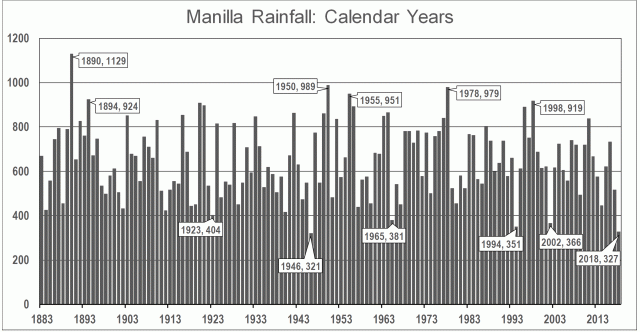
With a rainfall total of 327 mm (estimated), 2018 was the second driest calendar year in Manilla’s record from 1883. The driest was 1946, which had 321 mm. On the graph, the six driest years are marked, as well as the six wettest.
The official record of rainfall at Manilla Post Office, Station 55031, was continuous from March 1883 to 26 March 2015. It failed for lack of a volunteer observer. Since then the official record has been fragmentary. It relies on an automatic rain gauge, Manilla (Museum) Station 55312, which was faulty before it was re-sited, and has failed repeatedly since. Most of the rainfall readings used for this graph since March 2015 are from my non-standard rain-gauge on a non-standard site in Monash Street. They generally matched readings from the Manilla (Museum) automatic rain gauge when it was serviceable, but they have no official standing. A neighbour’s readings are similar but 10% higher. Those readings totalled 363.5 mm for the year 2018, which would make it not the second driest year, but the third driest year, after 1994 (351 mm).

Driest 18 months in 50 years

In December 2018, droughts of long duration got worse.

Rainfall shortage November-December 2018

Graph of Rainfall Shortages

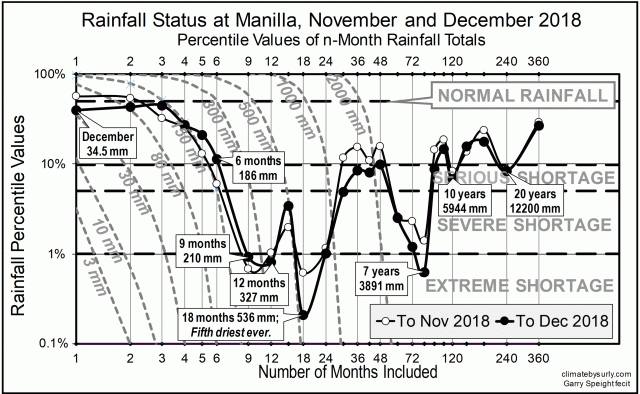
This graph shows all the present rainfall shortages at Manilla, short term and long term, as percentile values. The latest values, as at the end of December, are shown by a black line with black circles. Those from one month earlier, at the end of November, are shown by a thinner line with smaller white circles.

Changes this month

Short-term shortages

Although December rainfall (34.5 mm) was below normal, it was enough to keep the totals for 2, 3, 4, and 5 months above the level of “serious shortage”. Because the 6-month total rose to 186 mm, it too did not count as a serious shortage.

Extreme shortages

There were extreme shortages (1st percentile) at durations of 9 months (210 mm), 12 months (327 mm), 18 months (536 mm) and 7 years (3891 mm). The 18-month shortage was the most extreme, being the fifth lowest in history, after four lower values in 1966 (the lowest: 514 mm). The extreme 7-year shortage that has now appeared is lower than any since 1942.

Worsening long-term shortages

This drought brings worsening long-term rainfall shortages. Among the 14 selected durations longer than 2 years that are shown here, 10 of them are now serious shortages (10th percentile) or worse.
As well as the extreme 7-year shortage, two serious shortages that appeared in November are now worse: the 10 year total fell from 5964 mm to 5944 mm, and the 20-year total fell from 12209 mm to 12200 mm. The 10-year shortfall amounts to nearly one year of rain.
Such long-term rainfall shortages were common early in the 20th century. They have hardly occurred since the Keepit Dam was built in 1960.


Further Explanation

Drought 2018 contour chartMuch more detail was given in the post: “Contours of Manilla’s 2018 Drought” (with data up to October only). Notes include: “Long-term shortages”, “Classes of rainfall shortage”, and “Manilla rainfall records”.

November Drought Gets Longer

In November 2018, the drought faded in the short term, but became worse in the long term.

Rainfall Oct Nov 2018 Manilla

Graph of Rainfall Shortages

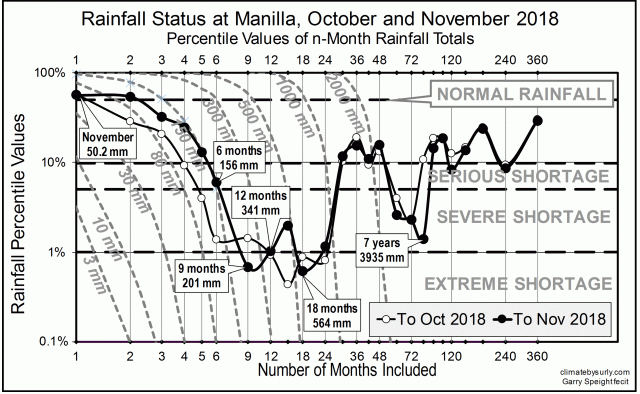
This graph shows all the present rainfall shortages at Manilla, short term and long term, in terms of percentile values. The latest values, as at the end of October, are shown by a black line with black circles. Those from one month earlier, at the end of October, are shown by a thinner line with smaller white circles.

Changes this month

November rainfall was almost normal at 50.2 mm, further raising the totals for 2, 3, 4, and 5 months, so they did not qualify as serious shortages. The 6-month total of 156 mm qualified as a serious shortage.
The remaining extreme shortages were at 9 months (201 mm) and 18 months (564 mm).

Worsening long-term shortages

Rainfall totals for periods from 72 months to 360 months (6 years to 30 years) are now all below normal. In decades before September 2017 those totals had been normal. (See the September 2017 plot on the graph in this earlier post.)

Three of the current data points are far below normal. The 7-year total (3935 mm) is a severe (almost extreme) shortage, not seen since 1946. The 120-month (10-year) total (5986 mm) is a serious shortage, not seen since 1967. Similarly, the 240-month (20-year) total is a serious shortage, not seen since 1949.
Such long-term rainfall shortages were common early in the 20th century. They have hardly occurred since the Keepit Dam was built in 1960.


Further Explanation

Drought 2018 contour chartMuch more detail was given in the post: “Contours of Manilla’s 2018 Drought” (with data up to October only). Notes include: “Long-term shortages”, “Classes of rainfall shortage”, and “Manilla rainfall records”.