Indoor versus Outdoor Minima (1096 days)

Indoor-Outdoor minimum temperature scatter-plot

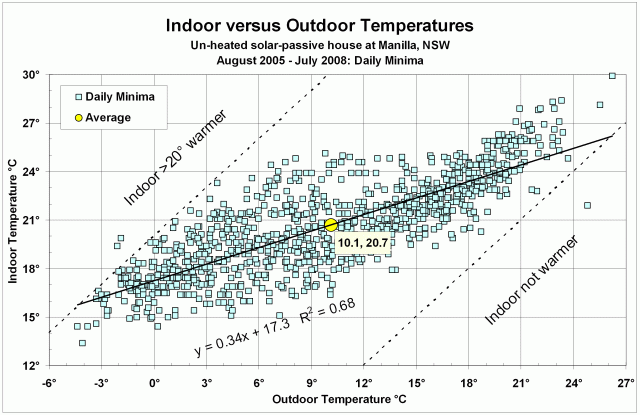
This scatter-plot shows only daily minimum temperatures, indoors and outdoors, and displays the average values. The Manilla average outdoor minimum of 10.1° is far too cold for comfort. Solar-passive design has raised the indoor minimum by 10.6° without applied heating. The indoor average minimum of 20.7° is near the middle of the comfort zone.

The slope of the linear regression line shows that indoor minima vary only 34% as much as outdoor minima. This results from effective insulation, daily and seasonal heat storage in thermal mass material, and warmth from the sun captured in winter.
A dashed line in the lower right shows that nearly all points have indoor minima warmer than outdoor minima. This is a disadvantage only on nights warmer than about 20 deg.

A dashed line in the upper left shows that many cold nights have indoor minima nearly 20° warmer than outdoors. One morning (9/5/06) the indoor temperature was 21.8° warmer than outdoors. Could this be a record for an unheated house?  Such large over-temperatures come with very dry air in autumn and early winter.

This post is one of a set of four back-dated to June 2010:
Indoor versus Outdoor Temperatures (1096 days)
Indoor versus Outdoor Minima (1096 days) (This post.)
Indoor versus Outdoor Maxima (1096 days)
Indoor/Outdoor Regressions for Maxima and Minima

[For a more personal perspective, there are testimonials.]


This article was originally posted in the weatherzone forum thread “Indoor Climate” on 7th June 2010. It is backdated here to 17th June 2010.
 

Indoor versus Outdoor Temperatures (1096 days)

Indoor-Outdoor temperature scatter-plot

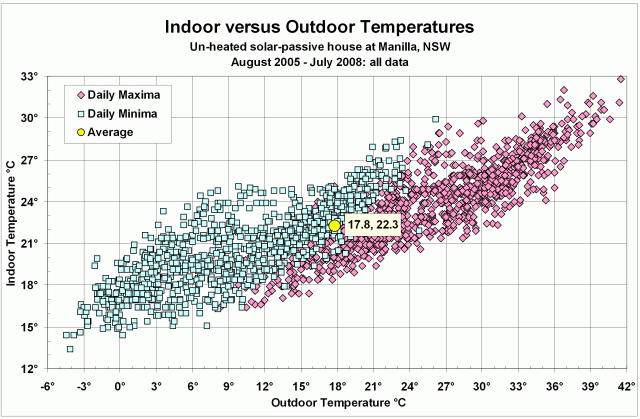
This is a scatter-plot of indoor and outdoor daily maximum and minimum temperatures for a solar-passive house in Monash Street, Manilla, NSW. The house is not heated or air-conditioned.

Data in this graph are taken from two thermometers; one in a Gill-type thermometer screen seven meters from the house (photo in Gallery), and one on a wall in a core room of the house. The data are for the first three years of good screen readings.

The graph shows that indoor temperatures vary only 42% as much as outdoor temperatures. The outdoor temperature range is 45.9° (from -4.4° to 41.5°), but the indoor temperature range is only 19.4° (from 13.4° to 32.8°). Most indoor temperatures are within the “adaptive comfort zone”. Average temperatures are 17.8° outdoors and 22.3° indoors. The house raises the indoor average by 4.5° to near the ideal for comfort.

There is a similar three-year scatter plot for a solar-passive house at Bonnyrigg, near Liverpool, Sydney in “Energy Efficient Housing for New South Wales” by Ballinger, Prasad and Cassell.
Very likely the data is in this paper by John Ballinger:
I think Ballinger’s scatter-plot for a house near Liverpool must include daily maxima and minima as mine does. His extreme outdoor points are 40° and +1° (range 39°) and extreme indoor points 32° and 12° (range 20°). In broad terms these two houses seem to yield similar levels of comfort, but the Manilla house does it in a more extreme climate. Manilla’s daily temperature range is 15.5°, while Prospect Reservoir, near Bonnyrigg, has only 10.9°.

This post is one of a set of four back-dated to June 2010:
Indoor versus Outdoor Temperatures (1096 days) (This post.)
Indoor versus Outdoor Minima (1096 days)
Indoor versus Outdoor Maxima (1096 days)
Indoor/Outdoor Regressions for Maxima and Minima


This article was originally posted in the weatherzone forum thread “Indoor Climate” on 5th June 2010. It is backdated here to 15th June 2010 and made sticky 9th July 2014.

Extremely Cloudy Autumn 2010

Weather log autumn 2010

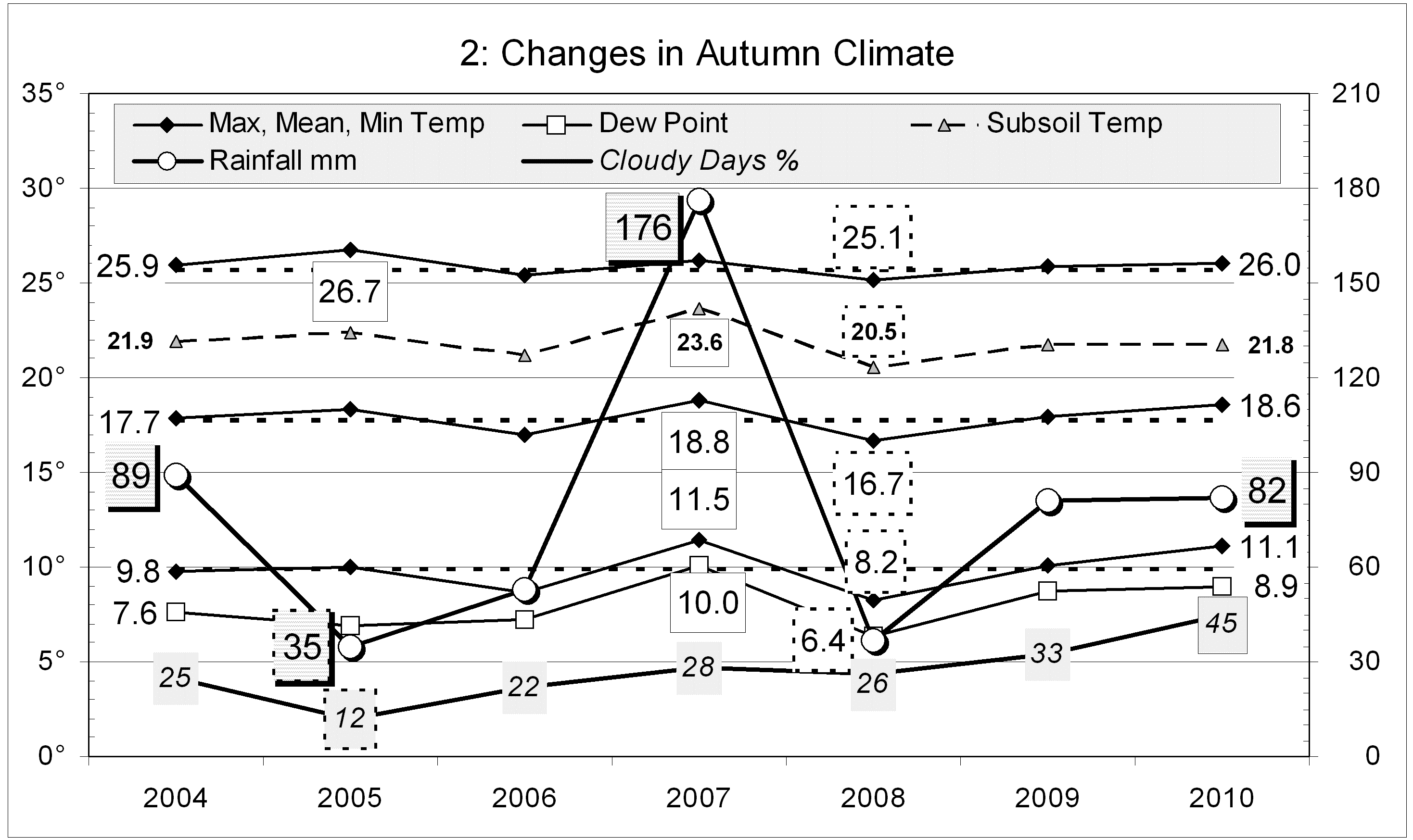
There were dry spells in mid-March, mid-April and early May. Each had very low humidity and mainly sunny weather. The first two had very warm days, but the third had cold nights. The final week brought one third of the season’s rain, with overcast skies, very high humidity, and very warm nights.
In all, there were 16 rain days, totalling 82.0 mm. No rain day exceeded 10 mm.
The subsoil temperature (750 mm depth) fell as is normal for autumn in Manilla, pausing for a few days after each peak in air temperature. By the end of the season, the subsoil was as warm as the air during the heat of the day.


This year, each of the months March, April and May was the cloudiest in the 11 year record. As a result, this autumn (45%) was also the cloudiest. Of 92 mornings, 41 were cloudy (>4/8 cloud): nearly twice the usual number of 23. The previous highest (last year) had only 30 cloudy mornings.
Due to the cloud, the daily temperature range (14.9°) was a degree narrower than usual. As the mean temperature was rather high, the result was a daily minimum temperature a degree above normal. Other temperatures, and the Dew Point, were near normal.
The total rainfall of 82 mm is again on the 30th percentile for autumn. It is 31 mm below the autumn median rainfall (113 mm).

Climate autumn 2010

Data. Rainfall data is from Manilla Post Office, courtesy of Phil Pinch. Temperatures, including subsoil at 750 mm, and other data are from 3 Monash Street, Manilla.

3-year trends to May 2010

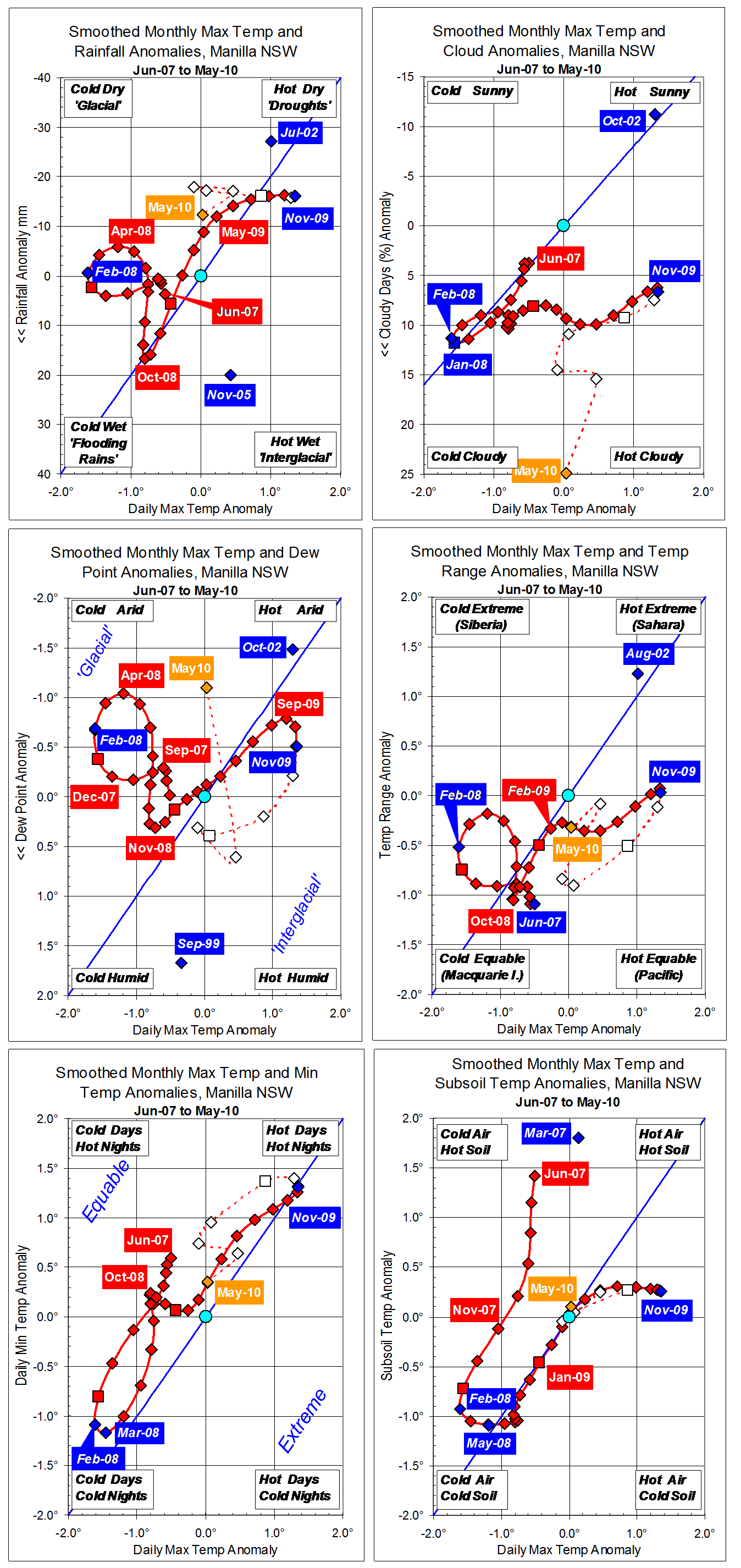
Parametric plots of smoothed climate variables at Manilla
“Temperatures normal”

Trends to May 2010

Manilla’s climate in the last three years has been marked mainly by cloudier skies and a narrower daily temperature range.

Raw anomaly values for climate variables for May 2010 (orange) were normal for daily maximum, daily minimum, and subsoil temperatures and for daily temperature range. Rainfall and humidity (dew point) were rather low, but skies were very cloudy.
Fully-smoothed data (red) for November 2009 showed a record value for daily maximum temperature anomaly, which seemed likely to be a peak value.

Note:
Fully smoothed data – Gaussian smoothing with half-width 6 months – are plotted in red, partly smoothed data uncoloured, and raw data for the last data point in orange. January data points are marked by squares.
Blue diamonds and the dashed blue rectangle show the extreme values in the fully smoothed data record since September 1999.


(Note added in May 2014:

This post titled “3-year trends to May 2010” is the first of a consecutive series of parametric plots, updated monthly at the time of observation and originally posted elsewhere.
Data exists back to March 1999, but the earlier data was not edited in this form at the time.
To display all existing fully-smoothed data points at least once, I have prepared back-dated posts in this same format for:
“3-year trends to August 2002” which includes smoothed data September 1999 to February 2002, covering the calendar years 2000 and 2001.
“3-year trends to August 2004” which includes smoothed data September 2001 to February 2004, covering the calendar years 2002 and 2003.
“3-year trends to August 2006” which includes smoothed data September 2003 to February 2006, covering the calendar years 2004 and 2005.
“3-year trends to August 2008” which includes smoothed data September 2005 to February 2008, covering the calendar years 2006 and 2007.)

Damp end to cloudy May 2010

The daily weather logWeather log May 2010

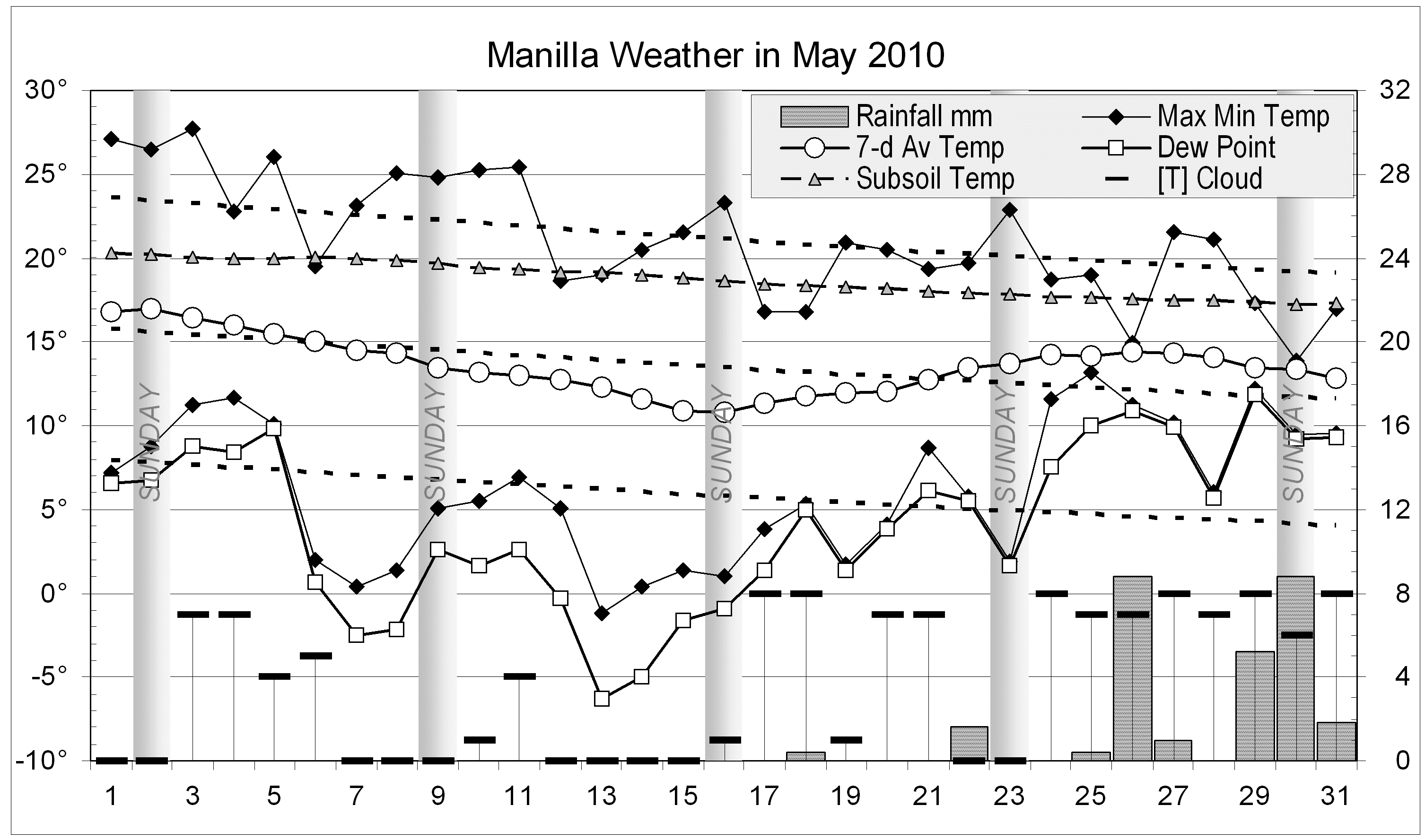
Dry weather with warm days and cool nights lasted most of the month. On the 13th the early morning Dew Point of -6.3° set a record for low humidity in May. The seven-day average temperature was quite low in the second week. Nine mild frosts (usually 6) all came about this time. By the 25th there had been only 57 mm of rain in 14 weeks: an average of barely 4 mm per week. A serious rainfall shortage was developing, despite months of cloudy weather.
Late in the month nights became very humid and warm. Mornings had fog on the 18th and 22nd and mist (visibility one kilometre) on the 27th and 31st. Three days had more than 5 mm of rain. In all, the month had 8 rain days, totalling 28.0 mm.

 Comparing May monthsClimate May 2010

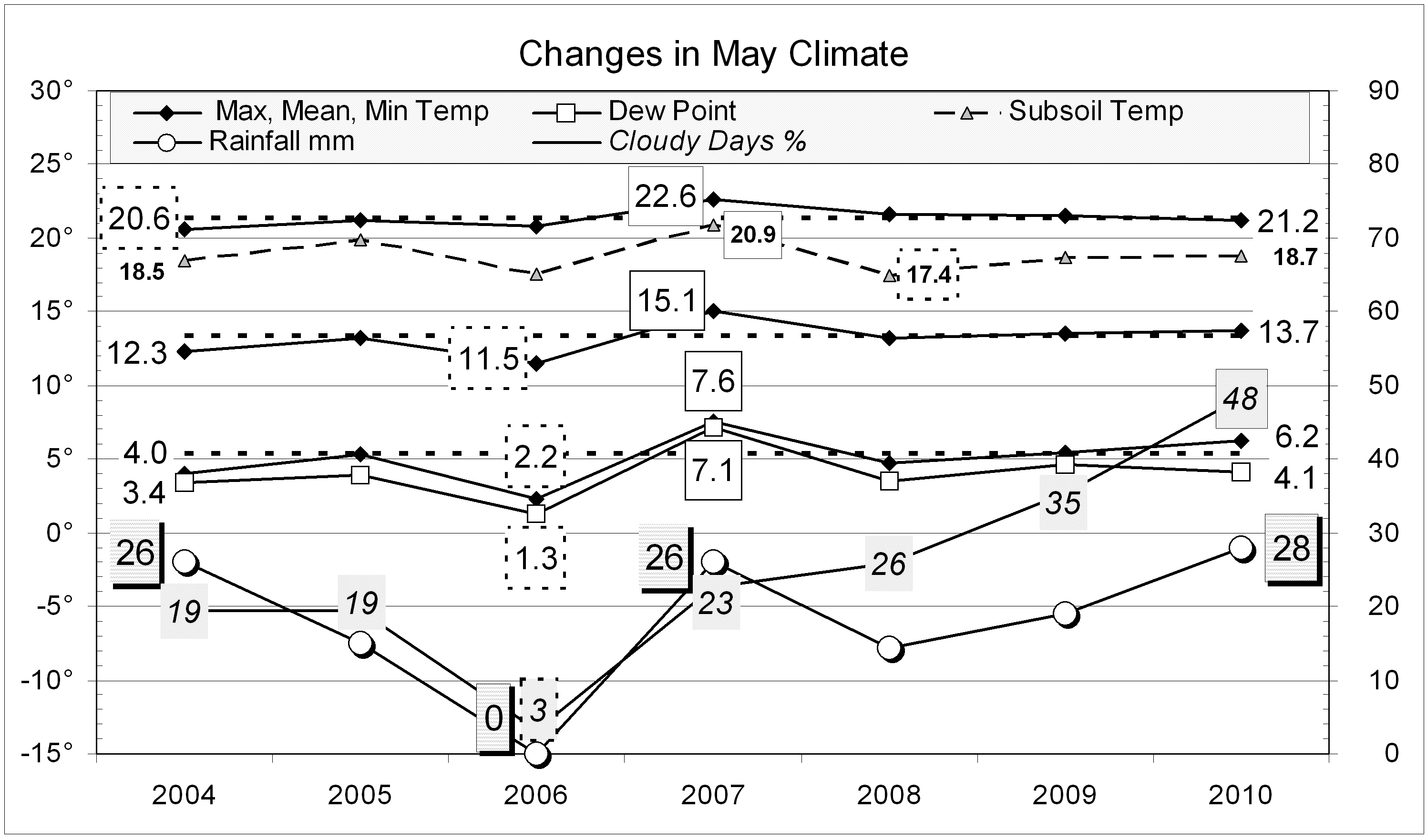
This was the cloudiest May in the 11-year record. The mean maximum temperature and the mean average were normal. The mean minimum was up, reducing the daily temperature range, and the mean Dew Point was down.
The rainfall of 28.0 mm is near the median for May (51st percentile). It is below the long-term average of 40 mm, but no May total has beaten the average since 1998! Rainfall totals for groups of months show just one serious shortage. The 15-month total (538 mm) is now down to the 7th percentile.

Subsoil Temperature

Both graphs now include subsoil temperature measured at 750 mm depth. There the temperature barely changes during a day. It changes slowly with the seasons. Usually it ranges from 26° in February to 14° in July.
As observed in Manilla, the  subsoil temperature does not relate to the normal average temperature of the air in a simple way. In May, it stays about five degrees warmer; in other autumn and winter months it is less than five degrees warmer. In spring and summer it is almost the same as the normal average air temperature.
In autumn 2007 the subsoil temperature was nearly two degrees warmer than usual; in autumn 2008 it was one degree cooler than usual. This is a puzzle, because the average air temperature did not change so much.


Data. Rainfall data is from Manilla Post Office, courtesy of Phil Pinch. Temperatures, including subsoil at 750 mm, and other data are from 3 Monash Street, Manilla.