3-year trends to May 2015

Parametric plots of smoothed climate variables at Manilla
“May 2015: less moist”
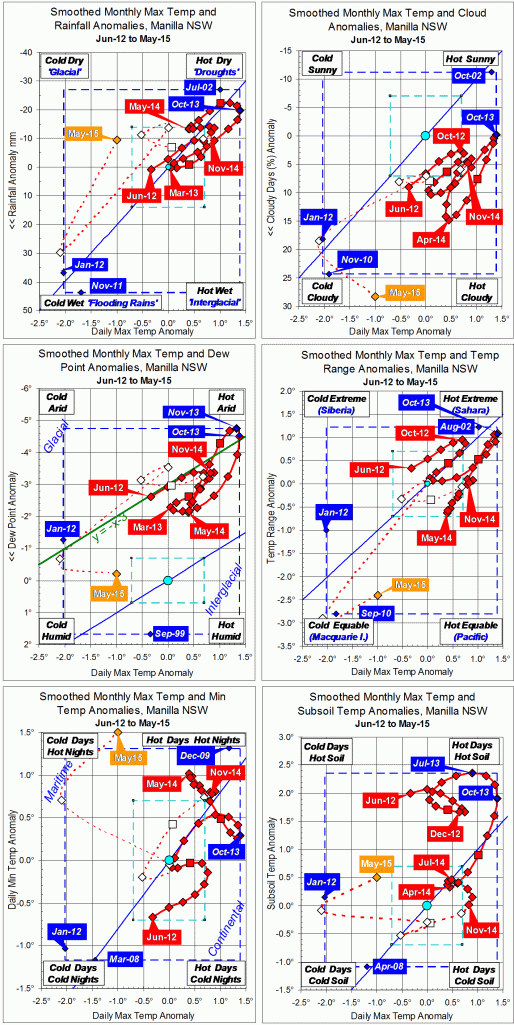
Trends to May 2015

May raw anomaly data (orange)

May anomalies moved back towards normal from the cool moist conditions of April for the variables daily maximum temperature, rainfall, and daily temperature range. Cloudiness, however, became extreme, as it had been in the (smoothed data) a year earlier. Daily minimum temperature became very high, keeping the climate in the “Maritime” area. This, again, prevailed just one year ago.

Fully smoothed data (red)

The latest fully-smoothed data anomalies (November 2014) complete the season for spring 2014 (SON). As is most clearly seen in the graph at the bottom right, the daily maximum temperature anomaly (smoothed) reached a minor maximum just above normal in October. Other variables moved little. All were “normal” except the Dew Point anomaly, which had the low value of minus three that has now become normal.

Springtime temperature peaks

Each of the spring seasons of 2012, 2013 and 2014 marked a peak in daily maximum temperature anomalies. Spring 2013 was the hottest, breaking the record for this data set. Spring 2013 also had extreme peaks of lowest rainfall, least cloud, lowest dew point, and highest daily temperature range. This is just what is expected at an extreme El Niño, but there was no El Niño at that time.


Note:

Fully smoothed data – Gaussian smoothing with half-width 6 months – are plotted in red, partly smoothed data uncoloured, and raw data for the last data point in orange. January data points are marked by squares.
Blue diamonds and the dashed blue rectangle show the extreme values in the fully smoothed data record since September 1999.

Normal values are based on averages for the decade from March 1999.* They appear on these graphs as a turquoise (turquoise) circle at the origin (0,0). A range of anomalies called “normal” is shown by a dashed rectangle in aqua (aqua). For values in degrees, the assigned normal range is +/-0.7°; for cloudiness, +/-7%; for monthly rainfall, +/-14 mm.

 * Normal values for rainfall are based on averages for the 125 years beginning 1883.
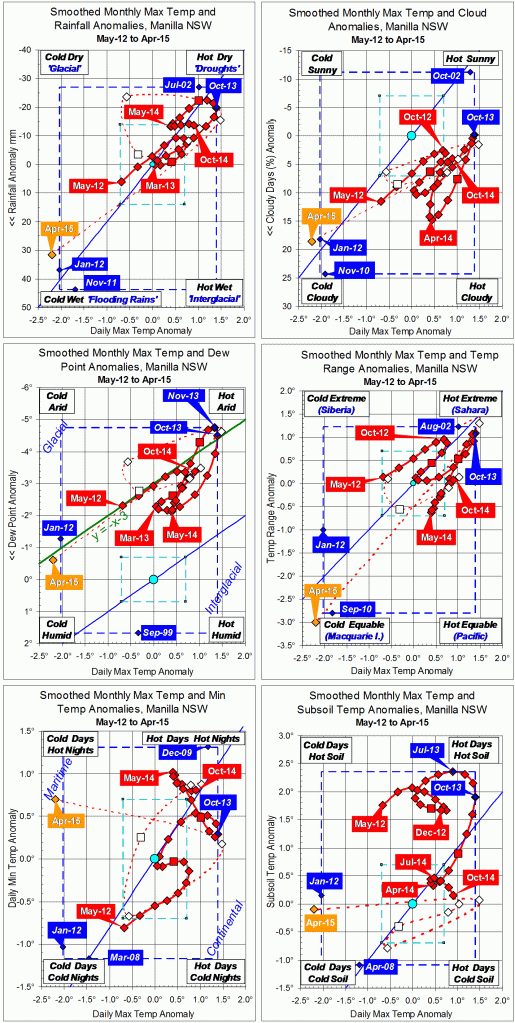
3-year trends to April 2015

Parametric plots of smoothed climate variables at Manilla
“April 2015: equable”

Trends to April 2015

  April raw anomaly data (orange)

In April, daily maximum temperature anomaly became very low (-2.1°) while daily minimum temperature anomaly remained high (+0.7°). Other anomalies, except subsoil temperature, moved down the graphs, showing moist conditions. The extremely low temperature range anomaly (-3.0°) shows that the climate was equable, as it had been in the spring of 2010 (a smoothed record value).

Fully smoothed data (red)

The latest fully-smoothed data anomalies (October 2014) moved little, being warm and slightly dry.

Loops in the subsoil anomaly graph

The parametric plot of subsoil temperature anomaly against that of daily maximum temperature (bottom right) shows several clockwise loops. That is, peaks or troughs of subsoil temperature precede those of daily maximum (air) temperature by a month or more. This is not what one would expect. Indeed, where graphs of these variables earlier in this sixteen-year record show such loops, they are always anti-clockwise. Subsoil temperature anmalies lag those of daily maximum air temperature. See the graphs for August 2002, August 2004, August 2006, August 2008, May 2010, and April 2012.

In the last mentioned graph, the three extreme points included show no lag between the two variables. That period, from early 2009 to late 2011 marks the transition from a stable regime of subsoil temperature lagging daily maximum air temperature to the current regime of subsoil temperature leading daily maximum air temperature.


Note:

Fully smoothed data – Gaussian smoothing with half-width 6 months – are plotted in red, partly smoothed data uncoloured, and raw data for the last data point in orange. January data points are marked by squares.
Blue diamonds and the dashed blue rectangle show the extreme values in the fully smoothed data record since September 1999.

Normal values are based on averages for the decade from March 1999.* They appear on these graphs as a turquoise (turquoise) circle at the origin (0,0). A range of anomalies called “normal” is shown by a dashed rectangle in aqua (aqua). For values in degrees, the assigned normal range is +/-0.7°; for cloudiness, +/-7%; for monthly rainfall, +/-14 mm.

 * Normal values for rainfall are based on averages for the 125 years beginning 1883.

3-year trends to March 2015

Parametric plots of smoothed climate variables at Manilla
“March 2015: hot”

Trends to March 2015

 March raw anomaly data (orange)

In March, the daily maximum temperature anomaly became very high (+1.6 degrees), but not nearly as high as the raw value had been in November (+5.1 degrees). Most other anomalies moved up the graphs towards “droughts” but not beyond normal values. Dew point remained as low as in February, and rainfall returned from very low to normal.

Fully smoothed data (red)

The latest fully-smoothed data anomalies (September 2014) moved a little towards “droughts” from the near-normal values of the winter.


Note:

Fully smoothed data – Gaussian smoothing with half-width 6 months – are plotted in red, partly smoothed data uncoloured, and raw data for the last data point in orange. January data points are marked by squares.
Blue diamonds and the dashed blue rectangle show the extreme values in the fully smoothed data record since September 1999.

Normal values are based on averages for the decade from March 1999.* They appear on these graphs as a turquoise (turquoise) circle at the origin (0,0). A range of anomalies called “normal” is shown by a dashed rectangle in aqua (aqua). For values in degrees, the assigned normal range is +/-0.7°; for cloudiness, +/-7%; for monthly rainfall, +/-14 mm.

 * Normal values for rainfall are based on averages for the 125 years beginning 1883.
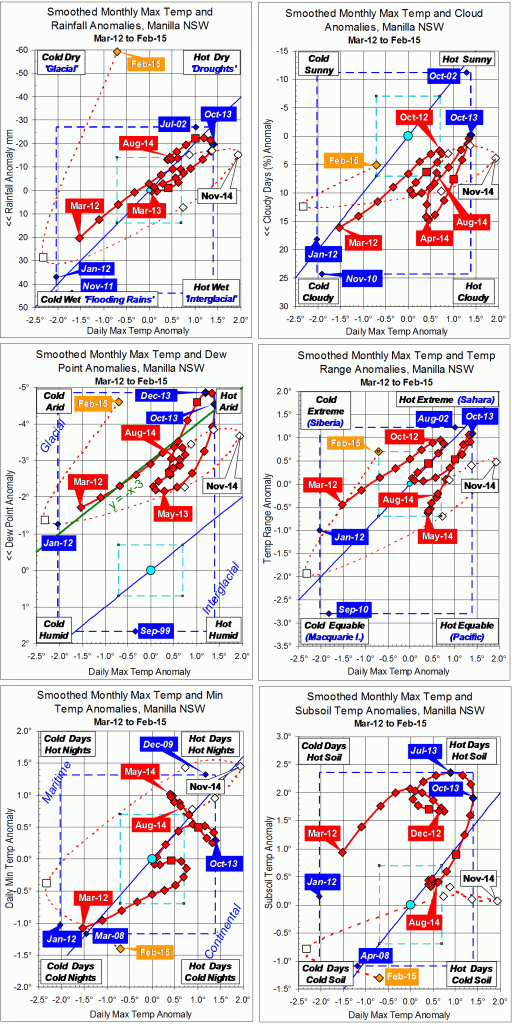
3-year trends to February 2015

Parametric plots of smoothed climate variables at Manilla
“February 2015: very dry”

Trends toFebruary 2015

  February raw anomaly data (orange)

In February, most anomalies moved back towards “droughts” from the “flooding rains” values of January. Rainfall became extremely low, but daily maximum temperature did not rise as far as “normal”.
Exceptionally, February daily minimum temperature and subsoil temperature became very low.

Fully smoothed data (red)

The latest fully-smoothed data anomalies (August 2014) complete the winter of 2014. Through the winter season, most values were static and near normal. (Dew point, like most recent values of that variable, was 3 degrees lower than normal.)


Note:

Fully smoothed data – Gaussian smoothing with half-width 6 months – are plotted in red, partly smoothed data uncoloured, and raw data for the last data point in orange. January data points are marked by squares.
Blue diamonds and the dashed blue rectangle show the extreme values in the fully smoothed data record since September 1999.

Normal values are based on averages for the decade from March 1999.* They appear on these graphs as a turquoise (turquoise) circle at the origin (0,0). A range of anomalies called “normal” is shown by a dashed rectangle in aqua (aqua). For values in degrees, the assigned normal range is +/-0.7°; for cloudiness, +/-7%; for monthly rainfall, +/-14 mm.

 * Normal values for rainfall are based on averages for the 125 years beginning 1883.

3-year trends to January 2015

Parametric plots of smoothed climate variables at Manilla
“January 2015: rainy cool days”

Trends to January 2015


January raw anomaly data (orange)

Anomalies for all variables except subsoil temperature moved across the graphs, from “droughts” in November to “flooding rains” in January. Subsoil temperature had been normal from February to December (11 months!), then became cooler than normal in January.
Most raw anomaly values for January were close to the fully-smoothed anomaly values of the La Niña-affected cool summer of 2012. This month’s daily temperature range was even narrower, and the subsoil temperature lower, but the daily minimum temperature was not so low.

Fully smoothed data (red)

The latest fully-smoothed data anomalies (July 2014) were near normal. (Dew point, like most recent values of that variable, was 3° lower than normal.)


Note:

Fully smoothed data – Gaussian smoothing with half-width 6 months – are plotted in red, partly smoothed data uncoloured, and raw data for the last data point in orange. January data points are marked by squares.
Blue diamonds and the dashed blue rectangle show the extreme values in the fully smoothed data record since September 1999.

Normal values are based on averages for the decade from March 1999.* They appear on these graphs as a turquoise (turquoise) circle at the origin (0,0). A range of anomalies called “normal” is shown by a dashed rectangle in aqua (aqua). For values in degrees, the assigned normal range is +/-0.7°; for cloudiness, +/-7%; for monthly rainfall, +/-14 mm.

 * Normal values for rainfall are based on averages for the 125 years beginning 1883.