Managing my low-energy house: I. Features needing no attention

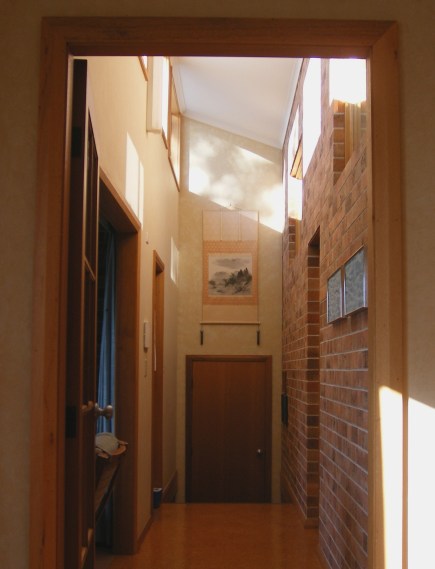
Photo of sunlit house interior

July sun heats the house

This post, and the companion post “II. Features needing attention” were posted originally to a forum of the Alternative Technology Association (See Note below.)

My low-energy house at Manilla, NSW, maintains year-round comfort in a climate of daily and seasonal extremes. In the climate classification of the Building Code of Australia, it is in Zone 4: “Hot dry summer, cool winter”, along with Tamworth, Mildura and Kalgoorlie.
This house differs from most houses in relying on the design of the house to achieve comfort, with hardly any energy needed for heaters or coolers.
There is little artificial control: the “home automation system” consists only of timers set twice a year. Some of the comfort features call for daily action in certain seasons. However, these simple daily chores could have been avoided by small changes in the design. [See “Note added 2016” below.]

The success of the house in maintaining comfort in all seasons is shown by scatter-plots of daily indoor and outdoor maximum and minimum temperatures over a period of three years.

I. Features needing no attention

Heat transfer to and from the heat bank

The mass of concrete, bricks and rubble under the concrete floor slab is edge-insulated with foam to a depth of half a metre to prevent heat leaking sideways to and from the surrounding soil and subsoil. This 150 tonne edge-insulated under-floor mass is a “heat bank” which absorbs and yields heat so slowly that it holds the same temperature (at 750 mm depth) within a degree for weeks at a time.
Double-brick walls (17 tonnes) inside the house, and the floor slab itself (28 tonnes), are also parts of the heat bank. Their exposed surfaces (See photo.) absorb heat from sunshine (and yield heat to cool flows of air) so as to spread heat (or coolness) around the rooms. Within each day they conduct heat to and from the rooms of the house, and from room to room. They then conduct heat slowly to and from the under-floor mass.
In the absence of the house, the under-floor mass would have the same temperature as the subsoil of the area. A thermometer at 750 mm in the subsoil near the house shows a 14.6° yearly temperature range, from 12.9° to 27.5°. Even an ordinary light-weight, poorly-insulated house built on a concrete slab on the ground here would be made more comfortable by these stable subsoil temperatures. Midsummer and midwinter temperatures in such a house (next door) are plotted here and here.
It is clear that temperatures in that conventional house vary much less than outdoor temperatures, and remain close to that of the subsoil. The heat bank under my solar-passive house has an even more stable temperature than that of the surrounding subsoil. (There is a graph showing one year of heat bank and subsoil temperatures here.)

Insulation

Thermal insulation reduces the flow of heat in and out of the house. With sufficient insulation, the heat of the day is replaced by the cool of night before the house becomes too warm. Insulation improves comfort permanently. Continue reading
February Climate Anomalies Log

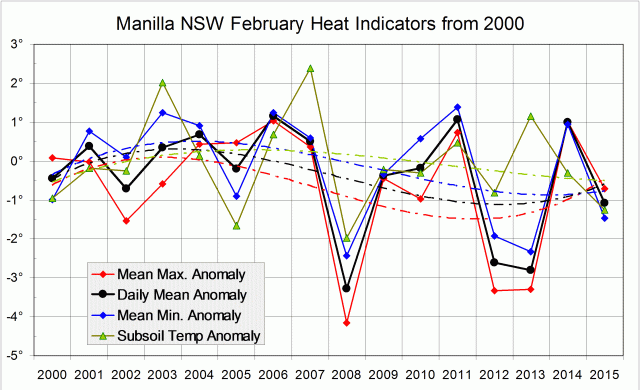
Heat indicators log for February

This post is the twelfth in a set for the 12 calendar months that began with March. Graphs are sixteen-year logs of the monthly mean anomaly values of nine climate variables for Manilla, NSW, with fitted trend lines. I have explained the method in notes at the foot of the page.

Raw anomaly values for February

Extreme values of February anomalies were as follows:

Daily Maximum Temperature Anomalies (3) -4.2 deg: February 2008; -3.3 deg: February 2012; -3.3 deg: February 2013;
Daily Mean Temperature Anomalies (1) -3.3 deg: February 2008;
Rainfall Anomalies (1) +120 mm: February 2012;
Dew Point Anomalies (2) -4.6 deg: February 2014; -4.6 deg: February 2015.

Trend lines for February

Heat Indicators

All heat indicator quartic trends began slightly low and ended slightly low. They had a low peak about 2004, and a trough later. The trough was deepest and earliest for daily maximum temperature (2011), followed by daily mean temperature in 2012, daily minimum temperature in 2014, and subsoil temperature in 2015 or later.

Moisture indicators log for February

Continue reading

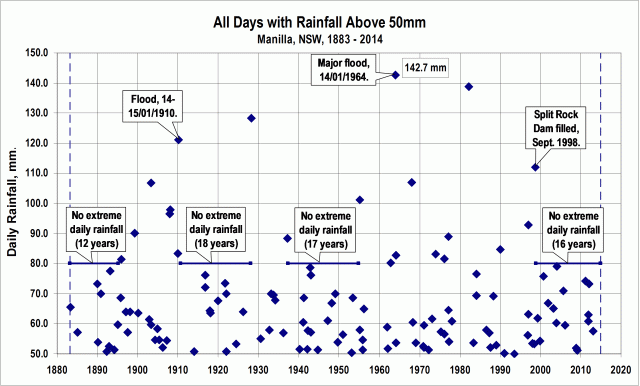
Log of Very Wet Days at Manilla.

Graphical log of days with over 50mm rain

In the 130-year record of very wet days at Manilla, NSW, extreme rainfalls have not become more common recently.

Data

I arranged all daily rainfall readings for Manilla, NSW, from March 1883 to December 2014 in order of rainfall amount, and selected only the 125 readings greater than 50 mm. I plotted the values against the date, expressed in years, to two decimal places. (See Note below.)

Result

The five highest readings

The five highest readings, greater than 110 mm per day, include events that gave rise to two floods and the filling of a reservoir newly-built to store water for irrigation. The highest daily reading, 142.7 mm, came with the highest flood known at Manilla, in 14/01/1964. Thus, the highest flood matches the highest daily rainfall. That is because nearly all the flood-water came down the Manilla River, which flows in a semi-circle, with none of the catchment area far away from the rain-gauge.
These five highest readings seem to fly in an arc above the rest, with a peak near the middle of the graph. The rise and fall of this arc may have no meaning, for there are very long gaps between the events. All the same, it is a fact that there were no readings above 110 mm per day in the decades before 1910 or after 1998.

Periods with no daily readings over 80 mm

Continue reading

Geoff’s solar-passive house at Manilla

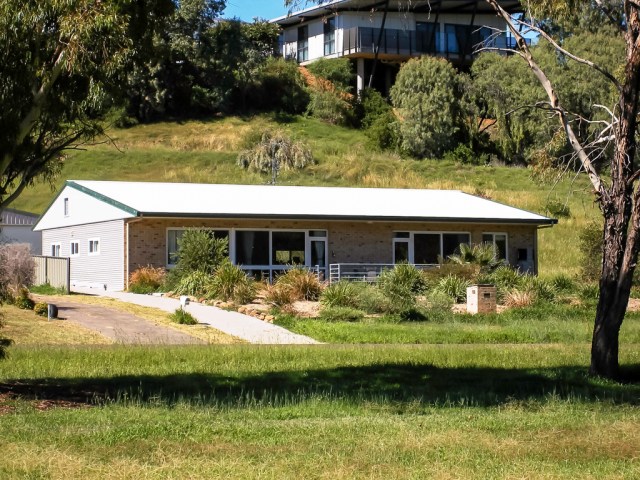
View of solar-passive house

Geoff’s solar-passive house

A second high-mass solar-passive house was built in 2009 in Strafford Street Manilla, within 300 metres of my house in Monash Street.
My friend Geoff designed his house and used the same builder that I did. Sadly, after five comfortable years in his house, Geoff has passed away. Thanks to his daughter, I can show you the features of the house.
Thermometers, and power bills show that its performance is similar to mine. That is to say, it is very successful!

In Manilla’s climate of daily and seasonal temperature extremes, Geoff rarely needed to use his low-powered reverse-cycle air conditioner.

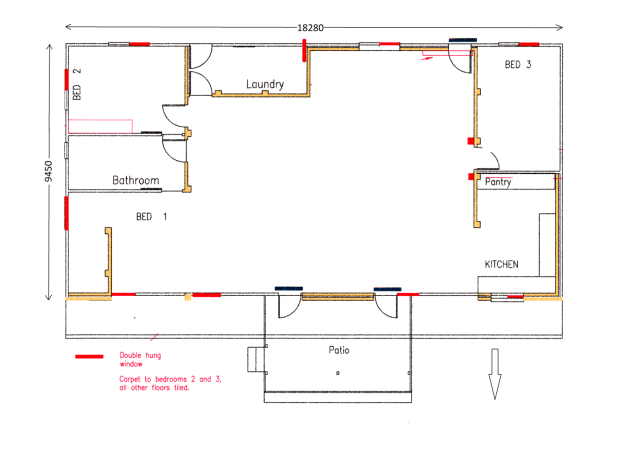
Plan of solar-passive house

Strafford Street solar-passive house: plan

Specifications

Dimensions

Length, East-West:     18.28 m
Width, North-South:    9.45 m
Ceiling height:               2.70 m

Area

Room area, Living/Kit/Bed 1/Study:      115.9 m^2
Room area, Bed 2:                                    13.8 m^2
Room area, Bed 3:                                    14.1 m^2
Room area, Bathroom:                              8.6 m^2
Room area, Laundry/Darkroom:               7.7 m^2
Area of walls:                                             12.7 m^2
Total House Area (without patio):       172.8 m^2

Exterior walls

North wall: double brick
East, west, and south walls: 90 mm stud, including 9.61 m reverse brick veneer
Cladding of stud walls: custom orb (horizontal)
Cladding of gable ends: plain roofing panels with 50 mm foam

Interior walls

Single brick:    17.16 m
Stud wall:        11.66 m

Windows (and two glass doors)

All double-glazed 3/6/3 in uPVC frames
(North-facing window area is 16% of the floor area of the house.)
North-facing:           27.00 m^2 (76%)
East-facing:               3.84 m^2 (11%)
South-facing:            4.50 m^2 (13%)
West-facing:             0.00 m^2 (0%)
Total:                      35.34 m^2 (100%) Continue reading

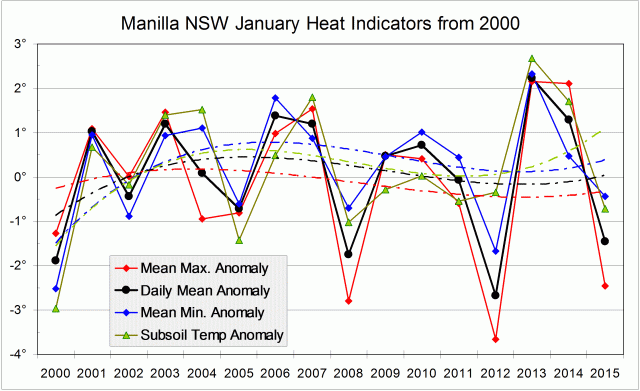
January Climate Anomalies Log

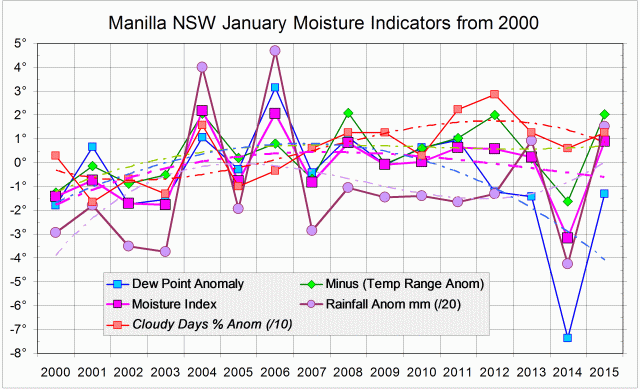
Heat indicators log for January

This post is the eleventh in a set for the 12 calendar months that began with March. Graphs are sixteen-year logs of the monthly mean anomaly values of nine climate variables for Manilla, NSW, with fitted trend lines. I have explained the method in notes at the foot of the page.

Raw anomaly values for January

Extreme values of January anomalies were as follows:

Daily Maximum Temperature Anomalies (1) -3.7 deg: January 2012;
Rainfall Anomalies (5) -70 mm: January 2002; -75 mm: January 2003; +80 mm: January 2004; +94 mm: January 2006; -85 mm: January 2014;
Dew Point Anomalies (2) +3.1 deg: January 2006; -7.4 deg: January 2014.

Trend lines for January

Heat Indicators

All heat indicator quartic trends began low and ended slightly high, and had a low peak in 2003, -05, or -06, and a shallow trough about 2012.

Moisture indicators log for January

Continue reading