More drought records in September 2019

Rainfall status Aug-Sep 2019 Manilla

Graph of Rainfall Shortages

This graph shows all the present rainfall shortages at Manilla, short term and long term, as percentile values. The latest values, as at the end of September, are shown by a thick black line with large circles. Those from one month earlier are shown by a thinner line with small diamonds. [The method is described in “Further Explanation” below.]

Record low rainfalls for 15-months to 36-months

With only 1.2 mm of rain falling in September 2019, most of the rainfall totals that had been record low values in August fell further to become new records. Some of these rainfall totals had been getting lower in each of the last four months. Until 2019, these records for low rainfall had not been broken in half a century, some having been set in the great drought of 1966.
Some of the current rainfall totals are very much lower than the previous long-standing records. For example:

  • 18-month total to Sep 2019: 384 mm; to Apr 1966: 514 mm; now lower by 130 mm.
  • 30-month total to Sep 2019: 853 mm; to Oct 1966: 1078 mm; now lower by 225 mm.
  • 36-month total to Sep 2019: 1161 mm; to Jan 1947: 1333 mm; lower by 172 mm.

Record low rainfalls for 72-months and 84-months

Record low rainfalls for 72-months and 84-months, which had appeared during 2019, got steadily lower. The earlier records had stood for more than a century, (Feb, Mar 1903) but are now beaten by about 100 mm.

The latest four months

September’s low rainfall has dragged down the totals for 2-, 3-, and 4-months. The 4-month total of 22 mm is the 2nd lowest ever.

The pattern of this drought

Two features of this drought are now clear from this data:

  • It is an extreme drought of two to three-year duration: one of Manilla’s six great droughts.
  • Record-breaking rainfall shortages at 72-month and 84-month duration show that the summer droughts of 2012-13 and 2013-14 still have an effect, not compensated by the wet winter of 2016.

Table of lowest-ever rainfalls

In a post of July 2018, I tabulated the lowest-ever rainfall for selected durations up to 360 months.

I commented that such records are rarely broken, and all had stood for at least forty-six years at that date.
The current drought has now broken most of those records for durations between 12-months and 84-months


Further Explanation

The following notes explain aspects of this work under these listed headings:

Data analysis

Cumulative rainfall totals
Percentile values
Severity of rainfall shortages

Limitations of this analysis

Monthly rainfalls form a single population
Observations are not retrospective
The rain gauge failed
Data analysis

Continue reading

New drought records in August 2019

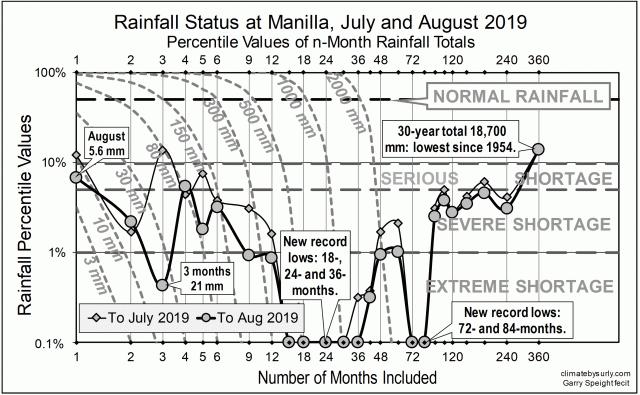
Rainfall status July-August 2019

Graph of Rainfall Shortages

This graph shows all the present rainfall shortages at Manilla, short term and long term, as percentile values. The latest values, as at the end of August, are shown by a thick black line with large circles. Those from one month earlier are shown by a thinner line with small diamonds. [The method is described in “Further Explanation” below.]

Record low rainfall values

August rainfall of only 5.6 mm at Manilla has brought more drought records. The rainfall totals for 18-, 24-, 36-, 72-, and 84-months are new record lows.
The record-low 36-month total is remarkable. Only the great droughts of 1947, 1914, and 1967 had rainfall nearly so low for so long, but the current 36-month total (1283 mm) is more than 50 mm lower than in those great droughts. Given that Manilla’s mean  annual rainfall is 652 mm, 1283 mm represents less than two years of rainfall in three years.

Severe and extreme rainfall shortages

For plotted durations longer than four months, only the very longest (30 years) is not a severe or extreme rainfall shortage. For durations beyond 84 months (including 30 years) every total is lower than has been seen since 1954, 65 years ago.


Further Explanation

The following notes explain aspects of this work under these listed headings:

Data analysis

Cumulative rainfall totals
Percentile values
Severity of rainfall shortages

Limitations of this analysis

Monthly rainfalls form a single population
Observations are not retrospective
The rain gauge failed

Data analysis

Continue reading

21-C Rain ENSO IPO: Scatterplot

The anomaly of monthly rainfall at Manilla, NSW varied with that of ENSO for only a part of the 21st century to date.

Scatterplot Rainfall vs ENSO

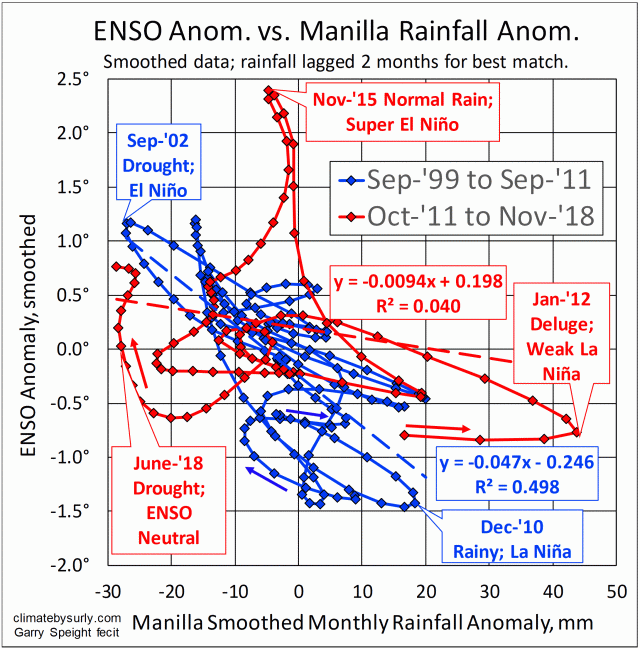
This connected scatterplot relates the smoothed anomaly of the El Niño-Southern Oscillation (ENSO) to the smoothed and 2-month-lagged anomaly of monthly rainfall at Manilla, NSW. The earlier data, from September 1999 to September 2011, is plotted in blue, and the later data, from October 2011 to November 2018, in red.

The same data was displayed as a dual-axis line plot in an earlier post titled “21-C Rain-ENSO-IPO: Line graphs”. Data sources are linked there.

The line plot revealed two things: the relationship changed from earlier to later times, and there was a better match when the rainfall data was lagged by two months. To clarify, I prepared various scatterplots with fitted regressions.

Raw data scatterplots

Scatterplots of the raw data values yielded regressions with very low values of the coefficient of determination (R-squared). For the whole population, R-squared was 0.028. I then checked the coefficient when I lagged the rainfall by 1-, 2-, or 3-months. A 1-month lag almost doubled the coefficient to 0.041; a 2-month lag gave 0.055, and a 3-month lag gave 0.041 again.
My observation that Manilla rainfall typically leads ENSO by 2 months is confirmed.

Connected scatterplots of smoothed and lagged data

The smoothing function used in the dual-axis line plot of the earlier post makes a good visual match. That suggests that local rainfall and ENSO are physically related at a periodicity no shorter than 12 months.
Using the smoothed and 2-month-lagged data, I have made the scatterplots shown in the graph above.
The better-matched data from September 1999 to September 2011 (blue) has a satisfactory R-squared of 0.498, nearly 20 times greater than that of the raw data. The very poorly-matched data from October 2011 to November 2018 (red) has an R-squared value of 0.040, no better than the raw data.

Patterns in the sequence of rainfall and ENSO values

In the above graph, I have joined the consecutive smoothed data points to make a connected scatterplot. Because little noise remains, clear patterns appear.

Matched rainfall and ENSO

The pattern up to September 2011 (blue) is mainly a series of ellipses, some clockwise and some anti-clockwise. They are almost parallel to the regression line:

y = -0.047x-0.246

The blue point furthest to the top left is that for September 2002, a time of extreme drought and El Niño.
The blue point furthest to the bottom right is that for December 2010, a time of very high rainfall and La Niña.

Discordant rainfall and ENSO

The pattern from October 2011 (red) swings about wildly and does not repeat. The regression (with a trivial coefficient of determination) is nearly horizontal. Near its ends are the extreme drought of June 2018 and the deluge of January 2012, both at times when ENSO was near neutral. At the top of the graph is the Super El Niño of November 2015, when Manilla rainfall was normal.

Conclusion

Scatterplots, connected scatterplots and regressions confirm that a strong relation between rainfall at Manilla and ENSO failed in 2011 as the IPO was rising from a negative toward a positive regimen.

21-C Rain-ENSO-IPO: Line graphs

From 1999, rainfall at Manilla NSW matched ENSO only up to 2011, before the IPO became positive.

Manilla rain, ENSO, IPO

This graphical log compares the rainfall at Manilla NSW with the El Niño-Southern Oscillation (ENSO) and the Inter-decadal Pacific Oscillation (IPO) through the 21st century to date. Values shown are anomalies, smoothed. (See Notes below on “Data”, “Smoothing”, and “Lagged Rainfall”.)

Rainfall (black) uses the left axis scale; the ENSO (magenta) and the IPO (green) use the inverted right axis scale.

[21st century temperature and rainfall at Manilla are compared as smoothed data in the post “21-C Climate: Mackellar cycles”.]

Matches between rainfall and ENSO

There is an excellent match between the rainfall and ENSO values in the left part of the graph.
I improved the visual match by various means:
1. The ENSO scale (magenta) is inverted, because positive values of the ENSO anomaly relate to negative values of rainfall anomaly here.
2. The scales are harmonised: the zero values are aligned, and 20 mm of monthly rainfall anomaly is scaled to (minus) one degree of ENSO anomaly.
3. Smoothing is applied to suppress cycles shorter than 12 months.
4. Rainfall anomaly values are lagged by two months. (See the Note below.)
As lagged, most peaks and troughs of rainfall coincide with troughs and peaks of ENSO, and their sizes (as scaled) are often similar.

Failure to match rainfall and ENSO

In the right part of the graph, the match between rainfall and ENSO fails. There are extreme mismatches: the Super-El Niño of 2014-16 had no effect on local rainfall, the rainfall deluge of 2011-12 came with a mild and declining La Niña, and the extreme drought of 2018 came while ENSO was neutral.
By visual inspection, I judge that a close relation of rainfall to ENSO, which had applied for the twelve years up to September 2011, then failed for the following seven years.

Influence of the IPO

The inter-decadal Pacific Oscillation (IPO) affects the relation between ENSO and Australian weather. (See note below “Effect of the IPO”.)

Power et al.(1999) show that Australian seasonal weather and its prediction align with ENSO only when the IPO is negative. It follows that a good match between ENSO and Manilla rainfall was expected while the IPO (green) was negative from 1999 to 2013, and was not expected from 2014 to 2017. The trend of the IPO through 2016-17 makes it likely that the IPO continued positive through 2018, as the mismatch between rainfall and ENSO persisted.
Power et al. note that the relation is not sensitive to the width of a neutral zone chosen to separate the positive and negative regimens of the IPO. In this particular case, the rainfall/ENSO match failed as the IPO rose through minus one degrees. However, the rainfall/ENSO match began in 1999, much earlier than the time when the IPO fell through minus one degrees.

Scatter plots

In a following post I show scatter plots and regressions for the periods of match and mismatch on this graphical log.


NOTES

Data

Rainfall

Continue reading

Drought worse in July.

At Manilla, most rainfall totals just got lower.
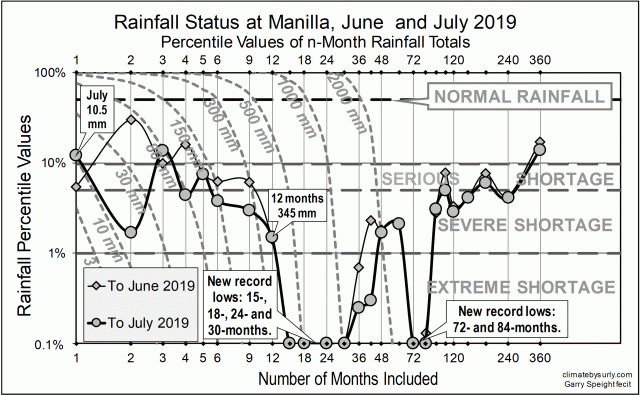
Rainfall status June and July 2019

Graph of Rainfall Shortages

This graph shows all the present rainfall shortages at Manilla, short term and long term, as percentile values. The latest values, as at the end of July, are shown by a thick black line with large circles. Those from one month earlier are shown by a thinner line with small diamonds. [The method is described in “Further Explanation” below.]

Results for July

Rainfall totals for months to July 2019 are the lowest ever registered here for six of the twenty-five chosen rainfall durations: 15-, 18-, 24-, 30-, 72- and 84-months.
Only three of the chosen durations do not have serious rainfall shortages below the 10th percentile: 1-month, 3-months and 360-months. Even those three values are far below normal, at the 12th, 14th, and 14th percentiles.

Weatherzone forum closed

I posted a provisional version of this graph to catch the final deadline for posting to the weatherzone forum. My first post was nearly 16 years ago.
That forum is now closed to postings and will close completely in November. It closed due to lack of public interest in climate and weather in Australia.


Further Explanation

The following notes explain aspects of this work under these listed headings:

Data analysis

Cumulative rainfall totals
Percentile values
Severity of rainfall shortages

Limitations of this analysis

Monthly rainfalls form a single population
Observations are not retrospective
The rain gauge failed
Data analysis

Continue reading