January “Coolth” in a House without Air-Conditioning

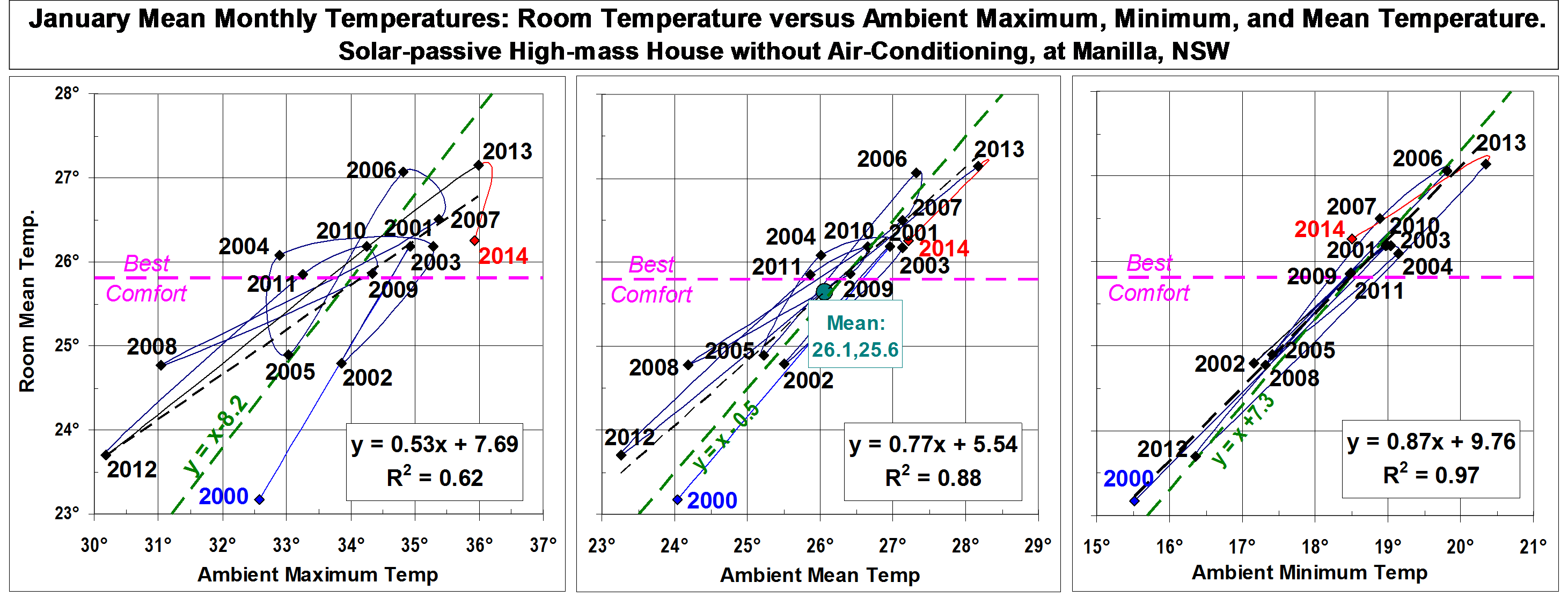
I have now 15 years of January average temperature data for my house at Manilla, North-west Slopes, NSW. These graphs show how the house temperature relates to the outdoor (or ambient) maximum, mean, and minimum temperatures.Regression graphs of indoor on outdoor temp in the hottest month
The house is not too hot and not too cold
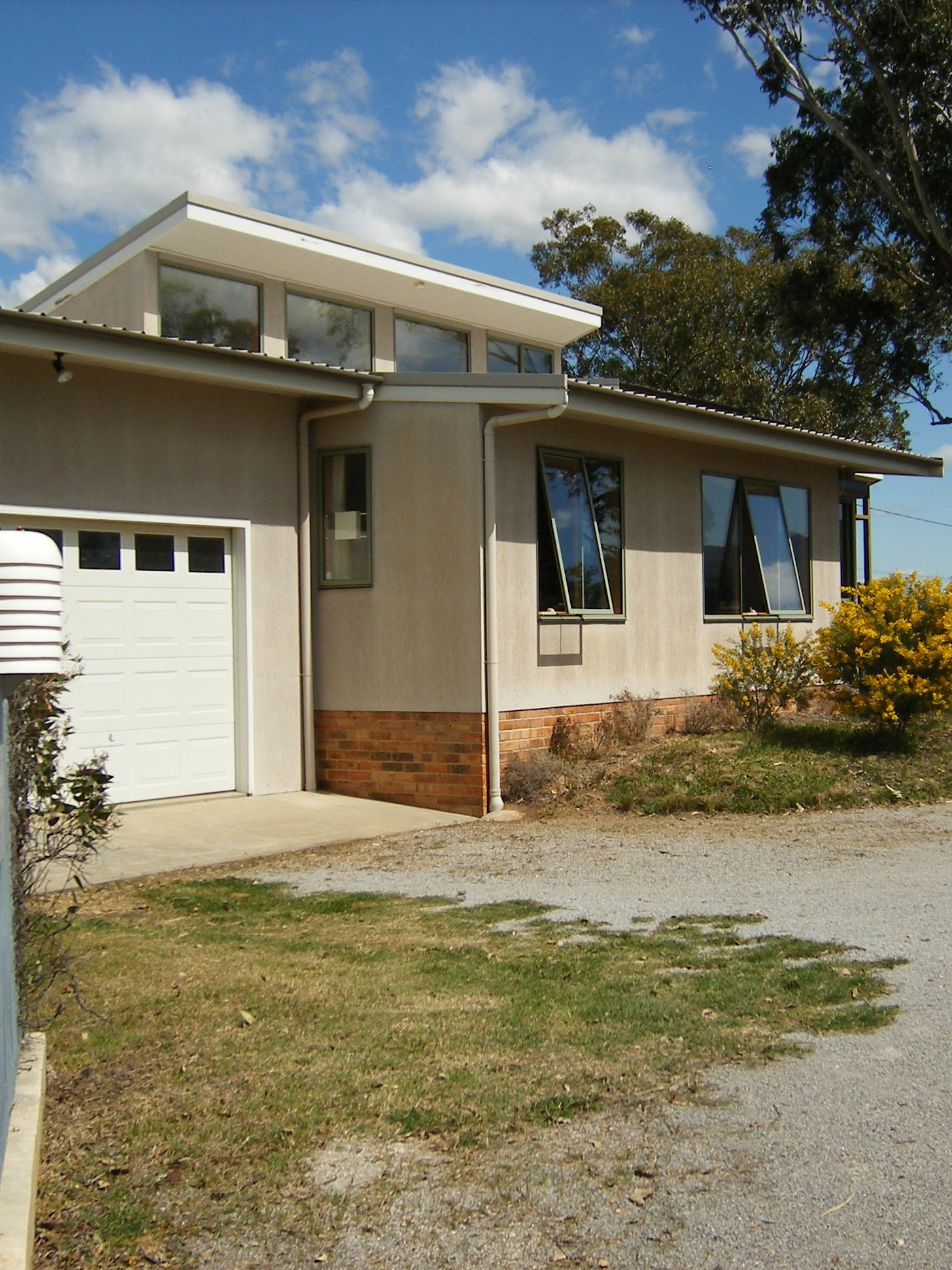
Solar-Passive House from the NE.

House at Monash St Manilla from NE

In January (the hottest month) the rooms* in this solar-passive house do not heat up much during the day, nor do they cool down much at night. Since the indoor temperature always rises and falls just one or two degrees from the mean, only the mean is shown. Green lines on the graphs, which are drawn to pass through the middle of each cloud of data points, show by how much (on the average) the indoor temperatures have differed from the outdoor maximum, mean, and minimum temperatures. On the middle graph the green line shows that the rooms have been 0.5° cooler than the mean temperature outdoors. The left graph shows that the rooms have been 8.2° cooler than the daily maximum outdoor temperatures. The right graph shows that the rooms have been 7.3° warmer than the daily minimum overnight temperatures.

The design of the house aimed to protect those living there from excessive summer heat. It may seem that reducing the mean temperature by only half a degree is a failure. Not so! The January mean temperature at this site (26.1°) is near the middle of the adaptive comfort zone for this month, and so is the indoor mean temperature (25.6°). The house succeeds in keeping the indoor temperature comfortable in the heat of the day, when that outdoors is an uncomfortable 34 degrees. The high thermal mass that achieves this has the unfortunate result that the minimum indoor temperature overnight (not shown) is some five degrees warmer than the outdoor minimum. However, on average, it is still a comfortable 23.5 degrees. (Curiously, no-one knows the best room temperature for sleep.) Continue reading

Predict weather from ENSO?

(Someone asked me to set down my thoughts about this.)

“Droughts and flooding rains” *

The climates of places in Australia cycle from hot, arid and dry, to cold, humid and wet every couple of years. (Dorothea Mackellar said she loved a sunburnt country “of droughts and flooding rains”*) This is a kind of quasi-biennial oscillation (QBO).  For more about the QBO, see this post, and the links in it. The cycles get weaker and stronger, more droughty or more rainy, and sometimes take about one year, sometimes three or more.

The climate of the Pacific Ocean has similar cycles, called the Southern Oscillation, discovered by Gilbert Walker a century ago. The pressure difference between Darwin and Tahiti oscillates in a way that reflects other widespread changes in climate. This is now called the El Niño – Southern Oscillation (ENSO) and it is monitored by sea-surface temperature east of Nauru in the Pacific Ocean, called NINO3.4. Now that we have up-to-date data on NINO3.4, the public has been led to believe that the data can be used to forecast Australian weather. It really can’t.

Problem No.1: Weather varies from place to place.

Every district in Australia has different weather, so one size does not fit all. Wasyl Drosdowsky made a map defining the regions that have consistent relationships to ENSO and other indices, but nobody has taken up the idea. (I would if I was boss of the Bureau of Meteorology!) Drosdowsky’s regions are rather similar to the States, but Victoria and the southern half of South Australia form a single region.

Problem No.2: Forecast is too late.

The ENSO cycle does not predict a cycle in any part of Australia because it happens at about the same time, and it takes a month or more to collate the data. Weather prediction from ENSO is always late. Consequently, there is a business to predict ENSO some months ahead. These predictions are very unreliable. Then the predictions of ENSO values are used to predict Australian weather, with vague statements of which regions will be affected.

To make matters worse, my Manilla data from 1999 shows that my weather happens in advance of the ENSO changes. I compared the ENSO log from 1999 to 2011 with smoothed daily maximum temperature anomaly, (1 month ahead)  smoothed monthly rainfall anomaly, (2 months ahead) and smoothed early morning dew point anomaly(3 months ahead). If droughts and deluges happen before peaks and troughs of ENSO at other places in Australia, this makes prediction from ENSO even less likely to work.

[Note added 14/07/2015. Updated graphs comparing the ENSO log from 1999 to 2014 with smoothed daily maximum temperature anomaly and smoothed monthly rainfall anomaly at Manilla are in this post. Manilla’s climate has not related very well to ENSO since mid-2011.]

[Note added 10/10/2019. Updated data confirm that ENSO lagged Manilla rainfall by 2 months from 1999 to August 2011, then failed to relate to Manilla rainfall after September 2011.
See: “21-C Rain-ENSO-IPO: Line graphs” and “21-C Rain ENSO IPO: Scatterplot”.
According to Power et al.(1999)Australian rainfall usually fails to relate to ENSO when the IPO goes positive, as it did from 2014 to 2017 (and 2018?).]


* By arrangement with the Licensor, The Dorothea Mackellar Estate, c/- Curtis Brown (Aust) Pty Ltd.


Data are cheap; information is expensive!


Originally posted on 12/5/2013 to a thread “ENSO Discussion 2013” on a “weatherzone forum.

3-year trends to March 2014

Parametric plots of smoothed climate variables at Manilla

“Plunge toward ‘flooding rains’ *Trends to March 2014.

Raw values of climate anomalies for March 2014 are nearly all in the bottom left corner “flooding rains” after months in the opposite corner “droughts”. Daily minimum temperature remains high: nights are warm.
Fully-smoothed values for September 2013 show that the drought was becoming as severe as in 2002. The dew point anomaly reached a new record low value of -3.94°.


* By arrangement with the Licensor, The Dorothea Mackellar Estate, c/- Curtis Brown (Aust) Pty Ltd.


Note: Fully smoothed data – Gaussian smoothing with half-width 6 months – are plotted in red, partly smoothed data uncoloured, and raw data for the last data point in orange. January data points are marked by squares. Blue diamonds and the dashed blue rectangle show the extreme values in the fully smoothed data record since September 1999.

Rainy March 2014

The daily weather log

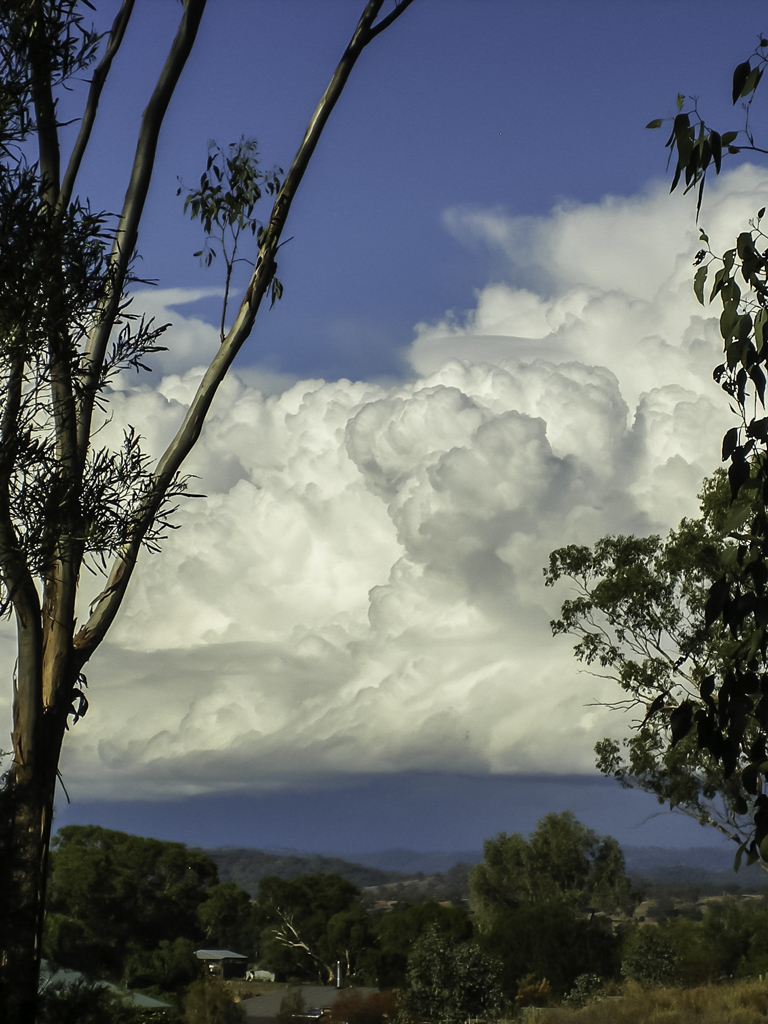
Towering cumulus cloud.

Shower on the Tablelands

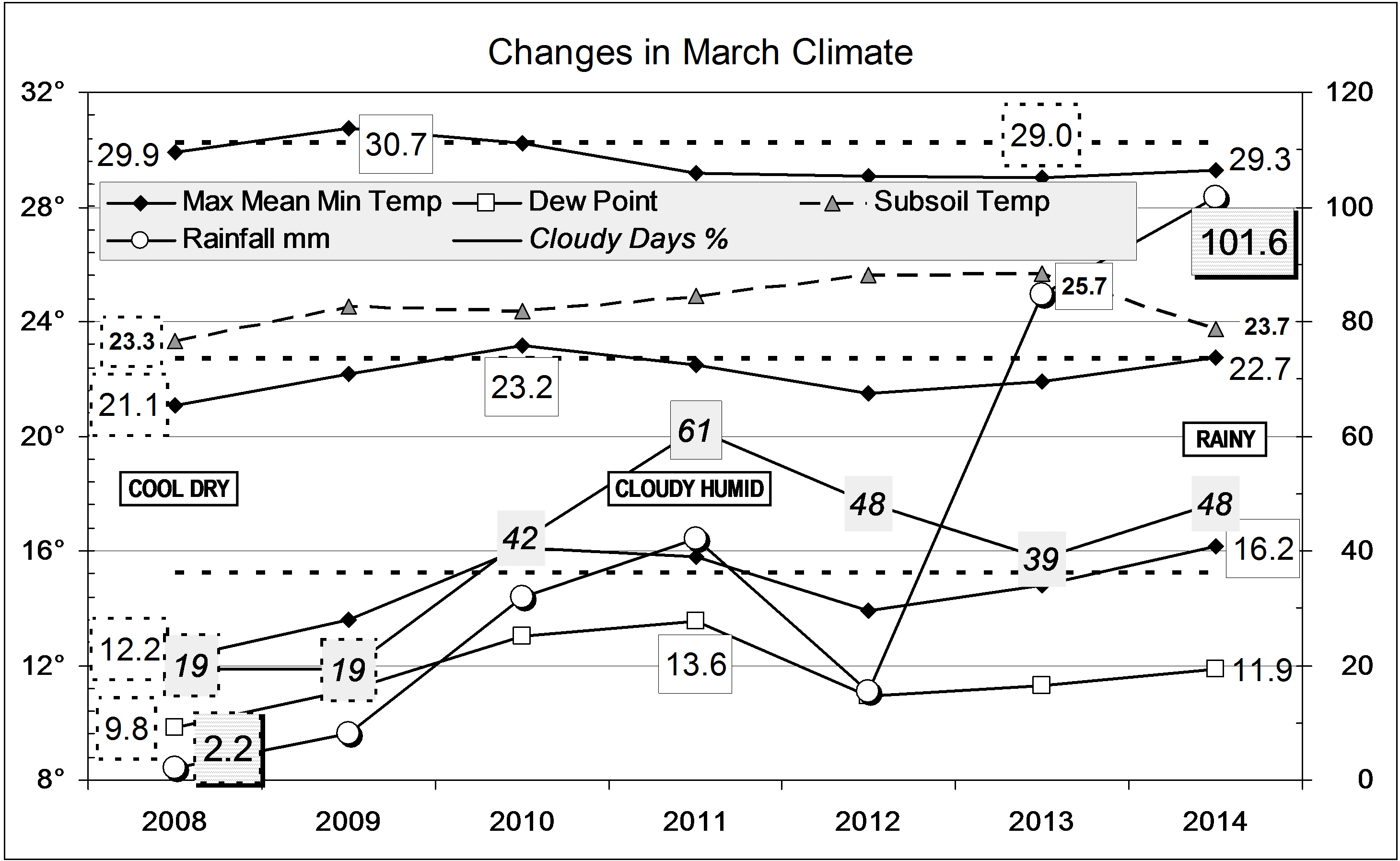
Three weeks of normal March weather were followed by six days that were cool, humid, overcast and rainy. While the wettest day had only 26.4 mm, the 14 rain days would be a record for March, but for the 16 rain days in March 1894. (Manilla never had a month with more rain days than June 1950, which had 18.)Weather log March 2014.

Comparing March months

Unlike recent arid months, March was near normal in day-time temperature, humidity and cloudiness. Nights were very warm, however .

The total rainfall of 101.6 mm is almost twice the March average of 53 mm, and in the 85th percentile. March has been wetter in nineteen years, including 2001 (103 mm) and 2007 (114 mm). Taking rainfall totals for more than one month, the greatest shortages are not serious (i.e. not below the 10th percentile). The twelve-month total (469 mm) is in the 14th percentile. Other totals have higher percentile values, and most totals for 30 months or more are above normal.

Climate March 2014


Data. Rainfall data is from Manilla Post Office, courtesy of Phil Pinch. Temperatures, including subsoil at 750 mm, and other data are from 3 Monash Street, Manilla.


2013-14: Third Driest Summer

Weather log summer 2013-14.

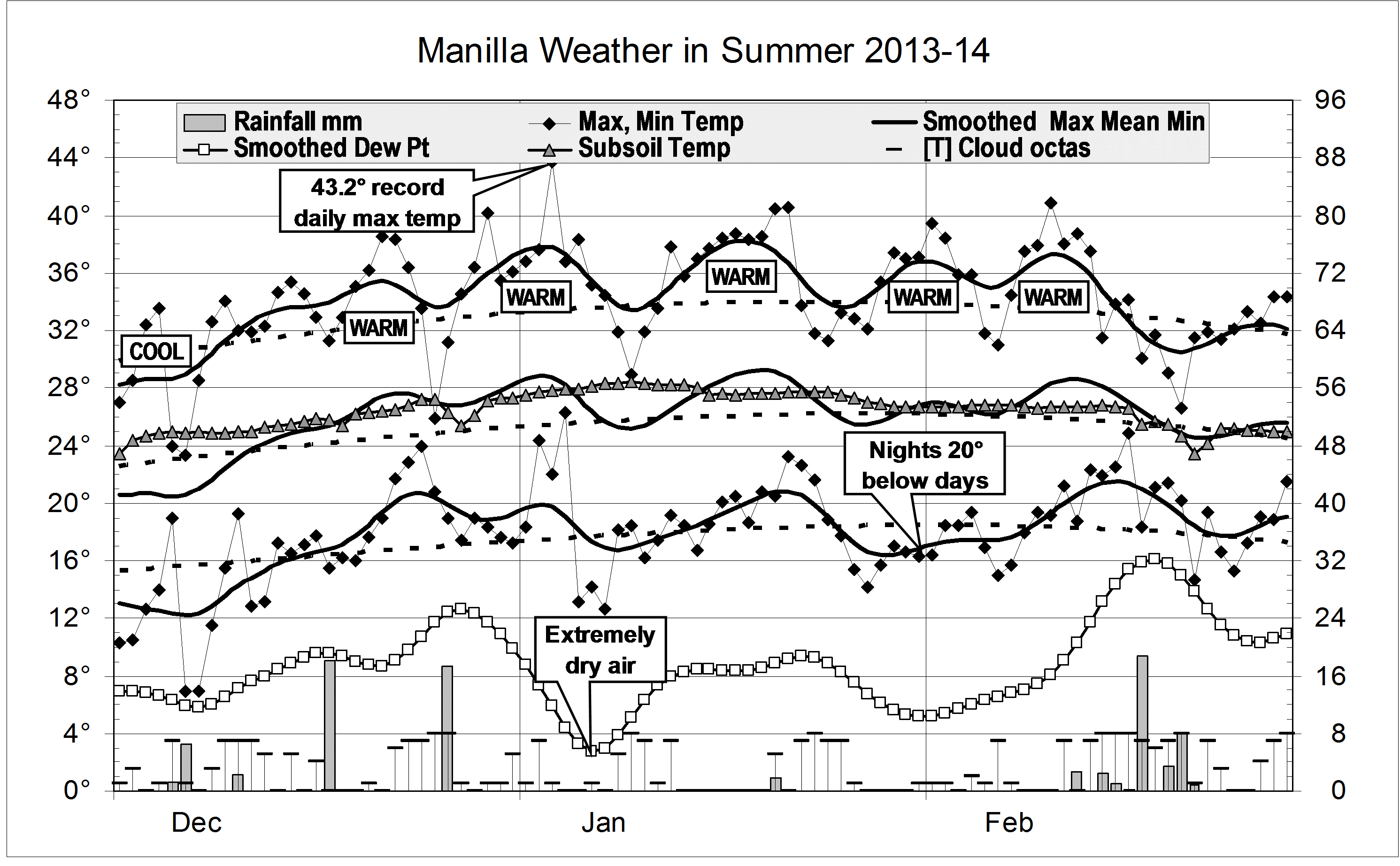
After a cool start, this summer had no more cool weather. There were five warm spells 3° to 4° warmer than normal. Days were particularly warm, with a new 21st century record high of 43.7° set on 3/1/14. During warm spells, nights were also warm, but often 17° cooler than the days. The air was phenomenally dry in early January, with morning dew points (usually 14°) falling below zero three times. There were only 14 rain days (usually 21), and the heaviest fall of 18.8 mm was a 21st century record low for summer.


Taking average values, this summer had the highest daily maximum temperature this century: the value of 34.3° beats the 34.1° of 2005-6. However, the daily mean of 26.1° does not beat the 26.3° of 2005-6. By contrast, the summer of 2011-12 was the coldest, by day and by night. The total rainfall of just 84.8 mm makes this the third driest summer in the 131-year record, after 1929-30 (66 mm) and 1964-5 (70 mm). The summers of 1999-2000 and the two following were also very dry (125 mm, 158 mm, 137 mm) but this summer had not only less rain but also very much drier air and a wider daily range of temperature. Both the low dew point, 8.6° , and the wide daily temperature range, 16.4°, were record values. The earlier dry summers were less cloudy, however.Climate summer 2013-14.

Data. Rainfall data is from Manilla Post Office, courtesy of Phil Pinch. Temperatures, including subsoil at 750 mm, and other data are from 3 Monash Street, Manilla.