
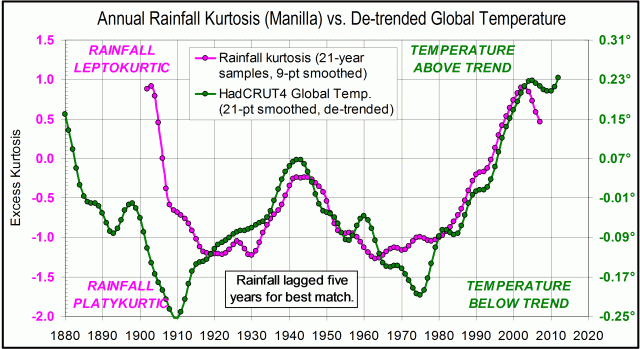
The kurtosis of annual rainfall at Manilla NSW forms a time-series that matches the time-series of global surface temperature when de-trended.
[SUPERSEDED
This post had inadequate data. It is now superseded by the post “Rainfall kurtosis vs. HadCRUT4, revised” of 20 May 2018.]
Features of the data
Data sources, noted on the graph, are specified below. The best match is achieved by decadal smoothing, by scaling 1.0 units of kurtosis to 0.16 degrees of temperature, and by lagging the rainfall data five years.
Closeness of the match
Although both variables have irregular traces, their patterns are almost the same. They begin and end very high, have a broad peak near 1943, and are low in the 1910’s, 1920’s, 1950’s, 1960’s and 1970’s.
The match is very close for ninety years from 1915 to 2005, except for one decade (at 1972). In all this time, both the values and the slopes (as scaled) agree. [See the Note below “1991-1992”.]
Before 1915, the patterns do not match well, but they remain similar. Both traces descend rapidly together from 1903 to 1910. The initial peak in the rainfall trace at 1903 (actually 1898) is similar in height (as scaled) to a peak of the de-trended temperature trace just off the graph at 1879.
Discovering the pattern match
I was seeking a robust measure of the occurrence of extreme values in annual rainfall at Manilla, NSW. As kurtosis is just such a measure, I calculated it. I then plotted out the time-series, as shown here. It reminded me of the well-established time-series of smoothed HadCRUT4 global near-surface temperature. In particular, I recalled a locally-dominant peak near 1940.
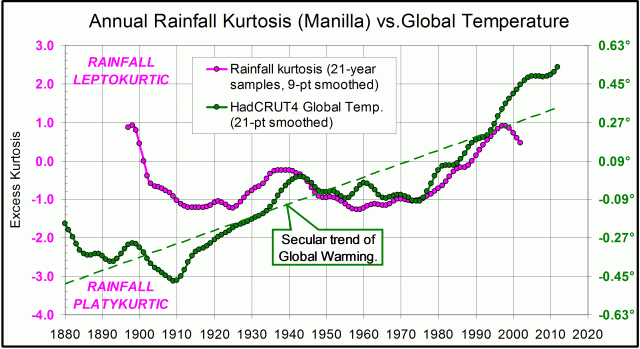
Simply reconciling the vertical scales of the two time-series gave me the second graph.
While not matching in details, the two curves remain very close from 1940 to 1995. Matching over the whole rainfall record is prevented by a difference in trend. While the rainfall kurtosis has no trend, the HadCRUT4 curve has a secular trend rising at half a degree per century (known as “global warming”).
To extend and improve the match, I subtracted the linear trend from the global temperature curve, and lagged the rainfall points by five years. The first graph is the closely-matching result.
What it means
As evidence of extreme behaviour in climate
It is said that more extremes in climate will occur as the world becomes warmer. The evidence is not strong. Most data sets are overwhelmed by noise, and “extreme” is seldom defined with rigor.
In the present case, I believe that the definition of “extreme” that I use is sound: that is, the kurtosis of a frequency-distribution. Only the instability of kurtosis when based on small samples is an issue.
My rainfall data set that displays more and less extreme behaviour is not general but local. It can merely suggest that data elsewhere may reveal functional relationships.
 A very strong and persistent empirical relationship is shown by the graphical logs above. In another post, “Rainfall Kurtosis vs. HadCRUT4 Scatterplots”, I show scatterplots like this in support of it.
De-trended global temperature
This strong link between local annual rainfall kurtosis and global climate has a surprising feature. Although this extreme behaviour seems to relate to global temperature, it does not relate to global warming! It relates to a temperature trace from which the global warming trend has been removed. Times of high kurtosis, denoting enhanced extremes, correspond to times when the global temperature was highest above trend. Such times occurred not only in the twenty-first century, but equally in the nineteenth century. There was another (widely-known), lower peak in de-trended global temperature near 1940: at that time also kurtosis was above normal.
Should global temperature remain static for a time, it would be falling rapidly below its rising trend. According to this data set, that should bring reduced extreme behaviour in annual rainfall at Manilla.
Data Sources
(i) Global temperature time-series
From the three available century-long time series of global near-surface temperature I have chosen to use HadCRUT4, published by the British Met Office Hadley Centre. The link is here.
I selected from the section: “HadCRUT4 time series: ensemble medians and uncertainties”.
From this, I downloaded two files:
(i) “Global (NH+SH)/2, annual”;
(ii) “Global (NH+SH)/2, decadally smoothed”.
[The “Decadally smoothed” data supplied is annual data smoothed with a 21-point binomial filter.]
From each data file, I used only the first column: the year date, and the second column: the median value.
I established the secular trend of global warming using the linear trend function in Charts for “Excel”. I found the linear trend of the whole HadCRUT4 annual series data (1850 to 2016) to be:
y = 0.005x – 0.52.
I then subtracted the annual value at the trend line from the decadally smoothed HadCRUT4 value to get the de-trended smoothed value shown on the first graph.
(ii) Kurtosis of Manilla annual rainfall
The rainfall data is that for Manilla Post Office, Station 055031 of the Australian Bureau of Meteorology. Station 055031 functioned without gaps from 1883 to March 2015. Since then, the official record is fragmentary.
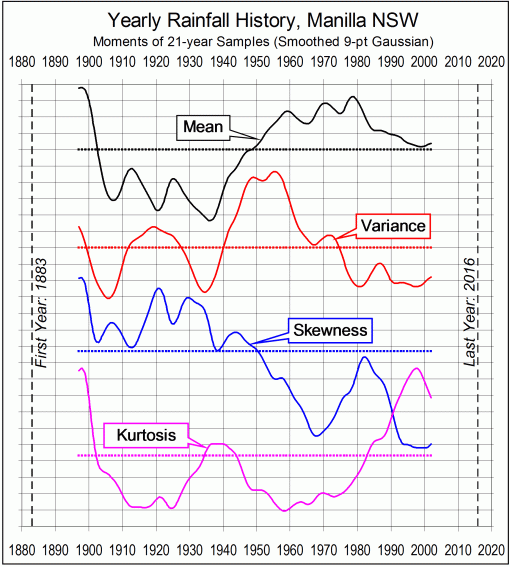
I found kurtosis values for annual rainfall by using the (excess) kurtosis function in “Excel”. I used sub-populations of 21 successive years, referred to the median year. I found values for the years 1893 to 2006. I smoothed these values with a 9-point gaussian filter (yielding similar smoothing to that of HadCRUT4). Smoothing reduced the plottable years to those from 1897 to 2002.
 I posted a line graph of this kurtosis data earlier, in “Moments of Manilla’s Yearly Rainfall History”.
Note: 1991-1992
The most striking match in the graph is that both traces pause at 1991-1992 within a two-decade-long steady rapid rise. That pause in the global temperature series has been attributed with little doubt to the injection into the atmosphere of seventeen million tonnes of sulphur dioxide by the eruption of Mount Pinatubo in the Philippines. That eruption cannot have affected the rainfall kurtosis five years earlier.




 climate by surly