“Novel graphs for rainfall shortages”

I display my drought poster

Garry’s drought poster

Drought poster for conference

Grasslands Conference Poster Display

A conference paper about drought graphs

This blog “Climate by Surly” has analyses of the current drought at Manilla, mainly in the form of graphs. I was invited to present these findings as a “Poster Paper” at a conference of the Grassland Society of NSW at Gunnedah in July 2019. The poster itself is shown in the photo and the reduced image above.

The paper

The paper is published in two parts: the colour poster shown above, and four pages of text and figures. Both have the title “Novel graphs show extreme rainfall shortages”.
The point of my paper was that these novel graphs bring out features of the current drought at Manilla in a way that could be applied at other times and places.
Because the paper is brief, I have referred the reader to further information in posts in this blog. The construction of each of the three kinds of graph is fully explained in the posts that I linked:
/2019/03/31/march-rain-leaves-drought-extreme/
/2019/04/09/rainfall-shortage-sequence-03-2019/
/2019/04/15/rainfall-shortage-history-manilla/
/2019/04/16/rainfall-shortage-jan-2000-mar-2019/

The complete reference to the paper is:
Speight JG (2019) Novel graphs show extreme rainfall shortages. In
‘Proceedings of the 31st Conference of the Grassland Society of NSW Inc.’ (Eds SR Murphy, SP Boschma, and M Simpson). pp. 36-39. (Grassland Society of NSW Inc., Orange).

The text can be accessed here as a pdf:

Click to access 6-2019-grassland-conf-proc-speight-pp35-39-web-ver.pdf

The paper will become accessible on the website of the Grassland Society of NSW.

The Poster on display

Thanks to the generosity and interest of the proprieters, the original of the poster can be seen at Molly May’s Coffee Shop in the main street of Manilla.

Rainfalls: 8 in the 0.1th percentile

Rainfall status October November 2019

Normal rainfall in November

Rainfall in November 2019 (40.2 mm) was near normal. That reduced shortages at durations from 2-months to 5-months. Otherwise it had little effect: fifteen of twenty longer durations remained extreme shortages.

Values plotted in the 0.1th percentile

For simplicity, the bottom line is labelled with the 0.1th percentile value, and percentile values below 0.1% are plotted on the line. As there are 1600 months of record, both the 2nd-driest month (percentile value 0.063%) and the driest month, (percentile value 0.000%, by convention), which would plot below the line, are plotted on it.
Driest records have again been broken at durations of 12-months (270 mm), 24-months (611 mm), 30-months (834 mm), 72-months (2927 mm), and 96-months (4205 mm). The 96-month record had stood at 4405 mm since November 1919.
A value that equals an earlier record occurs at 84-months (3555 mm).
Values that are 2nd-driest occur at 36-months (1129 mm) and at 240-months (11816 mm). The 240-month (20-year) total is now only 50 mm more than the lowest-ever value of 11766 mm set in February 1931.

How to read the graph

This graph shows all the present rainfall shortages at Manilla, short term and long term, as percentile values. The latest values, as at the end of October 2019, are shown by a thick black line with large circles. Those from one month earlier are shown by a thinner line with small diamonds. [The method is described in “Further Explanation” below.]


Further Explanation

The following notes explain aspects of this work under these listed headings:

Data analysis

Cumulative rainfall totals
Percentile values
Severity of rainfall shortages

Limitations of this analysis

Monthly rainfalls form a single population
Observations are not retrospective
The rain gauge failed

Data analysis

Continue reading

Spring 2019 hot and very dry

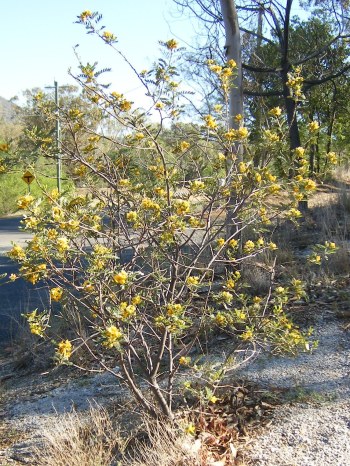
Blooming senna bush

Senna coronilloides

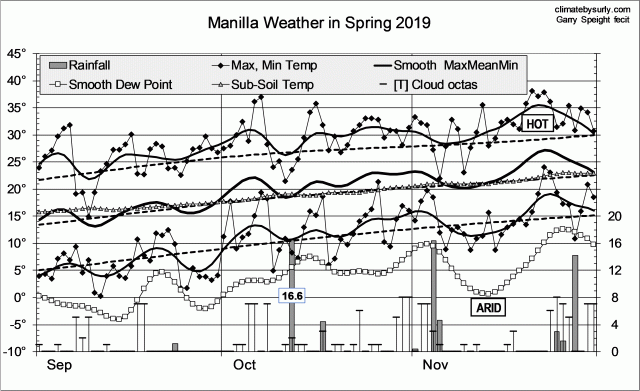
Spring was marked by a succession of warm and cool spells. Nights varied around the normal seasonal temperature but days had no spells cooler than normal. A hot spell late in November had days 6° above normal as a weekly average. The dew point showed very dry air in mid-November.
There were nine rain days, as in the droughty spring of 2002. The highest reading was 16.6 mm. Rainy and cloudy days came about every three weeks.

Weather log spring 2019

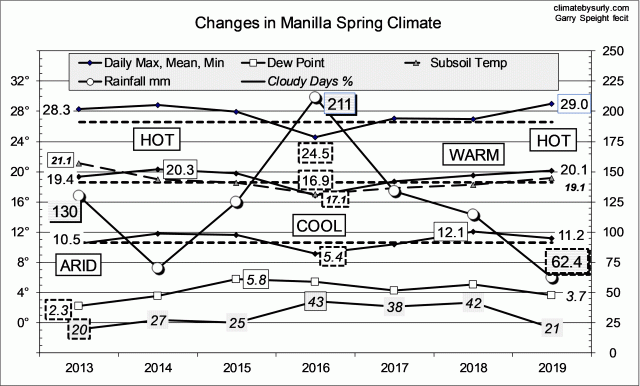
The hot dry climate this spring was very like that of 2014, and quite unlike the cool wet climate of 2016.
Days, averaging 29.0°, were hotter than in any spring except 2002 (29.2°). Nights, at 11.2°, were only half a degree above average. (The winter of 2019 had a similar pattern.)
Dryness was shown by very little morning cloud (21%), very low early-morning dew point (3.7°) and very wide daily temperature range (17.8°).
The total rainfall of 62.4 mm makes this the fourth driest spring, after 1957 (23 mm), 1944 (40 mm), and 1951 (54 mm).

Climate spring 2019


Data. A Bureau of Meteorology automatic rain gauge operates in the museum yard. From 17 March 2017, 9 am daily readings are published as Manilla Museum, Station 55312.  These reports use that rainfall data when it is available. I have used it since 20 July, when the Museum gauge began recording again. My estimates of early morning dew point have become anomalously low. From 1 August 2019, I use values taken from Tamworth Airport graphs at the time of minimum temperature.
All other data, including subsoil at 750 mm, are from 3 Monash Street, Manilla.

November 2019: one warm week

Bushfire smoke

Manilla View 18-11-2019

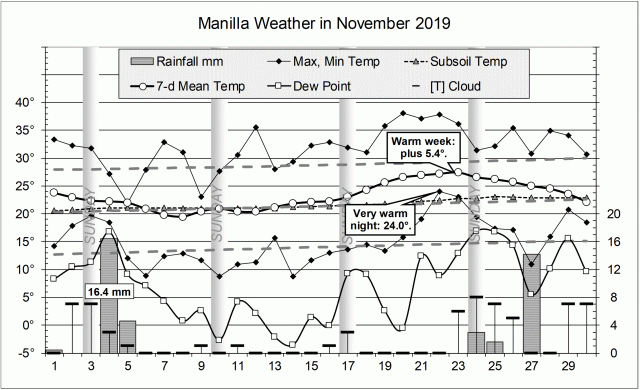
One week, beginning on the 20th, was 5.4° warmer than normal. The night of the 22nd did not get cooler than 24.0°, making it the 5th warmest November night in this century. (One night in November 2009 had been 27.8°, the warmest night of any month.) In other weeks of this month, temperatures were normal.
Most days were dry and sunny. However, days early and late in the month were cloudy, with high dew points and narrow daily temperature ranges. Six of these days had rain, with the highest reading 16.4 mm on the 4th.
Smoke from coastal bushfires reduced visibility from the 17th to the 29th. On the 18th, visibility was only one kilometre, as shown in the photo.

November 2019 weather log

Comparing November months

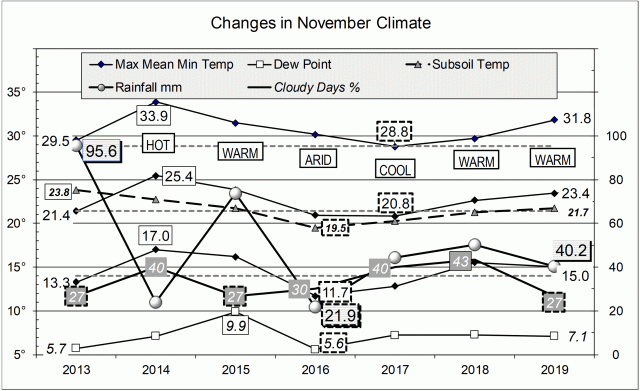
Although this month was warm. other November months have been warmer: in 2002, 2009, 2012, and 2014. All of these had especially warm days. While days this month averaged 31.8°, days in November 2009 averaged 34.3°. The coolest recent November was in 2017.
This was a dry month but, by various measures, not as dry as in 2002, 2009, 2014 or 2016. The rainfall total of 40.2 mm is in the 27th percentile.

November climate

Drought

I will report separately on the on-going drought that continues to break low-rainfall records at durations of 15-months and longer.


Data. A Bureau of Meteorology automatic rain gauge operates in the museum yard. From 17 March 2017, 9 am daily readings are published as Manilla Museum, Station 55312.  These reports use that rainfall data when it is available. Recording resumed on 20 July 2019.
My estimates of early morning dew point have drifted anomalously low. From August 2019, I use data from the Tamworth Airport published graphs.
All other data, including subsoil at 750 mm, are from 3 Monash Street, Manilla.

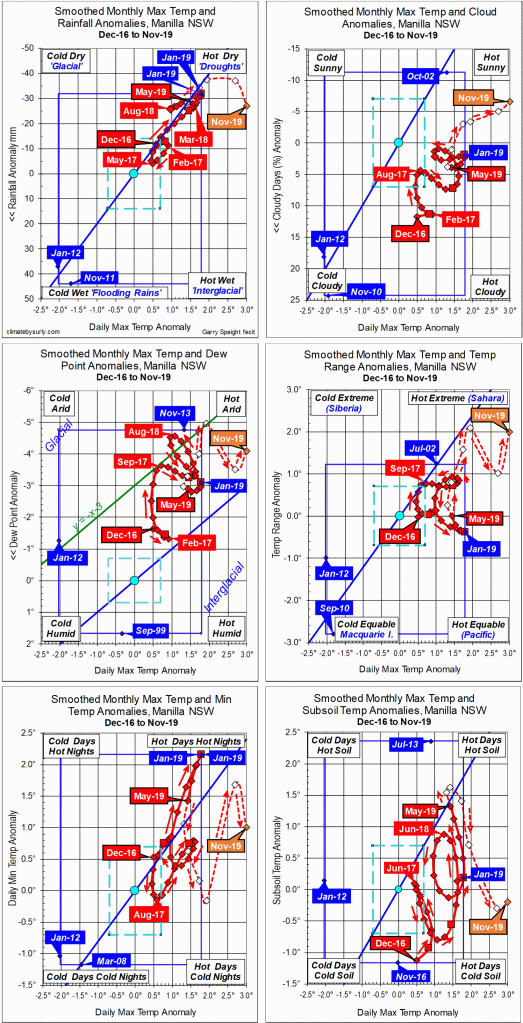
3-year trends to November 2019

November just like October

3-year trends to November 2019

November raw anomaly data (orange)

Temperatures

Daily maximum temperature anomaly (all x-axes): now three degrees above normal.
Daily minimum temperature anomaly (lower left): remains high.
Subsoil temperature anomaly (lower right): still near normal.

Moistures (moist is at the bottom)

Rainfall anomaly (upper left): still very low.
Cloudiness anomaly (upper right): still normal.
Dew point anomaly (middle left): still rather low.
Daily temperature range anomaly (middle right): has risen back to high.

 Latest fully smoothed data (red) includes autumn 2019

Smoothed anomaly values are now available for the autumn (MAM) of 2019. Generally they show a steady retreat from the extreme (smoothed) anomaly values of January. Rainfall anomaly rose, while daily maximum temperature anomaly fell. Daily minimum temperature anomaly fell rapidly, and subsoil temperature anomaly rose rapidly. Cloudiness and dew point changed little. Temperature range anomaly, which had decreased slowly to January, began to increase again.


Notes:

January data points are marked by squares.

Smoothing Continue reading