October 2014 hot and dry

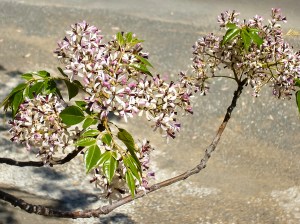
Blooms of Melia azedarach

Fragrant white cedar blooms

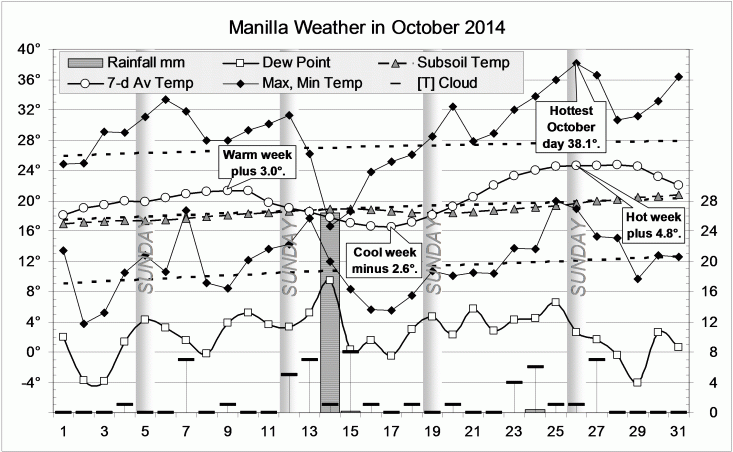
The month began with a warm spell, which was followed by a cool spell about the 15th. It ended with a long hot spell, 4.8 degrees above normal, including the hottest October day this century (38.1°) on the 26th. As usual, there were no frosts.

Of three rain days (usually seven), only the 14th had much rain: 26.4 mm, with heavy showers.
Half the mornings had no cloud at all, and nine days had very wide temperature ranges, greater than 20°.
Weather log October 2014

 Comparing October months

This was the hottest October month at Manilla in this 16-year record. Maximum, mean and minimum temperatures were all highest values, but the maximum was no higher than in October 2007. The subsoil temperature returned to a value below normal.
As indicators of low moisture, the daily temperature range was very high and cloudiness and dew point were very low, as in the last two October months. Even less cloud had been seen in 2002 and 2004.
Recently, lower rainfall occurred in October 2002 (15.0 mm), 2012 (12.6 mm), and 2013 (15.0 mm). However, this month’s total of 27.0 mm is well below the October average of 58 mm, in the 21st percentile. Since last month, little has changed in rainfall totals for periods of more than one month. There is still a serious shortage in the 6-month total (8th percentile) but not now in the 9-month total (10th percentile). The 15-month total has advanced to severe (4th percentile), while the 18-month total has retreated to serious (5th percentile). A serious shortage has also appeared in the 30-month total (8th percentile).

Climate October 2014  


Data. Rainfall data is from Manilla Post Office, courtesy of Phil Pinch. Temperatures, including subsoil at 750 mm, and other data are from 3 Monash  Street, Manilla.

Decadal and Inter-decadal changes in rainfall: III.

Summer rainfall anomalies and trends

Part 3 of 3: A growth and collapse model for summer rainfall

(See Notes below for data and plotting details.)

I have put this October 2014  post up on the front page as a “sticky” (5/1/15) because I have just found a relevant scientific article. See “Note added January 2015” below.

A linear trend

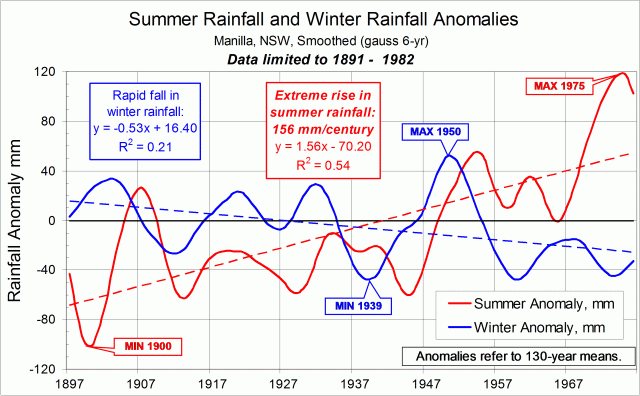
In Part II, I showed that a linear trend fits well (R-squared = 0.54) to smoothed summer rainfall at Manilla, NSW from 1897 to 1976. This trend-line rises extremely steeply: 156 mm per century.
(See also the Duodecadal Means graph below.)

Implications of the extreme trend

Such an extreme trend cannot extend more than a short time into the past or the future without reaching physical limits. Extremely high values must be followed by lower values and vice versa. The oscillation between higher and lower values in nature is often modeled as a smooth harmonic curve. That does not fit well here. Not only does the rise from 1897 to 1976 fail to curve down approaching the final peak, the falls from 1892 to 1900 and from 1975 to 1987 are extremely sharp. They are collapses.
It seems to me that a model of steady growth followed by sudden collapse may perhaps reflect the processes involved. On the graph I have added speculative trend lines of the same rising slope as that observed for 1897 to 1976. The constant for the first speculative trend line is 130 mm higher and leads to a 130 mm collapse from 1896 to 1899. A 90 mm collapse from 1978 to 1981 then leads to a renewed rising trend that is 90 mm lower.


Note added January 2015.

The sudden collapse in summer rainfall here at the beginning of the twentieth century was studied sixty years ago by E.B. Kraus (Snowy Mountains Authority!): “Secular changes of east-coast rainfall regimes” (1955).
“The mean rainfall along the east coasts of North America and Australia is shown to have decreased abruptly at the end of the 19th century… A simultaneous decrease of the rainfall in the Continue reading

Decadal and Inter-decadal changes in rainfall: II.

Log of smoothed summer and winter rainfall anomalies.

Part 2 of 3: The record restricted to 1891-1982 (92 years)

(See Notes below for data and plotting details.)

No climatic record is ever long enough to demonstrate apparent cycles, trends or extremes beyond doubt. In Part 1, a linear trend of summer rainfall rising at 24.7 mm per century was fitted to the whole 130-year record. Although this is a very high (perhaps unsustainable) rate of increase, the trend line explains hardly any of the variation. The R-squared value is 0.03! However, there does seem to be a steeper quasi-linear trend prevailing for most of the period of record. The graphs I have posted here show a restricted record beginning in 1891 and ending in 1982. This simulates an analysis done in 1983 (which could not have used more recent data) and supposes that records earlier than 1891 were unavailable for some reason.

I have chosen these dates so that
(i) the near-record smoothed summer rainfall maximum of 1891 is excluded but the record smoothed summer rainfall minimum of 1900 is included;
(ii) the record smoothed summer rainfall maximum of 1975 is included but the very low smoothed summer rainfall minimum of 1987 is excluded.
(Due to the smoothing window extending six years before and after a specified date, smoothed rainfall values can be calculated only from 1897 to 1976.)

Log of smoothed sum and difference of summer and winter rainfall anomalies.

Linear trends

For this restricted data set of 92 years, all four linear trends are very much steeper than for the whole 130-year record. The R-squared values are also much higher, indicating that the Continue reading

September 2014 cool and dry

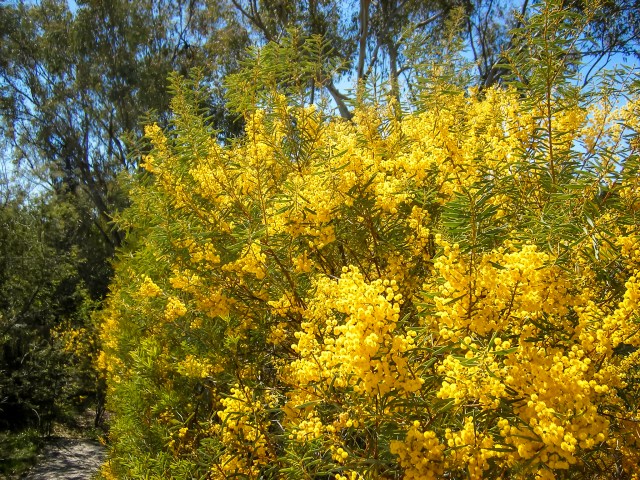
Acacia decora hedge

A hedge of western golden wattle

The daily weather log

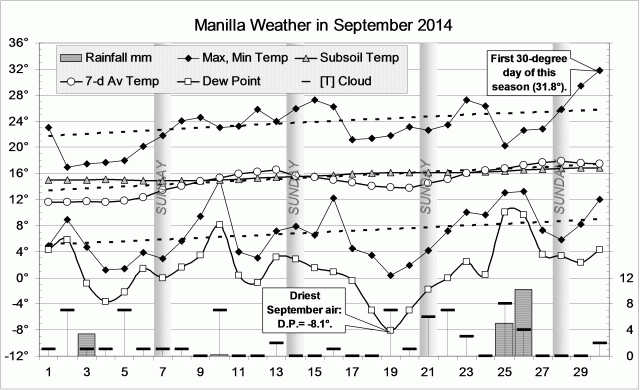
Two 5-day cool spells began on the 2nd and the 17th. Days and nights were both three or four degrees cooler than normal. At the same time, the air was very dry: a new lowest September dew point of minus 8.1° came on the 19th.
At other times, temperatures were near normal. There were four frosts (normally three). There were four rain days, which is normal.
The first thirty-degree day since mid-winter came on the 30th. At Manilla, it often comes near the spring equinox (September 22nd). In the 21st century, the first thirty-degree day came as early as August 23rd in 2009 and as late as November 9th in 2010.

Weather log September 2014.

 Comparing September months

Last September had been the warmest in this century. While not cold like September 2004, this month was half a degree cooler than normal. Like September in 2003, 2007, and 2012, it was both cool and dry. By contrast, the cool Septembers of 2010 and 2011 were wet, affected by La Nina.
Cloudiness and daily temperature range were near normal, but the mean dew point (1.4°) was not much higher than the extreme low value (0.6°) set last year.
The total rainfall of 18.8 mm is in the 26th percentile, well below the September average of 41 mm. Totals for periods of more than one month now have serious shortages for six months (7th percentile), nine months (7th percentile), and fifteen months (5th percentile), and a severe shortage for eighteen months (4th percentile).

The current drought report (6/10/2014) of the Bureau of Meteorology shows some serious and severe rainfall deficiencies in the area. Ten-month deficiencies extend west to Manilla from the Northern Tablelands, and there are 24-month rainfall deficiencies near Manilla and widespread around Walgett, 300 km to the north-west.

Climate September 2014.  


Data. Rainfall data is from Manilla Post Office, courtesy of Phil Pinch. Temperatures, including subsoil at 750 mm, and other data are from 3 Monash  Street, Manilla.
Decadal and Inter-decadal changes in rainfall: I.

Log of smoothed summer and winter rainfall anomalies.

Part 1 of 3: The whole 130-year record

(See Notes below for data and plotting details.)

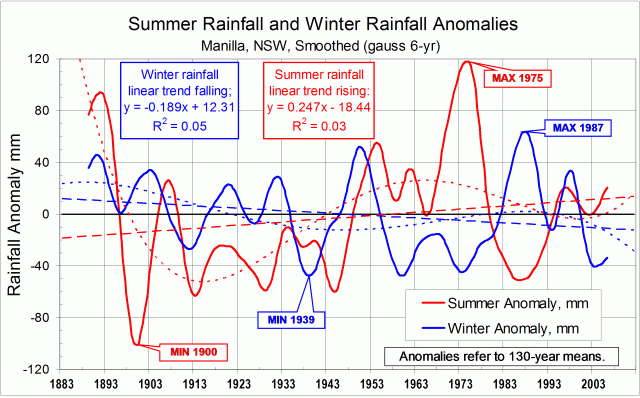
Anomalies of smoothed summer and winter rainfall

Episodes of high or low summer rainfall do not coincide with those of winter rainfall (except in 1891). Nor do they consistently oppose each other, although this is common. The summer rainfall anomaly (red) was extremely low (-101 mm) about 1900, and extremely high (+119 mm) about 1975. The winter rainfall anomaly (blue) had lower extreme values: 1939 (-48 mm) was the lowest of several low values, and 1987 (+63 mm) the highest of several high ones.

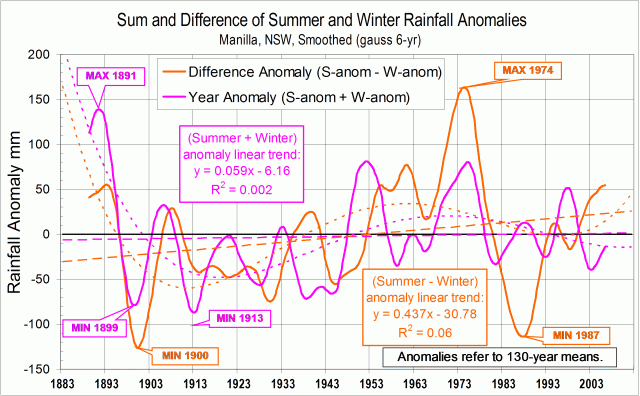
Seasonal sums and differences

I plotted the smoothed yearly value of rainfall anomaly as the sum (purple) of a winter anomaly value and that of the following summer. There was an extreme maximum in 1891 (+139 mm!), and minimal values in 1899 (-79 mm) and 1913 (-87 mm), among others.
The difference between summer and winter seasonal anomalies (orange) shows as an extreme summer excess in 1974 (+163 mm), and extreme winter excesses in 1900 (-126 mm) and 1987 (-114 mm).

Log of smoothed sum and difference of summer and winter rainfall anomalies.

“Dreadful Thirst”

Banjo Paterson’s comic verse “City of Dreadful Thirst” refers to the town of Narromine, 300 kilometres west of Manilla.
Continue reading