September 2015 cold and dry

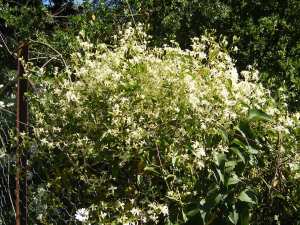
Photo of native clematis

Native clematis

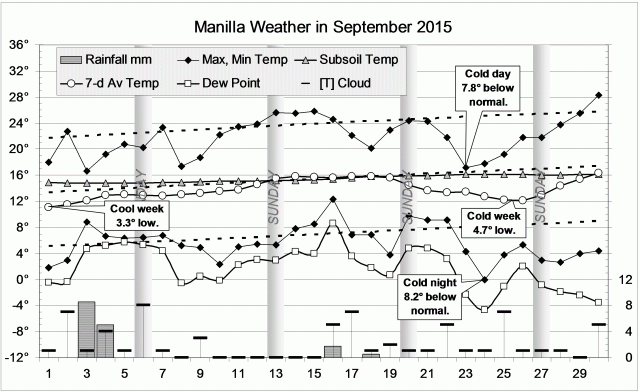
Few days or nights in September were warmer than normal. The 23rd was a very cold day (17.1°) and the 24th had a very cold morning (-0.1°). The weekly temperature was near normal in the third week, but it had been cool in the first. It was cold (4.7 below normal) in the fourth week, and was rising through normal at the month’s end.
As is usual in September, most days were fine, and they were much warmer than the nights. The afternoon humidity was low (24%), but not nearly as low as in 2013 (15%).
Rain fell on only four days, with the highest reading 8.6 mm on the 4th.
Weather log for September 2015

 Comparing September months

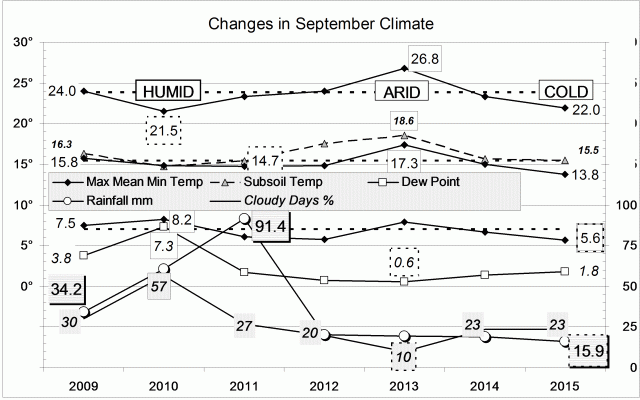
In a dramatic change from August, both days and nights were very cold, as they were in September 2004.
The aridity was not quite as bad as in 2013, when the dew point was lower and there was less cloud.
Such cold, dry conditions are not those of an El Niño event (hot and dry) or of a La Niña event (cold and wet). If more extreme, they would be those of a glacial period.
The rainfall of 15.9 mm was well below average, in the 22nd percentile. There are still no serious shortages in rainfall totals for small numbers of months. A severe shortage (4th percentile) has appeared in the 30 month total (1186 mm). There are still deep ponds in Greenhatch Creek.
Climate for September 2015


Data. All data, including subsoil at 750 mm, are from 3 Monash Street, Manilla. Rainfall data up to 26/3/15 is from Manilla Post Office, Station 055031.

August 2015 normal weather

Vine blossom photo

Wonga-Wonga Vine

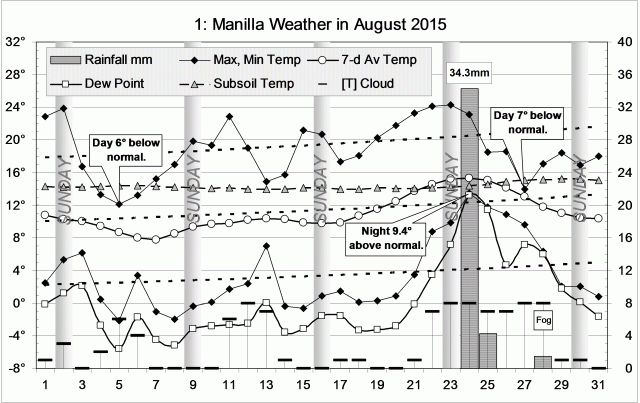
Up to the 24th of August, there had been no rainfall readings above 6 mm for 67 days, and none at all for 29 days. Then storms brought 34 mm one day and 4 mm the next. A little more fell on the 28th. Overcast skies came with the rain, and one morning had fog until after 9 am.
Two days were unusually cool: the 5th was 6° below normal and the 27th was 7° below normal. By contrast, the minimum temperature on the warm rainy morning of the 24th (13.5°) was 9.4° above normal. There were 15 frosts (normal), but the coldest morning, the 5th, reached only minus 2.1°.
The weekly average temperature was a little low in the sunny first half of the month. It was high just before and during the rain, then low again.

Weather log for August 2015

 Comparing August months

This month was close to normal, and very like August last year.
Days were a bit cool. That made the daily temperature range rather low, in line with rather cloudy skies.
The rainfall of 40.1 mm was on average, and in the 57th percentile. As happened last month, only one rainfall total was as low as the 9th percentile. That serious shortage had now moved back to the 30-month total (1255 mm). Water is flowing in Greenhatch Creek.

Climate for August 2015


Data. All data, including subsoil at 750 mm, are from 3 Monash Street, Manilla. Rainfall data up to 26/3/15 is from Manilla Post Office, Station 055031.

July 2015 cloudy and cool

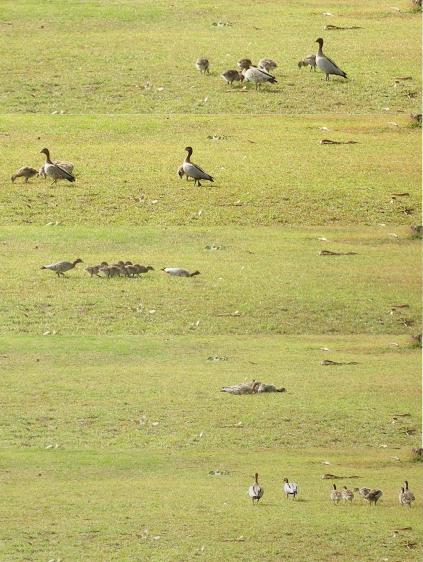
Photo sequence of Wood Ducks and ducklings

Wood Ducks Predator Drill

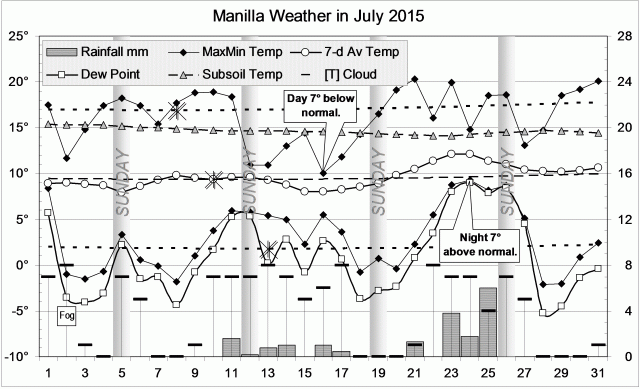
After a week of fine weather, most of the month was overcast, with cool days and warm nights. One day was very cool, 7 degrees below normal. Later, to make up for that, one night was 7 degrees above normal. There were 13 frosts (usually 17).
The news was full of items about cold weather. In fact, the weekly average temperature was not low here.
It rained on ten days, but never more than 6 mm.

Weather log for July 2015

 Comparing July months

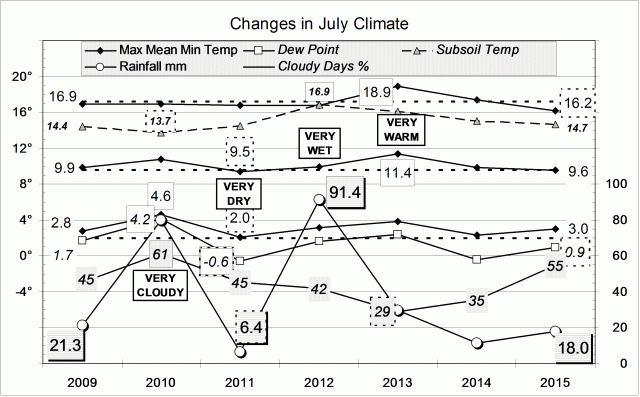
For monthly averages, the most remarkable was the cloudy mornings: 55%. Even that was not as high as in July 2010, which had 61%.
The mean daily maximum temperature was just one degree low and the mean daily minimum one degree high. That made the daily temperature range a narrow 13.2 degrees. This also was not quite as narrow as in July 2010.
The rainfall of 18.0 mm was in only the 21st percentile, but it was higher than in last July or in three other recent July months. This month, one rainfall total has fallen into the 9th percentile (a serious shortage): the 24-month total of 984 mm.

Climate for July 2015


Data. All data, including subsoil at 750 mm, are from 3 Monash Street, Manilla. Rainfall data up to 26/3/15 is from Manilla Post Office, Station 055031.
Hot Days and ENSO

Graphical log of max temps and hot days

More frequent hot days do not come in a three year cycle, but in a 1.5 year cycle related to ENSO.

The Hot Day data set

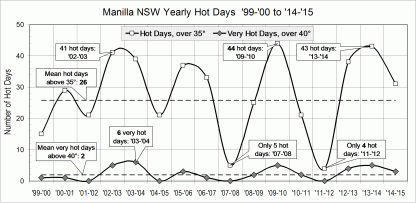
The graph of number of hot days per year

Log of annual hot days in 16 yearsThe graph on the left is one I posted earlier. The height of each data point represents the number of hot days in a year, plotted near January. The pattern of points led me to join them by a smooth curve. This curve swings up and down rather regularly, with five peaks and five dips in the fifteen years. That is, more frequent hot days seem to come in a three-year cycle.
Is this cycle “real”? Should we look for a cause? Will the cycle continue?
Probably not! The points of measurement are one year apart. Cycles that are only three years long may be “aliases” of different and shorter undetectable cycles. (See Note below on Nyquist frequency.)

More detailed hot day data

Other graphs already shown include further data: the number of hot days in each month, and the 13-year average number of hot days in each calendar month. From these I have calculated a relative frequency. That is, the ratio of the actual number to the average number for that month.
Only the months of November, December, January and February have enough hot days to calculate a relative frequency, but these can show changes within the hotter months of each year.

The daily maximum temperature data set

A graph that I posted in “El Niño and my climate” shows a curve of smoothed monthly means of daily maximum temperature anomalies. The yearly cycle of summer-to winter temperature has been removed. I have also applied a smoothing function, which makes the monthly points of measurement effectively two or three months apart. As a result, cycles longer than about six months can be detected.
There are about 10 peaks and 10 dips in the 15.5 year curve. They define a cycle of about 1.5 years wavelength. That cycle is so much longer than the minimum-detectable six month cycle that “aliasing” is not likely.
The reality of this temperature curve is supported by its close similarity to the recognised curve of the El Niño – Southern Oscillation (ENSO), as read from NINO3.4 Pacific Ocean sea surface temperature anomalies.

A combined graph of hot day and temperature data

The graph at the top of the page presents the monthly smoothed maximum temperature anomaly again, using the scale at the left. To this I have added data on the number and frequency of hot days.
The annual number of hot days is shown in blue, in blue boxes. The boxes are placed higher or lower according to the number, but the height is adjusted to match other data better.
A “Hot Day Index” is shown by blue diamonds. This index is based on the relative frequency of hot days in each month that has data.  I have re-scaled the values to improve the match. (See Note on Re-scaling below.)

Matching hot days with temperature

Continue reading

El Niño and My Climate

ENSO and Manilla NSW temperature anomalies over sixteen years

Temperature

The first graph shows that the temperature at Manilla NSW agreed very closely with El Niño and La Niña temperatures for a good part of the last sixteen years.
The El Nino – Southern Oscillation (ENSO) is shown by NINO3.4 monthly anomaly values, and temperature at Manilla, NSW is smoothed monthly mean daily maximum temperature anomalies. (See the Note below.)
Values of Manilla temperatures agree with those of ENSO through the major temperature peaks and troughs in the spring seasons of 2002, 2006, 2007, 2009, and 2010. In the two highest peaks of 2002 and 2009 and the deep trough of 2010, Manilla temperature extremes were more than a month ahead of ENSO temperature extremes.
Since mid-2011, the two curves do not agree well:
* A La Nina in summer 2011-12 that was very weak produced the deepest of all troughs in Manilla temperature.
* An El Nino in winter 2012 resulted in heat at Manilla, but not until four months later.
* In spring 2013, when there was no El Nino at all, Manilla had a heat wave just like those with the El Nino’s of 2002 and 2009, .
The record for ENSO since January 2013 is unlike that earlier this century: it flutters rather than cycles.
To show slower changes, I have drawn cubic trend lines for both of the variables. These also agree closely, with ENSO going from a maximum (2004) to a minimum (2011) seven years later. Manilla temperature trends remained ahead of ENSO temperature trends by one or two years.

Rainfall

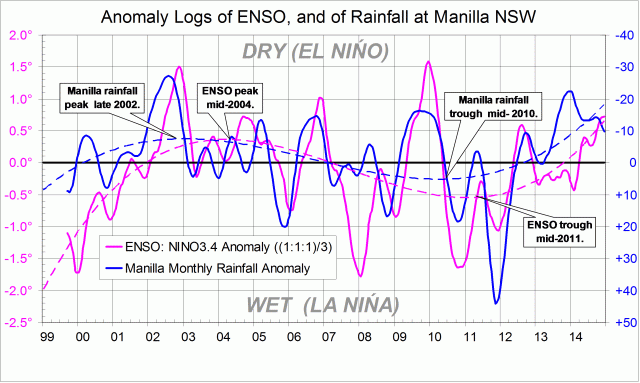
ENSO and Manilla NSW rainfall anomalies over sixteen years.

Continue reading