

Graph of Rainfall Shortages
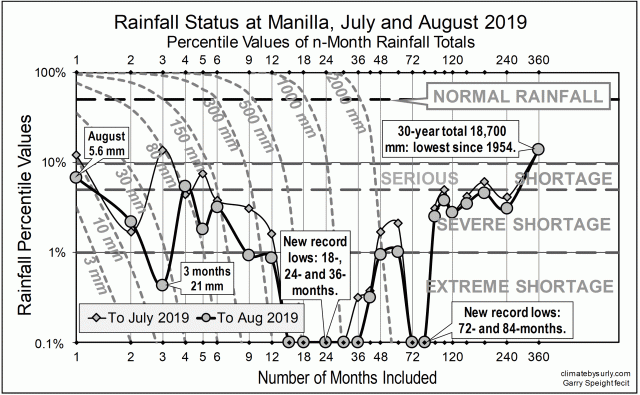
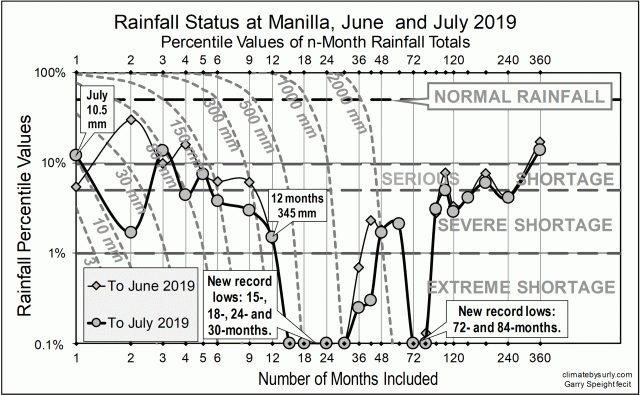
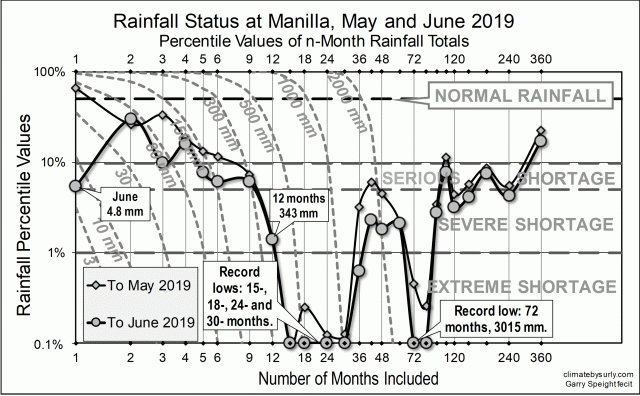
This graph shows all the present rainfall shortages at Manilla, short term and long term, as percentile values. The latest values, as at the end of September, are shown by a thick black line with large circles. Those from one month earlier are shown by a thinner line with small diamonds. [The method is described in “Further Explanation” below.]
Record low rainfalls for 15-months to 36-months
With only 1.2 mm of rain falling in September 2019, most of the rainfall totals that had been record low values in August fell further to become new records. Some of these rainfall totals had been getting lower in each of the last four months. Until 2019, these records for low rainfall had not been broken in half a century, some having been set in the great drought of 1966.
Some of the current rainfall totals are very much lower than the previous long-standing records. For example:
- 18-month total to Sep 2019: 384 mm; to Apr 1966: 514 mm; now lower by 130 mm.
- 30-month total to Sep 2019: 853 mm; to Oct 1966: 1078 mm; now lower by 225 mm.
- 36-month total to Sep 2019: 1161 mm; to Jan 1947: 1333 mm; lower by 172 mm.
Record low rainfalls for 72-months and 84-months
Record low rainfalls for 72-months and 84-months, which had appeared during 2019, got steadily lower. The earlier records had stood for more than a century, (Feb, Mar 1903) but are now beaten by about 100 mm.
The latest four months
September’s low rainfall has dragged down the totals for 2-, 3-, and 4-months. The 4-month total of 22 mm is the 2nd lowest ever.
The pattern of this drought
Two features of this drought are now clear from this data:
- It is an extreme drought of two to three-year duration: one of Manilla’s six great droughts.
- Record-breaking rainfall shortages at 72-month and 84-month duration show that the summer droughts of 2012-13 and 2013-14 still have an effect, not compensated by the wet winter of 2016.
Table of lowest-ever rainfalls
In a post of July 2018, I tabulated the lowest-ever rainfall for selected durations up to 360 months.
I commented that such records are rarely broken, and all had stood for at least forty-six years at that date.
The current drought has now broken most of those records for durations between 12-months and 84-months
Further Explanation
The following notes explain aspects of this work under these listed headings:
Data analysis
Cumulative rainfall totals
Percentile values
Severity of rainfall shortages
Limitations of this analysis
Monthly rainfalls form a single population
Observations are not retrospective
The rain gauge failed

 climate by surly