January 2019 very hot

Sun sets through gum tree

Eucalypt Silhouette

Weekly temperatures were high all month, peaking at 6.4° above normal on the 17th and never less than 3.4° above normal. Seven days had peak temperature over 40° (fewer than the nine in February 2017). Only one day was cooler than normal, while no nights were.
There were four rain days, with 18 mm recorded on the 21st.
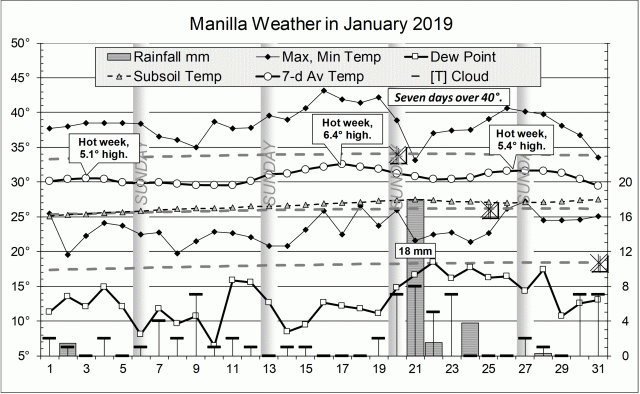
Graphical log for January 2019

Comparing January months

January 2019 was very hot: more than two degrees hotter than any recent month. Mean temperatures were far above the normal January temperatures for this station (means for the decade from March 1999):

Mean Maximum: 38.4°, above normal by 4.6°.
Mean average: 30.8°, above normal by 4.8°.
Mean minimum: 23.2°, above normal by 5.2°.

Manilla was not the only hot place. Australia-wide, this was the warmest January on record.

Apart from high air temperatures, Manilla’s climate was near normal. Even the subsoil temperature was normal. So were the cloudiness, dew point and daily temperature range.
The rainfall of 25.0 mm was at the 15th percentile, far below the average (87 mm). I will report the on-going drought in another post.

Climate for January months


Data. A Bureau of Meteorology automatic rain gauge operates in the museum yard. From 17 March 2017, 9 am daily readings are published as Manilla Museum, Station 55312.  These reports use that rainfall data when it is available.  Since no 9 am readings have been recorded since August, I have substituted my non-standard gauge readings for all days.
All other data, including subsoil at 750 mm, are from 3 Monash Street, Manilla.

Driest 6 years since 1903

The six-year rainfall total of 3142 mm to January 2019 was the lowest in a century. The only lower totals ended in the months January, February, and March 1903.

Rainfall shortages at Dec 2018 and Jan 2019

Graph of Rainfall Shortages

This graph shows all the present rainfall shortages at Manilla, short term and long term, as percentile values. The latest values, as at the end of January, are shown by a black line with large circles. Those from one month earlier, at the end of December, are shown by a thinner line with smaller circles.

Changes this month

The pattern

At this date, rainfall totals for short periods, one month to six months, are below normal but they are not serious shortages (below the 10th percentile). Now, nearly all rainfall totals for nine months up to twenty years are serious shortages or worse. Extreme shortages (below the first percentile) occur at durations from 12 months to 24 months, and at 6 and 7 years. Severe shortages (below the 5th percentile) have now developed at 30 months, 36 months and 48 months.

Short-term shortages

At durations less than nine months, rainfall shortages hover around the 20th percentile. While not classed as “serious”, such values cause the drought to extend to ever longer durations.

Extreme shortages

There are now extreme shortages (1st percentile) at durations of 12 months (331 mm), 15 months (444 mm) 18 months (548 mm), and 24 months (821 mm). The extreme 7-year shortage has now worsened, to become the 7th driest on record. However, the 6-year shortage is even worse, the 4th driest.

Long-term shortages

In the longer term, serious shortages at 8 years, 10 years and 20 years persist from the December graph, and a new one appears at 15 years.
Such long-term rainfall shortages were common early in the 20th century. They have hardly occurred since the Keepit Dam was built in 1960.


Further Explanation

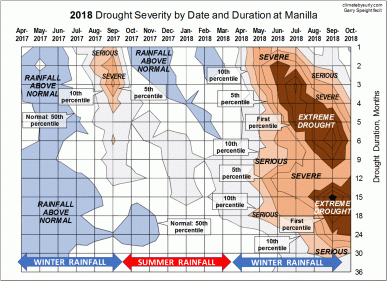
Drought 2018 contour chartMuch more detail was given in the post: “Contours of Manilla’s 2018 Drought” (with data up to October only). Notes include: “Long-term shortages”, “Classes of rainfall shortage”, and “Manilla rainfall records”.

3-year trends to January 2019

January very hot

3-year trends to January 2019

January raw anomaly data (orange)

In January 2019, the daily maximum temperature (x-axes, all graphs) and daily minimum temperature (lower left graph) were extremely high, while the subsoil had warmed to normal. Rainfall was very low, while cloudiness, dew point and daily temperature range were near normal.

 Fully smoothed data (red)

By July 2018, the last date for which data can be fully smoothed (as described below), variables had already peaked, or were about to peak, in their contribution to an extreme drought.

More recent data, only partially smoothed, suggests that temperatures and rainfall have since returned towards drought.


Notes:

January data points are marked by squares.

Smoothing

Smoothing uses Gaussian functions.
For fully smoothed data the function has a Standard Deviation of 2.5 months, it spans 13 monthly data points, and has a half-width of 6 months, which suppresses cycles shorter than 12 months. For partly smoothed data, the span of the function is reduced to 11 months, 9 months and so on.

Fully smoothed data points are plotted in red, partly smoothed data uncoloured, and raw data for the last data point in orange.

Limiting values

Blue diamonds and the dashed blue rectangle show the extreme values in the fully smoothed data record since September 1999.

Normal values

Normal values are based on averages for the decade from March 1999.* They appear on these graphs as a turquoise (turquoise) circle at the origin (0,0). A range of anomalies called “normal” is shown by a dashed rectangle in aqua (aqua). For values in degrees, the assigned normal range is +/-0.7°; for cloudiness, +/-7%; for monthly rainfall, +/-14 mm.

 * Normal values for rainfall are based on averages for the 125 years beginning 1883.

December 2018 dry and hot

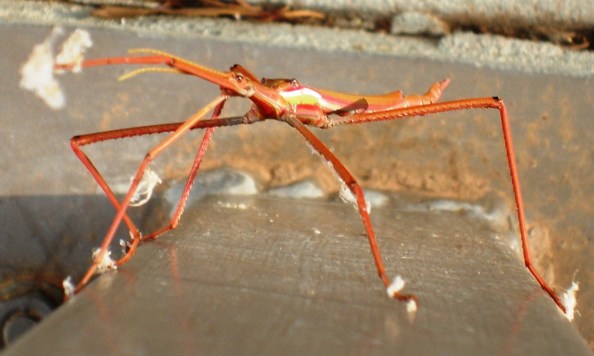
Tropidoderus stick insect

Stick Insect

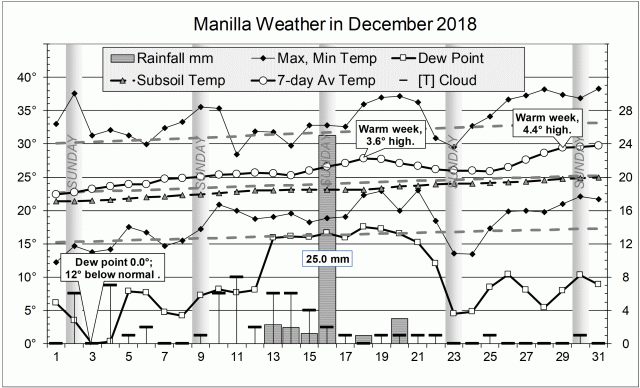
Weekly temperatures, which began normal, then remained high all month, peaking
around four degrees above normal on the 18th and again on the 29th. Only a few days or nights were cooler than normal.
There were six rain days, grouped around the 16th, which had 25 mm. Earlier and later times had sunny skies and low dew points.

Graphical log of weather December 2018

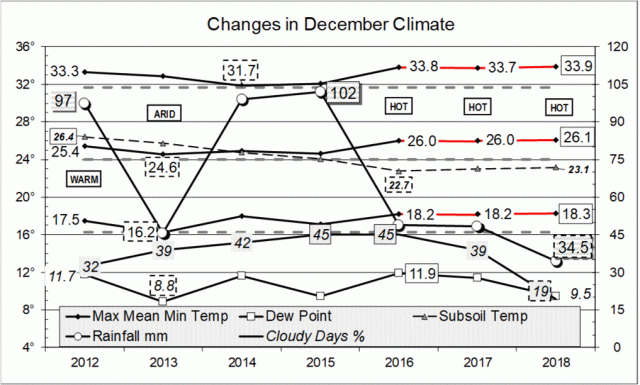
Comparing December months

Remarkably, the three mean temperatures this month are practically the same as those of both December 2017 and December 2016. They are higher, but by no more than 0.2°, near the limit that can be read on my thermometers. The mean daily maximum of 33.9° and the mean daily mean of 26.1° are the hottest for December in this record from 1999. (The mean daily minimum of 18.3° was exceeded by 18.6° in December 2009.)
This was one of the most sunny December months. The percentage of cloudy mornings (19.4%) was the same as in December 2006, but higher than in 2002 or 2005 (both 16.1%).
The rainfall of 34.5 mm is at the 22nd percentile, far below the average (74 mm). Lower rainfall totals occurred in December of 2001 (34 mm) and 2006 (19 mm). I have reported the on-going drought in another post.

Climate in December months


Data. A Bureau of Meteorology automatic rain gauge operates in the museum yard. From 17 March 2017, 9 am daily readings are published as Manilla Museum, Station 55312.  These reports use that rainfall data when it is available.  Since no 9 am readings have been recorded since August, I have substituted my non-standard gauge readings for all days.
All other data, including subsoil at 750 mm, are from 3 Monash Street, Manilla.

3-year trends to December 2018

December hot and dry

3-year trends to December 2018

December raw anomaly data (orange)

In December 2018, the top two graphs show that rainfall was low and skies sunny.
The daily maximum temperature (x-axes, all graphs) and daily minimum temperature (lower left graph) were extremely high, but the subsoil was cool. Dew point and daily temperature range were near normal.

 Fully smoothed data (red)

Climate anomaly data when smoothed in this way do not show changes from month to month, but only those cycles that last for a year or more. The smoothed data identify the month when a peak occurs in a cycle .

By June 2018, the last date for which data can be fully smoothed (as described below), some variables had already peaked in their contribution to the current extreme drought.

The anomaly of daily maximum temperature (x-axis, all graphs) had peaked in March 2018. Two months later, in May 2018, the rainfall anomaly peaked (negative) to a 21st-century record low value of minus 28.3 mm. (In the 2002 drought daily maximum temperature had not peaked until after the peak of minimum rainfall.)
By June, cloudiness was decreasing towards a minimum (perhaps in August 2018) without becoming much less cloudy than normal. Dew point anomaly was still decreasing, and seemed likely to reach a record low value about August.
The anomaly of daily temperature range had been at a (high) level characteristic of drought since the previous winter (2017). It had changed little, and peaked in May 2018 without getting near the record high value of July 2002.
The anomaly of daily minimum temperature has a cryptic relation to drought. In this case, the value peaked sharply in February 2018 before falling rapidly. It may have reached a minimum about August 2018.
The anomaly of subsoil temperature was high in June 2018, and seemed likely to peak about July, lagging four months behind the daily maximum temperature anomaly.


Notes:

January data points are marked by squares.

Smoothing

Smoothing uses Gaussian functions.
For fully smoothed data the function has a Standard Deviation of 2.5 months, it spans 13 monthly data points, and has a half-width of 6 months, which suppresses cycles shorter than 12 months. For partly smoothed data, the span of the function is reduced to 11 months, 9 months and so on.

Fully smoothed data points are plotted in red, partly smoothed data uncoloured, and raw data for the last data point in orange.

Limiting values

Blue diamonds and the dashed blue rectangle show the extreme values in the fully smoothed data record since September 1999.

Normal values

Normal values are based on averages for the decade from March 1999.* They appear on these graphs as a turquoise (turquoise) circle at the origin (0,0). A range of anomalies called “normal” is shown by a dashed rectangle in aqua (aqua). For values in degrees, the assigned normal range is +/-0.7°; for cloudiness, +/-7%; for monthly rainfall, +/-14 mm.

 * Normal values for rainfall are based on averages for the 125 years beginning 1883.