Summer 2016-17 the hottest

Young bearded dragon

Tiny Dragon

This summer, like summer 2013-14, was marked by repeated heat waves. The first, early in December, was brief. Another, in mid-January, led into one that was hotter, and persisted through the first half of February. On a weekly basis, temperatures did not fall below normal at any time in the season. Mid-February had the two hottest days of the new century, at 44.9° and 43.8°.
Although there were as many rain days as usual (22), only two days had rainfall exceeding 15 mm, and there was almost no rain in February.
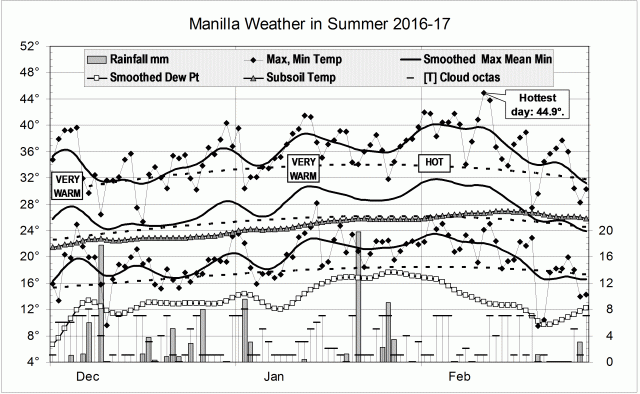
Graphical log for summer 2016-17.

Comparing summer seasons

Mean temperatures set new records for the summer season: daily maximum 35.6°, average 27.6°, and daily minimum 19.7°. Each of these was more than a degree higher than the old record. Nearly all such figures for the months December, January, and February had also been records. However, the subsoil temperature for the summer (24.7°) was low.
Two indicators of moisture were a little low: mean early morning dew point (13.4°) was down 0.7°, and mean daily temperature range (15.9°) was 0.8° wider than usual.
The percentage of cloudy mornings (38%) was almost the same as in the last four summers, and lower than in the previous two. However, 38% is much more cloudy than the “normal” figure of 31% cloudy mornings that was set in the decade 1999-2008. Summers were more sunny then.
This summer’s rainfall was very low. The unofficial total of 101.4 mm would place it as the seventh driest on record. As shown on the graph, summer 2013-14 was drier (85 mm). Otherwise,  there has not been a drier summer in the half-century since 1964-65 (70 mm).

[The following summer (Summer 2017-18) was not as hot and had more rain.]
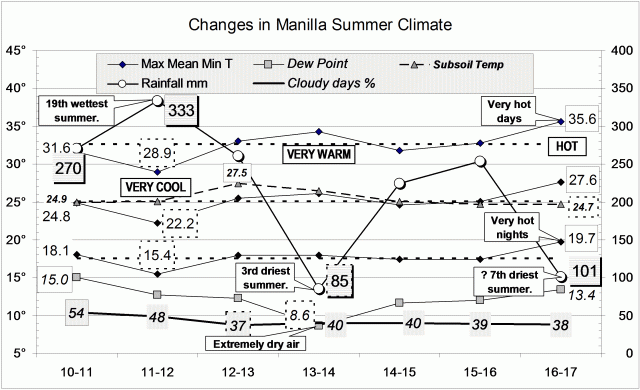
Climate for summer 2016-17


Data. Rainfall figures are usually from the automatic rain gauge at Manilla, published on the internet by the Bureau of Meteorology as Station 55031. However, the gauge ceased recording five months ago (8/10/16), and this month’s readings are from my non-standard gauge. All data, including subsoil at 750 mm, are from 3 Monash Street, Manilla.

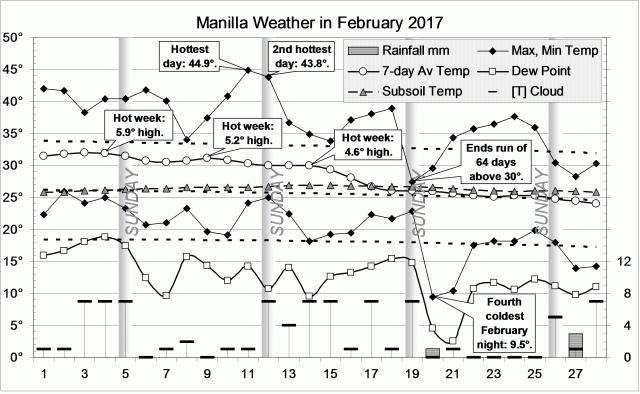
February 2017 had the hottest day

February 2017 was a month of extreme heat and hardly any rain.

Rainbow

No-rain Rainbow

The temperature rose to 44.9° on the 11th, the highest reading in this record from 1999. The next day, at 43.8°, was the next highest, beating readings of 43.7° on 3/01/2014 and 43.2° on 12/01/2013. These extremely hot days were part of a long heat-wave. Every day reached above 30° for 64 days up to the 19th, and the average weekly temperature was above 30° (4° above normal) from the 1st to the 15th.
Nights also remained warmer than normal until, abruptly, the temperature fell to 9.5° on the 20th: the 4th coldest February night! After that, day and night temperatures were normal.
Rain showers were seen frequently, but the only daily readings (unofficial) were 1.1 mm on the 20th and 3.0 mm on the 27th.

Weather log February 2017

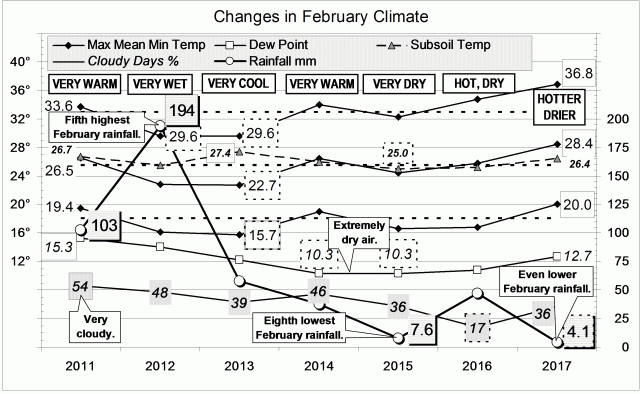
Comparing February months

This was by far the hottest February of the new century, with highest values of all three temperatures: mean maximum temperature (36.8°), mean average temperature (28.4°) and mean minimum temperature (20.0°). Subsoil temperature was normal.
While cloudiness was normal, a rather low dew point and rather wide daily temperature range reflect low moisture, while the rainfall was very low indeed.
The estimated monthly rainfall total of 4.1 mm exceeds that of just a very few February months: 1901 (2 mm), 1932 (3 mm), and perhaps 1923 and 1938 (both 4 mm), but no others. However, this extremely low rainfall for the month has not brought any serious rainfall shortages for totals of more than one month. The four-month total of 123 mm is at the 17th percentile, which is not even as bad as the five-year total (2844 mm) which is at the 14th percentile.

Climate for February 2017.


Data. Rainfall figures are usually from the automatic rain gauge at Manilla, published on the internet by the Bureau of Meteorology as Station 55031. However, the gauge ceased recording four months ago (8/10/16), and this month’s readings are from my non-standard gauge. All data, including subsoil at 750 mm, are from 3 Monash Street, Manilla.
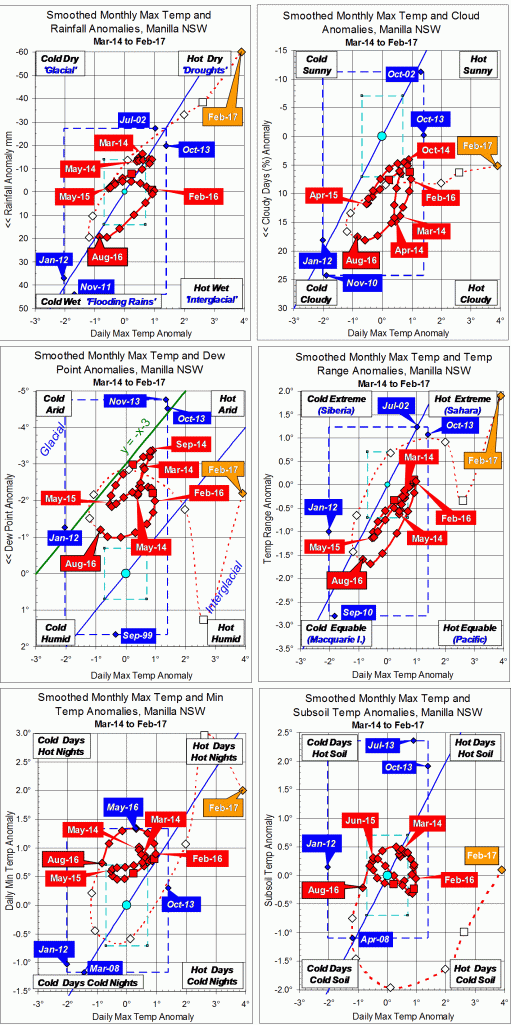
3-year trends to February 2017

Parametric plots of smoothed climate variables at Manilla
“Extreme heat with little rain”

3-year trends to February 2017.

February raw anomaly data (orange)

In February 2017 days became extremely hot and rainfall very low. The subsoil temperature rose from low to normal.

 Fully smoothed data (red)

Fully-smoothed values are now available for the winter months (June, July, and August) of 2016. That winter, as daily maximum temperature fell through normal values, a maximum in moisture was shown by maxima in rainfall, cloudiness, and dew point, and a minimum in daily temperature range. None of the smoothed values was extreme; in fact, the dew point remained on the dry side of normal.
Not only daily maximum temperature anomaly fell during the summer. Both the daily minimum temperature anomaly and the subsoil temperature anomaly also fell. The smoothed daily minimum temperature anomaly had just reached a record high value in May, and was still above normal as the summer ended.


Note:

Fully smoothed data – Gaussian smoothing with half-width 6 months – are plotted in red, partly smoothed data uncoloured, and raw data for the last data point in orange. January data points are marked by squares.
Blue diamonds and the dashed blue rectangle show the extreme values in the fully smoothed data record since September 1999.

Normal values are based on averages for the decade from March 1999.* They appear on these graphs as a turquoise (turquoise) circle at the origin (0,0). A range of anomalies called “normal” is shown by a dashed rectangle in aqua (aqua). For values in degrees, the assigned normal range is +/-0.7°; for cloudiness, +/-7%; for monthly rainfall, +/-14 mm.

 * Normal values for rainfall are based on averages for the 125 years beginning 1883.

January 2017 had the hottest night

Cumulus congestus at 130 km

Showers at 130 kilometres

The daily weather log

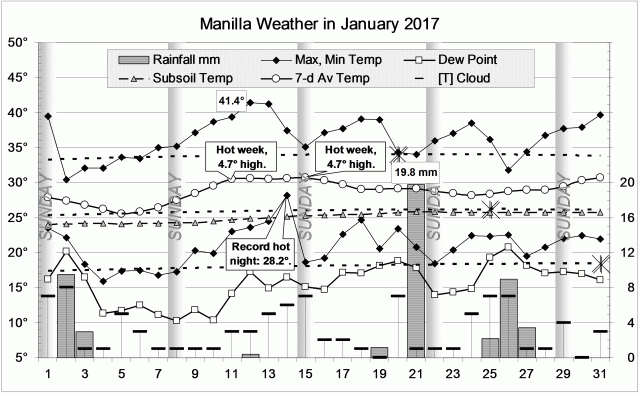
In the early morning on the 14th, the minimum temperature was 28.2°, the hottest night in this record from 1999. That beat 27.8° set on November the 28th, 2009. Of January months, only this month and January 2006 had no nights as cool as 15°. There were no cool days either: like January 2002, no days were as cool as 30° (and none since 16/12/16). However, only two days this month went over 40°: the 12th with 41.4° and the 13th with 41.2°. That hardly compares with January 2003, which had five. The weekly average temperature was over 30° (4.7° above normal) from the 11th to the 15th. Late in the month, it got as low as 28°, then climbed again.
Showers and storms brought rain on 8 days, but the maximum was only 19.8 mm.

Weather log January 2017

Comparing January months

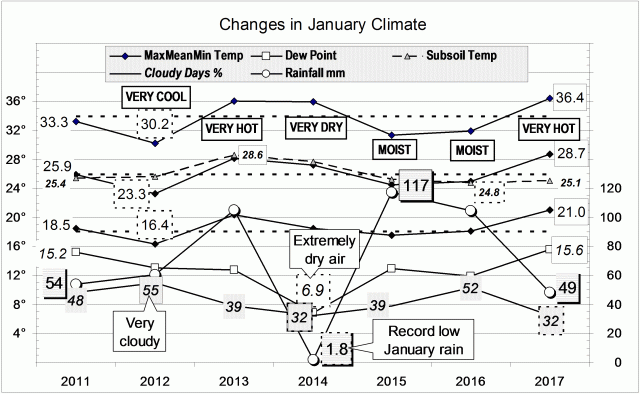
As in December, this was the hottest January of the new century. It easily beat January 2013 in mean daily maximum (36.4°), mean average (28.7°), and especially mean daily minimum (hot nights: 21.0°). As this months days and nights were both so warm, the daily temperature range was quite normal (15.4°).
Contradicting the high air temperatures, the subsoil temperature was below normal, at 25.1°.
The month was more humid than usual. Afternoon humidity, at 36%, was the highest January value in twelve years (normally 28%), and early morning dew point was the highest in eleven years.
The monthly rainfall total of 48.5 mm is in the 30th percentile, well below the average of 87 mm. Rainfall totals for more than one month still show no shortages. The 48-month total of 2320 mm (down 280 mm) has the lowest percentile value (23rd percentile) as a legacy of dry months around 2013.

Climate for January


Data. Rainfall figures are usually from the automatic rain gauge at Manilla, published on the internet by the Bureau of Meteorology as Station 55031. However, the gauge ceased recording four months ago (8/10/16), and this month’s readings are from my non-standard gauge. All data, including subsoil at 750 mm, are from 3 Monash Street, Manilla.
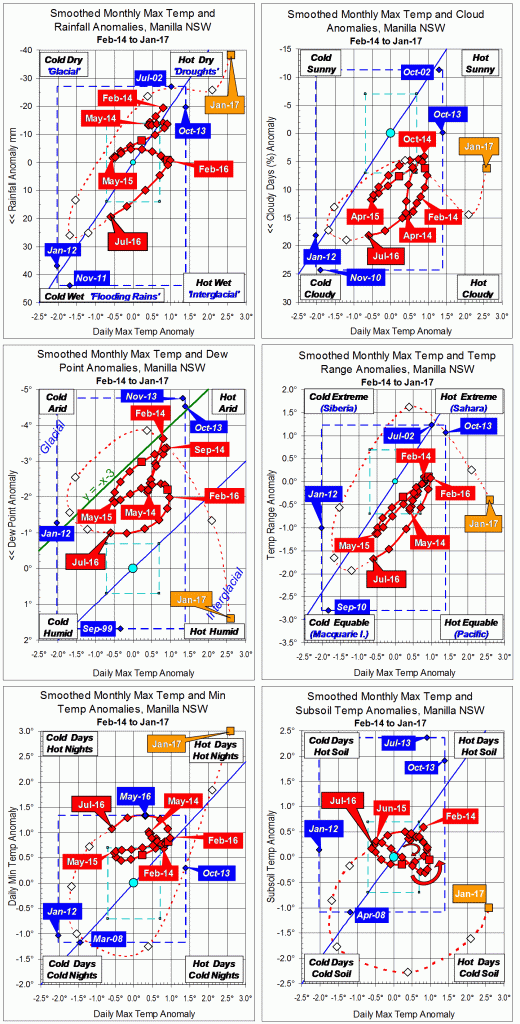
3-year trends to January 2017

Parametric plots of smoothed climate variables at Manilla
“January 2017 very hot”

3-year trends to January 2017

January raw anomaly data (orange)

In January 2017 both days and nights became even hotter. While rainfall was low, dew point was high.

 Fully smoothed data (red)

At the time of the latest fully-smoothed anomalies, in July 2016, most variables were still moving towards towards cool and moist.


Note:

Fully smoothed data – Gaussian smoothing with half-width 6 months – are plotted in red, partly smoothed data uncoloured, and raw data for the last data point in orange. January data points are marked by squares.
Blue diamonds and the dashed blue rectangle show the extreme values in the fully smoothed data record since September 1999.

Normal values are based on averages for the decade from March 1999.* They appear on these graphs as a turquoise (turquoise) circle at the origin (0,0). A range of anomalies called “normal” is shown by a dashed rectangle in aqua (aqua). For values in degrees, the assigned normal range is +/-0.7°; for cloudiness, +/-7%; for monthly rainfall, +/-14 mm.

 * Normal values for rainfall are based on averages for the 125 years beginning 1883.