
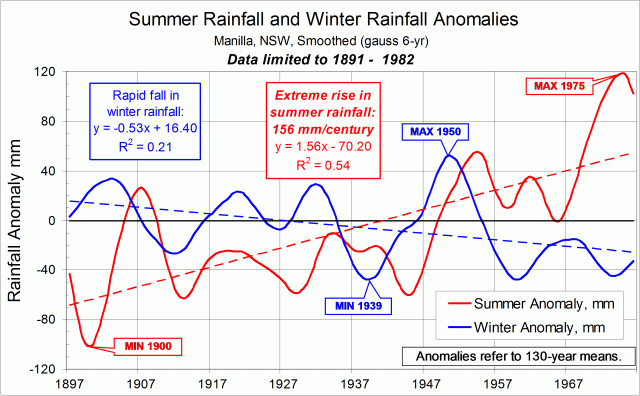
Part 2 of 3: The record restricted to 1891-1982 (92 years)
(See Notes below for data and plotting details.)
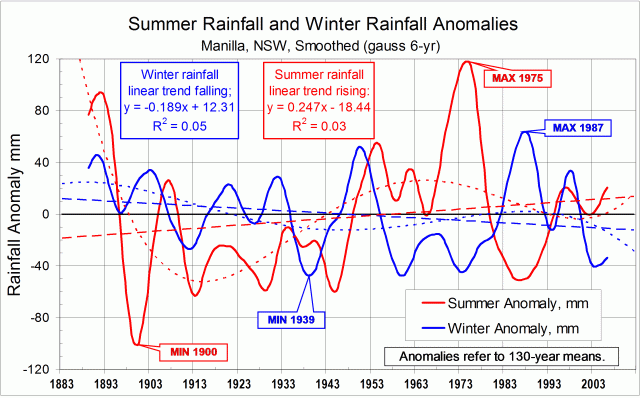
No climatic record is ever long enough to demonstrate apparent cycles, trends or extremes beyond doubt. In Part 1, a linear trend of summer rainfall rising at 24.7 mm per century was fitted to the whole 130-year record. Although this is a very high (perhaps unsustainable) rate of increase, the trend line explains hardly any of the variation. The R-squared value is 0.03! However, there does seem to be a steeper quasi-linear trend prevailing for most of the period of record. The graphs I have posted here show a restricted record beginning in 1891 and ending in 1982. This simulates an analysis done in 1983 (which could not have used more recent data) and supposes that records earlier than 1891 were unavailable for some reason.
I have chosen these dates so that
(i) the near-record smoothed summer rainfall maximum of 1891 is excluded but the record smoothed summer rainfall minimum of 1900 is included;
(ii) the record smoothed summer rainfall maximum of 1975 is included but the very low smoothed summer rainfall minimum of 1987 is excluded.
(Due to the smoothing window extending six years before and after a specified date, smoothed rainfall values can be calculated only from 1897 to 1976.)

Linear trends
For this restricted data set of 92 years, all four linear trends are very much steeper than for the whole 130-year record. The R-squared values are also much higher, indicating that the Continue reading
 climate by surly