Still hot and dry in November 2014

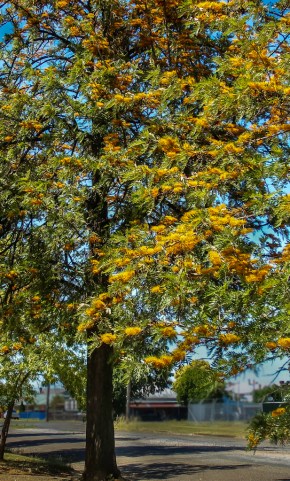
Silky oak trees in full bloom

November Silky Oaks

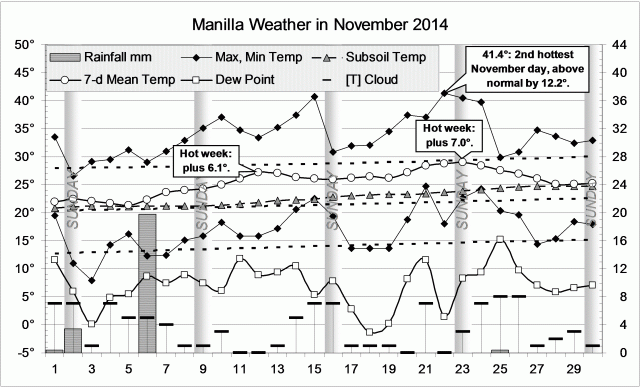
Although the month began near normal, with two rain days, the weather became hot and dry again. Saturday the 22nd reached 41.4°, to be the second hottest November day on this 15-year record.
There were two heat waves, with the average weekly temperature above normal by 6.1° on the 12th and by 7.0° on Sunday the 23rd. (November of 2009 had a worse heat wave, being above normal by 9.5°, and reaching 31.3°: the hottest week in any month.)
Most nights this month were warm, with low dew points. By contrast, many days were cloudy.
 Weather log November 2014

Comparing November months

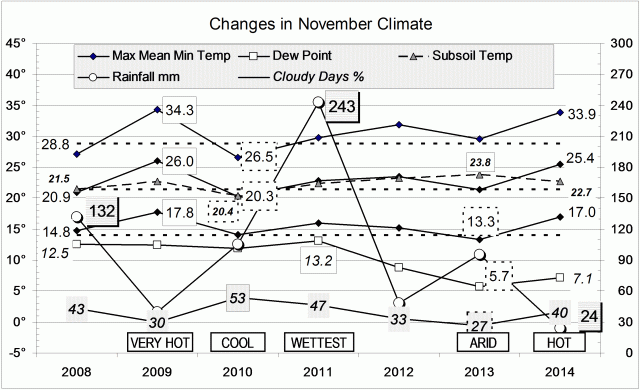
On average, the month was not quite as hot as November 2009, the hottest this century. The air was again very dry, with an early morning dew point of 7.1°, a little higher than the lowest value (5.7°) recorded for November last year.
Following only three years after the wettest November on the 130-year record (242.9 mm), the total rainfall of only 24 mm was in the 15th percentile. That is, such low November rainfalls happen about one year in seven. However, the time since a lower November rainfall (15 mm in November 1990) is thirteen years: the longest gap ever.
For the third month in a row, little changed in rainfall totals for periods of more than one month. There is no longer a serious shortage in the 6-month total (now in the 10th percentile) but there are now serious shortages in the totals for 5 months (9th percentile), 9 months (8th percentile), 15 months (6th percentile), 18 months (6th percentile), and 30 months (9th percentile). There is one severe shortage: the total for 12 months (393 mm) is in the 4th percentile.
Climate fro November 2014


Data. Rainfall data is from Manilla Post Office, courtesy of Phil Pinch. Temperatures, including subsoil at 750 mm, and other data are from 3 Monash  Street, Manilla.
October 2014 hot and dry

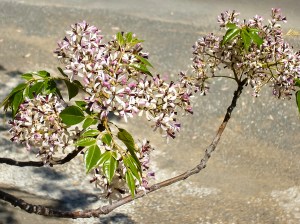
Blooms of Melia azedarach

Fragrant white cedar blooms

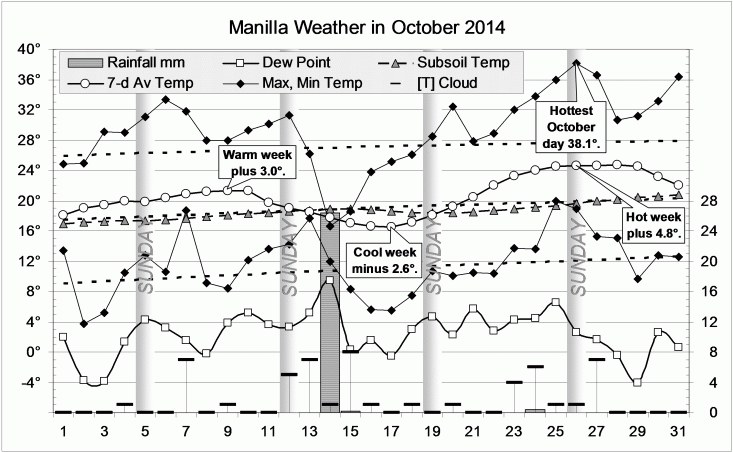
The month began with a warm spell, which was followed by a cool spell about the 15th. It ended with a long hot spell, 4.8 degrees above normal, including the hottest October day this century (38.1°) on the 26th. As usual, there were no frosts.

Of three rain days (usually seven), only the 14th had much rain: 26.4 mm, with heavy showers.
Half the mornings had no cloud at all, and nine days had very wide temperature ranges, greater than 20°.

Weather log October 2014

 Comparing October months

This was the hottest October month at Manilla in this 16-year record. Maximum, mean and minimum temperatures were all highest values, but the maximum was no higher than in October 2007. The subsoil temperature returned to a value below normal.
As indicators of low moisture, the daily temperature range was very high and cloudiness and dew point were very low, as in the last two October months. Even less cloud had been seen in 2002 and 2004.
Recently, lower rainfall occurred in October 2002 (15.0 mm), 2012 (12.6 mm), and 2013 (15.0 mm). However, this month’s total of 27.0 mm is well below the October average of 58 mm, in the 21st percentile. Since last month, little has changed in rainfall totals for periods of more than one month. There is still a serious shortage in the 6-month total (8th percentile) but not now in the 9-month total (10th percentile). The 15-month total has advanced to severe (4th percentile), while the 18-month total has retreated to serious (5th percentile). A serious shortage has also appeared in the 30-month total (8th percentile).

Climate October 2014  


Data. Rainfall data is from Manilla Post Office, courtesy of Phil Pinch. Temperatures, including subsoil at 750 mm, and other data are from 3 Monash  Street, Manilla.
3-year trends to October 2014

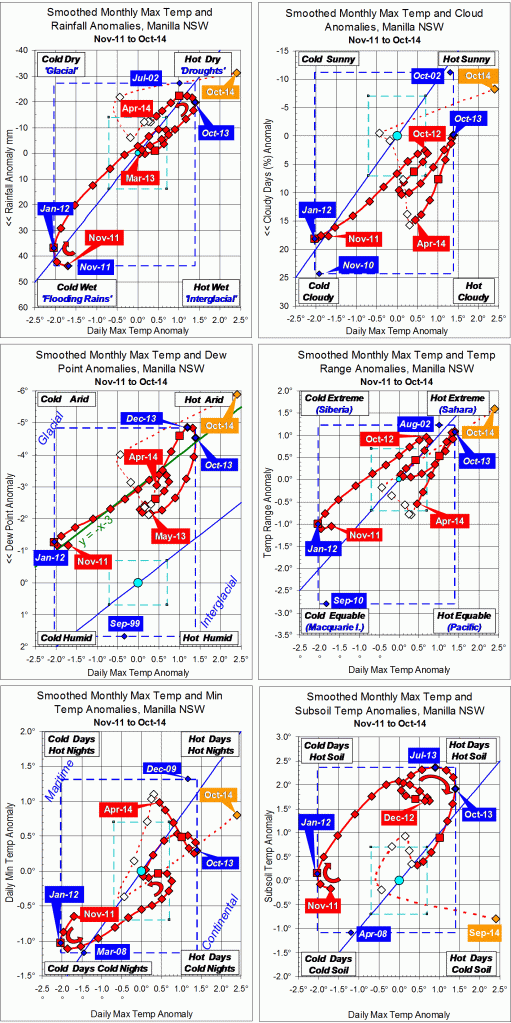
Parametric plots of smoothed climate variables at Manilla
“October 2014 droughty”

Trends to October 2014

October data (orange)

All raw anomaly values for October, except subsoil temperature, moved suddenly to drought: high temperatures and little moisture. Subsoil temperature, which had been at a record high value fifteen months earlier, became very low.

Fully smoothed data (red)

The latest fully-smoothed data (April 2014), like that of the previous month, continued the trends established in summer. All (except daily minimum temperature) moved away from drought. A movement back towards drought came only later.
Since the major “flooding rains” episode of summer 2011-12, (lower left corner on the graphs)  Manilla’s climate has swung towards drought three times:
(i) a very mild drought in October 2012, returning to normal by March 2013;
(ii) a moderate drought that was very hot in October 2013 and dry in January 2014, returning to normal about May 2014;
(iii) perhaps a further drought about October 2014 (to be identified later).


Note:

Fully smoothed data – Gaussian smoothing with half-width 6 months – are plotted in red, partly smoothed data uncoloured, and raw data for the last data point in orange. January data points are marked by squares.
Blue diamonds and the dashed blue rectangle show the extreme values in the fully smoothed data record since September 1999.

Normal values are based on averages for the decade from March 1999.* They appear on these graphs as a turquoise (turquoise) circle at the origin (0,0). A range of anomalies called “normal” is shown by a dashed rectangle in aqua (aqua). For values in degrees, the assigned normal range is +/-0.7°; for cloudiness, +/-7%; for monthly rainfall, +/-14 mm.

 * Normal values for rainfall are based on averages for the 125 years beginning 1883.

September 2014 cool and dry

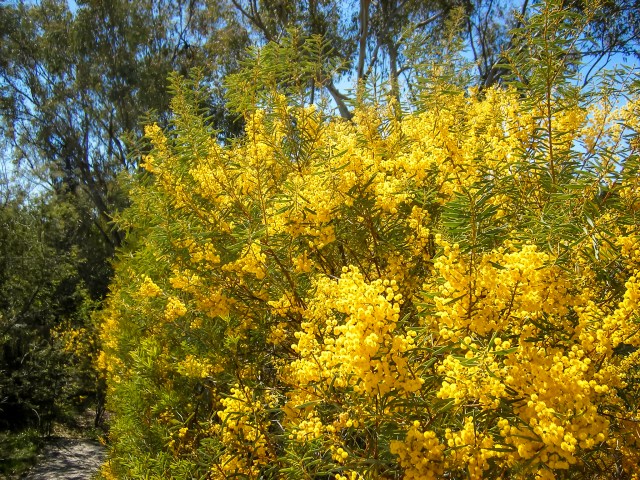
Acacia decora hedge

A hedge of western golden wattle

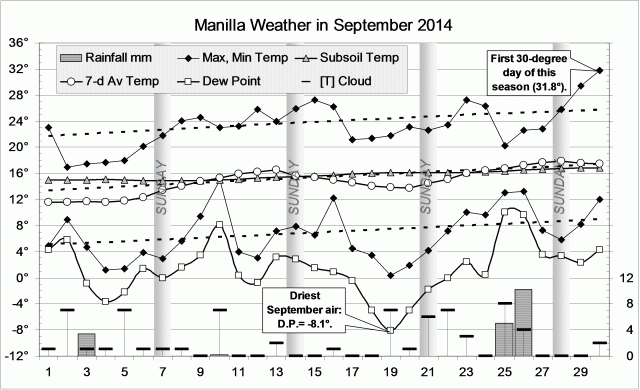
The daily weather log

Two 5-day cool spells began on the 2nd and the 17th. Days and nights were both three or four degrees cooler than normal. At the same time, the air was very dry: a new lowest September dew point of minus 8.1° came on the 19th.
At other times, temperatures were near normal. There were four frosts (normally three). There were four rain days, which is normal.
The first thirty-degree day since mid-winter came on the 30th. At Manilla, it often comes near the spring equinox (September 22nd). In the 21st century, the first thirty-degree day came as early as August 23rd in 2009 and as late as November 9th in 2010.

Weather log September 2014.

 Comparing September months

Last September had been the warmest in this century. While not cold like September 2004, this month was half a degree cooler than normal. Like September in 2003, 2007, and 2012, it was both cool and dry. By contrast, the cool Septembers of 2010 and 2011 were wet, affected by La Nina.
Cloudiness and daily temperature range were near normal, but the mean dew point (1.4°) was not much higher than the extreme low value (0.6°) set last year.
The total rainfall of 18.8 mm is in the 26th percentile, well below the September average of 41 mm. Totals for periods of more than one month now have serious shortages for six months (7th percentile), nine months (7th percentile), and fifteen months (5th percentile), and a severe shortage for eighteen months (4th percentile).

The current drought report (6/10/2014) of the Bureau of Meteorology shows some serious and severe rainfall deficiencies in the area. Ten-month deficiencies extend west to Manilla from the Northern Tablelands, and there are 24-month rainfall deficiencies near Manilla and widespread around Walgett, 300 km to the north-west.

Climate September 2014.  


Data. Rainfall data is from Manilla Post Office, courtesy of Phil Pinch. Temperatures, including subsoil at 750 mm, and other data are from 3 Monash  Street, Manilla.

3-year trends to September 2014

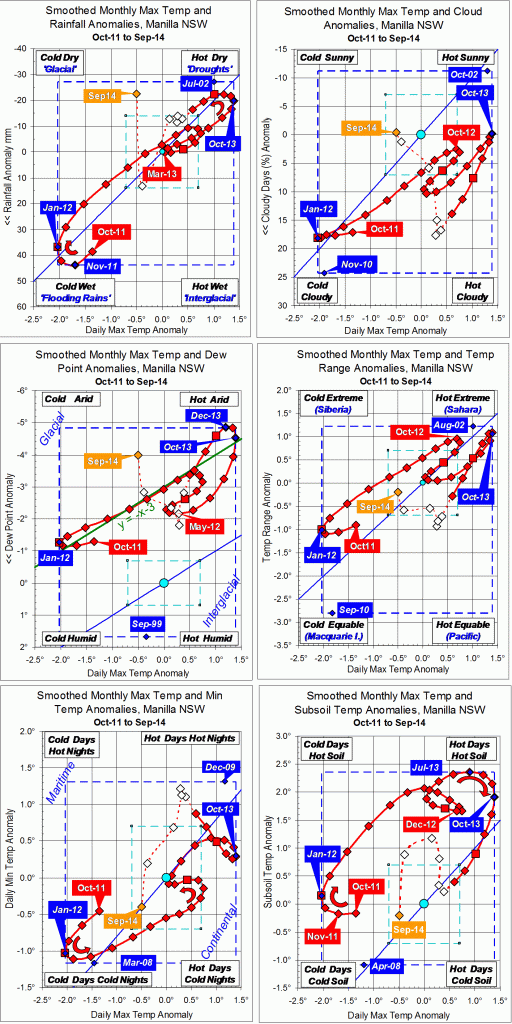
Parametric plots of smoothed climate variables at Manilla
“September 2014 had little rain”

Trends to September 2014

 September data (orange)

Most raw anomaly values for September remained on the cool-moist side of normal. However. both rainfall and dew point were again well below normal.

Fully smoothed data (red)

The latest fully-smoothed data (March 2014) continued the trends established in summer. All were moving away from drought, except for daily minimum temperature. That is, nights were becoming very warm.


Note:

Fully smoothed data – Gaussian smoothing with half-width 6 months – are plotted in red, partly smoothed data uncoloured, and raw data for the last data point in orange. January data points are marked by squares.
Blue diamonds and the dashed blue rectangle show the extreme values in the fully smoothed data record since September 1999.

Normal values are based on averages for the decade from March 1999. They appear on these graphs as a turquoise (turquoise) circle at the origin (0,0). A range of anomalies called “normal” is shown by a dashed rectangle in aqua (aqua). For values in degrees, the assigned normal range is +/-0.7°; for cloudiness, +/-7%; for monthly rainfall, +/-14 mm.