April 2008: fog and black frosts

The daily weather log
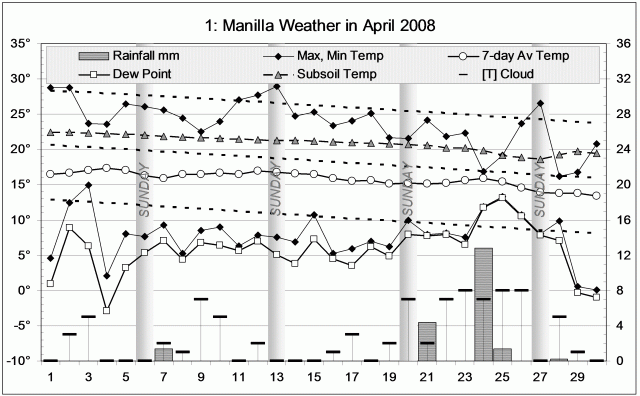
Weather log April 2008

Usually, the air cools and dries out quickly during April. This time only the daily maximum temperature came steadily down. The average temperature hovered near 16° until the last days.
At first, the air was very dry, with a Dew Point below 5°. Under a clear sky on the 4th the early morning temperature went down to 2.1° in the screen, which would be 0.1° of frost. Because the Dew Point (-3.8°) was much lower than that, there was no ice on the grass, which made it a “black frost”. It is said that frosts seldom occur in Manilla before ANZAC Day (April 25th).
As the month went on the air got moister. By the 24th the clouds in the overcast sky were down on the hills. On the 26th the town was blanketed in fog as the humidity hit 100%. (Temperature and Dew Point were both 8°.)
Evaporation was increased by strong winds on the 27th and 28th.
Dry southerly air made the last three days cool and sunny. Black frosts came back giving screen temperatures of 0.6° and 0.1° (around 2° of frost).
Practically no rain (3.6 mm) fell in more than seven weeks from 29 February to 21 April. After that, there were four rain days, including 12.8 mm on the 24th. In total, 20.2 mm fell in April, on five rain days.

 Comparing April months
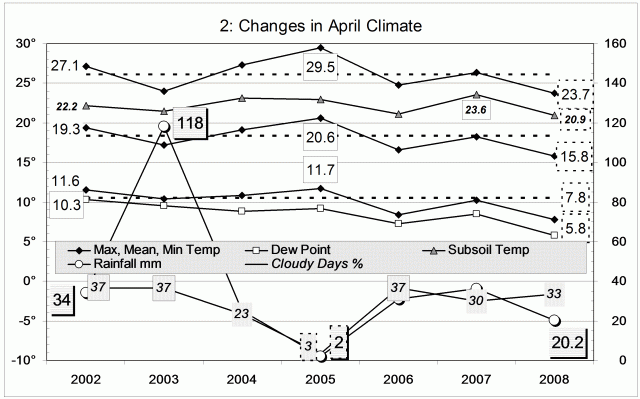
Climate April 2008

The mean temperature this month was nearly as low as the coolest  April in ten years (1999). This was the fifth cool month in a row: December (1.0° down)  January (1.9° down) February (3.1° down) March (0.9° down) and April (2.1° down). As a 5-month average the temperature was 1.8° below normal. It is as if Manilla had been moved 400 km south (near Grenfell) or 150 metres higher (like Barraba). (Note added: This was a time of global low temperature.)

The month was as cloudy as usual, but less humid.
At 20 mm, this April’s total rainfall is about 20 mm below average, as in 2001 and 2004. It is much higher than in April 2005, when Manilla was in a rainfall  drought for several months.
The rainfall total for this March and April (22 mm) is in the 4th percentile of two-monthly totals: a severe shortage. However, the three-month total (138 mm) is just below the median, and the totals for 4, 5, 6, 9 and 12 months are all at the median or above it. In particular, the 6-month total (401 mm) is quite high, at the 75th percentile.


Data. Rainfall data is from Manilla Post Office, courtesy of Phil Pinch. Dew point values before August 2005 are from Tamworth Airport 6 am data supplied by the Bureau of Meteorology. Temperature and other data are from 3 Monash Street, Manilla.
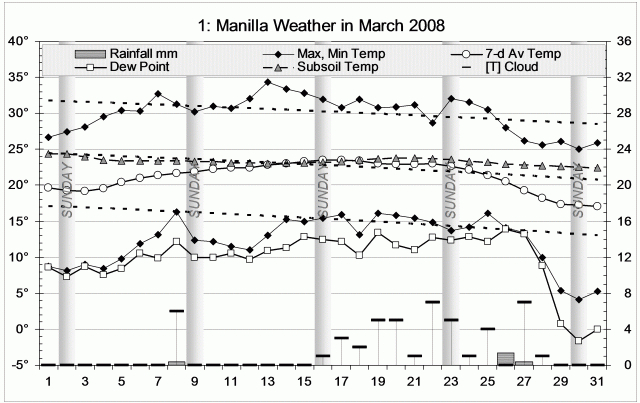
 

Dry, Dry March 2008

The daily weather log

Weather log March 2008

After 115.6 mm of rain in February, March crashed to just 2.2 mm with only three rain days. In 1971 it was worse: that year February had 173 mm and March 1 mm!
This month the air was very dry, too. Morning Dew Points which had been quite low (10°) all month, plunged to zero or less in the last days.
Although there were six cloudy mornings, eighteen mornings were completely cloud-free. The whole of the summer had only thirteen free of cloud!
Due to the dry, fine weather, three-quarters of the days had a range of temperature higher than the normal value of 15.4°. Three days had a range of 21° or more.
The 7-day average temperature began and ended well below normal, but was above normal in the third week. Nights were cold (8° below normal) in the first and last days.

 Comparing March months

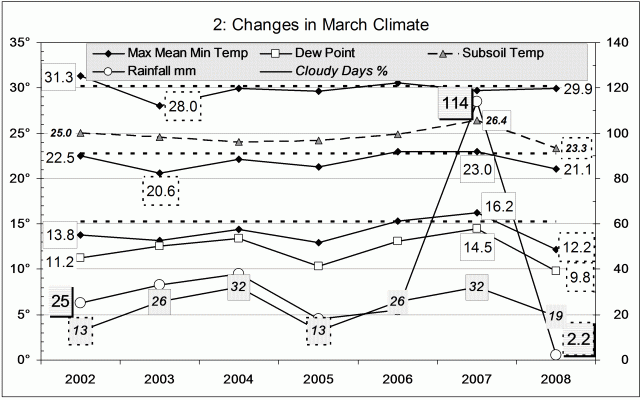
Climate March 2008

The mean daily maximum temperature this March (29.9°) is normal, but the mean daily minimum (12.2°) is the lowest in ten years. It is 2° below the average, and 4° below that of 2007 (and 2000).
The mean morning Dew Point, 8.8°, is 3° lower than normal for March. This shows very dry air, which is wilting many shallow-rooted plants.
The total rainfall of 2.2 mm is much lower than the other Marches on the graph. It is not very low compared with Marches in the long-term record: it is on the 6th percentile. In Manilla, rainfall varies more in March and April than in other months.
There must be a lot of water deep in the soil. Total rainfalls for the last 2, 3… 18 months are all above the median. The four and five-month totals are particularly high, in the 83rd percentile.


Data. Rainfall data is from Manilla Post Office, courtesy of Phil Pinch. Dew point values before August 2005 are from Tamworth Airport 6 am data supplied by the Bureau of Meteorology. Temperature and other data are from 3 Monash Street, Manilla.
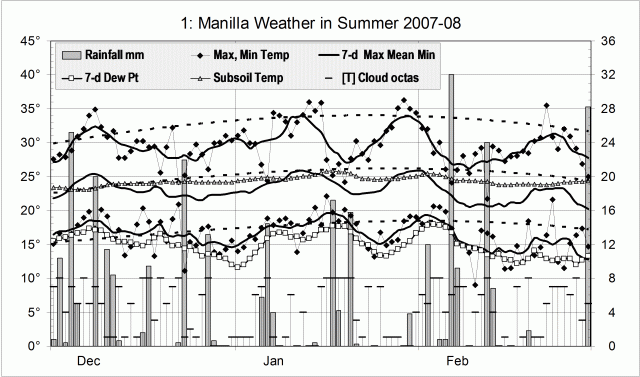
 

Summer 2007-08 was very cool,cloudy and wet

Weather log summer 2007-08

The daily weather log

Most summers recently have had one or two days over 40° and nights over 25°. Not this summer! The hottest day reached only 36.3°, and the warmest night 22.1°. Only 37 days went over 30°: half the usual number. Air conditioners may not have had much use!
The 7-day temperature curves show warm spells in the second week of December, and in the second and fourth weeks of January. Temperatures were then normal. The rest of the time they were well below normal.
Daily minimum temperatures were not so low. This made the daily temperature range small, especially during humid spells.
Humid weather (dew point 16°) came with rain in early December, mid-January, and early February. The air was rather dry (dew point 10°) at New Year and in the very last days of summer.
There were 33 rain days (normally 21). The longest dry spells were eight days from the 22nd of January, and nine days from the 20th of February. February the 6th was the wettest day, with 32 mm, and the summer total was high, at 311 mm.
It was a very cloudy summer. More than half the mornings were cloudy (over 4 octas) and many (18) were completely overcast. Only 13 mornings had a sky clear of cloud.

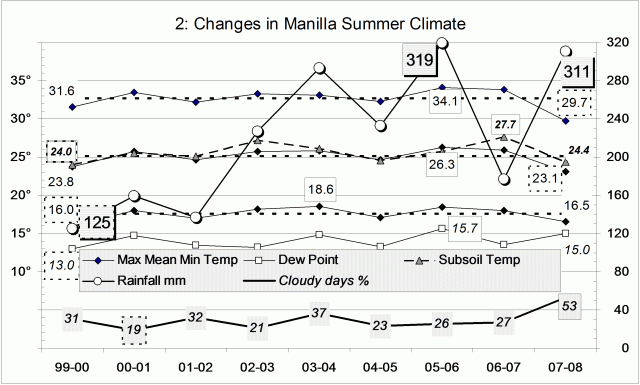
Comparing summer seasons

Mean daily maximum temperature and mean temperature this summer were the lowest in the nine year record. Mean daily minimum temperature was lower in 1999-2000, which has the next coolest mean temperature. While the cool summer of 1999-2000 had a large daily temperature range (15.6°) related to low rainfall, this summer had a very small daily temperature range (13.2°) related to high rainfall and cloud.
The mean daily maximum this summer (29.7°) is 3.3° below the nine-year average. The fall of over 4° from the very high maxima of the last two summers is dramatic.
Humidity was normal for the time of year.
For rainfall, this short record begins with the 15th driest summer (99-00, 125 mm) and includes the 19th wettest summer (05-06, 319 mm). This summer’s rainfall of 311 mm is 84 mm above the long-term summer average of 227 mm. It is on the 83rd percentile.
At 53% cloudy mornings, this summer season is by far the cloudiest of any season in the nine-year record. No others exceeded 41%.

Climate for summer 2007-08

Data. Rainfall data is from Manilla Post Office, courtesy of Phil Pinch. Dew Point values before August 2005 are from Tamworth Airport 6 am data supplied by the Bureau of Meteorology. Temperatures, including subsoil at 750 mm, and other data are from 3 Monash Street, Manilla.

Cold, cloudy wet February 2008

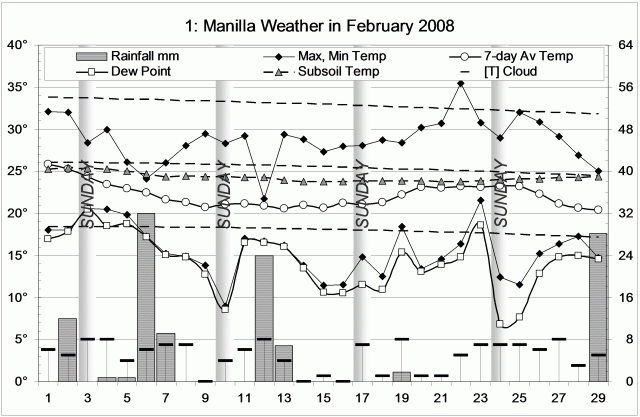
The daily weather logWeather log February 2008

Reading the 7-day mean temperatures, the month started near normal, but cooled to unusually low figures by the end of the first week – five degrees down! For a week from the 19th it was only two degrees below normal, then back to four degrees down at the end of the month.
Days were particularly cool, running about 29° instead of 33°.  However, the coolest days were not extreme.
The warmest day, Friday the 22nd, reached only 35.5°. The following morning was the warmest at 26.1°.
Dry air arrived from the south on the 24th, with a Dew Point of only 5.8°.
Rain fell frequently until the 19th, with the 6th being the wettest day (32 mm). The 29th was also very wet. There were nine rain days, totalling 115.6 mm. This is nearly twice the long-term February average of 66 mm.
Very few mornings were “Fine” (with no cloud).

 Comparing February months

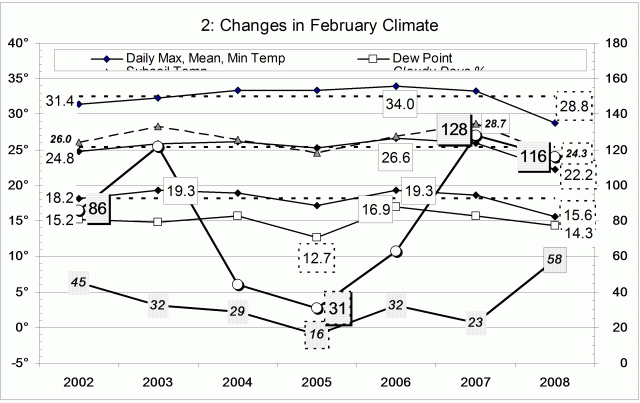
Climate February 2008

This was by far the coldest of the last nine Februaries, by day and by night. The mean daily maximum of 28.8°, the mean daily mean of 22.2°, and the mean daily minimum of 15.6° were all well below average, by 3.7°, 3.1°, and 2.5° respectively.
The contrast with the last two years is stark: the days in February 2007 were 4.5° hotter, and those in February 2006, 5.2° hotter than this month. (Note added: This cooling was global.)
With 58% of mornings exceeding 4 octas of cloud, this February, along with December 2007 (58%) and June 2007 (60%) was one of the cloudiest months in nine years. Most months in Manilla have about 30% cloudy mornings.

This month’s rainfall of 116 mm is in the 81st percentile of February totals. (Last February’s 128 mm was the seventeenth wettest February on record.) Taking rainfall totals for more than one month, every total up to 12 months is very high: above the 70th percentile.


Data. Rainfall data is from Manilla Post Office, courtesy of Phil Pinch. Dew point values before August 2005 are from Tamworth Airport 6 am data supplied by the Bureau of Meteorology. Temperature and other data are from 3 Monash Street, Manilla.
 

Very cool January 2008

The daily weather logWeather log January 2008

The month began sunny and dry, but two degrees cooler than usual. Three rainy days beginning on the fifth brought high humidity and one daily maximum temperature as low as 24.4°. This is 9.2° below normal! Eight fine days followed, with normal January temperatures.

With a second rainy spell from the 17th to the 21st, days were again remarkably cool: five days were more than 8° below normal. In the dry fine weather that followed, all temperatures – maximum, minimum, and mean – were even lower than when the month began. They slowly rose to normal by the end of the month.
Humidity was normal for January: the morning Dew Point was 10° to 12° in the dry spells and 18° in wet spells, giving an average of 14.2°.
Rain fell on nine days. The wettest day, the 17th, had 17.2 mm, and the total was 65.8 mm.

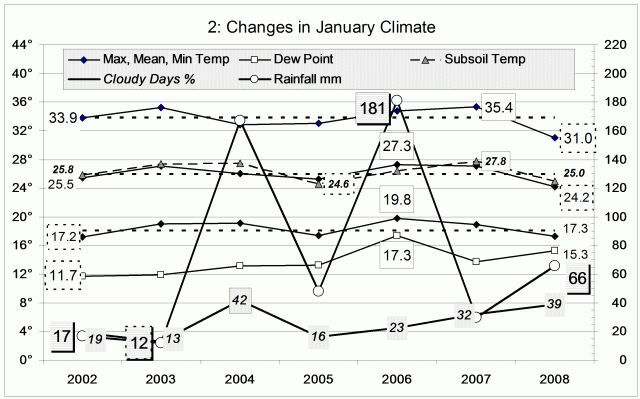
 Comparing January monthsClimate January 2008

This January had the coolest days in nine years, and the second coolest mean temperature. This month’s mean daily maximum (31.0°) was 2.9° below the nine-year average (33.9°), and an astonishing 4.4° below last year’s figure (35.4°). Because the mean maximum was low and the mean minimum was not, the mean daily temperature range this month (13.7°) was also low.

Using Dew Point to measure humidity, January and February are Manilla’s most humid months. This month’s mean morning Dew Point of 15.3° is normal.

With 39% of mornings having more than 4 octas of cloud, this was a cloudy month, but not as cloudy as December (58%) or November (50%).
The total monthly rainfall of 65.8 mm is 21 mm short of the long-term January average. However, total rainfalls for the last 2, 3, and 4 months are all above the 80th percentile.


Data. Rainfall data is from Manilla Post Office, courtesy of Phil Pinch. Dew point values before August 2005 are from Tamworth Airport 6 am data supplied by the Bureau of Meteorology. Temperature and other data are from 3 Monash Street, Manilla.