More Droughts After Heavier Rains II.

Scatter-plot 1890 to 1975

Droughts and flooding rains at Manilla NSW were related in a way that is remarkable and unexpected.

Part II. Scatter-plots

[Back to Part I: Graphical logs]

I have made scatter plots to see how much correlation there is between the two data sets: the frequency % of severe 12-month drought and the total decadal daily rainfall excesses over 50 mm, when lagged five years. (For data details, see Note 1, below.)

A. The first 70% of the data

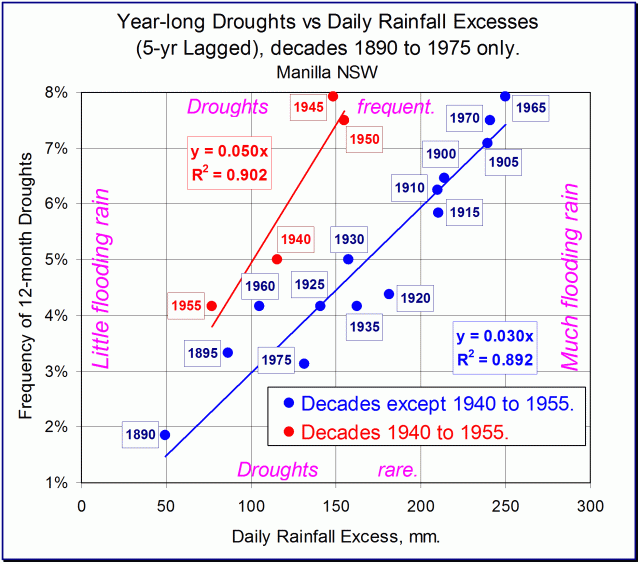
The first scatter-plot includes only the first 70% of the data, from 1890 to 1975, which showed matching patterns on the graphical log copied below. I have broken the data points into two groups: the aberrant group 1940 to 1955 (red) and the fourteen best-matched points (blue). The trend line that best fits those fourteen points is y = 0.028x + 0.407, with R-squared = 0.898. However, I have been able to fit the trend line y = 0.030x, that shows y proportional to x, without making R-squared worse than 0.892.
Similarly, the four decades centred on 1940, 1945, 1950 and 1955, had y = 0.050x, with R-squared equal to 0.902.

Expressed in words: for fourteen of the first eighteen data points, the frequency % of severe 12-month droughts remained close to 0.03 times the decade total of daily rainfall (>50 mm/day) measured five years earlier. For the other group of four adjacent points, the number was not 0.03, but 0.05.

B. All the data
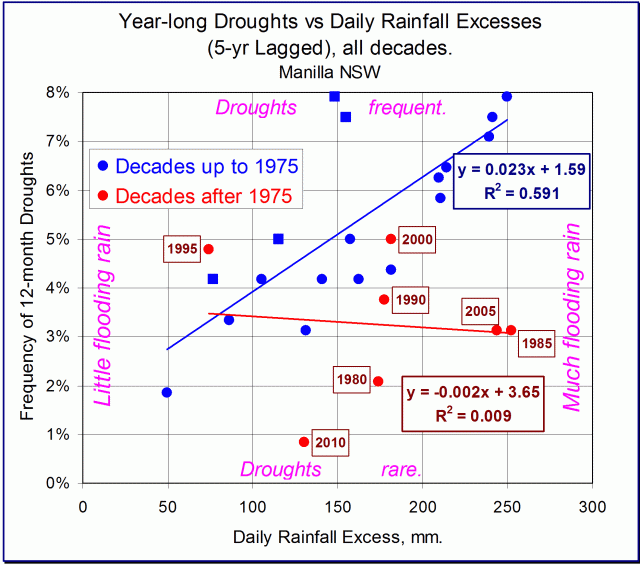
Scatter-plot 1890 to 2010

The second scatter plot shows data for all 25 (five-year overlapped) decades. There is a “shot-gun” pattern, as expected. Continue reading
More Droughts After Heavier Rains I.

Log of 1-year droughts and 5-year lagged heavy rainfalls

Droughts and flooding rains at Manilla NSW were related in a way that is remarkable and unexpected.

Part 1. Graphical logs

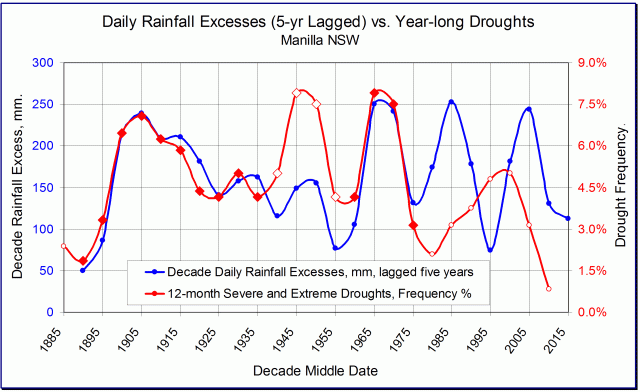
As the first graph shows, for most of the 130-year record year-long droughts came in direct proportion to very heavy daily rainfall five years earlier. (For data details, see Note 1, below.)
The match between these two variables is astonishing. Both are based on rainfall readings, but they are scarcely related. Excessive daily rainfalls are transient extreme weather events; 12-month droughts are an aspect of climate.

Mackellar’s “Droughts and flooding rains”

Dorothea Mackellar’s famous line * is more apt for this graph than for other graphs where I use “flooding rains” to mean periods unlike drought. (See Note 2. below.) The rains and droughts that I plot here both bring hardship. Severe droughts lasting one year are among the worst of droughts: long enough to use up reserves, and not so long as to be eased by periods of rain. The daily rainfall events plotted are the ones that cause damaging floods.

Features of the graphical log

Log of 1-year droughts and heavy rainfalls

This second graph shows the data at the actual dates. Although the data points for the decade excess of heavy daily rainfall and those for frequency % of 12-month droughts have a matching pattern for much of the record, the pattern is offset. Heavy rainfall points come five years earlier than corresponding drought points. Notice that the heavy rainfalls do not (except in 1980) come squarely in gaps between droughts.
Lagging the rainfall points by five years (as in the first graph) makes some matches almost exact. Such matches occur at all data points from 1890 to 1975, except those from 1940 to 1955, where drought frequencies are relatively higher. Both variables show a two-decade-long, slow decline from 1905 to 1925. At the chosen scales, the amplitude of corresponding rises and falls are usually similar as well.
After 1975, daily rainfall oscillates through a wide amplitude with a twenty-year period, while the frequency % of drought varies Continue reading

Very Wet Days at Manilla: Decade Excesses

Log of decade totals of rainfall excess, Manilla, NSW Last month I posted a complete log of days at Manilla that had more than 50 mm of rainfall.
I call days that have more than 50 mm of rainfall “very wet days”. At Manilla, on the average, these have come only once per year. Days with more than 50 mm of rainfall have no special meaning, but they can be taken as a rough indication that local flooding, or even general flooding, is likely: the “Flooding Rains” of Dorothea Mackellar.*
The graph I posted did not show whether these very wet days, likely to cause floods, had a bigger effect at some times than at others. This graph shows that.

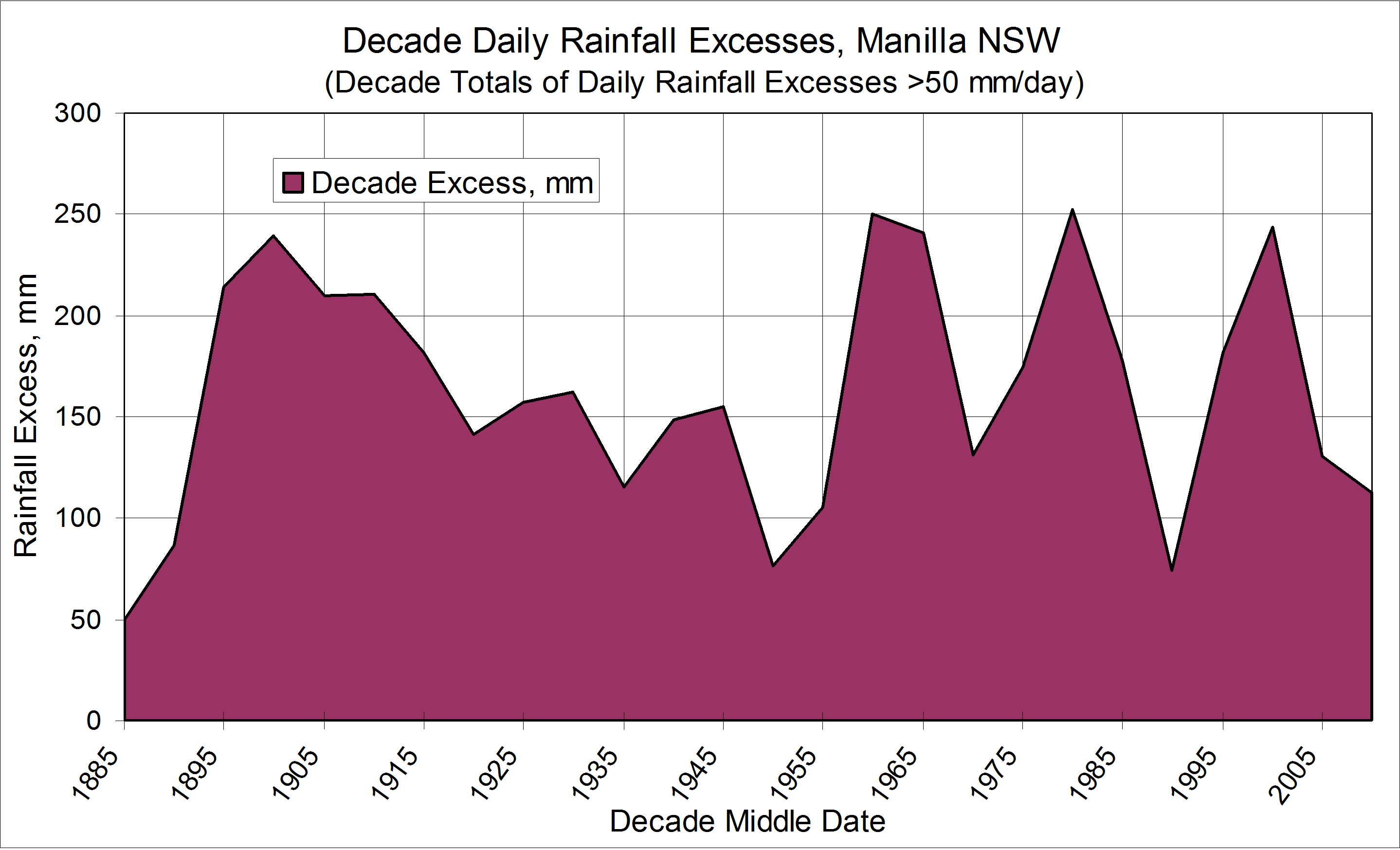
Since it is only the excess rainfall that runs off, leading to flooding, I have subtracted 50 mm from each “very wet day” rainfall amount. Then I have summed all such excesses for each half-decade. I summed the half-decades in pairs to give a decade sum (in mm) centered on the years 1885, 1890, 1895, etc. For example, the decade centered on 1925 had a total of daily rainfall excesses of 157 mm. (Values for 1880-84 were estimated from those for 1883 and 1884.)
Some decades had very high values of excess rainfall: there was about 250 mm in the decades centered on 1900, 1960, 1965, 1980, and 2000. There were very low values, below 100 mm, in the decades centered on 1885, 1890, 1950, and 1990. There appears to be no trend.

Note added June 2015.

The close similarity of two graphs, the one of heavy rainfalls in this post, and the one of year-long droughts in an earlier post led me to write a further series of three posts:
More droughts After Heavier Rains I.
More droughts After Heavier Rains II.
More droughts After Heavier Rains III.

* By arrangement with the Licensor, The Dorothea Mackellar Estate, c/- Curtis Brown (Aust) Pty Ltd.

Log of Very Wet Days at Manilla.

Graphical log of days with over 50mm rain

In the 130-year record of very wet days at Manilla, NSW, extreme rainfalls have not become more common recently.

Data

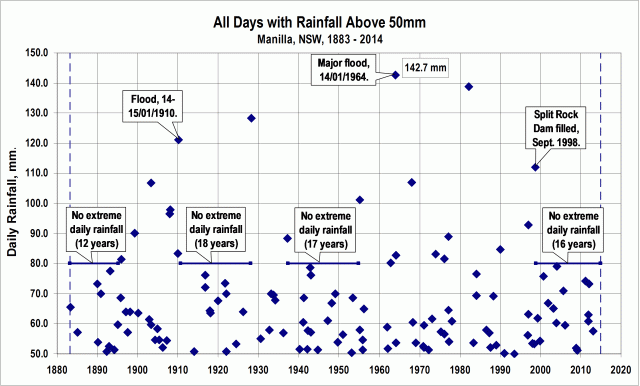
I arranged all daily rainfall readings for Manilla, NSW, from March 1883 to December 2014 in order of rainfall amount, and selected only the 125 readings greater than 50 mm. I plotted the values against the date, expressed in years, to two decimal places. (See Note below.)

Result

The five highest readings

The five highest readings, greater than 110 mm per day, include events that gave rise to two floods and the filling of a reservoir newly-built to store water for irrigation. The highest daily reading, 142.7 mm, came with the highest flood known at Manilla, in 14/01/1964. Thus, the highest flood matches the highest daily rainfall. That is because nearly all the flood-water came down the Manilla River, which flows in a semi-circle, with none of the catchment area far away from the rain-gauge.
These five highest readings seem to fly in an arc above the rest, with a peak near the middle of the graph. The rise and fall of this arc may have no meaning, for there are very long gaps between the events. All the same, it is a fact that there were no readings above 110 mm per day in the decades before 1910 or after 1998.

Periods with no daily readings over 80 mm

Continue reading

Rainfall Deficiencies IV: 120-months Duration

Log of severe and extreme rainfall deficiency of 120-month duration at Manilla This is the fourth of four graphs that show Manilla’s history of rainfall deficiencies (rainfall droughts), for periods of duration 3 months, 12 months, 36 months, and 120 months.

This fourth graph includes those periods of severe or extreme rainfall deficiency that last one-hundred-and-twenty months. They are rainfall droughts that affect about ten successive years.

(As I note below, in this series, a time of severe rainfall deficiency is one that is drier than the 5th percentile of cases, and a time of extreme rainfall deficiency is one that is drier than the 1st percentile of cases.)

In Manilla’s climate, a time of severe 120-month rainfall deficiency has a rainfall total less than 5860 mm, when it normally would be 6390 mm: that is, through the 10-year period, there is as an average a rainfall deficit of 53 mm each year. A time of extreme 120-month rainfall deficiency has a rainfall total less than 5670 mm: that is, through the 10-year period, there is as an average a rainfall deficit of 72 mm each year.

Even more than three-year droughts, these ten-year droughts have quite different effects to those that are shorter. The importance of severe and extreme rainfall deficiencies of 120-month duration is that even very large surface and sub-surface reservoirs may not be adequate to supply demand through to the end of the drought.

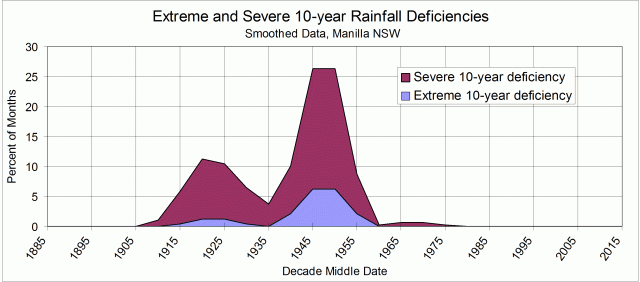
The graph shows that such ten-year droughts hardly occurred earlier than 1915 or later than 1955, but were confined to that 40-year interval. While deficiencies of this duration were twice as common as normal (5%) in the decades around 1920 and 1925, it was the decades around 1945 and 1950 that were extraordinary: 26% of all months had a severe rainfall deficiency of this duration.

Again, extreme 120-month droughts generally comprised about one-fifth of the total, as one might expect (unlike the case for one-year droughts).

Areas shown on the graph

Rainfall deficiencies are called “severe” when they are lower than are recorded for five percent of the months. I have called deficiencies “extreme” when they are lower than are recorded for one percent of the months. In this graph, I have coloured extreme deficiencies in blue. The maroon colour is deficiencies that are severe, but not extreme. The top edge of the maroon area marks the proportion of severe deficiencies including extreme deficiencies. As an average, this line is at five percent.

Data analysis

Continue reading