Managing my low-energy house: I. Features needing no attention

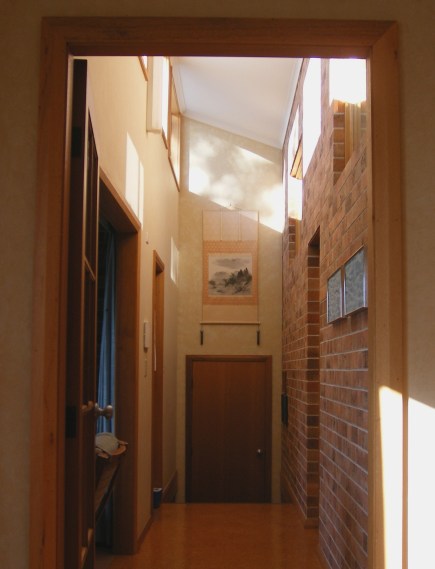
Photo of sunlit house interior

July sun heats the house

This post, and the companion post “II. Features needing attention” were posted originally to a forum of the Alternative Technology Association (See Note below.)

My low-energy house at Manilla, NSW, maintains year-round comfort in a climate of daily and seasonal extremes. In the climate classification of the Building Code of Australia, it is in Zone 4: “Hot dry summer, cool winter”, along with Tamworth, Mildura and Kalgoorlie.
This house differs from most houses in relying on the design of the house to achieve comfort, with hardly any energy needed for heaters or coolers.
There is little artificial control: the “home automation system” consists only of timers set twice a year. Some of the comfort features call for daily action in certain seasons. However, these simple daily chores could have been avoided by small changes in the design. [See “Note added 2016” below.]

The success of the house in maintaining comfort in all seasons is shown by scatter-plots of daily indoor and outdoor maximum and minimum temperatures over a period of three years.

I. Features needing no attention

Heat transfer to and from the heat bank

The mass of concrete, bricks and rubble under the concrete floor slab is edge-insulated with foam to a depth of half a metre to prevent heat leaking sideways to and from the surrounding soil and subsoil. This 150 tonne edge-insulated under-floor mass is a “heat bank” which absorbs and yields heat so slowly that it holds the same temperature (at 750 mm depth) within a degree for weeks at a time.
Double-brick walls (17 tonnes) inside the house, and the floor slab itself (28 tonnes), are also parts of the heat bank. Their exposed surfaces (See photo.) absorb heat from sunshine (and yield heat to cool flows of air) so as to spread heat (or coolness) around the rooms. Within each day they conduct heat to and from the rooms of the house, and from room to room. They then conduct heat slowly to and from the under-floor mass.
In the absence of the house, the under-floor mass would have the same temperature as the subsoil of the area. A thermometer at 750 mm in the subsoil near the house shows a 14.6° yearly temperature range, from 12.9° to 27.5°. Even an ordinary light-weight, poorly-insulated house built on a concrete slab on the ground here would be made more comfortable by these stable subsoil temperatures. Midsummer and midwinter temperatures in such a house (next door) are plotted here and here.
It is clear that temperatures in that conventional house vary much less than outdoor temperatures, and remain close to that of the subsoil. The heat bank under my solar-passive house has an even more stable temperature than that of the surrounding subsoil. (There is a graph showing one year of heat bank and subsoil temperatures here.)

Insulation

Thermal insulation reduces the flow of heat in and out of the house. With sufficient insulation, the heat of the day is replaced by the cool of night before the house becomes too warm. Insulation improves comfort permanently. Continue reading
Summer 2014-15 on average

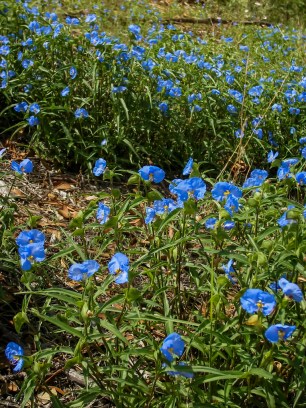
Wildflower photo

Commelina cyanea in Monash Street

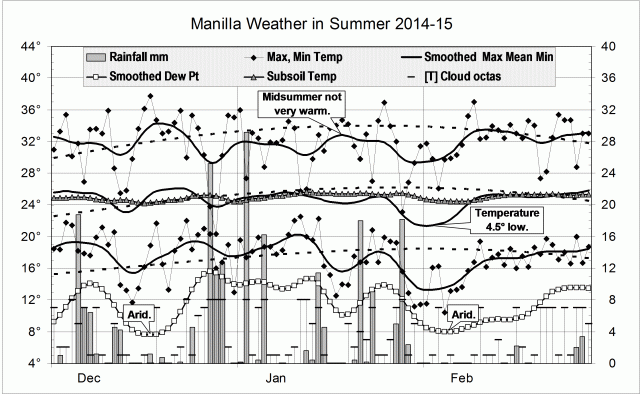
This summer, January was no warmer than December or February, and none of these months was as warm as November! The number of hot days (over 35°) had a similar pattern that “sagged” in midsummer: Oct: 4 days; Nov: 10 days; Dec: 7 days; Jan: 2 days; Feb: 3 days; Mar: 2 days (in the first week). There were no very hot days over 40° this summer, although there had been three in spring.

A very cool spell from late January to early February had day and night temperatures 4.5° degrees lower than normal. Humidity was also low at that time and earlier, in mid-December.

Weather log for summer 2014-15

By most measures, this was a normal summer. Compared with the 21st century average, the daily maximum temperature and the daily temperature range were both just one degree low, and skies were a little more cloudy. The dew point (humidity) was low, but much higher than last summer.

The rainfall of 224 mm could hardly be more “normal”. It lies between the 125-year average of 227 mm and the 125-year median value of 221 mm. Summer rainfall totals like this also occurred in 2002-03 (227 mm) and 2008-09 (229 mm). Historically, summer rainfall totals in the “normal” range from 220 mm to 230 mm occurred in 1902-03, 1917-18, 1936-37, 1948-49, and 1957-58.

Climate for summer 2014-15.


Data. Rainfall data is from Manilla Post Office, courtesy of the Post-master, Phil Pinch. I thank Phil for his help over the years. When he retires this March, there is some uncertainty about the future of rainfall observations that have been maintained for 132 years since March 1883.

 Temperature, including subsoil at 750 mm, and other data are from 3 Monash Street, Manilla.

3-year trends to February 2015

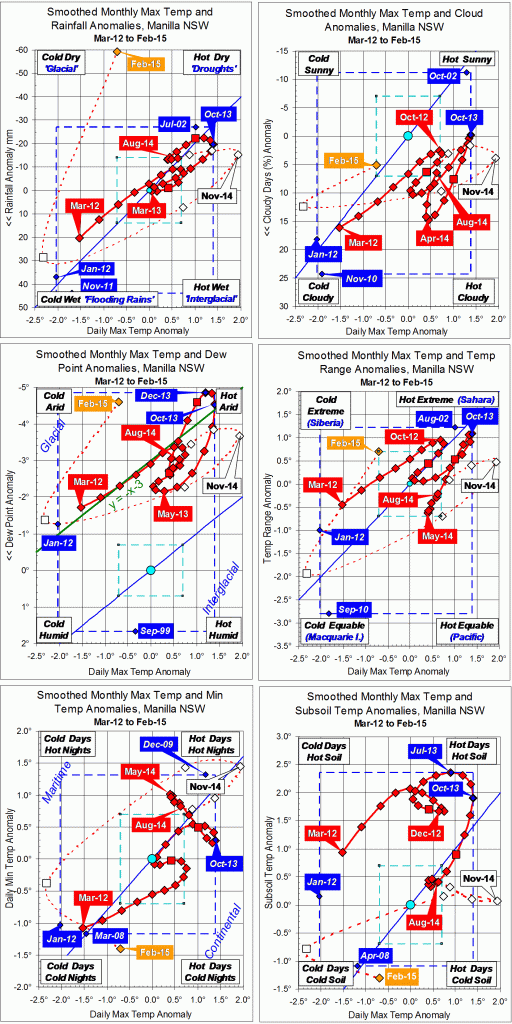
Parametric plots of smoothed climate variables at Manilla
“February 2015: very dry”

Trends toFebruary 2015

  February raw anomaly data (orange)

In February, most anomalies moved back towards “droughts” from the “flooding rains” values of January. Rainfall became extremely low, but daily maximum temperature did not rise as far as “normal”.
Exceptionally, February daily minimum temperature and subsoil temperature became very low.

Fully smoothed data (red)

The latest fully-smoothed data anomalies (August 2014) complete the winter of 2014. Through the winter season, most values were static and near normal. (Dew point, like most recent values of that variable, was 3 degrees lower than normal.)


Note:

Fully smoothed data – Gaussian smoothing with half-width 6 months – are plotted in red, partly smoothed data uncoloured, and raw data for the last data point in orange. January data points are marked by squares.
Blue diamonds and the dashed blue rectangle show the extreme values in the fully smoothed data record since September 1999.

Normal values are based on averages for the decade from March 1999.* They appear on these graphs as a turquoise (turquoise) circle at the origin (0,0). A range of anomalies called “normal” is shown by a dashed rectangle in aqua (aqua). For values in degrees, the assigned normal range is +/-0.7°; for cloudiness, +/-7%; for monthly rainfall, +/-14 mm.

 * Normal values for rainfall are based on averages for the 125 years beginning 1883.

February 2015 a very dry month

Photo of a baby Kookaburra

Baby Laughing Kookaburra

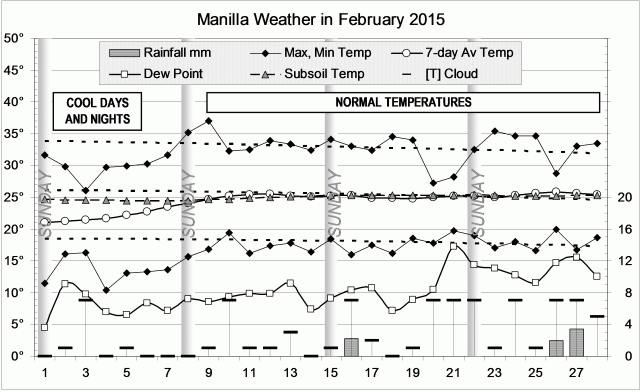
After a very cool first week, normal temperatures returned, both by day (33°) and by night (18°) . Early on, most mornings were sunny. Later, many were almost overcast, but only three days had light rain, with a maximum of 3.4 mm.

Weather log  February 2015

Comparing February months

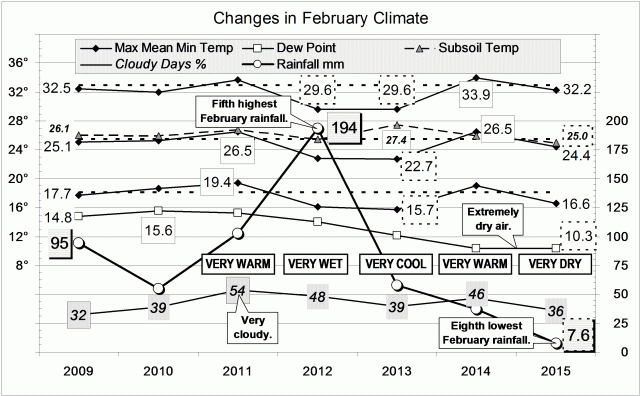
Most of the last seven February months have been unusual in some way. This month was very dry, with near-record low rainfall and very low humidity. By contrast, February 2012 was very wet, as well as very cool. Both 2011 and 2014 were very warm, but 2011 was also very cloudy and humid. February 2013 was the coolest, without being wet like 2012.
The total rainfall of 7.6 mm this month was very low (6th percentile): this was the 8th driest February, and the driest since 1989, which (like 1974) had 7.0 mm. Still, taking rainfall totals for groups of months, only the 24-month total (985 mm) is a serious shortage, in the 9th percentile.

Climate forFebruary 2015


Data. Rainfall data is from Manilla Post Office, courtesy of Phil Pinch. Temperatures, including subsoil at 750 mm, and other data are from 3 Monash  Street, Manilla.

With the retirement of the Post-master, Phil Pinch, the future of rainfall observations at Manilla Post Office (055031), kept for 132 years since March 1883, is uncertain.

February Climate Anomalies Log

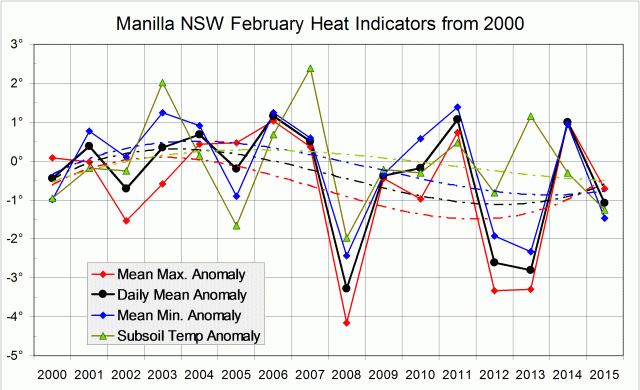
Heat indicators log for February

This post is the twelfth in a set for the 12 calendar months that began with March. Graphs are sixteen-year logs of the monthly mean anomaly values of nine climate variables for Manilla, NSW, with fitted trend lines. I have explained the method in notes at the foot of the page.

Raw anomaly values for February

Extreme values of February anomalies were as follows:

Daily Maximum Temperature Anomalies (3) -4.2 deg: February 2008; -3.3 deg: February 2012; -3.3 deg: February 2013;
Daily Mean Temperature Anomalies (1) -3.3 deg: February 2008;
Rainfall Anomalies (1) +120 mm: February 2012;
Dew Point Anomalies (2) -4.6 deg: February 2014; -4.6 deg: February 2015.

Trend lines for February

Heat Indicators

All heat indicator quartic trends began slightly low and ended slightly low. They had a low peak about 2004, and a trough later. The trough was deepest and earliest for daily maximum temperature (2011), followed by daily mean temperature in 2012, daily minimum temperature in 2014, and subsoil temperature in 2015 or later.

Moisture indicators log for February

Continue reading