More Droughts After Heavier Rains III.

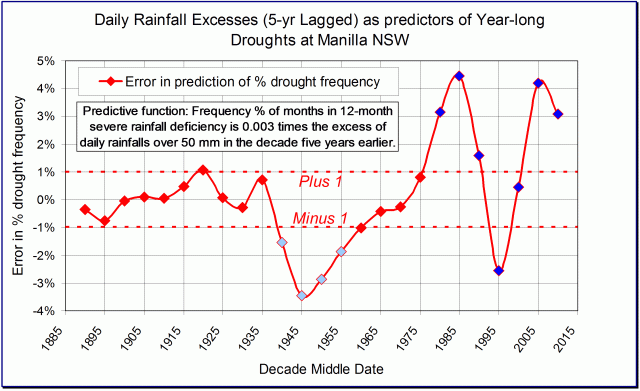
Graphical log of errors when droughts are predicted from rains

Droughts and flooding rains at Manilla NSW were related in a way that is remarkable and unexpected.

Part III. Predicting drought from heavy rain

[Back to Part II: Scatter-plots]

The graph above is derived from the first graph in this series (copied here) by using the blue regression trend-line from the scatter plot of selected data (also copied here). (For data details, sLog of 1-year droughts and 5-year lagged heavy rainfallsee Note 1, below.)
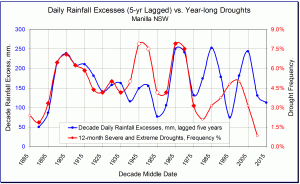
The equation of the trend line, y = 0.030x is used AS IF to use the daily rainfall excesses to predict the drought frequency five years later. The graph shows the “error” of this “prediction”. (In Note 2, below, I concede that this data set could not support such prediction.)
As expected from the previous graphs, the “prediction” is accurate at most data points to 1975. It is correct to the nearest percentage whole number at nine of the eighteen points. From 1940 to 1955, droughts are uniformly more frequent than predicted. After 1975, the error curve swings wildly up and down.

Could droughts have been predicted from heavy rainfalls?
Scatter-plot 1890 to 1975

By about 1915, it is conceivable that this relationship could have been discovered, either by analysis of such data, or by modelling of the climate system. Then, the data for the next 20 years, up to 1935, would seem to confirm it. Data from 1940 to 1955 would cause doubts, but data from 1960 to 1975 would restore confidence. Then the utter failure of the model in the following four decades would have led to its abandonment, at least for the time being.
Climate shifts of 1975

Continue reading

More Droughts After Heavier Rains II.

Scatter-plot 1890 to 1975

Droughts and flooding rains at Manilla NSW were related in a way that is remarkable and unexpected.

Part II. Scatter-plots

[Back to Part I: Graphical logs]

I have made scatter plots to see how much correlation there is between the two data sets: the frequency % of severe 12-month drought and the total decadal daily rainfall excesses over 50 mm, when lagged five years. (For data details, see Note 1, below.)

A. The first 70% of the data

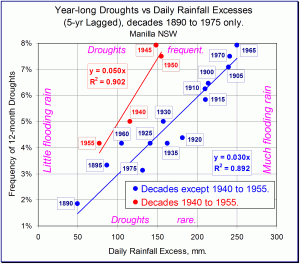
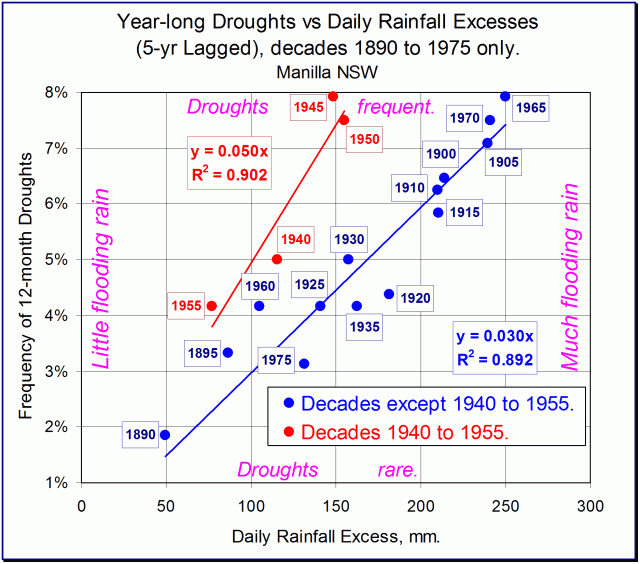
The first scatter-plot includes only the first 70% of the data, from 1890 to 1975, which showed matching patterns on the graphical log copied below. I have broken the data points into two groups: the aberrant group 1940 to 1955 (red) and the fourteen best-matched points (blue). The trend line that best fits those fourteen points is y = 0.028x + 0.407, with R-squared = 0.898. However, I have been able to fit the trend line y = 0.030x, that shows y proportional to x, without making R-squared worse than 0.892.
Similarly, the four decades centred on 1940, 1945, 1950 and 1955, had y = 0.050x, with R-squared equal to 0.902.

Expressed in words: for fourteen of the first eighteen data points, the frequency % of severe 12-month droughts remained close to 0.03 times the decade total of daily rainfall (>50 mm/day) measured five years earlier. For the other group of four adjacent points, the number was not 0.03, but 0.05.

B. All the data

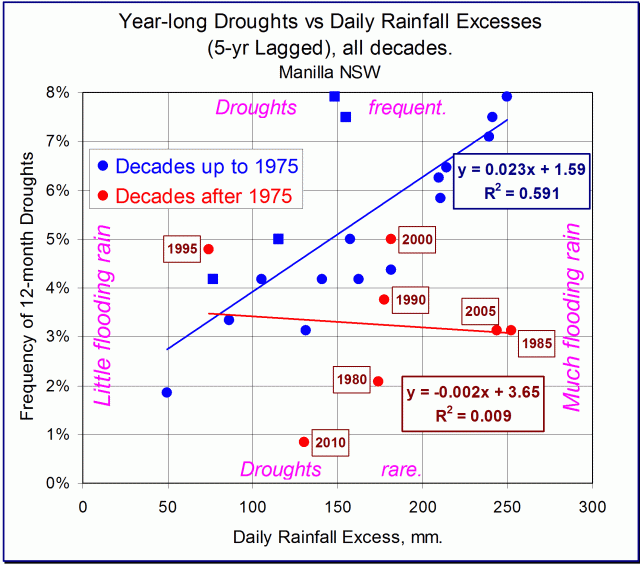
Scatter-plot 1890 to 2010

The second scatter plot shows data for all 25 (five-year overlapped) decades. There is a “shot-gun” pattern, as expected. Continue reading

My Solar-passive House Photos and Details


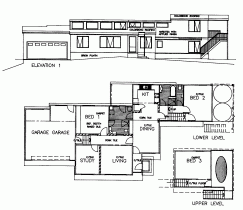
A plan of the house

Monash Street House Plan

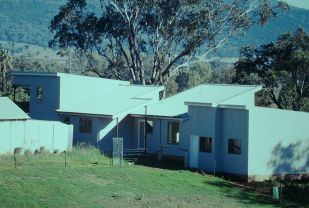
Distant view from the south-east

Distant view from the south-east

Posts on “Indoor Climate” in this blog come from my experience living in my solar-passive house from 1999, and monitoring its performance.

Until now, I have not given readers a clear idea of what the house is like. I have now set up a special page called “My House Page” where details can be found. So far, there are two sub-pages, both referring to the time when the house was new:

  • A gallery of photos called “Award photos 1999”, and a house plan, which were submitted in an entry for the Housing Industry Association (NSW) awards for 1999.
  • An essay “House Profile 1999” that sets out the principles that I thought important then, and the features that I had built in to the house. I added a reading list of books available at that time, and a list of Credits to those people who built the house.

Navigation

The “My House Page” is not directly indexed in the main menu on the banner, but it appears with a hover over “Indoor Climate”.

Posts and Pages on Indoor Climate have links to each other in the side-bar on the right, in the panel “Indoor Climate Blog and Pages”. This panel does not appear on the Home Page, but only when an “Indoor Climate” blog post (or Category of posts) is selected.

I intend to add more pages in time.

More Droughts After Heavier Rains I.

Log of 1-year droughts and 5-year lagged heavy rainfalls

Droughts and flooding rains at Manilla NSW were related in a way that is remarkable and unexpected.

Part 1. Graphical logs

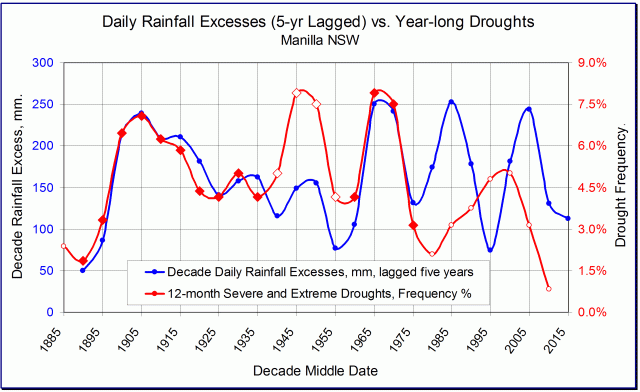
As the first graph shows, for most of the 130-year record year-long droughts came in direct proportion to very heavy daily rainfall five years earlier. (For data details, see Note 1, below.)
The match between these two variables is astonishing. Both are based on rainfall readings, but they are scarcely related. Excessive daily rainfalls are transient extreme weather events; 12-month droughts are an aspect of climate.

Mackellar’s “Droughts and flooding rains”

Dorothea Mackellar’s famous line * is more apt for this graph than for other graphs where I use “flooding rains” to mean periods unlike drought. (See Note 2. below.) The rains and droughts that I plot here both bring hardship. Severe droughts lasting one year are among the worst of droughts: long enough to use up reserves, and not so long as to be eased by periods of rain. The daily rainfall events plotted are the ones that cause damaging floods.

Features of the graphical log

Log of 1-year droughts and heavy rainfalls

This second graph shows the data at the actual dates. Although the data points for the decade excess of heavy daily rainfall and those for frequency % of 12-month droughts have a matching pattern for much of the record, the pattern is offset. Heavy rainfall points come five years earlier than corresponding drought points. Notice that the heavy rainfalls do not (except in 1980) come squarely in gaps between droughts.
Lagging the rainfall points by five years (as in the first graph) makes some matches almost exact. Such matches occur at all data points from 1890 to 1975, except those from 1940 to 1955, where drought frequencies are relatively higher. Both variables show a two-decade-long, slow decline from 1905 to 1925. At the chosen scales, the amplitude of corresponding rises and falls are usually similar as well.
After 1975, daily rainfall oscillates through a wide amplitude with a twenty-year period, while the frequency % of drought varies Continue reading

Cool cloudy days in April 2015

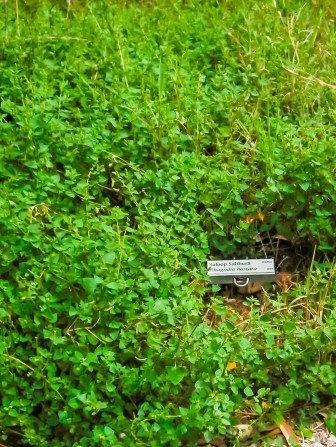
Photo of labelled Saloop saltbush

Flourishing local Saloop saltbush

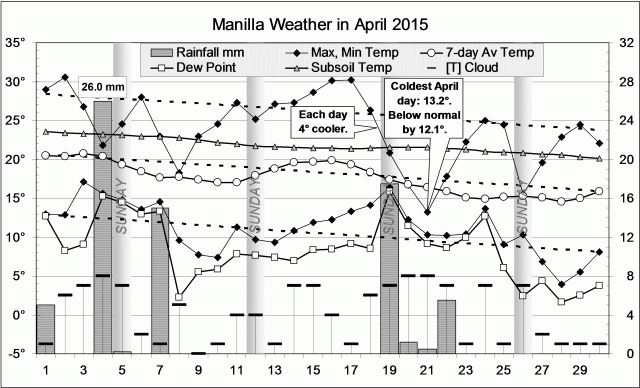
After 5 hot days in March (a record number), there were none in April. In fact, there were six days not reaching 20°, also a record number! On the 21st the temperature reached only 13.2°, making it the coldest April day of the century, 12.1° below normal. To get so cold, the temperature had fallen by 4° each day for four days. Many nights, however, were warm, and on four occasions the night was less than six degrees cooler than the day. As usual, there were no frosts.
There were eight rain days, with the highest reading 26.0 mm on the 4th.

Weather log for April 2015

Comparing April months

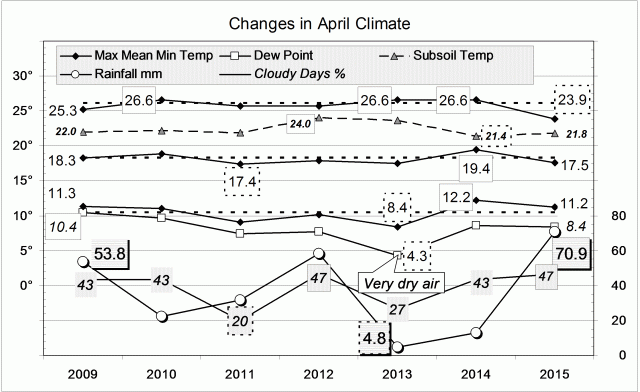
The average daily maximum temperature, at 23.9°, was colder than in any April since 1999 (23.5°). Night temperatures, while lower than last year’s record, were above normal, making the mean daily temperature range (12.7°) the narrowest for an April month, followed by April 2003 (13.6°). The percentage of cloudy mornings (more than 4/8 cloud) was a record 46.7%, equal with April 2012. The cloudiness and narrow daily temperature range, with high rainfall, make the climate this month like that on the coast.
The subsoil temperature (21.8°) and the early morning dew point (8.4°) were normal. (In March, the dew point had been almost the same (8.3°) but that was a record low value: in that month the normal dew point is much higher.)
The total rainfall of 70.9 mm is in the 84th percentile, far above the average of 40 mm. Among rainfall totals for more than one month, there are small increases. Even the 24-month total is now in the 12th percentile: not a serious shortage.

Climate for April 2015


Data. All data, including subsoil at 750 mm, are from 3 Monash Street, Manilla.
After 132 years of continuous record, rainfall readings are no longer taken at Manilla Post Office, Station 055031.