Climate trends for thermal soaring

For pilots who soar at Lake Keepit or Mount Borah: relevant summer climate data for Manilla, NSW, since 1999.
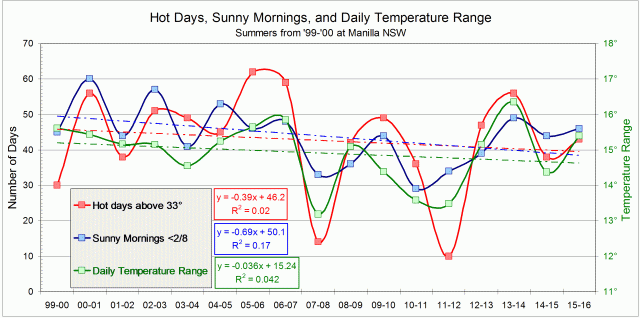
Graph of some summer climate variables 1999 to 2015.

Variables relevant to thermal soaring

From my data I have selected three variables that are relevant to success in soaring flight using thermals. I have chosen to use values for summer: a total or average for the three months of December, January and February.
The variables are:

  • The number of hot days, when the maximum temperature was over 33°C;
  • The number of sunny days, when the cloud amount seen at 9 am was less than two octas;
  • The average daily temperature range in degrees celsius.

Changing values of the variables

The graph shows that each variable fluctuated wildly, with each summer very different from the last. These variables often moved in the same sense.
Two summers had high values of all three variables: 2006-07 and 2013-14. Two summers had low values of all three variables: 2007-08 and 2011-12. I would expect that longer and faster thermal soaring flights would have been achieved in the summers with high values, compared to those with low values.

Trends

I have fitted linear trend lines, and displayed their equations within the graph.
All three trend lines slope down. This suggests that summer thermal soaring conditions have been getting worse.
I have cited the values of “R-squared”, the Coefficient of Determination. All three R-squared values are abysmally low. Even the best is below 20%, which can be taken to mean that more than 80% of the variation has nothing to do with the trend line shown.
You could say that the trends are nonsense, but we are dealing with Climate Change here!

The future

In the spirit of Mark Twain, we can extend the trend lines forward to where they come to zero:

  • There will be no hot days above 33° by the summer of 2118;
  • There will be no sunny mornings with less than 2 octas of cloud by 2073;
  • Days will be no warmer than nights by 2423.

That last date seems too remote to worry about. However, the daily temperature range will be unacceptable when it gets down to 11°. That is the current summer value for Lasham, England, after all. According to the trend, the daily temperature range will be worse than at Lasham by 2117. That is the same year that the very last 33° day is expected.

Global Warming

You may be surprised that the linear trend lines fitted to this data set slope downwards. It seems to contradict Global Warming. Continue reading

Hard Winter for Solar-passive

Graphical log of daily indoor and outdoor temperatures for winter 2016.

Temperature log: main features

This graph, for 2016, shows a winter pattern of indoor and outdoor temperatures that is typical for this house. Indoor temperatures vary much less than outdoor temperatures, they rise and fall with them, and they are higher nearly all the time.
While the outdoor temperatures shown go as low as minus three degrees, those indoors lie within the winter “comfort zone” from 17° to 24° (see this post) nearly all the time.

Weather this winter

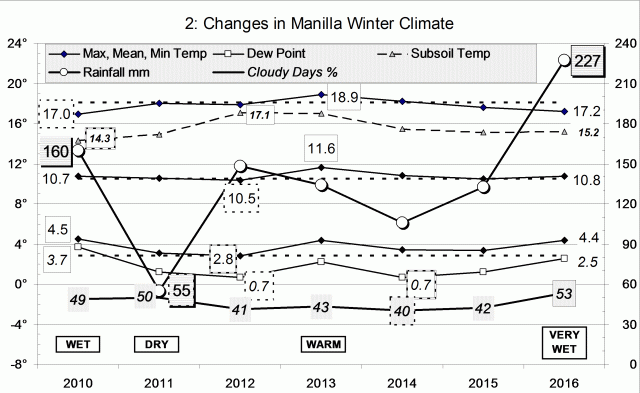
This winter was harsh for a solar-passive house. Near-record rainfall (227 mm) came with the greatest number of cloudy days of any winter in the new century. There were 53 mornings with more than four octas of cloud, when the average is 33.

Heater use

Because cloud limited the the solar gain, I had to use blower heaters far more than in previous winters. My records show that I used 320 kWh ($80) in these heaters this winter, when I normally use about 40 kWh ($10).
Heaters were also used by guests who were present on the six days shown. As well as being unused to the climate, the guests lived in the colder west wing of the house. They may have used 72 kWh ($18). Those guests have kindly written reviews of their visit.
Even using 400 kWh of electricity for personal heating in a winter could not make a detectable change in house temperature. I have found that blower heaters are surprisingly good at making a room in this house comfortable. As the radiant temperature of the walls is only 2° or 3° too low for comfort, it can be compensated by making the air temperature only slightly higher.

The pattern in detail

While cloudy days are not plotted here (Cloud observations for this winter are plotted elsewhere.), cloudy days can be recognised on the graph. In this climate, days with low maximum temperature and high minimum temperature are always due to cloud. Only in fine weather are days warm and nights frosty. The graph shows how the weather goes through a cycle every week or two: sunny days get warmer, then rain sets in. As it clears, the air gets even colder, before warming up again.
Indoor temperatures follow the same cycle, but there are differences. There may be a delay of up to a day, and sometimes longer.

Correlations

I did scatter plots comparing all the variables shown in the first graph and I fitted linear regressions. I present the four scatter-plots that had the highest coefficients of determination (“R-squared”). Continue reading

Extremely wet winter 2016

Water flowing over a weir

Manilla Weir Fish Ladder

This winter, with 227.4 mm of rain, was the fifth wettest in the record from 1883. In order of rainfall, wetter winters were: 1920 (318 mm), 1998 (304 mm), 1950 (261 mm) and 1952 (233 mm). This winter’s total was more than 100 mm over the average (125 mm). The heaviest daily fall, 37 mm, was on 5 June, and there were four other falls of more than 15 mm; two in June and two in August.
There were big week-long swings in temperature through June and July. On four occasions nights were more than four degrees warmer than normal and on one occasion days were four degrees cooler than normal. No such swings occurred from late July to mid-August, then days became five degrees cooler than normal. In this winter, there were few spells of either hot days or cold nights. The number of frosts (42) was near the usual number (44).

Graphical log for winter 2016
While the mean temperature of the season was normal, most other measures of climate were not.
The winter seasons of 2016 and 2010 were both extremely moist. Winter 2016 had more rain (227 mm versus 160 mm) and more cloudy days (53% versus 49%). In other respects 2010 was more moist: the dew point was higher (3.7° versus 2.5°), and the days had a narrower temperature range (12.5° versus 12.8°). The daily temperature range for winter is usually much wider: 15.3°. It was 17.5° in winter 2002!

Climate for winter 2016


Rainfall figures for this month are from the automatic rain gauge at Manilla, published on the internet by the Bureau of Meteorology as Station 55031. All other data, including subsoil at 750 mm, are from 3 Monash Street, Manilla.

Wet August 2016 had two cold days

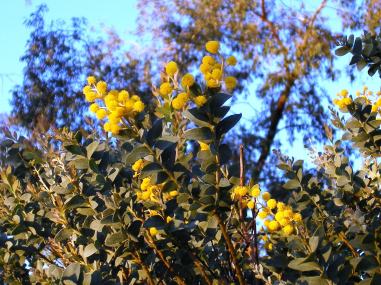
Photo of knife-leaf wattle blooms

Knife-leaf Wattle

Six days with at least eight millimetres of rain made for a very wet August.
On the average, the temperature was normal until the fourth week, which was cool. However, there were two remarkably cold days. The 3rd, at 10.6°, was the second coldest August day and the 22nd, at 11.6°, the fifth coldest. Most nights were cool, around 1°, but several were much warmer, generally with the rain. Most days were sunny, and eighteen of the mornings were frosty, about three more than usual.

Weather log for August 2016

Comparing August months

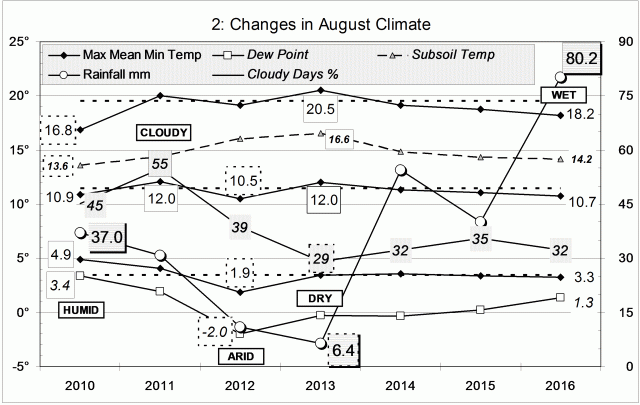
On average, the days were cold: as cold as in August 2001, but not as cold as in 2008 or 2010. The average night-time temperature, however, was normal. The dew point, while not high, was higher than in the previous four August months.
The monthly rainfall total of 80.2 mm was twice the average (40 mm), and in the 89th percentile. No rainfall total for any number of months is now below the 19th percentile. That is the 42-month total of 1949 mm, which is a mere 313 mm lower than the median 42-month value. Both Greenhatch Creek and Rushes Creek have flowed in recent weeks.

Climate for August 2016


Data. Rainfall figures for this month are from the automatic rain gauge at Manilla, published on the internet by the Bureau of Meteorology as Station 55031. All other data, including subsoil at 750 mm, are from 3 Monash Street, Manilla.