Cool spring 2016

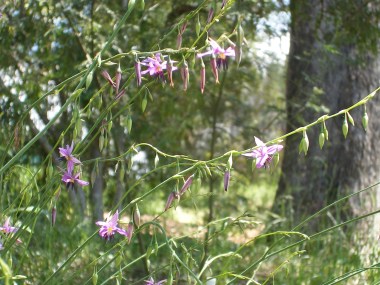
Photo of a wildflower

Nodding Chocolate Lilies

Through September, days were very cool, making for a narrow daily temperature range. Then, through October, both days and nights were very cool. In November, days and nights were nearer to normal but, in contrast to September, the daily temperature range was wide. The dew point failed to rise during the season, making the air very dry in November.
Rain fell frequently up to the middle of November, then ceased. There were 24 rain days, when there are normally 19 in spring. The highest reading was 28.8 mm on the 14th of September. The season total of 216.4 mm was rather high, in the 77th percentile.
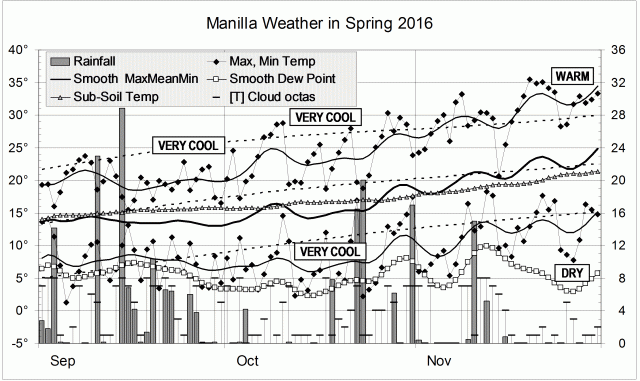
Graphical log for spring 2016
All temperature measures were below normal by 1.5° to 2.0°. Only spring of 2001 had low values like that but in 2010 the mean daily maximum (only) was 2.5° below normal.
Measures of moisture were near normal, with cloud, rainfall, and daily temperature range on the moist side, and dew point on the dry side.
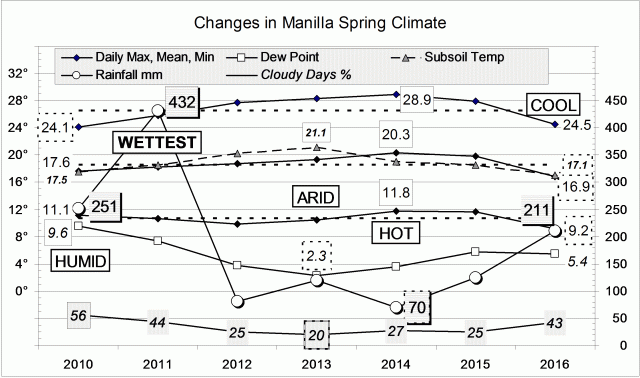
Climate for spring 2016


Data. Rainfall figures for this season began from the automatic rain gauge at Manilla, published on the internet by the Bureau of Meteorology as Station 55031. That gauge ceased reporting on the 8th of October, and later readings are from my non-standard gauge. All other data, including subsoil at 750 mm, are from 3 Monash Street, Manilla.

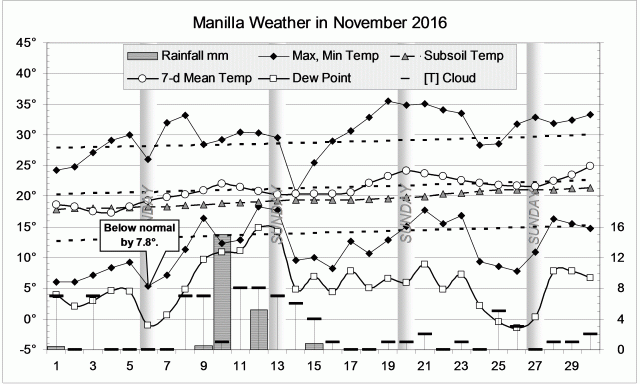
November 2016 was arid

While there was some rain, measures of moisture this month were at or near their lowest November values for this century.

Photo of a yellow dragon lizard

Eastern Bearded Dragon

There were five rain days early in the month, the highest reading being 15.0 mm on the 10th. Some early days were overcast, but skies were sunny after the 15th.
Temperatures rose and fell, but few days or nights were especially hot or cold. The early morning of the 6th went as low as 5.4° , which is 7.8° below normal. Curiously, the month had a record number of cool nights: 12 nights were cooler than 10°, when there are usually only about 5.
Weekly average temperatures, which had been very low in October, were nearer to normal through this month.

Weather log November 2016

Comparing November months

Both the mean maximum temperature (30.2°) and the mean average temperature (20.9°) were near normal, but the mean minimum temperature (11.7°) was very low. On this record, only 1999 had colder November nights (at 11.6°!). This extreme value brought a very wide mean daily temperature range of 18.5°, also a record.
The subsoil was at its coolest recorded November value: 19.5°.
A very wide daily temperature range is one of the measures of moisture showing this month to be arid. The early morning dew point of 5.6° was the lowest November value on this record, and the cloudiness (30%) was low. The monthly rainfall total of 21.9 mm, while not really low (22nd percentile), was the lowest November total in the 26 years since 1990, which had only 15 mm.

Climate for November 2016


Data. Rainfall figures are usually from the automatic rain gauge at Manilla, published on the internet by the Bureau of Meteorology as Station 55031. However, the gauge ceased recording on the 8th of October, and later readings are from my non-standard gauge. All other data, including subsoil at 750 mm, are from 3 Monash Street, Manilla.

3-year trends to November 2016

Parametric plots of smoothed climate variables at Manilla
“November 2016 cold nights warm days”

3-year trends to November 2016


November raw anomaly data (orange)

In November 2016 the daily maximum temperature anomaly rose sharply to a high value. Moisture variables also moved high on the graphs: Temperature range became very high, rainfall low, dew point low, and cloud below normal. Daily minimum air temperature and subsoil temperature (bottom graphs) remained extremely low.

 Fully smoothed data (red)

The autumn months (MAM) of 2016 are now fully smoothed. Daily maximum temperature moved down into the normal range. All moisture values increased, but only the rainfall and daily temperature range were in the normal range of values: skies were more cloudy than normal, but the dew point was below normal.
Daily minimum temperature and subsoil temperature rose slightly during the autumn season. However, while the subsoil temperature was normal, the daily minimum temperature anomaly reached a new record high for a smoothed value in May 2016: +1.34°, beating the value of +1.32° reached in December 2009. This variable may peak in June 2016.


Note:

Fully smoothed data – Gaussian smoothing with half-width 6 months – are plotted in red, partly smoothed data uncoloured, and raw data for the last data point in orange. January data points are marked by squares.
Blue diamonds and the dashed blue rectangle show the extreme values in the fully smoothed data record since September 1999.

Normal values are based on averages for the decade from March 1999.* They appear on these graphs as a turquoise (turquoise) circle at the origin (0,0). A range of anomalies called “normal” is shown by a dashed rectangle in aqua (aqua). For values in degrees, the assigned normal range is +/-0.7°; for cloudiness, +/-7%; for monthly rainfall, +/-14 mm.

 * Normal values for rainfall are based on averages for the 125 years beginning 1883.

House in a cold October

This October has been very cold. That has kept indoor temperature
in this solar-passive house almost too cool for comfort. I wore warmer clothes and opened windows to admit warm air.

Indoor/outdoor temperature scatter-plot.

The climate this October

The graph shows (on the x-axis) how cold this October [in red] was: the coldest of the new century.
Here on the North-west Slopes of NSW, October warms and cools more from year to year than other months. It is the month most affected by climate cycles such as the El Nino-Southern Oscillation (ENSO). As shown, October warmed by one degree each year from 2011 to 2015, then cooled by nearly six degrees from 2015 to 2016.
ENSO followed almost the same pattern, but October 2012 was warmer than October 2013.
For five months, world temperature has also been down: much lower than it was in the record-breaking months of February and March 2016. (HadCRUT4 Global monthly near-surface data set (Column 2 in the linked table.))

Indoor climate this October

As shown on this graph beginning 2005, the indoor mean temperature in October months has varied with outdoor mean temperature. This coldest October outdoors (15.9 degrees) was also the coldest indoors (20.8 degrees). (But see Note below.)
October is the final month that I keep the house in its winter warming regimen. In 2014 and 2015 it had been almost ideally warm, but in 2016 it was just above the comfort minimum. Since this figure is just an average, there were times when the house was too cool for comfort, especially in the mornings.

Successive unfavourable months this year

As in other seasons, I intend the indoor climate to be comfortable through each spring season.
As I posted in “Hard Winter for Solar-passive” this very cloudy winter had reduced solar gain, making heaters needed much more than usual. However, the mean indoor temperature at winter’s end (August) was normal, although the heat bank was 0.7 degrees cooler than normal.
In September months, the warmth indoors still depends on solar gain through the north windows. This time,the sky continued very cloudy, and the daytime temperature was a record low value. As a result, the indoor temperature was 0.9 degrees down and the heat bank 0.7 degrees down.
By October, there is no solar gain through the north windows: warmth is gained from the surroundings in daytime by conduction, convection and radiation and retained by closed curtains at night. This time, both day and night temperatures were three degrees below normal, reducing daily heat gain and increasing nightly loss. As a result, the indoor temperature was 1.2 degrees down and the heat bank 0.9 degrees down.

What I did

Continue reading

October 2016 was cold

Photo of the bark of a Eucalyptus tree

White Box at Sunset

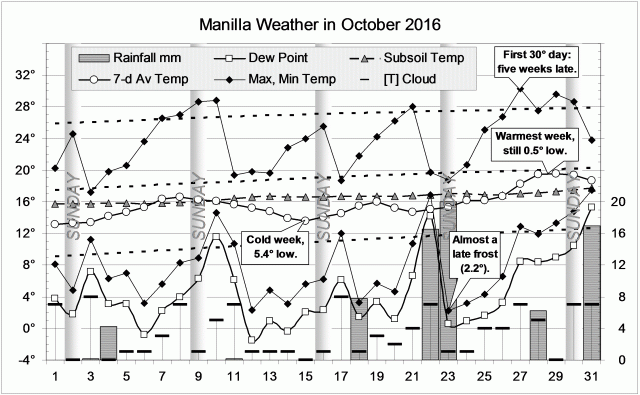
In this month, each of five sunny spells of normal temperature was followed by a cold, cloudy, humid break, generally with rain. Only a few days were warmer than normal, including the 27th. That was the first 30° day of the season, five weeks late.
The average weekly temperature was persistently three or four degrees cooler than normal. One cold week about the 15th was more than five degrees below normal, and the warmest week, about the 29th, was still half a degree low.
Most nights were very cool. I recorded no frosts, but others may have done. My most recent frost was early in September.
There were six rain days, not counting two readings of 0.2 mm. The highest reading was 20.0 mm on the 23rd.

Weather log for October 2016

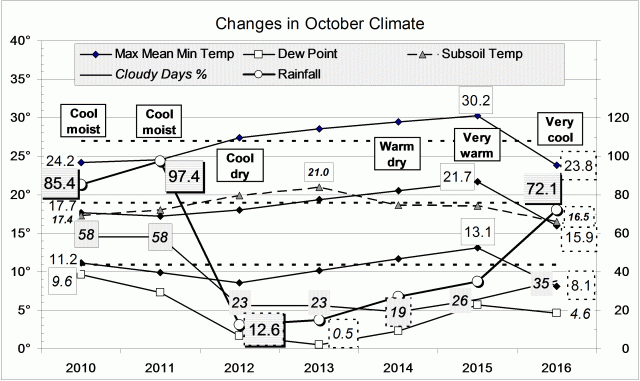
Comparing October months

This was the coldest October on this record from 1999. That includes not only the maximum, mean, and minimum air temperatures read in the Gill Screen, but also the subsoil temperature at 750 mm. Noting that October 2015 had the highest October temperatures, the sudden collapse is astonishing. Last October was three degrees warmer than normal; this month was almost three degrees colder than normal. Put another way, the seasonal warming is a month late this year and was a month early last year.
Unlike September, there was not an unusual amount of moisture in October. Humidity, cloudiness and daily temperature range were near normal.
The monthly rainfall total of 72.1 mm was above the average of 58 mm, in the 70th percentile.
I have discussed the current drought status (that is, drought-free) in another post.

Climate for October 2016


Data. Rainfall figures are usually from the automatic rain gauge at Manilla, published on the internet by the Bureau of Meteorology as Station 55031. However, the gauge ceased recording on the 8th of October, and later readings are from my non-standard gauge. All other data, including subsoil at 750 mm, are from 3 Monash Street, Manilla.