Spring 2017 slightly dry

Photo of a Persian silk tree at Manilla NSW

Persian silk tree

Each year, the weather warms by about eight degrees during the three months of spring. This time, the warming came all at once. After cold nights at first, by the third week of September both days and nights were five degrees above normal. As extremes, one day reached 34° and one night 22°. After that, the temperature rose no higher through to the end of the season. By then, such temperatures are normal.

For much of the season, the air was dry, but a humid spell in October brought 63 mm of rain within four days. The season’s rainfall of 134 mm was at the 40th percentile, about 30 mm below average. Other measures of moisture were slightly low.
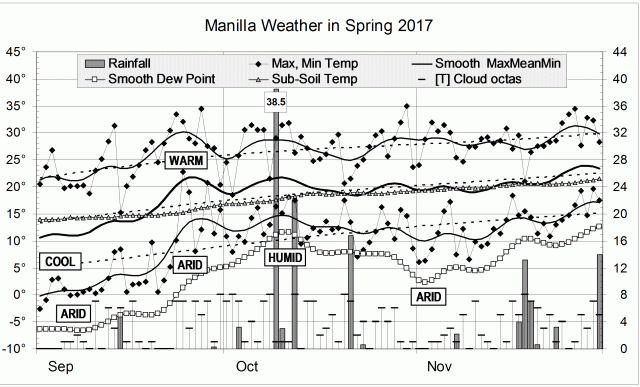
Graphical weather log for spring 2017

Air temperatures were near normal, with days slightly warm and nights slightly cool. Spring last year had been two degrees cooler, and spring 2014 two degrees warmer. The subsoil temperature was more than a degree below normal, as it often has been in the last two years.
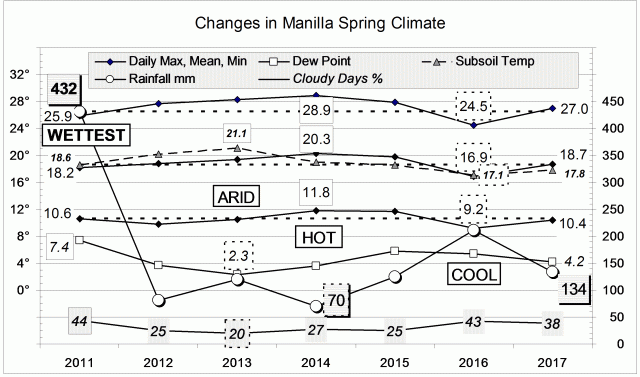
Climate for spring 2017


Data. A Bureau of Meteorology automatic rain gauge operates in the museum yard. From 17 March 2017, 9 am daily readings are published as Manilla Museum, Station 55312.  These reports use that rainfall data when it is available. That gauge failed (again) on the 25th of September 2017, and later readings are from my non-standard gauge.

All other data, including subsoil at 750 mm, are from 3 Monash Street, Manilla.
November 2017 dry again with cold nights

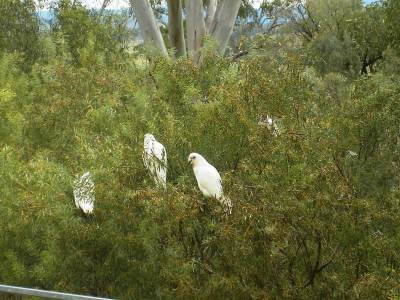
Cockatoos feeding in a wattle

Corellas in Acacia decora

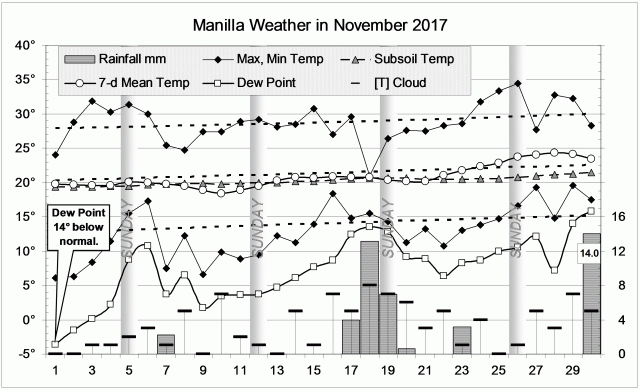
While day temperatures were normal, many nights were below normal, around 10°. The cold night air was extremely dry. The early morning dew point on the 1st was minus 3.6°, about 14° below normal.
My rain gauge registered seven rain days, but readings were moderate, the highest being 14.0 mm on the 30th. (The automatic gauge at the Museum remained down.)

Weather log for November 2017

Comparing November months

With a mean of 20.8°, this month was cool, but not as cool as several other November months. November 1999, at 19.4°, was the coolest. On the graph, November 2014 (25.4°) stands out as very much warmer.
The rainfall of 44.2 mm is at the 31st percentile: not high, but enough to prevent any shortages. This graph still includes November 2011, the wettest on record. At 242.9 mm, it beat a record of 226 mm that had stood for fifty years.

Climate log for November


Data. A Bureau of Meteorology automatic rain gauge operates in the museum yard. From 17 March 2017, 9 am daily readings are published as Manilla Museum, Station 55312.  These reports use that rainfall data when it is available.  The gauge last reported on 24 September 2017.

All other data, including subsoil at 750 mm, are from 3 Monash Street, Manilla.
3-year trends to November 2017

Dry with cold nights

3-year trends to November 2017

November raw anomaly data (orange)

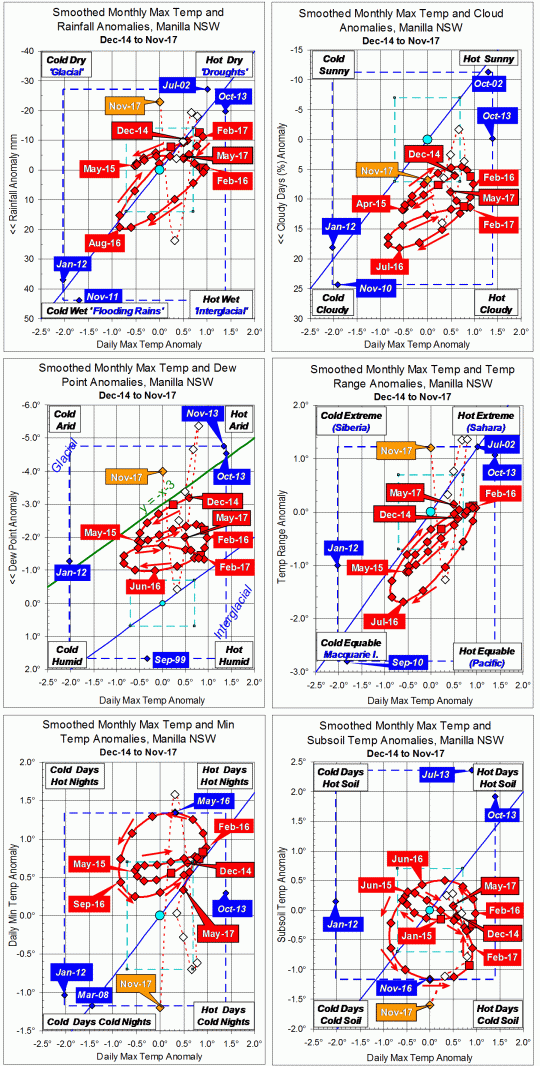
November 2017 reverted to the anomalies of August and September: low moisture (top four graphs) and cold nights (bottom left), with continuing cold subsoil (bottom right). Day temperature (x-axes)had cooled to normal since September.

 Fully smoothed data (red)

Anomaly data for autumn 2017 (MAM) are now fully-smoothed, plotted in red. That season was near the centre for the last three years, but day temperatures fell from high towards normal (seen best on the top right graph). Meanwhile, moisture measures disagreed somewhat. Rainfall rose towards normal, cloudiness decreased towards normal, dew point fell through low values, and daily temperature range was static near normal.
Daily minimum temperature fell towards normal, and subsoil temperature rose to normal.


Note:

Fully smoothed data – Gaussian smoothing with half-width 6 months – are plotted in red, partly smoothed data uncoloured, and raw data for the last data point in orange. January data points are marked by squares.
Blue diamonds and the dashed blue rectangle show the extreme values in the fully smoothed data record since September 1999.

Normal values are based on averages for the decade from March 1999.* They appear on these graphs as a turquoise (turquoise) circle at the origin (0,0). A range of anomalies called “normal” is shown by a dashed rectangle in aqua (aqua). For values in degrees, the assigned normal range is +/-0.7°; for cloudiness, +/-7%; for monthly rainfall, +/-14 mm.

 * Normal values for rainfall are based on averages for the 125 years beginning 1883.

Moments of Manilla’s Yearly Rainfall History

Manilla Annual rainfall history: Four moments

Comparing all four moments of the frequency-distributions

Annual rainfall for Manilla, NSW, has varied widely from decade to decade, but it is not only the mean amounts that have varied. Three others measures have varied, all in different ways.

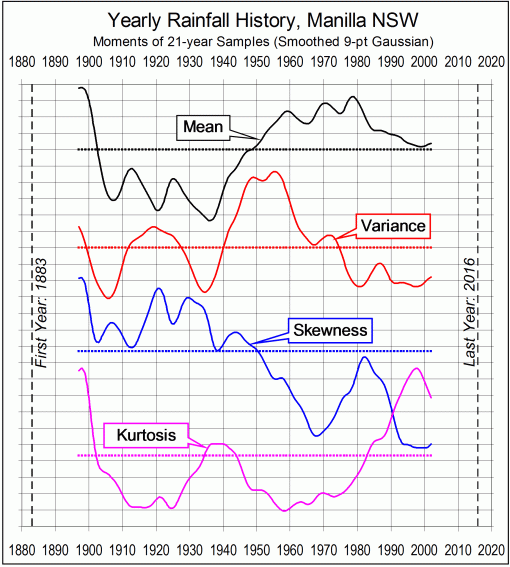
I based the graph on 21-year sub-populations of the 134-year record, centred on consecutive years. I analysed each sub-population as a frequency-distribution, to give values of the four moments: mean (drawn in black), variance (drawn in red), skewness (drawn in blue) and kurtosis (drawn in magenta).

[For more about the moments of frequency-distributions, see the recent post: “Kurtosis, Fat Tails, and Extremes”. See also the Note below: “Instability in the third and fourth moments.”]

Each trace of a moment measure seems to have a pattern: they are not like random “noise”. Yet each trace is quite unlike the others.

The latest values are on the right. They show that the annual rainfall is now remarkable in all four respects. First, the mean rainfall (black) closely matches the long-term mean, which has seldom happened before. By contrast, the other three moments are now near historical extremes: variance (red) is very low, skewness (blue) very negative, and kurtosis (magenta) very positive.

To my knowledge, such a result has not been observed or predicted, or even suspected, anywhere.

[SEE A REVISED VERSION OF THIS WORK
A revised version of this post uses twelve times as much data. It is “Moments of Manilla’s 12-monthly Rainfall” posted on 15 May 2018.]

Manilla Annual rainfall history: Mean

The mean yearly rainfall (the first moment)

As I have shown before, the mean annual rainfall was low in the first half of the 20th century, and high in the 1890’s, 1960’s and 1970’s. Rainfall crashed in 1900 and again in 1980.

Manilla Annual rainfall history: Variance

Yearly rainfall variance (the second moment)

Continue reading

Manilla’s automated rain gauge down again

Photo of rain gauges

The rain gauge we had

[In the post “No rain, and no rain gauge” of 18 March 2016, I reported that the Manilla Post Office rain gauge, after 132 years, was no longer being read. Now the automated gauge that replaced it is not being read either.]

Manilla’s official rainfall record since 2015

For the last eighteen months, Manilla’s official rainfall record has depended on an automatic rain gauge. The Bureau of Meteorology moved this gauge from the Post Office to a nearby yard of the Manilla Historical Society Museum. The gauge, which had provided flood warnings only, became also the general-purpose rain gauge for Manilla.

From the date when manual readings ceased, 26 March 2015, there was no Manilla rain gauge for 424 days. From 23 May 2016, the re-purposed, and re-located automatic rain gauge then operated as Station 055031, Manilla Post Office, for 137 days to 7 October 2016.
Due to a fault, there were no readings for 161 days to 17 March 2017. After repair, the gauge then operated as Station 055312, Manilla (Museum), for 191 days to 24 September 2017, when it failed again. At the present date (5 November 2017) it has been out of service for 42 days.

Summary

Since Manilla rainfall readings became automated eighteen months ago, 38% of the readings have been missed, missing months at a time. This is appalling. When the Manilla rain gauge was read by the Postmaster, from 1883 to 2015, far less than 1% of readings were missed, never for more than two days at a time.

Without records from a rain gauge that is recognised officially, Manilla residents will have no evidence to prove the severity of the next drought. If people think this is important, it seems they would be far better-served by a local volunteer than by a Bureau of Meteorology that cannot afford to keep the automatic rain gauge running.