Manilla NSW in Global Warming Context

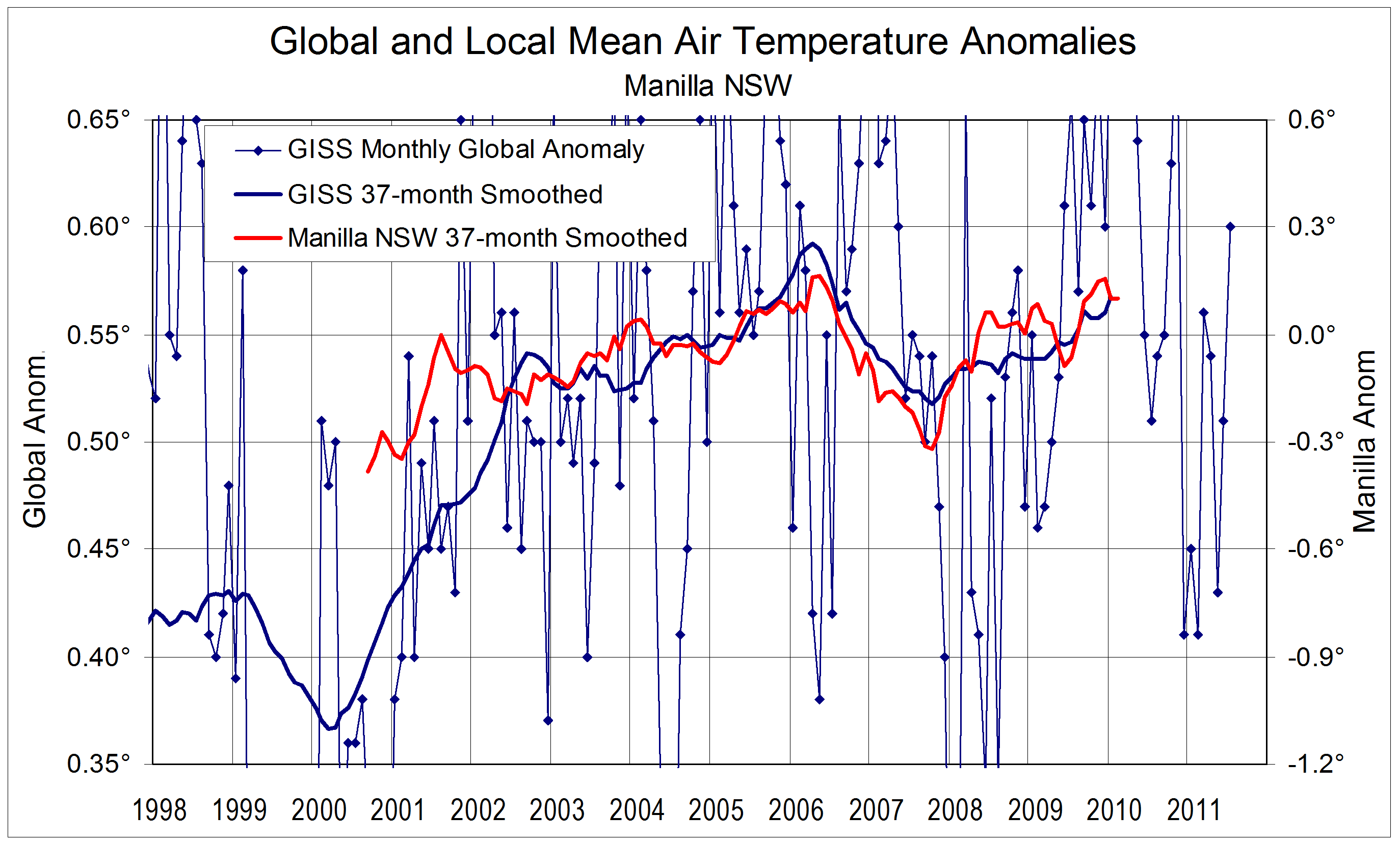
Logs of smoothed world and local temperatures.

[I posted an Up-dated version of this graph in July 2014]

Up-to -date data on global temperature change can easily be down-loaded from Ole Humlum’s website “climate4you“.
Humlum favours sampling windows 37 months wide. For my own data at Manilla, NSW, I have always used windows about six months wide, which show up Australia’s vigorous Quasi-biennial oscillations of climate. I tried Humlum’s 37-month window on my data, with quite startling results, as shown in the graph above.

Humlum re-presents three records since 1979 of global monthly air surface temperature anomalies:
* HadCRUT3: by the (UK Met Office) Hadley Centre for Climate Prediction and Research, and the University of East Anglia’s Climatic Research Unit (CRU), UK.
* NCDC: National Climatic Data Centre, NOAA, USA.
* GISS: Goddard Institute for Space Studies, Columbia University, New York, NASA, USA.
When smoothed by a 37-month running average, these data sets give very similar results. I use the GISS data because it matches my data best.

The match is very good, particularly in the sharp fall from the maximum in April 2006 to the minimum in September 2007. Where my data begins in September 2000, both curves rise steeply from low values, but mine peaks in August 2001, more than a year before a corresponding peak in global temperature (September 2002). After that, there is a plateau, where the graphs rise together to the highest peak (April 2006).
The other global data sets, HadCRUT and NCDC, have temperature falling or steady along the 2002-2006 plateau.
There are two reasons for plotting my data on a separate axis (on the right). First, the reference periods are different: GISS uses 1951-1980, while I use the decade from April 1999. Second, temperature varies much more at a single station than in the average of many stations around the world. I use a scale six times larger.

It turns out that the cold time in Manilla in late 2007, which I had mentioned in several contexts, was a cold time world-wide.
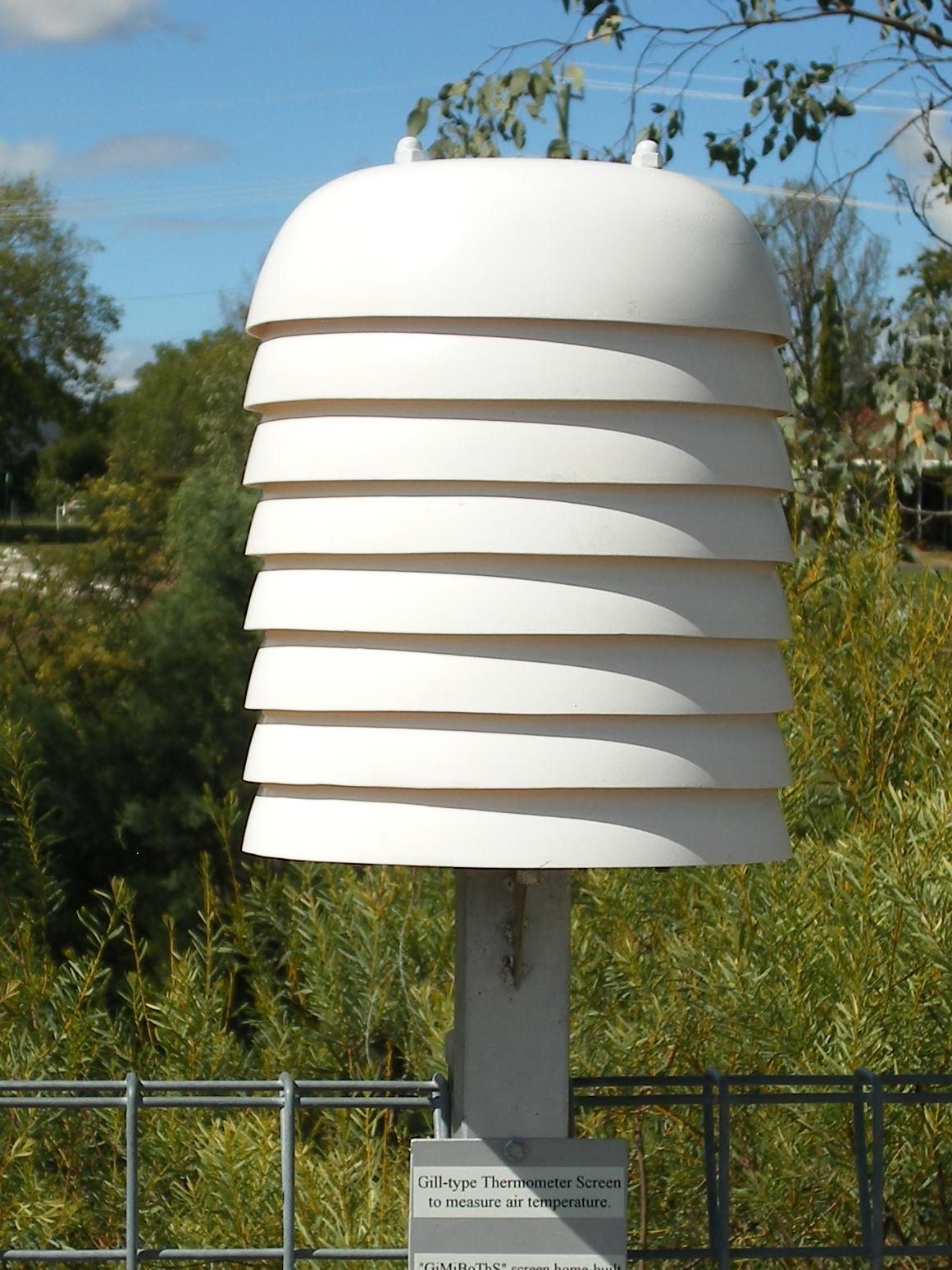
Home-made thermometer screen

Giant Mixing Bowl Thermometer Screen

I am over the moon at getting agreement between data from my home-made thermometer screen and the best that world climatologists can do. It makes me inclined to believe some of the things they say.


This article and graph were posted on 18th August 2011 in a weatherzone forum: General Weather/ Observations of Climate Variation.

 

Manilla’s Hot Days

I have used my 13-year weather record to find the number of hot days in each year and in each month. Earlier I did the same for frosty mornings. Because the summer, which has the most hot days, crosses from one calendar year to the next, I have begun each year at July.
I have called days warmer than 35° “hot days”, and days warmer than 40° “very hot days”.

Total hot days

The first graph shows the number of hot and very hot days in each year. The most hot days were in the year ’09-’10, which had 44; the fewest were in the year ’11-’12, which had only 4. The 13-year average is 26, but the number of hot days is quite different from year to year.

Counting only the very hot days, ’03-’04 had the most (6), and four years had none at all. On the average, two days exceeded 40° in a year.
Hot days each year, and seasonal distribution.

Months with hot days

The second graph shows how the number of hot and very hot days peaks strongly in January, with very few earlier than November or later than March. On average, Manilla’s summer has about 22 days warmer than 35°, while spring has 3, and autumn only 1.


The other graphs show how each year had a different pattern of hot days. The highest monthly peaks, each 19 hot days, came in January 2003 (following drought) and January 2007. Annual peaks also came in January in 2008 and 2012, but these peaks were extremely low: only 4 and 3 hot days. Continue reading

Manilla’s Frosts

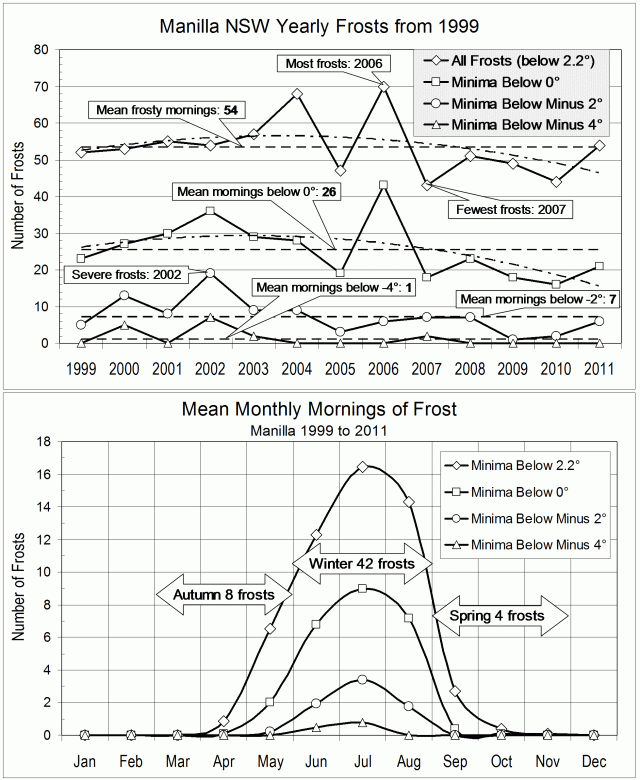
I have a 13 year record that shows how frosty Manilla is, and how some years are frostier than others. My thermometer is on high ground, so people living where cold air collects will have had more frosts. However, my readings show changes from one time to another. As I do not have a thermometer in the grass, I have recorded a frost when my screen reading is below +2.2°.

There is a matching post for Manilla’s hot days.

Total frosts

The first graph shows the number of frosty mornings in each year. The most frosts were in the years 2004 (68) and 2006 (70); the fewest were in the years 2007 (43) and 2010 (44). The 13-year average is 54.
The graph also shows the number of mornings colder than zero, minus two, and minus four degrees. On the average, these occurred on 26, 7, and 1 mornings per year. For those colder than zero degrees, 2006 was again the frostiest, but 2002 was also very frosty. Counting only the most severe frosts (below minus two or minus four degrees) 2002 was the frostiest year. It had the coldest mornings: -5.1° on both the 2nd and 11th of July.Frosts each year, and seasonal distribution.

Frosty months

The second graph shows how most frosts come in the winter months, especially July, with some frosts in autumn, but few in spring and none in summer. Few come before Anzac Day (25th April) or after Labour Day (first Monday in October in NSW).


The graphs below show that each year was different. The drought year 2002 had the highest number of frosts in a single month: 27 in July – half of all frosts in that year. By contrast, the 70 frosts of 2006 were spread through the months of winter and autumn: there were more frosts in June and August than in July. Continue reading

Manilla Dew Point leads ENSO by three months

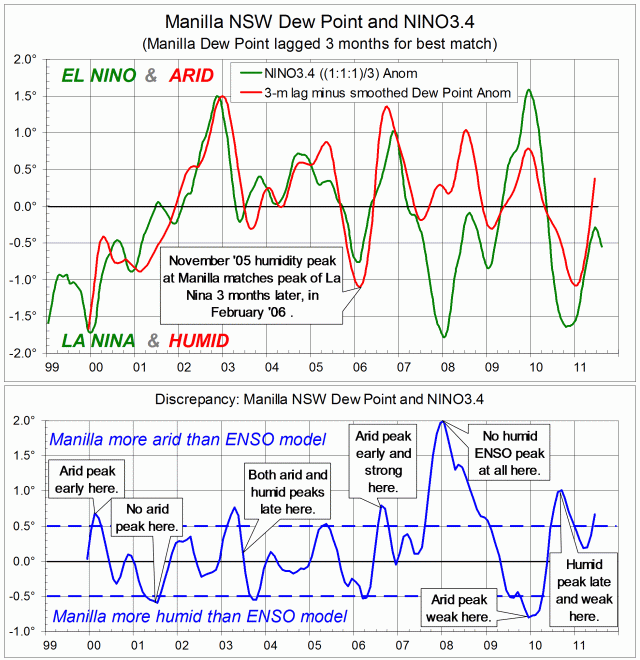
Manilla dew point lags NINO3.4 sea surface temperature by 3 months.

(This material justifies a statement in the post “Predict weather from ENSO?”)

The graphs above are like those in two previous posts, but show how Manilla smoothed monthly dew point anomalies, like temperature anomalies and rainfall anomalies, relate to the El Niño-Southern Oscillation (ENSO).

High (El Niño) values of Sea Surface Temperature (NINO3.4) are shown here to relate to low humidity at Manilla, NSW. As humidity data, I estimate dew points daily at sunrise. Dew points, like Sea Surface Temperatures, are expressed in degrees celsius, but corresponding anomalies take the opposite sense. The first graph plots the Manilla dew point anomaly, given a  negative sign, and the NINO3.4 anomaly. To improve the match, I have lagged the Manilla dew points by three months. As an example, I have noted on the graph the match of Manilla’s November 2005 humidity peak with the La Nina ENSO peak of February 2006.

To the eye, the over-all match is better than in either the rainfall or the maximum temperature plots of earlier posts. The two curves here match very well from 2000 to 2007.

The second graph shows the discrepancy between the two curves. Dashed lines show limits of a good match at +/-0.5 degrees. The nature of each larger discrepancy is noted. (“Here” in text boxes means “at Manilla”.)
After 2007 there are large mis-matches between Manilla dew point and ENSO. Dew point fluctuations suddenly become less than might be expected from NINO3.4 values. It may be relevant that, as I posted elsewhere  in July 2010, skies suddenly became very much cloudier at Manilla after August 2007.

I have also tried plotting the following variables against NINO3.4:

Daily minimum temperature;
Daily temperature range;
Percent cloudy mornings;
Subsoil temperature.

None of them matches NINO3.4 well enough to display.

The three sets of graphs show “teleconnections” between Sea Surface Temperatures in the equatorial Pacific and climate variables at Manilla in inland NSW, Australia. Climatic peaks come earlier at Manilla than in the Pacific:

Peaks of daily maximum temperature come one month earlier;
peaks of rainfall come two months earlier;
peaks of Dew Point come three months earlier.

In a simple-minded way, it seems to me more likely that Australia’s climate drives the Southern Oscillation than the other way around. I know that this is speculation. (Sort of like Abraham Ortellius suggesting in 1587 that Africa and South America might have drifted apart.)

Notes
1. High frequency noise is reduced in the case of the Manilla monthly data by a Gaussian smoothing function of half-width six months.
2. On advice, I represent the El Nino – Southern Oscillation phenomenon (ENSO) by the NINO3.4 area anomalies from the OISSTv2 data set.
My enquiries about the best data to use are in this “weatherzone”  thread.
The ensemble of sea surface temperatures does not have much high-frequency noise. There is some, however, and I have used the same smoothing as used in the (formerly authoritative) Oceanic Nino Index (ONI), that is, a running mean of each three monthly values.


This was posted originally in a “weatherzone” forum, with the date 12 November 2011. It is posted here with the nominal date 29 November 2011.


Manilla rainfall extremes reflect NINO3.4 temperature

Manilla rainfall matches NINO3.4 sea surface temperature.

(This material justifies a statement in the post “Predict weather from ENSO?”)

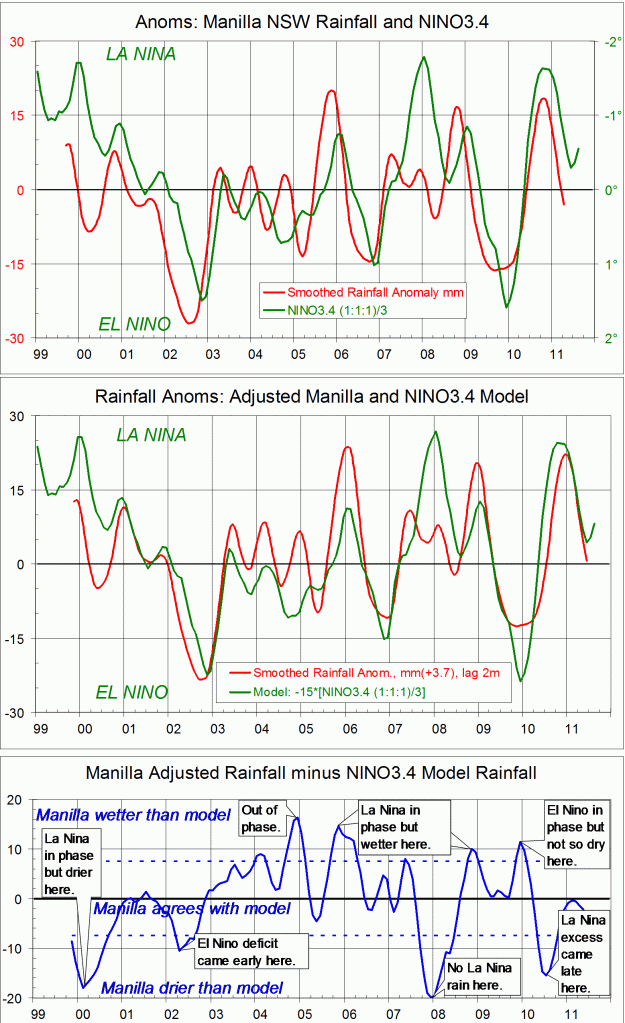
The graphs above are like those in an earlier post, but show how Manilla monthly rainfall anomalies, rather than maximum temperature anomalies relate to the El Nino-Southern Oscillation (ENSO). Most people using ENSO  want to predict Australian regional rainfall.

In the second graph I have improved the match at peaks and troughs of smoothed Manilla monthly rainfall anomalies and NINO3.4 sea surface temperature anomaly data in two ways.
1. I converted the sea surface temperature anomaly (degrees C) into a model of resultant rainfall anomaly (mm) by multiplying by minus fifteen.
2. I added 3.7 mm of rainfall to the Manilla figures, and I lagged the data by two months.

To the eye, the over-all correspondence between actual and modelled rainfall is good, but not quite as good as in the temperature graphs. One form of mis-match is that two of the greatest rainfall deficits (“El Nino” Nov-06, Dec-09) are broader and shallower than in the model. (Perhaps an arithmetic measure of rainfall anomaly is not the best.)

The third graph shows how much Manilla rainfall, as adjusted, differs from the rainfall “predicted” by the NINO3.4 model. Dashed lines show limits of a good match at +/- 7.5 mm (corresponding to +/-0.5 degrees). The nature of each larger discrepancy is noted.

A good match demands lagging actual rainfall at Manilla by two months. That implies that peaks and troughs in Manilla rainfall anomalies happen two months before the matching anomalies of NINO3.4. I wonder if prediction is even practical if that is the case in other parts of Australia.

Notes
1. High frequency noise is reduced in the case of the Manilla monthly data by a Gaussian smoothing function of half-width six months.
2. On advice, I represent the El Nino – Southern Oscillation phenomenon (ENSO) by the NINO3.4 area anomalies from the OISSTv2 data set.
My enquiries about the best data to use are in this “weatherzone”  thread.
The ensemble of sea surface temperatures does not have much high-frequency noise. There is some, however, and I have used the same smoothing as used in the (formerly authoritative) Oceanic Nino Index (ONI), that is, a running mean of each three monthly values.


This was posted originally in a “weatherzone” forum, with the date 28 October 2011. It is posted here with the nominal date 16 November 2011.

(Note added: Updated to include 2013 here.)