Manilla’s automated rain gauge down again

Photo of rain gauges

The rain gauge we had

[In the post “No rain, and no rain gauge” of 18 March 2016, I reported that the Manilla Post Office rain gauge, after 132 years, was no longer being read. Now the automated gauge that replaced it is not being read either.]

Manilla’s official rainfall record since 2015

For the last eighteen months, Manilla’s official rainfall record has depended on an automatic rain gauge. The Bureau of Meteorology moved this gauge from the Post Office to a nearby yard of the Manilla Historical Society Museum. The gauge, which had provided flood warnings only, became also the general-purpose rain gauge for Manilla.

From the date when manual readings ceased, 26 March 2015, there was no Manilla rain gauge for 424 days. From 23 May 2016, the re-purposed, and re-located automatic rain gauge then operated as Station 055031, Manilla Post Office, for 137 days to 7 October 2016.
Due to a fault, there were no readings for 161 days to 17 March 2017. After repair, the gauge then operated as Station 055312, Manilla (Museum), for 191 days to 24 September 2017, when it failed again. At the present date (5 November 2017) it has been out of service for 42 days.

Summary

Since Manilla rainfall readings became automated eighteen months ago, 38% of the readings have been missed, missing months at a time. This is appalling. When the Manilla rain gauge was read by the Postmaster, from 1883 to 2015, far less than 1% of readings were missed, never for more than two days at a time.

Without records from a rain gauge that is recognised officially, Manilla residents will have no evidence to prove the severity of the next drought. If people think this is important, it seems they would be far better-served by a local volunteer than by a Bureau of Meteorology that cannot afford to keep the automatic rain gauge running.

October 2017: no drought

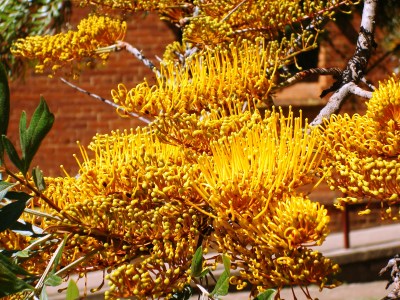
Grevillea robusta flowers

Flowers of Silky Oak

No temperatures were extreme in this month. In the second week, the mean weekly temperature was four degrees above normal, rather like the last week of September.
Dry air on the 6th and on the 31st made the dew point eight degrees low, but humid air on the 11th made it seven degrees high.
My rain gauge registered six rain days, with high readings of 38.5 mm on the 9th, 22.0 mm on the 12th, and 16.8 mm on the 21st. (The automatic gauge at the Museum remained down.)

Weather log for October 2017

Comparing October months

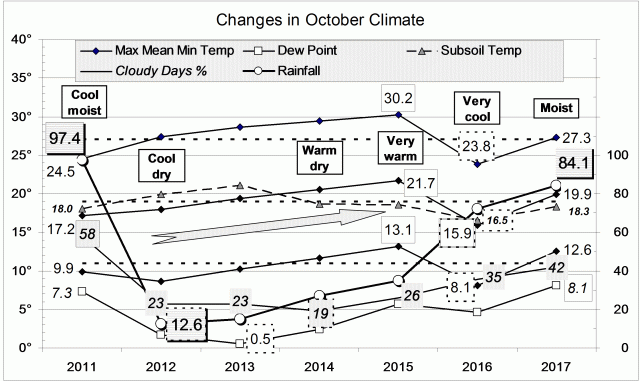
As shown by the arrow on the second graph, October months became warmer and more moist with each year from 2012 to 2015. October 2016 was very cool, then this month was again warm. The trend to more moisture continued through all six October months from 2012 to 2017. It was shown not only by rainfall, but also by cloudiness, dew point, and narrowing daily temperature range. No other calendar months had this trend.
The high total rainfall of 84.1 mm (80th percentile) wiped out the serious and severe rainfall shortages seen in September. Now, the lowest percentile value is that for the 4-month total (117 mm). Being at the 15th percentile, it does not rate as serious.

Note added December 2019.
Data in this post for October 2017 and the preceding October months seem to give no warning of the approach of the drought of 2018-19 – the worst drought in the history of Manilla.

Climate for October


Data. A Bureau of Meteorology automatic rain gauge operates in the museum yard. From 17 March 2017, 9 am daily readings are published as Manilla Museum, Station 55312.  These reports use that rainfall data when it is available.  The gauge last reported on 24 September 2017.

All other data, including subsoil at 750 mm, are from 3 Monash Street, Manilla.

3-year trends to October 2017

Avoiding drought

3-year trends to October 2017

October raw anomaly data (orange)

October 2017 was moist: all moisture indicators had dropped sharply down the graphs, retreating from the aridity of August and September. Daily maximum temperature anomaly (x-axis in all graphs) fell towards normal, while that of the subsoil (lower right graph) remained low. Daily minimum temperature anomaly (lower left graph) jumped from extremely low to extremely high.

 Fully smoothed data (red)

The latest fully-smoothed data point is that for April 2017.
At that time, the climate was warm and almost static. There was a pause in a drift towards aridity.


Note:

Fully smoothed data – Gaussian smoothing with half-width 6 months – are plotted in red, partly smoothed data uncoloured, and raw data for the last data point in orange. January data points are marked by squares.
Blue diamonds and the dashed blue rectangle show the extreme values in the fully smoothed data record since September 1999.

Normal values are based on averages for the decade from March 1999.* They appear on these graphs as a turquoise (turquoise) circle at the origin (0,0). A range of anomalies called “normal” is shown by a dashed rectangle in aqua (aqua). For values in degrees, the assigned normal range is +/-0.7°; for cloudiness, +/-7%; for monthly rainfall, +/-14 mm.

 * Normal values for rainfall are based on averages for the 125 years beginning 1883.

House June warmth profiles: IV

Part IV: Solar gain in the clear-story


In a solar-passive house, do clear-story windows trap much heat?
How about overcast days?

Graph of clear-story temps, 2 days

[This post repeats some data of an earlier post, headed  “Part III: Daily temperature cycles, east wing”. Please refer to that post for more details.]

The graph above shows records of temperature for two days in mid-winter. Records of cloud cover (plotted in purple) show that the first day was overcast and the second mainly sunny.
Through the sunny second day, the temperature readings taken just inside the clear-story windows (black) rose and fell just like the outdoor temperature (red), but they were much higher. I have drawn a dotted red line at a temperature 13.5° higher than outdoors. It fits well to the clear-story temperature (black) on that day. During the previous day, which was overcast, the dotted red line does not fit. It is about 6° higher than the actual clear-story temperature.
By experiment, I found that I could make a model (plotted in green) that would match the actual clear-story temperature as the cloud cover changed. As well as adding 13.5° to the outdoor temperature, I subtracted two thirds of the cloud cover measured in octas. As plotted (green), this model matches the clear-story temperature through both days. At two data points there was a mis-match: those points have not been plotted.

 Graph of clear-story temps, 5 days

The second graph shows all five days of the experiment. My model of temperature in the clear-story space (plotted green), fits the actual readings (black) on all days.

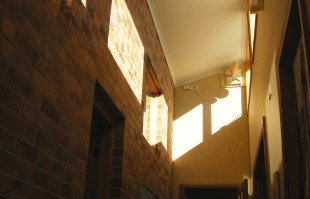
Photo of clear-story area with winter sun and a fan

Clear-story fan set for winter

The model includes one other feature: the maximum temperature that I allow is 26°. That also matches. As mentioned in Part III, a thermostat turns on fans at 26°. That prevented the temperature from rising higher.

Comment

A solar passive house is likely to gain more winter heat if it has north-facing windows in a clear-story above room level. It may also lose more heat. If so, the cost of the clear-story design may not be justified.
This experiment shows that, in this particular house during one harsh winter, the clear-story performed very well.

People may be as surprised as I was at the closely-matching pattern of outdoor and clear-story temperatures in mid-winter, and at how very much warmer the clearstory was: more than thirteen degrees warmer in fine weather.
It may also provoke some thought that the match persisted in overcast weather, but with the clearstory being only eight degrees warmer than outdoors in that case.

Back to Part I: Average temperature values.
Back to Part II: The two-storied west wing’s daily temperature cycles
Back to Part III: the single-storied east wing’s daily temperature cycles

Kurtosis, Fat Tails, and Extremes

sketch demonstrating kurtosis

PLATYKURTIC left; LEPTOKURTIC right

Why must I explain “kurtosis”?
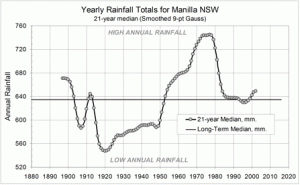
Manilla 21-year rainfall mediansThe annual rainfall at Manilla, NSW has changed dramatically decade by decade since the record began in 1883. One way that it has changed is in the amount of rain each year, as shown in this graph that I posted earlier.

Another way, unrelated to the amount of rain, is in its kurtosis. Higher kurtosis brings more rainfall values that are extreme; lower kurtosis brings fewer. We would do well to learn more about rainfall kurtosis.

[A comment on the meaning of kurtosis by Peter Westfall is posted below.]

Describing Frequency Distributions

The Normal Distribution

Many things vary in a way that seems random: pure chance causes values to spread above and below the average.
If the values are counted into “bins” of equal width, the pattern is called a frequency-distribution. Randomness makes this pattern form the unique bell-shaped curve of Normal Distribution.
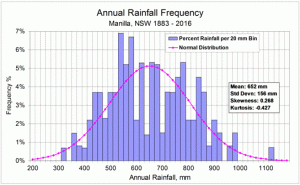
Histogram of annual rainfall frequency at Manilla NSWThe values of annual total rainfall measured each year at Manilla have a frequency-distribution that is rather like that. This graph compares the actual distribution with a curve of Normal Distribution.

Moments of a Normal Distribution: (i) Mean, and (ii) Variance

The shape of any frequency-distribution is described in a simple way by a set of four numbers called moments. A Normal Distribution is described by just the first two of them.
The first moment is the Mean (or average), which says where the middle line of the values is. For Manilla annual rainfall, the Mean is 652 mm.
The second moment is the Variance, which is also the square of the Standard Deviation. This second moment says how widely spread or scattered the values are. For Manilla annual rainfall, the Standard Deviation is 156 mm.

Moments of other (non-normal) distributions: (iii) Skewness, and (iv) Kurtosis

The third moment, Skewness, describes how a frequency-distribution may have one tail longer than the other. When the tail on the right is longer, that is called right-skewness, and the skewness value is positive in that case. For the actual frequency-distribution of Manilla annual rainfall, the Skewness is slightly positive: +0.268. (That is mainly due to one extremely high rainfall value: 1192 mm in 1890.)
Kurtosis is the fourth moment of the distribution. It describes how the distribution differs from Normal by being higher or lower in its peak (but see the comments below) or its tails, as compared to its shoulders.
As it was defined at first, a Normal Distribution had the kurtosis value of 3, but I (and Excel) use the convention “excess kurtosis” from which 3 has been subtracted. Then the excess kurtosis value for a Normal Distribution is zero, while the kurtosis of other, non-normal distributions is either positive or negative.

Smoothed rainfall frequency and a platykurtic curveManilla’s total frequency distribution of annual rainfall has a Kurtosis of -0.427. As shown here (copied from an earlier post), I fitted a curve with suitably negative kurtosis to Manilla’s (smoothed) annual rainfall distribution.

Platykurtic, Mesokurtic, and Leptokurtic distributions

Karl Pearson invented the terms: platykurtic for (excess) kurtosis well below zero, mesokurtic for kurtosis near zero, and leptokurtic for kurtosis well above zero.
The sketch by W S Gosset at the top of this page shows the typical shapes of platykurtic and leptokurtic curves.
(See the Note below: ‘The sketch by “Student”‘.)

In the two graphs that follow, I show how a curve of Normal Distribution can be modified to be leptokurtic (+ve) or platykurtic (-ve) while remaining near-normal in shape. (See the note “Constructing the kurtosis adjuster”)
In both of these graphs, I have drawn the curve of Normal Distribution in grey, with call-outs to locate the mean point and the two “shoulder” points that are one Standard Deviation each side of the mean.

A leptokurtic curve

A leptokurtic (+ve) curve

By adding the “adjuster curve” (red) to the Normal curve, I get the classical leptokurtic shape (green) as was sketched by Gosset. It has a higher peak, lowered shoulders, and fat tails. The shape is like that of a volcanic cone: the peak is narrow, and the upper slopes steep. The slopes get gentler as they get lower, but not as gentle as on the Normal Curve.
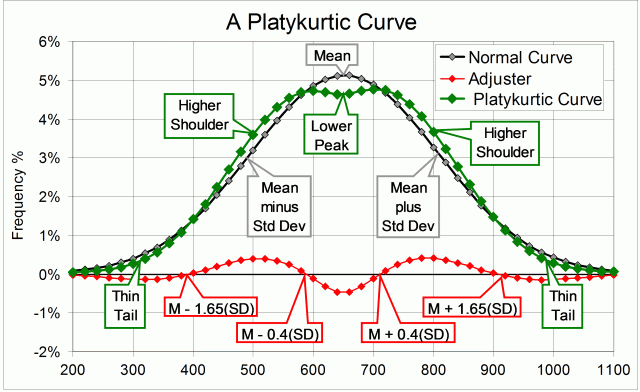
A platykurtic curve

A platykurtic (-ve) curve

Continue reading