February 2009: swelter and shiver

The daily weather log
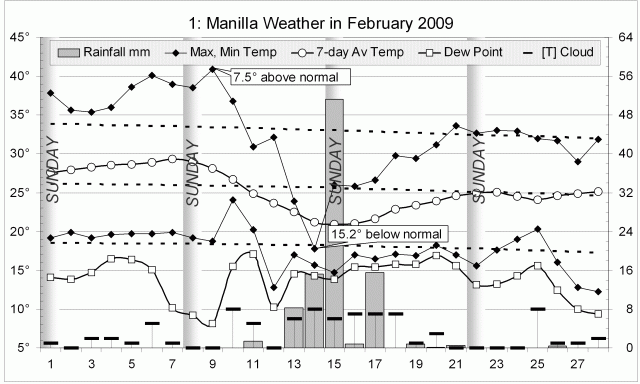
Weather log February 2009

February days began hot (37.8°), and got hotter. The 9th reached 40.9°: that was 7.5° above normal, and the hottest day of the summer. At 20°, nights were unpleasantly warm, but it is normal for the first week of February to have the hottest nights of the year (18.4°).
The daily maximum on the 14th was an amazingly cool 17.8°, that is, 23.1° lower than five days before! The reading was 15.2° below normal. On that day, half of NSW, excluding only the borders on the east, south and west, had daily maximum temperatures more than 12° below normal.
A wet spell from the 11th to the 17th brought most of the month’s rain.At Manilla the highest reading was 51.2 mm on the 15th.
The month ended dry, with temperatures normal, except that nights became cool.

 Comparing February months
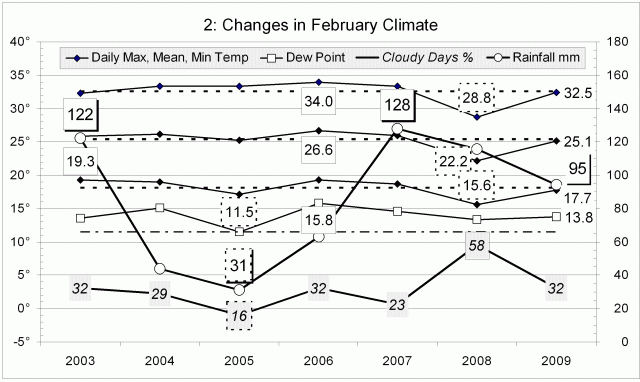
Climate February 2009

This month’s climate was normal, if rather wet. Other Februaries on the graph vary in every way:

February 2005 was sunny, dry, and not humid;
February 2006 was hot and humid;
February 2007 was very rainy;
February 2008 was very cloudy and very cold.
The rainfall total (94.5 mm) was in the 75th percentile for the month; well above the February average of 67 mm. This neatly makes up the January shortfall. Rainfall totals for groups of months remain very high. The 6 month total (525 mm) is in the 92nd percentile, and more than 200 mm above the median value. Totals are still above the median for all periods up to 72 months, with the exception of the 36-month total, and that has now risen to the 46th percentile.


Data. Rainfall data is from Manilla Post Office, courtesy of Phil Pinch. Dew point values before August 2005 are from Tamworth Airport 6 am data supplied by the Bureau of Meteorology. Temperature and other data are from 3 Monash Street, Manilla.
 

January 2009 a bit dry

The daily weather log

Weather log January 2009

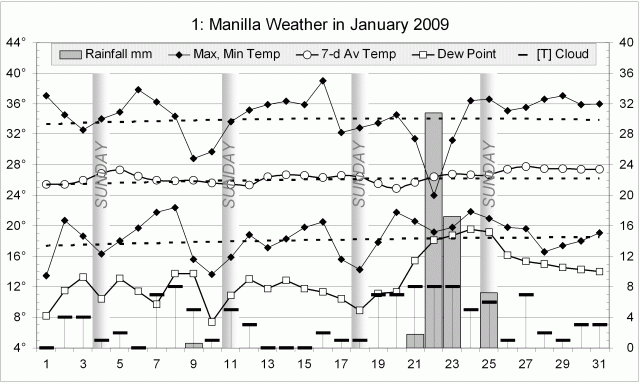
January was a bit on the dry side. Otherwise, it was close to normal, like December. Not only were the mean temperatures perfectly normal: there were few hot or cold days or nights.
The percentage of cloudy mornings (39%) was rather high and the number of cloud-free mornings (5) very low.
Four of the five rain days came in one short spell from the 21st, the 22nd having 30.8 mm. This spell was extremely humid, with Dew Points above 17°, typical of stormy weather. The evening of the 24th had a magnificent lightning display. Many storms, far and near, could be seen at once. Every second or two, flashes lit up the towers of cumulonimbus clouds from many different directions, or from inside.

 Comparing January months

Climate January 2009


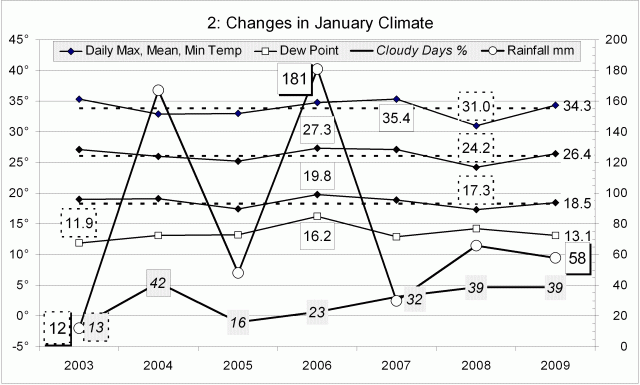
Normal temperatures this month contrast with last January’s low values and the high values of the two before that.
The rainfall total (57.6 mm) was in the 39th percentile for the month. Although this is well below the January average of 87 mm, rainfall totals for groups of months remain very high. The four-month total, for example, is in the 91st percentile. Totals are still above the median for all periods up to 72 months, with the exception of the 36-month total, which has fallen to the 41st percentile.
Some January rainfalls in this decade were extreme. January 2006 (181 mm) was the eleventh wettest ever, and January 2003 (12 mm) was the third driest.


Data. Rainfall data is from Manilla Post Office, courtesy of Phil Pinch. Dew point values before August 2005 are from Tamworth Airport 6 am data supplied by the Bureau of Meteorology. Temperature and other data are from 3 Monash Street, Manilla.


December 2008 normal weather again

The daily weather log

Weather log December 2008

Unlike last December’s cool, humid, cloudy and rainy weather, this December’s weather was very close to normal in every way. There was a time in the middle of the month when the 7-day temperature was rather low, with low humidity and clear skies, but this was balanced by warmer, moister times.
Days were slightly cooler than average, but the very hottest day was remarkably cool: only 35.0°. Only two Decembers in a decade failed to make 35°. Even October and November this year had days warmer than 34°!
There were eight rain days, the wettest having 38.2 mm.

 Comparing December months

Climate December 2008

All mean temperatures, including the Dew Point and the daily range, were within one degree of the December average. The rainfall total (77 mm) was just 3 mm above the long-term average for the month.

Most rainfall totals for groups of months have risen yet higher. The total for 2 months (November and December) is in the 91st percentile, 3 months in the 93rd, 4 months in the 91st, 5 months in the 88th, and 6 months in the 83rd percentile. Totals are now above the median for all periods up to 72 months.
The year 2008 had spring rainfall nearly 100 mm down and autumn rainfall 130 mm up. The total of 720 mm is 68 mm above average, and on the 64th percentile for annual figures. The year 2007 had been a little wetter, at 740 mm. In broad terms, only one third of all years were wetter than these.


Data. Rainfall data is from Manilla Post Office, courtesy of Phil Pinch. Dew point values before August 2005 are from Tamworth Airport 6 am data supplied by the Bureau of Meteorology. Temperature and other data are from 3 Monash Street, Manilla.


November 2008 cool and very wet

The daily weather log

Weather log November 2008

This November was like last November, but wetter. Again, a sunny dry week separated times of overcast rainy days.
Sudden cold changes, which had come twice in October, came again on the 8th, 17th, and 22nd. The last was severe. The maximum on the 23rd was nearly 12° below normal. The temperature that day did not rise above 15° until 5 pm!
Steady soaking rain on the 3rd amounted to 44 mm. A long spell of six rain days from the 17th brought another 48 mm. It began as persistent drizzle but included storms (one with 15 mm size hailstones). These days had low cloud and high humidity. Extremely low humidity (Dew Point 0.1°) came with the cold change, but dew points rose to a peak of 17.4° on the 29th. Over 26 mm of rain fell that day.
Manilla missed two heavy rainstorms of 80 mm each that swept through Tamworth at 10 am and 10 pm on the 28th. There was flooding at Tamworth, at Carroll Gap, and on the plain east of Gunnedah. The Namoi River at Manilla also rose due to rain near Bendemeer.

 Comparing November months

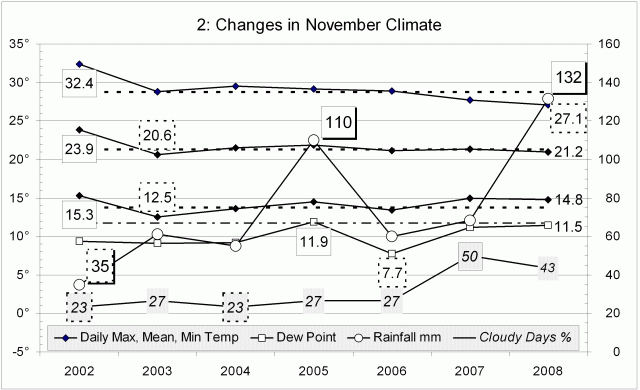
Climate November 2008

Days were the coolest in ten Novembers. However, the mean daily minimum was high, making the daily temperature range (12.4°) even narrower than last November. This agrees with high values for cloudiness and dew point.

The rainfall total, 132 mm, is far above the long-term November average of 67 mm, but that is now common. Five of the last ten Novembers had 110 mm or more. This month and November 2000 were equal ninth wettest on record, and November 2001 (133 mm) eighth wettest.
The rainfall totals for groups of months get higher and higher. The total for 2 months (October and November) is in the 94th percentile, 3 months in the 92nd, 4 months in the 86th, 5 months in the 80th, and 6 months in the 81st percentile. Totals are now above the median for periods up to 72 months with only one exception: that for 9 months is in the 47th percentile. The six-year total rainfall is now 100 mm more than in six average years.


Data. Rainfall data is from Manilla Post Office, courtesy of Phil Pinch. Dew point values before August 2005 are from Tamworth Airport 6 am data supplied by the Bureau of Meteorology. Temperature and other data are from 3 Monash Street, Manilla.


Rain storm in October 2008

The daily weather log

Weather log October 2008

October began fine and very warm, with 32° days and 17° nights. Wet days from the 4th to the 6th brought warm nights at first, followed by a very cold day (19.2°) and night (4.4°). From the 10th to the 21st normal temperatures prevailed. Then a strong southerly made days and nights 10° colder again. The night of the 23rd was 9.0° cooler than normal. The month was frost-free, however.
Calmer, sunny weather returned, with the last day the hottest, at 34.5°.
The seventh rain day of the month brought 52 mm. Rain drove in horizontally during a south-westerly gale after 5pm on Tuesday the fourteenth. This was reported, with a photo of broken trees, in the “Manilla Express” (21/10/08). The gale was a gustfront fanning out from the downburst of a thunderstorm. Storm gustfront gales in this area often blow from the south-west. Within minutes, cold air is dumped on the ground from a height of more than 5 kilometres. The downburst brings the strong south-west winds found there down to ground level.

 Comparing October months

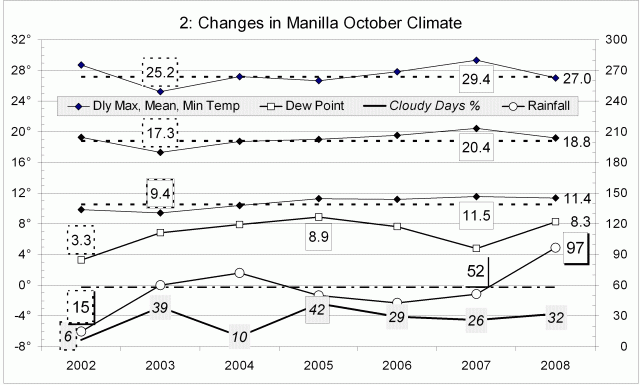
Climate October 2008

Unlike last October, which was remarkably warm and had a high daily temperature range, this October had temperatures near normal, with rather warm nights bringing a lower daily temperature range. Both humidity and cloudiness were slightly above normal.

Manilla has had a lot of rain.
The high rainfall total, 97 mm, is on the 83rd percentile for October. Only 21 recorded Octobers were wetter, including October 1999 (104mm) and 2000 (110 mm). Most rainfall totals for several months together are now above the median (the 50th percentile). The total for 2 months (September and October) is in the 82nd percentile, 3 months in the 71st, 4 months in the 60th, 5 months in the 63rd, and 6 months in the 50th percentile. Rainfall totals for longer periods, up to 60 months, are above the median with only two exceptions: the totals for 9 months (42nd percentile) and for 30 months (35th percentile).


Data. Rainfall data is from Manilla Post Office, courtesy of Phil Pinch. Dew point values before August 2005 are from Tamworth Airport 6 am data supplied by the Bureau of Meteorology. Temperature and other data are from 3 Monash Street, Manilla.