Above-average rainfall in March reduced the shortage of rainfall in the last 3 months. It did not relieve extreme shortages at durations between 12 months and 7 years.
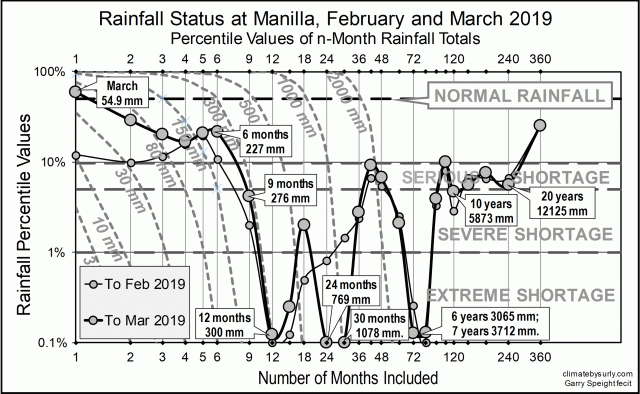
Graph of Rainfall Shortages
This graph shows all the present rainfall shortages at Manilla, short term and long term, as percentile values. The latest values, as at the end of March, are shown by a thick black line with large circles. Those from one month earlier are shown by a thinner line with smaller circles. [The method is described in “Further Explanation” below.]
Good rain in March
A rain front at the end of March 2019 that brought about 40 mm took the March total up to the average. This raised the 2-month and 3-month totals nearer to normal. It did nothing to increase longer-duration totals.
Extreme rainfall shortages
By February, six of the eleven rainfall shortages measured over durations from 12 months to 7 years were extreme. (That is, those totals were in the driest one percent in history.)
Despite the high rainfall of March, March figures also record six extreme shortages. The 18-month total is no longer extreme, but the 30-month total has now become extreme.
Two of the rainfall totals (plotted on the 0.1% line) are near-record low values. The 24-month total of 769 mm is the second lowest after July 1966 (766 mm). The 30-month total of 1078 mm is equal lowest with October 1966.
Data for February, plotted on the thinner line, show the record low values for 12 months (271 mm) and for 84 months (3672 mm).
The previous 24 months
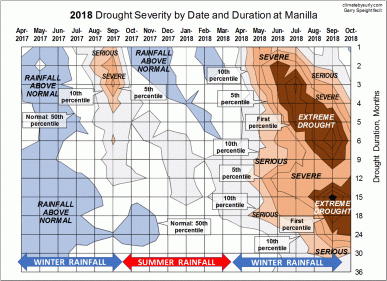
The development of this drought through the previous 24 months is shown in the later post “Rainfall Shortage Sequence 03/2019”. A contour graph shows severity of shortage by contoured layer tints, with serial months on the x-axis and duration of shortage on the y-axis.
Further Explanation
[Update 5 April 2019.]
The following notes explain aspects of this work under these listed headings:
Data analysis
Cumulative rainfall totals
Percentile values
Severity of rainfall shortages
Limitations of this analysis
Monthly rainfalls form a single population
Observations are not retrospective
The rain gauge failed
Data analysis
This graph is based on analysis of monthly rainfall totals from 1884. Using the spreadsheet application Excel, I calculate cumulative totals and their percentile values. Using these values, I identify rainfall shortages as serious, severe, or extreme .
Cumulative rainfall totals
I prepare two tables. The rows in each table are serial months, more than 1600 in total. The columns in each table are headed by the selected number of months, n, as specified below. In the first table I cumulate the rainfall totals. First, I add each month’s rainfall total to that of the previous month for a 2-month total. Using the previous two months, I get a 3-month total, and so on. In this way, I get n-month rainfall totals from n = 1 up to n = 360 (30 years). However, I calculate for only the following 25 values of n:
n = 1, 2, 3, 4, 5, 6, 9, 12, 15, 18, 24, 30, 36, 42, 48, 60, 72, 84, 96, 108, 120, 144, 180, 240, 360
Continue reading →


 climate by surly