My Heat-control Courtyard

Photo of a small courtyard

A Heat-control Courtyard

I have added a courtyard to my high-mass solar-passive house to improve summer cooling and winter heating.
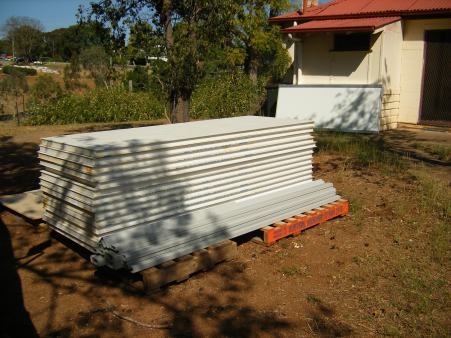
Photo of building materials

Courtyard Wall Panels and Gates

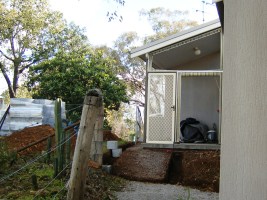
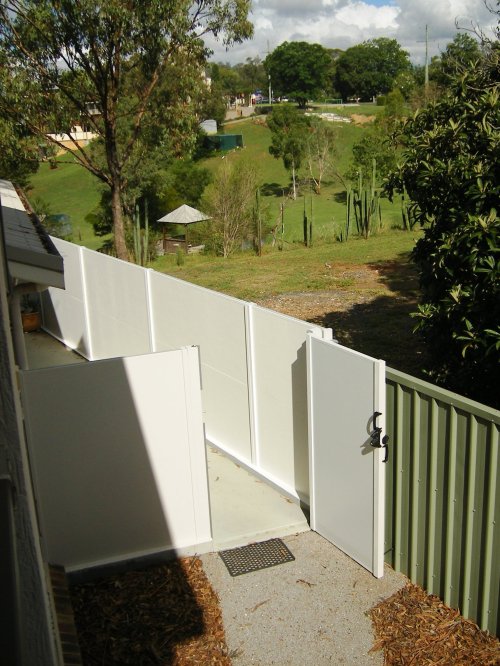
The courtyard extends 13 metres along the south wall of the house. It is completely enclosed by a wall of white-painted polystyrene sandwich panels 1.8 metres high, with two gates of the same material.

By September 2015 trenches had been dug for the courtyard foundation, and by December it was complete.

Photo of trenches dug for courtyard

Courtyard Trenches, West

Photo of trenches dug for courtyard

Courtyard Trenches, East

Operation

This house is in BCA Climate Zone 4: Hot dry summer, cool winter. For comfort, it must be made very much cooler in summer and very much warmer in winter. The courtyard was built to help to achieve both results without the use of heaters or coolers.
In summer, it should ensure a supply of very cool air at night. In this house, cool air is drawn in to replace warm air that flows out the clear-story windows by the stack effect, assisted by fans. By day, the courtyard walls also block some solar radiation.
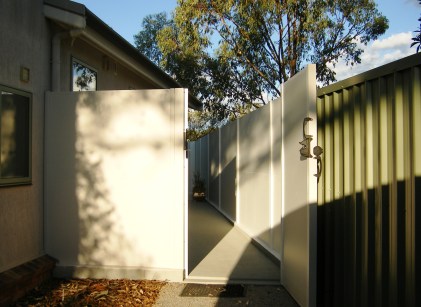
Photo of courtyard from the west

The Courtyard Through The Western Gate

In winter, the white courtyard wall reflects sunshine north towards the house, and re-radiates heat lost from the house wall back towards it.

More

Much more detail is given in the page “A Heat-control Courtyard”. All photos on this topic are in a gallery in “House Photos – 2016”.

New Post on Wicket Gates

In August 2017 I added a new post about wicket gates that were added to the solid gates in the courtyard gateways.


To invite discussion of how courtyards can affect indoor and outdoor climate of houses, I opened a thread “Courtyards for Climate Control” on the forum of the Alternative Technology Association (ATA) based in Melbourne.
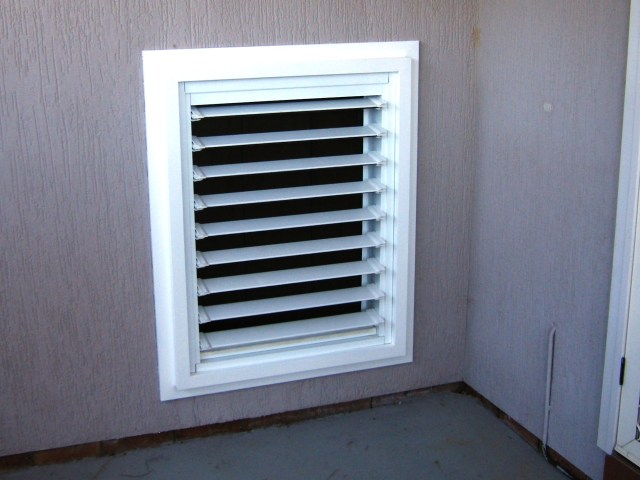
Louvre window for summer nights

Photo of an opened louvre window

The louvre opened

A daily chore in summer

My high-mass solar-passive house keeps me comfortable through the year with very little attention. I have detailed the actions I must take in this post. Being in BCA Climate Zone 4 “Hot dry summer, cool winter”, I have a summer regimen to keep the house cool, and a winter regimen to keep it warm. Most actions are required only twice a year: to change over from one regimen to the other. However, one action is required daily throughout the hot season: I must open doors each evening to admit cool air, then close them again in the morning. At night, air is drawn through the house and out the clearstory windows by the stack effect, assisted by fans at the windows. Warm air in the house is purged by the flow of cold night air, which continues to cool the mass of the house until sunrise.

My louvre vent project

[Photos, with descriptions, may be seen in carousel view here.]

Note.
Subsequently, I had to have the wooden louvre blades replaced with glass ones, as I describe in a later post.

Installation

I have put into effect a long-standing project to avoid the daily chore of opening and closing doors. I bought a motorized louvre window (Breezway Altair Powerlouvre Innoscreen) to let in the night air.

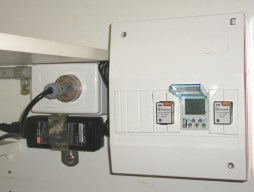
Photo of a programmable time clock

Louvre Time Clock

It is controlled by a programmable electric time clock (Hager EG203E) that will open the louvre at 21:00 and close it at 07:00 daily through the hot season. In the cold season the louvre will remain closed, with the motor control turned off.


The louvre closed

The louvre closed

The louvre is installed low in a wall on the colder south side of the house. It is near the back door that I have been opening and closing up to now. It was difficult to find a place to fit it.

I thought of fitting a motorized louvre in the back door itself. This would have been awkward and expensive. Doubly so, because the back door opens into the laundry, which forms an air-lock, and the inner laundry door would also have needed a motorized louvre.
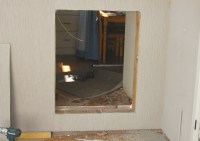
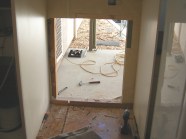
The kitchen was the only suitable room to admit the cooling air. Of course, it is almost completely lined with benches and cupboards. Eventually, I found a place for the louvre, and had a hole cut in the wall for it.

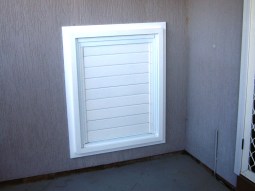
Wall hole for a louvre

Louvre aperture from outdoors

Wall hole for louvre

Louvre aperture from indoors


The place I chose is partly behind the refrigerator. Continue reading

Managing my low-energy house: II. Features needing attention

Photo of clear-story area with winter sun and a fan

Clear-story fan set for winter

This post, and the companion post I. Features needing no attention were posted originally to a forum of the Alternative Technology Association (See Note below.)

My low-energy house at Manilla, NSW, maintains year-round comfort in a climate of daily and seasonal extremes. In the climate classification of the Building Code of Australia, it is in Zone 4: “Hot dry summer, cool winter”, along with Tamworth, Mildura and Kalgoorlie.
This house differs from most houses in relying on the design of the house to achieve comfort, with hardly any energy needed for heaters or coolers.
There is little artificial control: the “home automation system” consists only of timers set twice a year. Some of the comfort features call for daily action in certain seasons. However, these simple daily chores could have been avoided by small changes in the design. [But see “Note added 2016.”]

The success of the house in maintaining comfort in all seasons is shown by scatter-plots of daily indoor and outdoor maximum and minimum temperatures over a period of three years.

Features re-set twice a year

Dates for re-sets

For part of each year, the Manilla climate is too hot for comfort, and for the rest it is too cold. Some house features are re-set twice a year, making a “winter regimen” and a “summer regimen”. At first, I set the change-over dates near the equinoxes, 20th March and 22nd September. For simplicity I changed on 1st April and on 1st October. Later, I found it better to change on 1st March and 1st November, because the time when the climate is too hot is shorter than the time when it is too cold.

Motorized curtains

Curtains fitted to five north-facing windows, and a shutter fitted to a sun-porch window, should be opened to admit winter sun and closed at night to trap the heat. In summer they should be closed by day to keep out radiant heat and opened at night to allow heat to radiate out. The curtains and the shutter have motors controlled by a programmable timer (at lower right in the photo). In autumn (1st March), the timer is set to open at 07:40 and close at 17:20 daily. In spring (1st November) the timer is set to open at 18:00 and close at 06:00 (Standard Time).

Clear-story windows and fans

Continue reading

Managing my low-energy house: I. Features needing no attention

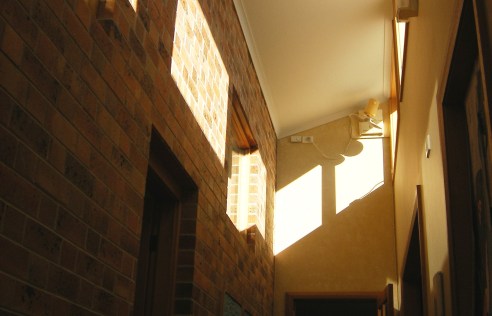
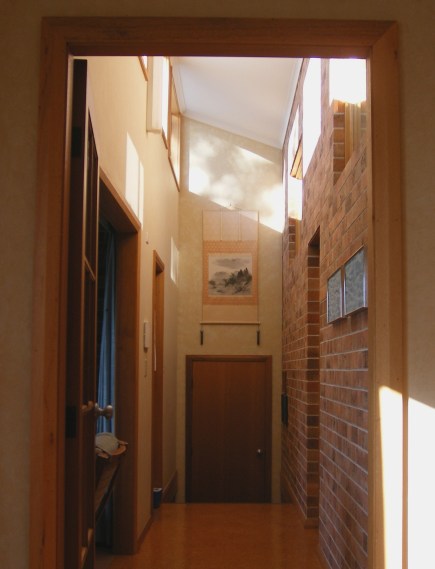
Photo of sunlit house interior

July sun heats the house

This post, and the companion post “II. Features needing attention” were posted originally to a forum of the Alternative Technology Association (See Note below.)

My low-energy house at Manilla, NSW, maintains year-round comfort in a climate of daily and seasonal extremes. In the climate classification of the Building Code of Australia, it is in Zone 4: “Hot dry summer, cool winter”, along with Tamworth, Mildura and Kalgoorlie.
This house differs from most houses in relying on the design of the house to achieve comfort, with hardly any energy needed for heaters or coolers.
There is little artificial control: the “home automation system” consists only of timers set twice a year. Some of the comfort features call for daily action in certain seasons. However, these simple daily chores could have been avoided by small changes in the design. [See “Note added 2016” below.]

The success of the house in maintaining comfort in all seasons is shown by scatter-plots of daily indoor and outdoor maximum and minimum temperatures over a period of three years.

I. Features needing no attention

Heat transfer to and from the heat bank

The mass of concrete, bricks and rubble under the concrete floor slab is edge-insulated with foam to a depth of half a metre to prevent heat leaking sideways to and from the surrounding soil and subsoil. This 150 tonne edge-insulated under-floor mass is a “heat bank” which absorbs and yields heat so slowly that it holds the same temperature (at 750 mm depth) within a degree for weeks at a time.
Double-brick walls (17 tonnes) inside the house, and the floor slab itself (28 tonnes), are also parts of the heat bank. Their exposed surfaces (See photo.) absorb heat from sunshine (and yield heat to cool flows of air) so as to spread heat (or coolness) around the rooms. Within each day they conduct heat to and from the rooms of the house, and from room to room. They then conduct heat slowly to and from the under-floor mass.
In the absence of the house, the under-floor mass would have the same temperature as the subsoil of the area. A thermometer at 750 mm in the subsoil near the house shows a 14.6° yearly temperature range, from 12.9° to 27.5°. Even an ordinary light-weight, poorly-insulated house built on a concrete slab on the ground here would be made more comfortable by these stable subsoil temperatures. Midsummer and midwinter temperatures in such a house (next door) are plotted here and here.
It is clear that temperatures in that conventional house vary much less than outdoor temperatures, and remain close to that of the subsoil. The heat bank under my solar-passive house has an even more stable temperature than that of the surrounding subsoil. (There is a graph showing one year of heat bank and subsoil temperatures here.)

Insulation

Thermal insulation reduces the flow of heat in and out of the house. With sufficient insulation, the heat of the day is replaced by the cool of night before the house becomes too warm. Insulation improves comfort permanently. Continue reading

House Thermal Mass Works in Summer Too

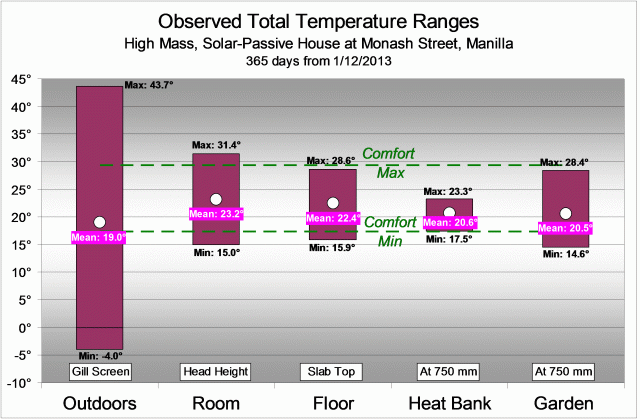
House temperature ranges diagram

My house at Manilla, NSW, is in a climate with temperatures that are extreme, but comfortable on the average. To reduce extreme temperatures indoors, the house contains more than a hundred tonnes of thermal mass within a shell of insulation.
The “thermal mass” is the materials, such as bricks, stones, concrete, earth or water, that have high thermal capacity (See Notes below): they take in and give out a lot of heat.
Many people, who can see that having thermal mass inside a house will help to keep it warm in winter, think that the thermal mass will make it hard to keep the house cool in summer. They see many brick and brick-veneer houses in which thermal mass is exposed to the intense heat of the summer sun. In that case, thermal mass material does no good.

In this graph, I have used my last twelve months of temperature data to show the benefit of well-insulated thermal mass in summer as well as in winter.
Outdoor temperature in this year went as low as minus 4.0° Celsius and as high as plus 43.7°: a range of 47.7°. Continue reading