3-year trends to March 2019

March warm

3-year trends to March 2019

March raw anomaly data (orange)

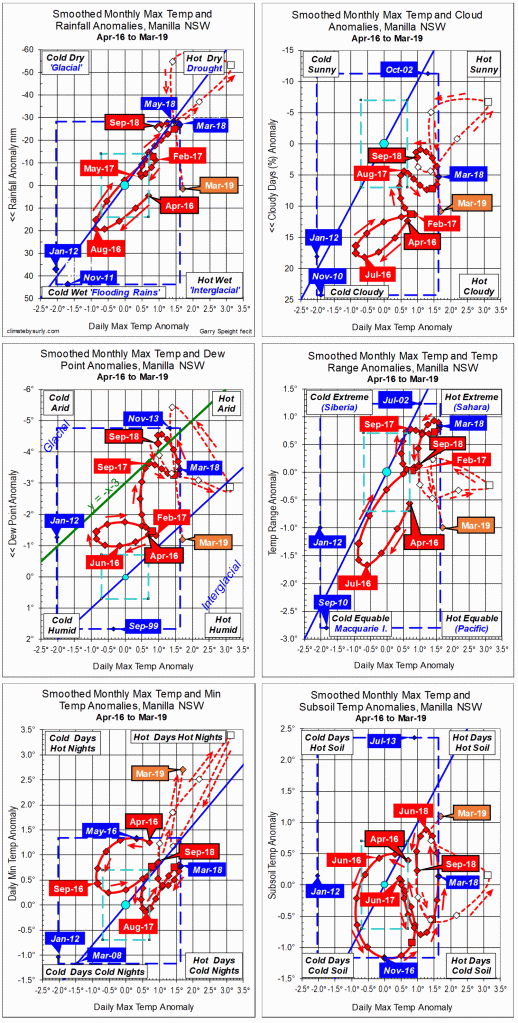
In March 2019, the raw anomaly for daily maximum temperature was near the upper limit for normal. Daily minimum and subsoil temperatures were high. Rainfall and other moisture measures were near normal.

 Fully smoothed data (red)

Fully smoothed data to September 2018 (except daily minimum temperature anomaly) showed a movement away from drought. More recent data, only partially smoothed, suggest that temperatures and rainfall later returned towards drought.


Notes:

January data points are marked by squares.

Smoothing

Smoothing uses Gaussian functions.
For fully smoothed data the function has a Standard Deviation of 2.5 months, it spans 13 monthly data points, and has a half-width of 6 months, which suppresses cycles shorter than 12 months. For partly smoothed data, the span of the function is reduced to 11 months, 9 months and so on.
Continue reading

Warm, Dry February 2019

Photo of bushfire smoke at 40 km.

Bushfire at Warrabah

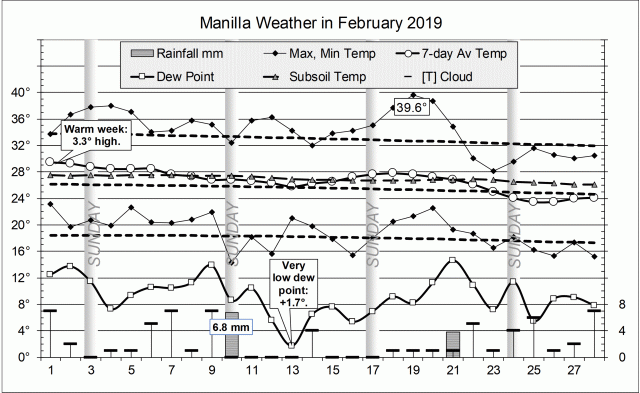
The month began warm, with weekly temperature three degrees above normal, but it ended slightly cool. Day and night temperatures remained near normal. The highest maximum was just under 40°.
The morning of the 13th had very dry air, with a dew point of only 1.7°. (Serious bushfires were burning that day.)
There were only 2 rain days (usually 7). Neither recorded as much as 7 mm.

Graphical log for Feb 2019

Comparing February months

After the extreme heat of January, February was only 1° warmer than normal, by day and by night.
Two indicators of moisture, cloudiness and daily temperature range, were normal. However, the mean early morning dew point, 9.2°, showed the lowest February humidity this century.
The monthly rainfall of 10.6 mm was at the 9th percentile, far below the average (67 mm). This was the 12th driest February, but it had more rain than either February 2017 (6th driest) or February 2015 (ninth driest).
I have reported the on-going drought in another post.

The last 7 February months


Data. A Bureau of Meteorology automatic rain gauge operates in the museum yard. From 17 March 2017, 9 am daily readings are published as Manilla Museum, Station 55312.  These reports use that rainfall data when it is available.  Since no 9 am readings have been recorded since August, I have substituted my non-standard gauge readings for all days.
All other data, including subsoil at 750 mm, are from 3 Monash Street, Manilla.

February: Two Record Droughts

Two rainfall totals to February 2019 were the lowest ever recorded at Manilla: 271 mm in 12 months, and 3672 mm in 7 years.

Rainfall status Jan-Feb 2019

Graph of Rainfall Shortages

This graph shows all the present rainfall shortages at Manilla, short term and long term, as percentile values. The latest values, as at the end of February, are shown by a thick black line with large circles. Those from one month earlier are shown by a thinner line with smaller circles.

The pattern

The very low rainfall of February 2019 (10.6 mm) has driven the rainfall totals lower than they were in January for nearly all the durations that are shown.
The rainfall totals up to 6 months are still not “serious” shortages (below the 10th percentile), but the only other total that is not now a serious shortage, or worse, is that for 30 years (360 months).
In recent months, extreme shortages (below the 1st percentile) have persisted at durations of 12 to 24 months, and at durations of 6 to 7 years.

Record-breaking drought

Two rainfall totals to the end of February are new drought records for Manilla.

The 12-month total of 271 mm beats 288 mm set in October 1965.
The 84-month (7-year) total of 3672 mm beats of 3699 mm set in March 1903.

Earlier, another record had been broken in September. The 15-month total of 400 mm at that date beat 404 mm set in May 1912.


Further Explanation

Drought 2018 contour chartMuch more detail was given in the post: “Contours of Manilla’s 2018 Drought” (with data up to October only). Notes include: “Long-term shortages”, “Classes of rainfall shortage”, and “Manilla rainfall records”.

3-year trends to February 2019

February arid

3-year trends to February 2019

February raw anomaly data (orange)

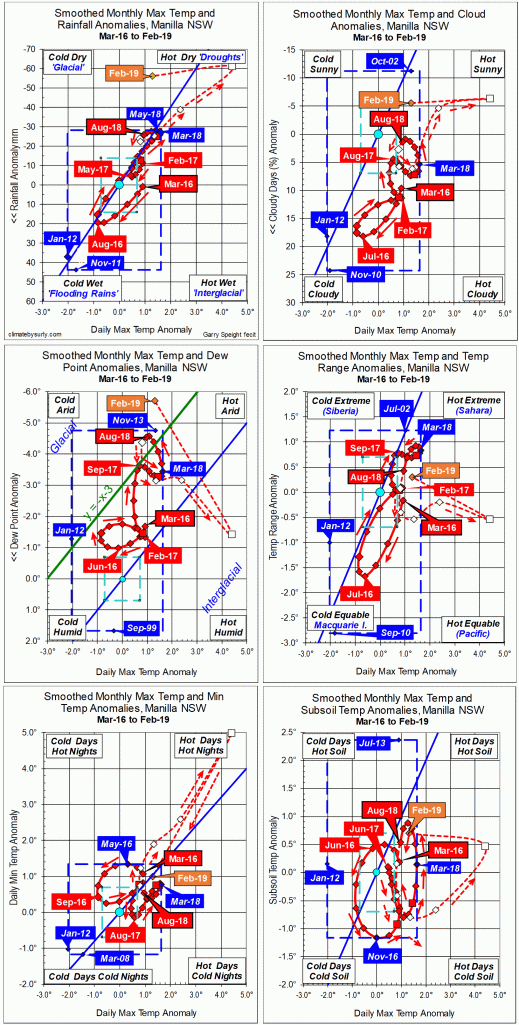
By February 2019, temperatures had returned from very high to normal. Rainfall remained very low, and dew point also became very low.

 Fully smoothed data (red)

Fully smoothed data to August 2018 showed that several trends for the spring were typical of drought:

Maximum temperature anomaly was steadily falling from the record high in March.
Minimum temperature anomaly was a little high and steady.
Subsoil temperature anomaly was falling towards normal from a low peak in June.
Rainfall anomaly was near the record low (smoothed) and steady.
Cloudiness anomaly was near zero.
Dew point anomaly was near the record low (smoothed) and steady.
Temperature range anomaly peaked rather high in July, then fell.

More recent data, only partially smoothed, suggest that temperatures and rainfall have since returned towards drought.


Notes:

January data points are marked by squares.

Smoothing

Smoothing uses Gaussian functions.
For fully smoothed data the function has a Standard Deviation of 2.5 months, it spans 13 monthly data points, and has a half-width of 6 months, which suppresses cycles shorter than 12 months. For partly smoothed data, the span of the function is reduced to 11 months, 9 months and so on.

Fully smoothed data points are plotted in red, partly smoothed data uncoloured, and raw data for the last data point in orange.

Limiting values

Blue diamonds and the dashed blue rectangle show the extreme values in the fully smoothed data record since September 1999.

Normal values

Normal values are based on averages for the decade from March 1999.* They appear on these graphs as a turquoise (turquoise) circle at the origin (0,0). A range of anomalies called “normal” is shown by a dashed rectangle in aqua (aqua). For values in degrees, the assigned normal range is +/-0.7°; for cloudiness, +/-7%; for monthly rainfall, +/-14 mm.

 * Normal values for rainfall are based on averages for the 125 years beginning 1883.

One- and two-year droughts recur in January 2019

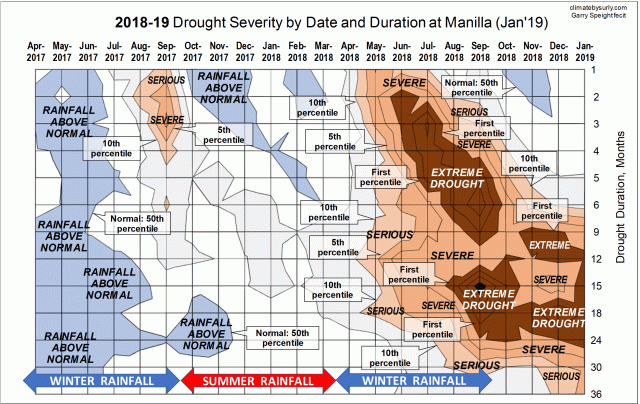
Drought contour plot to Jan 2019

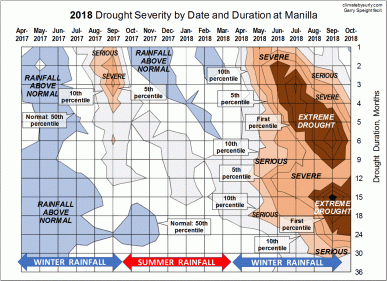
This contour plot shows the progress of the extreme drought at Manilla up to January 2019. Colours show rainfall shortages as percentiles. Dates plot along the top, and durations down the side.

One month rainfall totals (on the top row)

By January 2019, there had been six months without serious monthly rainfall shortages. The months of serious rainfall shortage (light brown) were earlier, in May, June and July 2018. The only other month with such low rainfall was September 2017.

Droughts lasting less than one year (rows 2, 3, 4, 5, 6, 9)

As the effects of low monthly rainfall added up, extreme droughts appeared (dark brown). That is, rainfall totals below the 1st percentile. (They are the lowest rainfall totals, that have occurred in less than 1% of the historical record.)
By June 2018, the 2-month and 3-month totals were already extreme shortages. Similarly, by July, the 3-month, 4-month, and 5-month totals were extreme shortages. By September 2018, extreme shortages extended as far as the 9-month total. That total, adding up the nine months from January to September 2018, included only one month (February) that had rainfall above normal.
In these durations of less than one year, extreme droughts were rare after September 2018. Because the last six months had no serious monthly shortages, the final month (January) includes no serious shortages for durations from 2 months up to 6 months.

Droughts of 1 year to 2 year duration (rows 12, 15, 18, 24)

By August 2018, an extreme 15-month drought appeared. That 15-month total then included not only the dry months of winter 2018, but also the dry month of September 2017. By September 2018, the 15-month total became the driest on record (400 mm). By October all four droughts in this group (12-, 15-, 18-, and 24-month droughts) were extreme. This became true again in January 2019. By that date, some of the dry months of 2017 were no longer included, but dry months in the current summer replaced them in the total.


Related graphs

A similar contour plot with data to October 2018 is here.

A line graph of the rainfall status for January 2019 reveals that extreme shortages also exist now at the much longer durations of six years and seven years that are not included in this contour plot.


Notes

The following notes include:

Classes of rainfall shortage

Rainfall rate versus percentile rank

Limitations of this analysis

Note: Classes of rainfall shortage

Continue reading