The 2002 rainfall shortages at Manilla

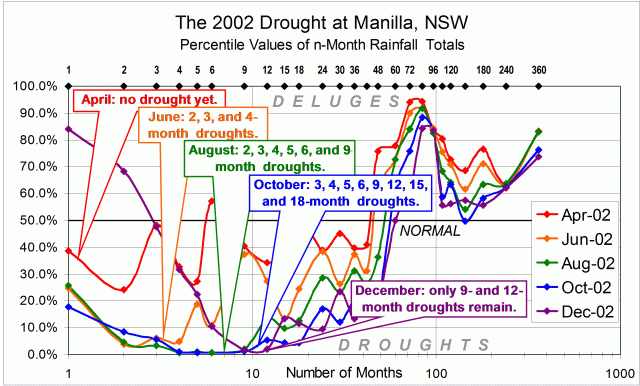
Graph of monthly percentile rainfall in a drought

In 2002, Manilla had a 6-month drought with one of the most extreme rainfall shortages on record. In nearly fifty years since 1966 there have been no other shortages like it.

I have discussed this drought in two posts: “Profile of an Extreme Drought”, and 3-year trends to August 2004 (An extreme 1-year drought).

[For an update on the longer and more extreme drought of 2018-19, see the note below.]

This post is about the rainfall record only. It compares the percentile values of rainfall totals for groups of months: one month, two months, and so on. The graph shows how the drought began, developed and faded. Other droughts may go through similar stages. I have plotted the pattern of rainfall shortages month by month, showing only even-numbered months. I have plotted them in different colours, with matching “Call-out” labels.

April 2002 (Red): no drought yet.
In April, the monthly rainfall was slightly below average: in the 40th percentile. In this month, nearly all rainfall totals up to the 42-month total were also below average. Only the 6-month total was above average. This set up the conditions for a drought. Notice that rainfall totals for periods longer than 42 months were all well above average. This hardly changed at all in this year. There had been a lot of rain in previous decades.

June 2002 (Orange): 2, 3, and 4-month droughts.
When May rainfall was in the 1st percentile and June rainfall in the 25th percentile, the June 2, 3, and 4-month totals became serious or severe shortages (below the 10th percentile).

August 2002 (Green): 2, 3, 4, 5, 6, and 9-month droughts.
With July rainfall again in the 1st percentile, and August rainfall in the 26th, the drought became extreme. The 4, 5, and 6-month totals were in the 1st percentile: few months had ever had such low figures.

October 2002 (Blue): 3, 4, 5, 6, 9, 12, 15, and 18-month droughts.
September and October both had rainfall in the 18th percentile. That relieved the short-term shortages somewhat, but not those in the medium term. Shortages in the 4, 5, and 9-month totals were in the 1st percentile, but the 6-month total was very much worse. At 76 mm, this 6-month total was the third driest on record, beaten only by August 1888 (43 mm) and September 1888 (69 mm).

December 2002 (Purple): only 9- and 12-month droughts remain.
November rainfall that was near average (40th percentile) and high December rainfall (84th percentile) broke the drought. Only some longer-term effects persisted as severe rainfall shortages in 9- and 12-month totals.
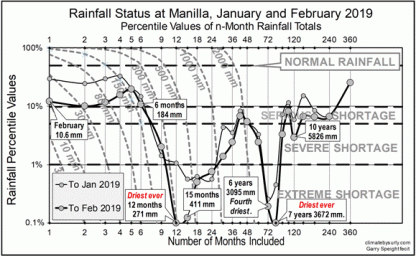
Rainfall status Jan-Feb 2019


Note added 2019.
Later such graphs in this blog have a logarithmic scale to distinguish the extreme rainfall shortages. Here is the one for the even more extreme drought of February 2019.

3-year trends to January 2015

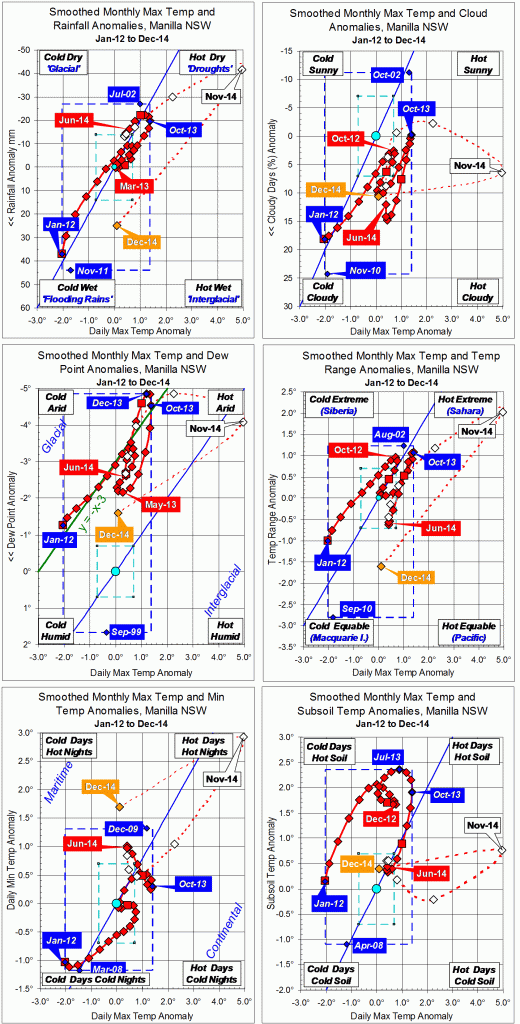
Parametric plots of smoothed climate variables at Manilla
“January 2015: rainy cool days”

Trends to January 2015


January raw anomaly data (orange)

Anomalies for all variables except subsoil temperature moved across the graphs, from “droughts” in November to “flooding rains” in January. Subsoil temperature had been normal from February to December (11 months!), then became cooler than normal in January.
Most raw anomaly values for January were close to the fully-smoothed anomaly values of the La Niña-affected cool summer of 2012. This month’s daily temperature range was even narrower, and the subsoil temperature lower, but the daily minimum temperature was not so low.

Fully smoothed data (red)

The latest fully-smoothed data anomalies (July 2014) were near normal. (Dew point, like most recent values of that variable, was 3° lower than normal.)


Note:

Fully smoothed data – Gaussian smoothing with half-width 6 months – are plotted in red, partly smoothed data uncoloured, and raw data for the last data point in orange. January data points are marked by squares.
Blue diamonds and the dashed blue rectangle show the extreme values in the fully smoothed data record since September 1999.

Normal values are based on averages for the decade from March 1999.* They appear on these graphs as a turquoise (turquoise) circle at the origin (0,0). A range of anomalies called “normal” is shown by a dashed rectangle in aqua (aqua). For values in degrees, the assigned normal range is +/-0.7°; for cloudiness, +/-7%; for monthly rainfall, +/-14 mm.

 * Normal values for rainfall are based on averages for the 125 years beginning 1883.

Rainfall Deficiencies IV: 120-months Duration

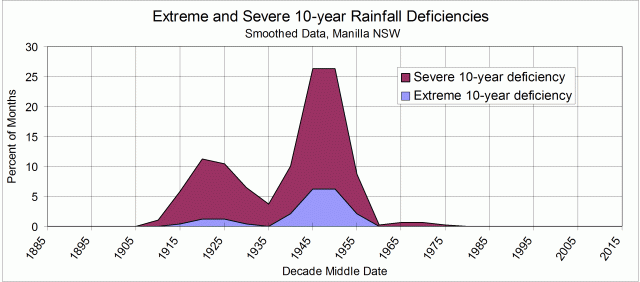
Log of severe and extreme rainfall deficiency of 120-month duration at Manilla This is the fourth of four graphs that show Manilla’s history of rainfall deficiencies (rainfall droughts), for periods of duration 3 months, 12 months, 36 months, and 120 months.

This fourth graph includes those periods of severe or extreme rainfall deficiency that last one-hundred-and-twenty months. They are rainfall droughts that affect about ten successive years.

(As I note below, in this series, a time of severe rainfall deficiency is one that is drier than the 5th percentile of cases, and a time of extreme rainfall deficiency is one that is drier than the 1st percentile of cases.)

In Manilla’s climate, a time of severe 120-month rainfall deficiency has a rainfall total less than 5860 mm, when it normally would be 6390 mm: that is, through the 10-year period, there is as an average a rainfall deficit of 53 mm each year. A time of extreme 120-month rainfall deficiency has a rainfall total less than 5670 mm: that is, through the 10-year period, there is as an average a rainfall deficit of 72 mm each year.

Even more than three-year droughts, these ten-year droughts have quite different effects to those that are shorter. The importance of severe and extreme rainfall deficiencies of 120-month duration is that even very large surface and sub-surface reservoirs may not be adequate to supply demand through to the end of the drought.

The graph shows that such ten-year droughts hardly occurred earlier than 1915 or later than 1955, but were confined to that 40-year interval. While deficiencies of this duration were twice as common as normal (5%) in the decades around 1920 and 1925, it was the decades around 1945 and 1950 that were extraordinary: 26% of all months had a severe rainfall deficiency of this duration.

Again, extreme 120-month droughts generally comprised about one-fifth of the total, as one might expect (unlike the case for one-year droughts).

Areas shown on the graph

Rainfall deficiencies are called “severe” when they are lower than are recorded for five percent of the months. I have called deficiencies “extreme” when they are lower than are recorded for one percent of the months. In this graph, I have coloured extreme deficiencies in blue. The maroon colour is deficiencies that are severe, but not extreme. The top edge of the maroon area marks the proportion of severe deficiencies including extreme deficiencies. As an average, this line is at five percent.

Data analysis

Continue reading

Rainfall Deficiencies III: 36-months Duration

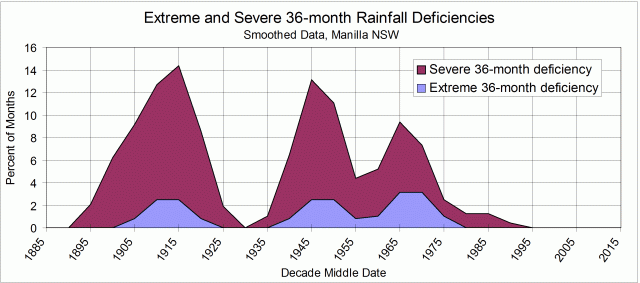
Log of severe and extreme rainfall deficiency of 36-month duration at Manilla

This is the third of four graphs that show Manilla’s history of rainfall deficiencies (rainfall droughts), for periods of duration 3 months, 12 months, 36 months, and 120 months.

This third graph includes those periods of severe or extreme rainfall deficiency that last thirty-six months. They are rainfall droughts that affect about three successive years.
In Manilla’s climate, a time of severe 36-month rainfall deficiency has a rainfall total less than 1505 mm, when it normally would be 1940 mm. A time of extreme 36-month rainfall deficiency has a rainfall total less than 1380 mm.
Droughts of this duration have quite different effects to those that are much shorter.
While the 3-month drought that just qualifies as “severe” (by having rainfall in the fifth percentile) would have a rainfall total of 50 mm, in the similarly defined 36-month drought, each 3-month period within it would have, on average, a rainfall total of 125 mm (i.e. 1505*3/36). This 3-month rainfall total is only 25 mm less than the normal 150 mm total. It would scarcely be noticed if it did not persist for 36 months.
The importance of severe and extreme rainfall deficiencies of 36-month duration is that they use up the reserves that are held in surface and sub-surface water storage.

In the Manilla rainfall record, such three-year droughts were concentrated in just a few decades. They were very common around 1910-1915 and 1945 (in more than 12% of months) and in 1965 (in 9% of months). They were very rare or absent (less than 2% of months) before 1900, from 1925 to 1935, and in the entire forty years since 1975.
Extreme 36-month droughts generally comprised about one-fifth of the total, as one might expect (unlike the case for one-year droughts).

Areas shown on the graph

Rainfall deficiencies are called “severe” when they are lower than are recorded for five percent of the months. I have called deficiencies “extreme” when they are lower than are recorded for one percent of the months.
In this graph, I have coloured extreme deficiencies in blue. The maroon colour is deficiencies that are severe, but not extreme. The top edge of the maroon area marks the proportion of severe deficiencies including extreme deficiencies. As an average, this line is at five percent.

Data analysis

Continue reading

3-year trends to December 2014

Parametric plots of smoothed climate variables at Manilla
“December 2014 rain again”

Trends to December 2014

December data (orange)

From November to December, the raw anomaly value for daily maximum temperature returned to normal from extremely high. Rainfall anomaly moved from very dry to rather wet. Most other anomalies came back to near zero, where they had been (as smoothed values) in June 2014, six months earlier.
Temperature range became low while daily minimum temperature remained high. (Which causes which?)

Fully smoothed data (red)

The latest fully-smoothed data (June 2014) mainly show a renewed movement towards drought.


Note:

Fully smoothed data – Gaussian smoothing with half-width 6 months – are plotted in red, partly smoothed data uncoloured, and raw data for the last data point in orange. January data points are marked by squares.
Blue diamonds and the dashed blue rectangle show the extreme values in the fully smoothed data record since September 1999.

Normal values are based on averages for the decade from March 1999.* They appear on these graphs as a turquoise (turquoise) circle at the origin (0,0). A range of anomalies called “normal” is shown by a dashed rectangle in aqua (aqua). For values in degrees, the assigned normal range is +/-0.7°; for cloudiness, +/-7%; for monthly rainfall, +/-14 mm.

 * Normal values for rainfall are based on averages for the 125 years beginning 1883.